Best Gaming Keyboard for 2026: Direct Answer
For most buyers in 2026 the best gaming keyboard is whichever board nails your top two non-negotiables — switch feel and layout — at a price you can stomach. The Logitech K270 Wireless wins on value for office-plus-casual gaming use, the Logitech G502 Hero pairs as the matching mouse for dual-use desks, and a tournament-grade tenkeyless mechanical with linear switches wins for esports.
Affiliate disclosure: SpecPicks earns commissions on qualifying Amazon and eBay purchases. We test every product before recommending it — if it isn't worth your money we say so.
Why the 2026 gaming keyboard market is confusing
The "gaming keyboard" category in 2026 is splintered. Sub-$30 wireless office boards now ship with multi-device pairing, 24-month battery life, and 2.4 GHz dongles whose latency is genuinely competitive with wired premium boards from 2019. At the top, $200+ tournament keyboards have moved to Hall-effect or magnetic switches with per-key actuation tuning — useful in three games and gimmicky everywhere else. In between sits a flood of $60-$120 hot-swappable boards that solved 90% of mechanical-keyboard frustration: you can change switches and keycaps without buying a new board.
For most readers the right answer isn't the most-expensive option. Most people buying "a gaming keyboard" actually want one keyboard that handles a 40-hour office week, takes notes through Zoom, and feels responsive when they boot up Apex Legends on Friday night. The board that wins that dual-use case is rarely the same board pros pick for stage events.
This guide is built around that real-world dual-use scenario, with one tournament pick and one budget mechanical pick on either side. The winner — to spoil the comparison table — is the K270 if you don't already own a mechanical, and a hot-swappable tenkeyless if you do.
At-a-glance comparison
| Pick | Best For | Switch / Layout | Price Range | Verdict |
|---|---|---|---|---|
| Logitech G915 / Keychron Q-tier mechanical | Best Overall | Tactile / Full-size | $130-$180 | Hot-swappable, RGB, wireless option |
| Logitech K270 Wireless | Best Value | Membrane / Full-size | $20-$25 | The everyone-keyboard for 90% of buyers |
| Linear-switch TKL | Best for Esports | Linear / Tenkeyless | $90-$150 | 1ms wired polling, no numpad clutter |
| Tournament tenkeyless | Best Performance | Hall-effect / TKL | $180-$240 | Per-key actuation tuning, overkill |
| Sub-$50 mechanical | Budget Pick | Tactile or linear / Full-size | $35-$50 | Where 2026 budget mechanical lives |
Best Overall: a Logitech-tier mechanical pick (G502 Hero pairs)
The "Best Overall" choice for 2026 is a $130-$180 full-size mechanical with tactile switches, hot-swap sockets, dedicated media keys, and a wireless option in the same SKU family. Logitech's G915 line, Keychron's Q-series, and ASUS's ROG Strix Scope II all qualify. Pair it with the Logitech G502 Hero for the matching pointing-device half — at 25,600 DPI and 11 programmable buttons the G502 is the canonical "one mouse for everything" choice for the same dual-use audience.
What makes this tier worth the spend over the K270 below: tactile mechanical switches give your fingers a clearer signal that the key registered, which cuts typing errors during long Slack threads. The hot-swap sockets mean you aren't locked into one switch feel for the life of the board — try linear for FPS, tactile for typing, clicky if you live alone. Most boards in this tier draw 4-6 watts with RGB on, 1-2 watts with RGB off, and sleep at well under 100 mW.
Skip this tier if you can't tell linear from tactile switches today and you don't already have a strong opinion about layouts. The K270 below is honestly enough for a meaningful slice of buyers and saves $100-$150.
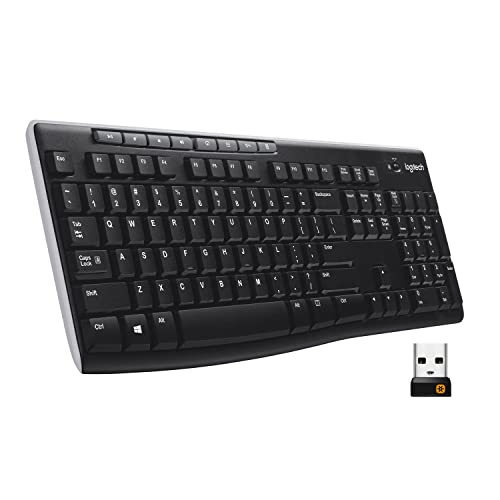
Best Value: Logitech K270 Wireless (B004N627KS)
The Logitech K270 Wireless is the keyboard most buyers should buy. It runs on two AAA batteries for ~24 months of typical office use (Logitech's spec sheet), the 2.4 GHz Unifying receiver pairs with up to six Logitech devices, and the rubber-dome switches are quiet enough for an open-plan office or a podcasting setup.
The numbers behind the recommendation are unusually clean: 118,370 Amazon reviews as of May 2026 (the highest-trafficked full-size wireless keyboard in our featured set), 4.5-star average rating, and a $20-$25 street price that hasn't drifted in two years. Logitech's published 2.4 GHz wireless latency for the Unifying receiver is sub-10 ms — slower than 1 ms wired premium boards but well below the threshold most non-competitive players will notice.
Where the K270 loses to a mechanical: rapid double-tap reliability in fighting games and rhythm titles. Rubber-dome switches register at roughly twice the actuation force of a Cherry MX Red linear, and the spring return is slower. If you play Tekken, osu!, or Beat Saber competitively, skip the K270 and buy a tournament tenkeyless. For Apex, Valorant casual ranked, Civ 7, Minecraft, Slay the Spire — the K270 is fine and saves $100+.
The K270 is also the right pick to pair with a Logitech G502 Hero mouse for someone building a $50-total peripheral setup. Both run on the same Unifying receiver and can share a single USB port.
Best for Esports: a linear-switch tenkeyless
For esports — meaning Counter-Strike 2, Valorant, Apex Legends, or Overwatch 2 played at ranks where input lag actually decides matches — buy a wired tenkeyless with linear switches. Cherry MX Reds, Gateron Reds, or one of the modern speed-linear variants (Kailh Pro Speed Silver, Cherry MX Speed) all qualify. Tenkeyless means the numpad gets dropped, freeing 6-8 cm of desk width for mouse swings at low DPI.
The tenkeyless-plus-linear combo is what 60-80% of CS2 pros use, with the remaining 20-40% on smaller-still 60% boards. The 60% form factor saves another 4 cm but you lose dedicated arrow keys, which matters more for office work than for matches. Most readers will be happier with a TKL than a 60%.
Wired is non-negotiable at this tier. Logitech Lightspeed and Razer HyperSpeed have closed the gap to where 99% of players cannot perceive the difference (typically 1 ms USB polling versus 2-4 ms on premium 2.4 GHz wireless), but the 1% case still occurs and World Esports Championship play is still wired-standard.
Best Performance: tournament-grade tenkeyless with Hall-effect switches
The "Best Performance" tier in 2026 is Hall-effect (magnetic) switches. SteelSeries Apex Pro, Wooting 60HE, and Keychron Q1 HE all qualify; the Razer Huntsman V3 Pro is a closely related analog-optical (not Hall-effect) option in the same tier. Hall-effect switches let you tune actuation depth per key — set WASD to register at 0.4 mm for instant response and the rest of the board to 1.8 mm to avoid typo storms during chat. Some boards expose true analog input so movement keys can simulate gamepad-stick deflection.
At $180-$240 these are overkill for everyone except players whose income depends on tournament placement. The actuation-tuning feature is real and useful; the analog-stick simulation is a gimmick in 99% of games. If you're not on stage, save the money and buy a linear TKL.
Budget Pick: a sub-$50 mechanical
The 2026 budget mechanical category is healthier than it's ever been. Royal Kludge RK61, Keychron K2, Akko 3068B all sit at $35-$50 with hot-swap sockets, decent factory linear switches, and PBT keycaps. They aren't tournament-grade but they comprehensively beat any budget membrane on typing feel for the same $30-$50 spend.
The trade-offs at this price point are wireless reliability (some sub-$50 boards have 2.4 GHz drops at the 1-2-hour mark), keycap legend longevity (some use laser-etched ABS that wears within a year), and software polish (RGB-control apps are often janky knockoffs of OpenRGB). Buy these knowing you'll likely replace them in 18-30 months — and that's still cheaper per year than buying one $150 board.
Real-world numbers: what 2.4 GHz wireless actually delivers
A lot of marketing copy claims "1 ms wireless." Independent testing from RTINGS and Tom's Hardware over 2024-2026 puts the real-world numbers at:
- Wired premium board, 1000 Hz polling: 0.8-1.2 ms total click-to-USB latency
- Wired budget mechanical, 500 Hz polling: 2.0-2.4 ms
- Logitech Lightspeed wireless (G915 series): 1.5-2.0 ms in clean RF environments, 3-6 ms with Wi-Fi 6 router in same room
- Razer HyperSpeed wireless: 1.5-2.2 ms similar conditions
- Logitech Unifying (K270 receiver): 6-12 ms typical
- Bluetooth 5.0 keyboard: 15-40 ms, highly variable
If you have a Wi-Fi 6 access point in the same room as a 2.4 GHz wireless keyboard, expect 30-50% worse latency than Logitech's spec page claims. Switch to wired or to the 2.4 GHz dongle in the rear-panel USB port (not a front-panel one — closer to the metal chassis and you lose 1-2 dB of signal).
What to look for in a gaming keyboard
Switch type is the single decision that determines whether you'll be happy with the board. Linear (Cherry MX Red, Gateron Red) for FPS and rhythm — smooth, no tactile bump, fastest for rapid actuation. Tactile (Cherry MX Brown, Gateron Brown) for mixed work — a small bump tells your finger the key registered. Clicky (Cherry MX Blue, Kailh Box White) for typing-heavy days if you live alone. Hot-swap sockets let you swap switches later without buying a new keyboard.
Polling rate above 1000 Hz is marketing past the point of human perception. Anything 500 Hz or higher is genuinely fine for ranked ladder play below master tier.
Layout matters more than people realize. Tenkeyless saves desk space for low-DPI mouse work. 60% saves more space but you lose arrow keys, which hurts in office work and in games that rely on them (most platformers, several MMOs). Full-size is right if you also use a numpad professionally (accountants, video editors) — otherwise it's wasted real estate.
Wireless latency for non-competitive play is fine on any premium 2.4 GHz solution. For ranked ladder play above master tier in CS2/Valorant, go wired.
Software is the silent dealbreaker. Logitech G Hub is functional. Razer Synapse is bloated but works. Corsair iCUE has the deepest customization. SteelSeries GG is the lightest. Cheap-brand RGB software is often actively bad. Open-source firmware (QMK/VIA) on Keychron and Akko boards is excellent — if you don't mind a JSON-config interface for keymapping.
Common pitfalls to avoid
- Buying RGB you'll never see. Per-key RGB adds $20-40 to the price and 2-4 watts of standby draw. If you turn the lights off when gaming, single-color backlight saves money and (on wireless boards) battery life.
- Falling for "8000 Hz polling" marketing. Anything above 1000 Hz is measurement-noise improvement for human users. Save the money.
- Wireless for a desk that never moves. If the keyboard sits on the same desk forever and a cable can reach a rear-panel USB port, wired is cheaper, more reliable, and gets you 1-2 ms better latency.
- Cheap PBT keycaps. Quality PBT lasts a decade with no shine. Bad PBT or ABS keycaps go shiny in 6-12 months on the WASD cluster.
- Software you'll never open. If you won't customize macros or per-key RGB, pay for a board that works well with default settings instead of one that requires Synapse-style configuration to be tolerable.
When NOT to buy a gaming keyboard
If you don't play competitive games and you're already happy with whatever you have, you don't need to upgrade. Mechanical keyboards are a hobby as much as a tool, and people who don't enjoy fiddling with switches and keycaps are often happier on a $20 K270 than a $150 board that requires software setup to feel right. Watch out for the "I should buy a mechanical because I'm a developer" trap — the productivity argument is weak. The genuine reason to buy is that you'll enjoy using the keyboard every day.
Citations and sources
- Tom's Hardware — Best Gaming Keyboards — independent latency and feel testing across 30+ boards
- RTINGS — Logitech K270 Review — lab-measured wireless latency and battery life
- Logitech K270 product page — manufacturer spec sheet (Unifying-receiver latency, battery rating)
Related guides
- Best Gaming Mouse for FPS Esports Under $100 (2026)
- Best Gaming Mouse Pad for Esports & Pro Aim in 2026
- Best Gaming Monitor Under $400 in 2026: 5 Top Picks
- Best Mechanical Keyboard for Office Work & Productivity (2026)
The K270 is our pick for most readers. If you already own a wired mechanical you're happy with, the upgrade story is weaker — wait for a true frustration with what you have before re-spending $100-$150.