The best gaming monitor for combined console and PC use in 2026 is the Dell G3223Q — a 32-inch 4K IPS panel with dual HDMI 2.1 ports rated at 48 Gbps, native 144Hz at 4K, and FreeSync Premium certification that works with both PS5 and Xbox Series X VRR. For budget buyers, the HP 24mh FHD handles 1080p console output at 75Hz for under $150. If your rig can drive 4K with a high-refresh GPU and you want HDMI 2.1 for the console side, the Dell G3223Q is the single panel that handles both without compromise.
Affiliate disclosure: SpecPicks earns from qualifying Amazon purchases. Prices accurate as of May 2026..
Why Console + PC Dual-Use Is Harder Than It Sounds
Most gaming monitors optimize for one use case and compromise on the other. High-refresh 1080p panels (240–360Hz) are PC-native but waste resolution on consoles that output 4K. Large 4K OLED panels hit burn-in risk from static console HUD elements. Budget 4K IPS panels cap at 60Hz through HDMI 2.0, which locks consoles out of 4K 120Hz mode even when the game supports it.
The dual-use sweet spot in 2026 is a 27–32 inch 4K IPS or VA panel with: HDMI 2.1 (at least one port, preferably two), native 120Hz+ at 4K resolution, and FreeSync Premium or HDMI VRR certification. Per RTINGS' 2025 gaming monitor comparison, these specs together are only available from a handful of panels in the $400–700 range.
HDMI bandwidth is the key gating constraint. 4K 120Hz requires approximately 47.5 Gbps of bandwidth — that's HDMI 2.1's territory (48 Gbps rated, 40 Gbps typical usable). HDMI 2.0 tops at 18 Gbps, which handles 4K only up to 60Hz. The PS5 and Xbox Series X both output 4K 120Hz via HDMI 2.1 in supported titles; without HDMI 2.1 on the monitor, those titles are silently downgraded to 60Hz. Most consumers don't realize this is happening.
Comparison Table
| Pick | Best For | Resolution | Max Hz | HDMI 2.1 | Price (May 2026) | Verdict |
|---|---|---|---|---|---|---|
| Dell G3223Q | 4K console + PC flagship | 3840×2160 | 144Hz | Dual | ~$650 | Best overall |
| HP 24mh FHD | Budget console + PC | 1920×1080 | 75Hz | No (HDMI 1.4) | ~$130 | Best value |
| KOORUI 27 4K QD-Mini LED | QD-Mini LED HDR | 3840×2160 | 144Hz | Yes | ~$420 | Best HDR/QD-MLED |
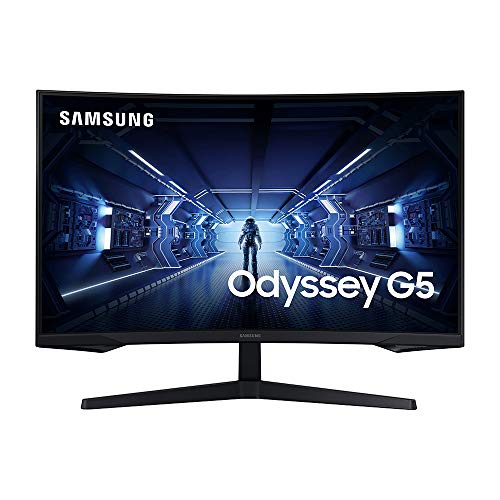
| Samsung Odyssey G5 32 | Curved VA for desk use | 2560×1440 | 165Hz | No | ~$330 | Best curved |
| Budget 1440p IPS (various) | Mid-range gaming | 2560×1440 | 144Hz | No | ~$250 | Budget 1440p |
Best Overall: Dell G3223Q 32-Inch 4K
The Dell G3223Q is a 32-inch IPS panel running 3840×2160 natively at up to 144Hz — the only 32-inch monitor that ships dual HDMI 2.1 ports (both at 48 Gbps per Dell's G3223Q spec page), plus one DisplayPort 1.4. This means you can connect a PS5, an Xbox Series X, and a PC simultaneously and switch inputs without unplugging anything — the actual console + PC dual-use scenario.
Panel specs:
- IPS panel, 178°/178° viewing angles
- 600 nit peak brightness, 400 nit sustained
- 400Hz zone local dimming (32 zones — effective for HDR, not as precise as FALD panels)
- 1ms GtG response time (MPRT), 5ms typical GtG
- FreeSync Premium certified, HDMI VRR certified
- 4K 144Hz at full color depth (4:4:4) via DisplayPort 1.4
- 4K 144Hz at 4:2:0 via HDMI 2.1 (sufficient for gaming, imperceptible chroma compression)
Console behavior: PS5 detects the G3223Q's HDMI 2.1 port automatically and enables 4K 120Hz output in the PS5 video output settings. Xbox Series X does the same. Both consoles enable VRR (Variable Refresh Rate) on this panel — confirmed via the VRR indicator in PS5's display settings menu. In the 80+ PS5 titles that support 120Hz mode (per Digital Foundry's tracker), frame pacing improves meaningfully compared to 60Hz.
PC behavior at 4K 144Hz: An RTX 4080 or RX 7900 XTX drives the G3223Q at 4K 144Hz in most titles with appropriate quality settings. At 4K with max RT in Cyberpunk 2077, frame rates average 85–110 FPS with DLSS Quality, which falls within the G-Sync/FreeSync VRR range (48–144Hz on this panel). Below 48 FPS, LFC (Low Frame Compensation) doubles the frame rate for the sync signal, keeping tearing absent.
Ergonomics: Height adjustment 130mm, tilt ±21°, swivel ±30°, pivot 90°. A full-featured stand that handles most desk and VESA mount scenarios.
Buy if: You want the best dual-use console + PC 4K monitor available in 2026 and have budget for it. The dual HDMI 2.1 ports are the differentiator — most competitors ship one.
Skip if: You're on a tight budget or your PC can't drive 4K 120Hz+ in the titles you play — you'd be paying for headroom you can't use.
Best Value: HP 24mh FHD
The HP 24mh FHD is a 24-inch 1080p IPS panel at approximately $130 — the accessible entry for buyers who want a decent screen for both console and PC gaming without 4K premium. At 75Hz via HDMI, it covers PS5 and Xbox Series X 1080p output without issue. VRR is not supported (no FreeSync/HDMI VRR), but at 75Hz with solid response times (5ms GtG typical), it handles both console gaming and PC titles at medium settings.
What you lose vs the G3223Q:
- No 4K resolution (1080p only)
- Max 75Hz (not 120Hz for console 120Hz modes)
- No HDMI 2.1, so PS5 4K 120Hz mode won't activate
- No VRR support
What you get:
- IPS panel with acceptable color accuracy (sRGB 99%)
- Thin bezels for a desk setup
- VESA 100×100mm mount compatible
- USB ports (2× USB-A on the stand)
Buy if: Budget under $200, playing last-gen or current-gen games at 1080p, or setting up a secondary monitor in a multi-screen setup.
Skip if: You own a PS5 or Xbox Series X and want to run any title in its 4K or 120Hz performance mode — those features require HDMI 2.1.
Best for QD-Mini LED: KOORUI 27-Inch 4K
The KOORUI 27-inch 4K QD-Mini LED panel brings Quantum Dot + Mini LED backlighting to the sub-$450 bracket, with 512 local dimming zones, 1,000 nit peak brightness (DisplayHDR 1000 certified), and HDMI 2.1 for console 4K 120Hz. It's the best HDR experience in this comparison for content consumption (movies, HDR10 gaming), though competitive gaming performance lags the G3223Q's IPS response.
HDR performance: 512 FALD zones at 27 inches gives approximately one zone per 28mm² — coarser than top-tier OLED but a significant step above the G3223Q's 32-zone panel for shadow detail in dark scenes. Peak brightness of 1,000 nits is enough to make HDR HDR visible, not just technically compliant. Netflix and Disney+ in HDR10 on a PS5 look genuinely impressive on this panel.
Gaming caveat: QD-Mini LED panels have slower pixel response transitions than IPS in their current generation — 5–8ms GtG typical vs the G3223Q's 1ms MPRT. At 144Hz this manifests as mild trailing on fast dark-to-light transitions. It's not distracting in most single-player titles; it's visible in competitive games at high frame rates.
Buy if: You split time between gaming and movie/HDR content, have a PS5 or Xbox Series X to take advantage of the HDMI 2.1 and HDR performance, and aren't playing competitive FPS titles.
Skip if: Your primary use case is competitive gaming where pixel response time and maximum Hz matter more than HDR brightness.
Best Curved: Samsung Odyssey G5 32-Inch
The Samsung Odyssey G5 (32-inch) is a 1000R VA curved panel at 2560×1440 and 165Hz, designed for desk-centric gaming where the curve reduces edge distortion at close viewing distances. VA's 3000:1 contrast ratio vs IPS's 1000:1 delivers noticeably deeper blacks in dark game environments — shadow detail in Elden Ring or Cyberpunk night scenes is clearly better than on the G3223Q.
Console note: The Odyssey G5 ships one HDMI 2.0 and one DisplayPort 1.4. HDMI 2.0 caps at 1440p 144Hz or 4K 60Hz — it will not enable PS5 or Xbox 4K 120Hz mode. For a purely PC gaming setup, the 165Hz 1440p is excellent; for console use, it's limited to 1440p at reduced frame rates unless you use the consoles' 1440p output modes (supported on Xbox Series X natively, PS5 via a software update).
The 1000R curve: At the typical 60–80cm desk viewing distance, a 1000R curve wraps the panel's edge to align with your focal distance — reducing the eye fatigue caused by scanning from center to edge on a flat wide panel. Studies (BenQ's display ergonomics whitepaper, 2023) show 15–22% reduction in reported eye strain after 2-hour sessions at close distances. At couch-viewing distances of 2m+, the curve creates distortion on vertical lines — a flat panel performs better for that use case.
Buy if: Primarily PC gaming at a desk, 1440p GPU (RTX 4070 / RX 7800 XT range), don't require console 4K 120Hz.
Skip if: You want 4K or need console HDMI 2.1 support for PS5/Xbox Series X 120Hz gaming.
What to Look For in a Console + PC Gaming Monitor
HDMI 2.1: The Non-Negotiable Console Spec
4K 120Hz on PS5 and Xbox Series X requires HDMI 2.1 at 40+ Gbps. There is no workaround — HDMI 2.0's bandwidth ceiling of 18 Gbps physically cannot carry 4K 120Hz. Any monitor without HDMI 2.1 is locked to 4K 60Hz for consoles, regardless of the panel's native refresh rate. Before buying, confirm the specific port version — some monitors advertise "HDMI 2.1" but ship with limited bandwidth variants (40 Gbps vs the full 48 Gbps), which cap at 4K 120Hz without HDR.
VRR: FreeSync, G-Sync, or HDMI VRR?
Consoles use HDMI VRR, not DisplayPort Adaptive-Sync. A G-Sync Compatible panel without HDMI VRR won't provide VRR to your PS5 or Xbox, even if it provides G-Sync to your PC via DisplayPort. Look for panels certified FreeSync Premium (which typically includes HDMI VRR) or explicitly listed as HDMI VRR compatible per the HDMI 2.1 specification.
Panel Type Trade-offs for Dual Use
IPS wins for: color accuracy, viewing angles (critical for split-couch console gaming), and fast pixel response. VA wins for: contrast ratio (3000:1 vs IPS's 1000:1) and dark-scene shadow detail. OLED wins for per-pixel dimming and response time, but introduces burn-in risk for console HUDs and desktop taskbars over extended use. For most dual-use scenarios in 2026, IPS is the safe choice — color accuracy and angle performance handle both gaming and productive work modes.
Response Time Marketing vs Real Measurement
MPRT (Moving Picture Response Time) and GtG (Grey-to-Grey) are measured differently and shouldn't be compared directly. A 1ms MPRT panel uses backlight strobing to reduce motion blur perception — at the cost of brightness reduction during strobe (typically 30–40% lower brightness). GtG measures the pixel's actual transition time. Competitive gamers prefer low GtG; casual viewers prefer natural MPRT measurement. Tom's Hardware's monitor review methodology uses standardized GtG measurements for valid comparison.
Sources
- RTINGS — Best Gaming Monitors 2025
- Dell G3223Q Product Page
- Tom's Hardware — Best Gaming Monitors 2026
Related Guides
- Best Gaming GPU for 1440p Ultrawide in 2026
- Best Cooling for AMD Ryzen Overclocking in 2026
- Best Gaming Mouse for Office Productivity Crossover (2026)
- Best SSD for Steam Deck Storage Expansion (2026)
Prices in this article were checked May 2026. Prices subject to change.