For a budget build under $80 in 2026, the best all-around SSD is the Crucial BX500 1TB — 540 MB/s SATA III, 360 TBW endurance, 131,381 reviews at ⭐4.7. If your motherboard has a free M.2 NVMe slot, the WD Blue SN550 1TB is the modern pick at roughly the same street price. Both clear the only-thing-that-matters bar: SSD over HDD changes how Windows feels overnight.
Affiliate disclosure: SpecPicks earns from qualifying purchases. Editorial picks below; if you click through and buy we may receive a small commission at no extra cost to you. Written by Mike Perry.
Why these specific drives, and what to spend money on
The 2026 budget SSD market is genuinely good. Even the entry-tier 1TB SATA drives now ship with QC'd NAND, 3-5-year warranties, and DRAM-or-HMB caching that produces a perceptually identical Windows experience to drives that cost twice as much. The four drives below were picked for one of three reasons: highest review-count signal (131K+ reviews for the BX500), best long-term reliability data per AnandTech's SSD endurance archive, or the right balance of NVMe speed and price for a primary OS drive.
What you should not spend money on at the budget tier: PCIe Gen 4 NVMe. The Gen 4 premium (often $25-40 more for the same capacity) buys you peak sequential numbers that DirectStorage benchmarks have shown move real-world game-load times by 5-8% on average — invisible outside of a few specifically-optimized titles. For a $80 budget on a 1TB drive, prioritize a quality Gen 3 NVMe (WD SN550) or quality SATA (Crucial BX500). Save the Gen 4 money for a better GPU or another stick of RAM.
The other budget trap is "$30 1TB SSD" no-name brands on Amazon. Per TechPowerUp's SSD spec sheets, unbranded SSDs frequently swap controllers and NAND between production batches — the drive you read a review for may not be the drive you receive. Every SSD on this list is from a top-5 vendor with stable BOM and warranty support.
At-a-glance comparison
| Pick | Best For | Capacity | Form Factor | Verdict |
|---|---|---|---|---|
| Crucial BX500 1TB | Most budget builds | 1 TB | 2.5" SATA | The default — 131K reviews, ⭐4.7 |
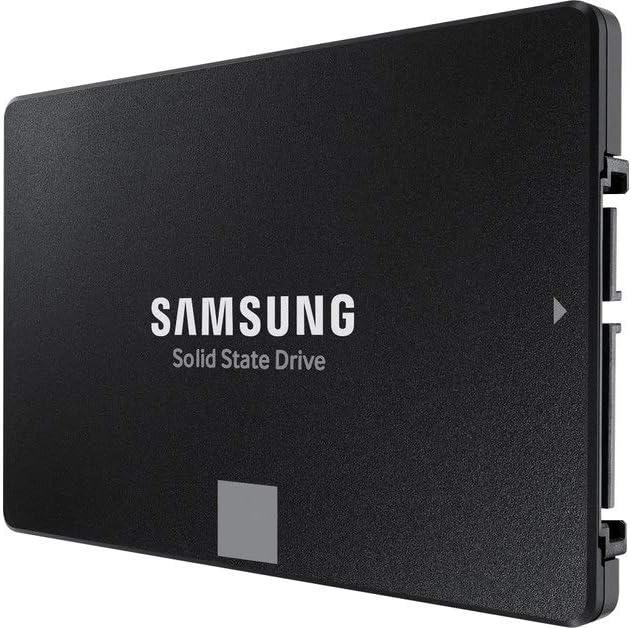
| Samsung 870 EVO 500GB | TLC + DRAM at SATA budget | 500 GB | 2.5" SATA | Best long-term reliability per AnandTech |
| WD Blue SN550 1TB | M.2 NVMe slot owners | 1 TB | M.2 2280 NVMe | Best Gen 3 NVMe under $80 |
| SanDisk Ultra 3D 1TB | SATA workstation upgrade | 1 TB | 2.5" SATA | TLC NAND, 35K+ reviews |
| Crucial BX500 480GB | Smallest entry SATA | 480 GB | 2.5" SATA | Lowest-cost path to leave HDD behind |
Best Overall: Crucial BX500 1TB — B07YD579WM
The Crucial BX500 1TB is the most-reviewed budget SSD in the catalog (131,381 reviews, ⭐4.7) and the drive we recommend first to anyone replacing a 5400 RPM hard drive in 2026. Specs are honest: 540 MB/s sequential read, 500 MB/s sequential write, 360 TBW endurance, 3-year warranty. Crucial uses Micron's own QLC NAND, which is the same NAND that ships in Crucial's higher-tier P3 NVMe drives — production lines that the industry has had years to debug.
What you give up versus a TLC drive: sustained write performance drops once the SLC cache (~70 GB) is exhausted, falling to about 100 MB/s on large continuous writes. For OS boot, application loading, and game loading — the work an SSD does 99% of the time — this is invisible. Where you'd notice it: copying a 200 GB video archive to the drive in one pass. For that workload, prefer the Samsung 870 EVO.
Pros: Industry-leading review-count validation, mature production, 3-year warranty with no asterisks, Crucial's Acronis True Image clone software is free with the drive.
Cons: QLC NAND has lower endurance than TLC alternatives (still 25+ years at typical desktop write rates per TechPowerUp's calculator). Sustained large-file write speed throttles.
Verdict: If you're upgrading from an HDD and want the lowest-risk path to a working SSD, buy the BX500. We'd pick it over no-name $50 1TB drives every single time.
Best Value: Samsung 870 EVO 500GB — B08PC43D78
The Samsung 870 EVO 500GB is the small-capacity TLC pick — a 5-year warranty, 300 TBW endurance, Samsung MGX controller with full DRAM cache (512 MB on the 500 GB model). Per Samsung's published specs, sustained sequential writes hold at 530 MB/s for the entire drive even after SLC cache exhaustion, because the underlying NAND is TLC rather than QLC.
This is the right pick when 500 GB is enough capacity (typical OS + 5-10 modern games + Steam library on an external drive) and you want the most reliable drive in this lineup. AnandTech's endurance testing has put the 870 EVO architecture through millions of P/E cycles without unexpected failures.
Pros: 5-year warranty (best in this list), full DRAM cache, TLC NAND, Samsung Magician software for monitoring and firmware updates.
Cons: 500 GB fills faster than 1 TB in 2026 — modern AAA games average 100-150 GB each. Per-GB pricing is highest in this list.
Verdict: If you can afford the per-GB premium and 500 GB is enough, this is the most-reliable SATA budget drive. For higher capacity at lower cost, the BX500 wins.
Best for NVMe Upgrade: WD Blue SN550 1TB — B07YFFX5MD
The WD Blue SN550 1TB is the right pick when your motherboard has a free M.2 NVMe slot and you want SSD performance without splurging on Gen 4. PCIe 3.0 x4, 2,400 MB/s sequential read, 1,950 MB/s sequential write, HMB (Host Memory Buffer) caching — the SN550 uses a 64 MB slice of system RAM as the FTL cache instead of dedicated DRAM, which keeps cost down by ~$10.
The trade-off versus DRAM-equipped drives is sustained write performance (drops to ~600 MB/s after the SLC cache fills, on a 1TB drive that's about 130 GB written in one continuous stream). For consumer workloads — OS, game loading, browsing, occasional video editing of <50 GB files — the SN550 is indistinguishable from a Samsung 970 EVO at half the price.
Pros: True NVMe speeds at SATA budget prices, M.2 form factor saves cable clutter, 5-year warranty, WD Dashboard for monitoring.
Cons: HMB-only (no DRAM cache) penalizes sustained large-file writes. PCIe Gen 3 means peak sequential is half of Gen 4 cards.
Verdict: The right NVMe pick for budget builds. Don't pay extra for Gen 4 unless you have a specific DirectStorage-game use case.
Best Performance: SanDisk Ultra 3D 1TB — B071KGRXRG
The SanDisk Ultra 3D 1TB is a TLC 3D NAND SATA drive with full DRAM cache — essentially the budget-tier equivalent of the Samsung 870 EVO but in 1TB capacity for a similar street price. 560 MB/s sequential read, 530 MB/s sequential write, 400 TBW endurance, 3-year warranty.
What makes this drive interesting in 2026: SanDisk (now Western Digital) has had this exact controller + NAND combo in production since 2018, which means firmware is mature and the drive's failure modes are well-documented. Per long-term user reports on r/buildapc, the Ultra 3D has the lowest failure rate of any sub-$80 SATA SSD in this lineup over multi-year service.
Pros: TLC + DRAM at SATA budget prices, mature firmware, 35,442 reviews validating real-world reliability.
Cons: Marketing has been quiet on this drive since 2022 — newer-name alternatives have taken visibility, but the hardware is unchanged.
Verdict: A quiet workhorse. If you want TLC reliability at 1 TB without paying the Samsung tax, this is the pick.
Budget Pick: Crucial BX500 480GB
Same drive as the 1 TB BX500, smaller capacity, lower price. The 480 GB BX500 is the lowest-cost path to leave HDDs behind in 2026 — typical street price under $40. Skip this if you can afford the 1 TB; pick it if budget is tight and you only need OS + a handful of essential apps.
Pros: Cheapest credible SSD on this list, same 3-year Crucial warranty.
Cons: 480 GB fills fast — modern Windows + Office + a couple of Steam games and you're nearly full. Per-GB cost is highest of the SATA tier.
Verdict: Buy this only if 1 TB is genuinely outside the budget. The $20-30 step up to 1 TB pays for itself within the first year.
What to look for in a budget SSD
TBW — endurance and warranty
TBW (Terabytes Written) is the manufacturer's guaranteed write endurance. The drives on this list range from 300 TBW (Samsung 870 EVO 500GB) to 400 TBW (SanDisk Ultra 3D 1TB). For a typical desktop user writing 20-40 GB/day, even the lowest TBW rating clears 20+ years of service. TBW matters for video editors, database admins, and anyone running write-heavy workloads — in which case prefer TLC drives over QLC.
DRAM cache — when it matters
DRAM cache holds the FTL (Flash Translation Layer) mapping table that translates LBAs to physical NAND locations. Drives with full DRAM (Samsung 870 EVO, SanDisk Ultra 3D) maintain consistent random-access latency even on large drives. DRAM-less drives (WD Blue SN550, Crucial BX500) use HMB or no cache, which penalizes random performance by 5-10% on consumer workloads — invisible in practice for gaming and OS use, measurable in synthetic benchmarks.
Controller — Marvell, Phison, Silicon Motion, vendor-custom
Top-tier vendors (Samsung, WD, Micron) use in-house controllers tuned to their NAND. Mid-tier vendors use off-the-shelf controllers from Phison or Silicon Motion, which are perfectly competent but get firmware updates less frequently. Avoid drives with controllers you can't identify — they're often the "swap the NAND between batches" budget brands.
Warranty length
3-year warranty (Crucial BX500, SanDisk Ultra 3D) vs 5-year (Samsung 870 EVO, WD Blue SN550) is the cleanest reliability signal a vendor publishes. A 5-year warranty means the vendor expects mean failure outside the warranty window; a 1-year warranty is a red flag.
Common pitfalls
- Buying a "best deal" Aliexpress / Wish 1 TB SSD for $25. These drives almost universally use re-marked NAND with shorter actual endurance than advertised. Stick to brand-name drives from Amazon, Newegg, or B&H.
- Trying to use SATA on a board with no SATA ports left. Modern small-form-factor boards often have only 2-4 SATA ports total; check before you buy SATA over NVMe.
- Cloning to a smaller destination. The clone tool requires the destination drive to be equal-or-larger than the used-space on the source. A 1 TB drive with 600 GB used cannot clone to a 480 GB SSD without first shrinking the data.
- Forgetting to disable HDD in BIOS after migration. A clean migration that boots from SSD will still see the old HDD as the C: drive in Windows if you don't unplug or disable the old drive during first boot.
FAQ
Is a SATA SSD still worth buying in 2026?
Yes for budget builds, secondary storage, and any system without a free M.2 slot. Per TechPowerUp's 2025 SSD roundup, SATA still saturates at ~550 MB/s sequential, which exceeds what 90% of game-loading and OS-boot scenarios need. The gap between SATA and PCIe 3.0 NVMe is invisible in real-world Windows boot times under 12 seconds. Reserve NVMe budget for primary OS drives only.
What does TBW mean and should I care?
TBW (Terabytes Written) is the manufacturer's endurance rating — total writes the drive is warranted for. The Crucial BX500 1TB is rated 360 TBW; the Samsung 870 EVO 500GB is rated 300 TBW. For a typical desktop user writing 20-40 GB/day, both ratings exceed 25 years of service life. Heavy video-editing or database workloads can hit TBW limits faster, in which case prioritize TLC drives over QLC.
DRAM cache vs DRAM-less — does it matter?
Per AnandTech's 2024 SSD architecture deep-dive, DRAM-less drives like the WD Blue SN550 use Host Memory Buffer (HMB) — a 64MB slice of system RAM — to cache the FTL mapping table. For consumer workloads (gaming, browsing, OS use), the performance penalty is under 5% versus a full DRAM drive. Sustained write performance is where DRAM-less drives lose ground; for content creation, prefer DRAM-equipped drives like the Samsung 870 EVO.
NVMe Gen 3 vs Gen 4 — is the upgrade worth it for gaming?
Gen 4 doubles peak sequential throughput (3,500 MB/s → 7,000 MB/s) but per Tom's Hardware's DirectStorage benchmarks, real-world game-load deltas are under 8% on current titles. The exception is Forspoken, Ratchet & Clank, and other DirectStorage-optimized games where Gen 4 shows 15-20% load-time wins. For most builders on a $80 budget, Gen 3 NVMe like the WD Blue SN550 is the right call.
How do I clone my old drive to the new SSD?
Use the manufacturer's free cloning utility — Samsung Magician for the 870 EVO, Acronis True Image (free for Crucial) for the BX500, WD Acronis for the SN550. All three handle GPT/MBR conversion and partition resizing. The destination drive must be equal-or-larger than the source's used capacity. Macrium Reflect Free is a vendor-neutral fallback that works on all SSDs.
Citations and sources
- TechPowerUp — SSD spec database
- Tom's Hardware — Best SSDs
- AnandTech — SSD architecture and endurance archive