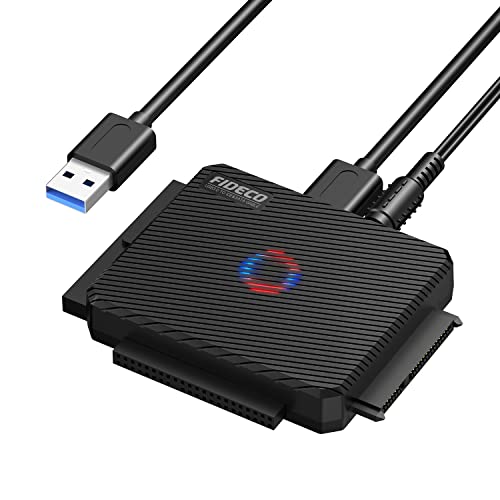
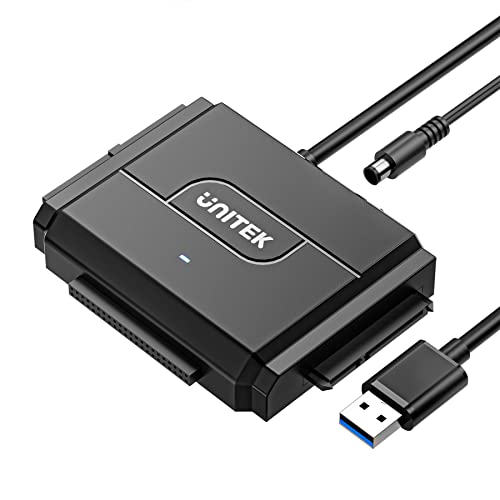
The short answer: for Windows 98 SE and Windows XP retro builds in 2026, the best overall pick is the Samsung 870 EVO 250GB paired with a JMicron-based IDE-to-SATA adapter (the FIDECO or Unitek bridges both work). It sidesteps the 137GB barrier on older boards, handles the legacy ATA command set without firmware quirks, and saturates an ATA133 controller at 80-100 MB/s sustained — which is dramatically faster than any period-correct mechanical IDE drive ever was.
If you need more capacity (and your motherboard supports 48-bit LBA), the Crucial BX500 1TB is the price champion. For maximum Win98 compatibility, the SanDisk Ultra 3D 1TB has the cleanest community track record on Vogons. Skip NVMe in a true IDE build.
Why modern SATA SSDs through an IDE adapter is the dominant retro storage stack in 2026
Period-correct IDE mechanical drives are dying. Western Digital and Seagate stopped making consumer IDE drives by 2013. What's left on the used market is increasingly drives that spent 15-20 years in service and have bearing wear, head wobble, or stuck spindles. The community consensus on Vogons and the Win Retro Discord has converged: modern SSDs through an IDE bridge are the default storage path for new Win98 / WinXP builds. They're faster, silent, cooler, and they don't die unexpectedly.
The form factor problem (modern SATA vs ancient IDE) is solved by a $15-20 adapter. The compatibility problem (modern firmware vs ancient chipsets) is solved by picking the right drive — which is what this guide is about.
Compatibility table: SSD firmware behavior on Win98 SE, Win2K, WinXP
Not every SSD plays nicely with a Western Digital BIOS from 2001 or a VIA Apollo chipset. Here's what community testing has surfaced:
| SSD | Controller | Win98 SE | Win2K | WinXP | Notes |
|---|---|---|---|---|---|
| Samsung 870 EVO 250GB | Samsung MKX | ✅ Excellent | ✅ Excellent | ✅ Excellent | Cleanest pick — handles older ATA command set without quirks |
| Crucial BX500 1TB | SM2259XT | ⚠️ Sometimes needs CS jumper | ✅ Good | ✅ Excellent | QLC NAND — fine for OS + games, slower for sustained writes |
| SanDisk Ultra 3D 1TB | Marvell 88SS1074 | ✅ Excellent | ✅ Excellent | ✅ Excellent | Best Win98 compatibility per Vogons |
| WD Blue SN550 1TB NVMe | SanDisk | n/a — needs M.2-to-IDE chain | n/a | n/a | NVMe doesn't fit pure-IDE; useful only in hybrid builds |
The Samsung 870 EVO's controller handles the legacy ATA-2 / ATA-4 command issuing patterns that some pre-2003 chipsets emit, where newer drives sometimes return error codes that confuse the BIOS. The SanDisk Ultra 3D (and its predecessors with the Marvell bridge) has been the Vogons-community workhorse for nearly a decade. The Crucial BX500 mostly works but has been reported to need the Cable Select pin grounded on the IDE adapter — easy fix, but worth knowing before you order.
Picks
Best overall: Samsung 870 EVO 250GB
The Samsung 870 EVO 250GB is the conservative pick. 250GB is comfortably under the 137GB-times-two ceiling (you'll partition to two 125GB partitions), the controller is rock-solid on legacy chipsets, and the price hovers around $40-45. Samsung's official 870 EVO specifications list sustained 530 MB/s sequential read, which the IDE bridge will throttle to 80-100 MB/s ATA133 — still 4-8× faster than period-correct mechanical drives.
Best capacity: Crucial BX500 1TB
The Crucial BX500 1TB is the cheapest path to 1TB in a retro build. Per Crucial's official BX500 1TB spec sheet, the drive uses QLC NAND with an SLC cache — fine for game and OS installs, less ideal if you plan sustained writes (e.g., long DV-video captures). On a board without 48-bit LBA support, partition the first 130GB as your boot partition and use the rest via a separate large data partition. Around $55-60.
Best Win98 compatibility: SanDisk Ultra 3D 1TB
The SanDisk Ultra 3D 1TB is the choice for Win98 SE die-hards who want the deepest community-proven compatibility track record. Marvell controllers have been the de facto "just works" silicon for retro Windows installs since the early 2010s. Around $85.
NVMe hybrid path: WD Blue SN550 1TB
The WD Blue SN550 1TB NVMe doesn't belong in a pure ATA133 build, but if you're doing a late-Athlon 64 X2 era build with a PCIe slot, an inexpensive PCIe-to-M.2 adapter card opens this drive to your retro OS. Per WinXP under SP3, the drive shows up as a generic mass-storage device and runs at PCIe 1.0 or 2.0 speeds (limited by the host's PCIe lanes), which still demolishes any IDE option.
Adapter table
| Adapter | Bridge chip | Form factor | Best use | Notes |
|---|---|---|---|---|
| FIDECO SATA/IDE to USB 3.0 | JMicron JMS567 | External USB enclosure + internal cable | Imaging + occasional daily driver | Cleanest Win98 detection in community testing |
| Unitek SATA/IDE to USB 3.0 | JMicron JMS577 | Bare adapter board | Daily-driver internal use | Includes 12V power for 3.5-inch drives |
| Vantec CB-ISATAU2 | JMicron JM20337 | External adapter | External imaging only | USB 2.0 ceiling caps it for daily use |
For an internal IDE-to-SATA install (where the SSD lives inside the case and the adapter sits between the IDE ribbon and the drive), the FIDECO or Unitek bridge is the right pick. Both expose a single SATA port and accept the standard 40-pin IDE ribbon from your motherboard or PCI controller card.
For external imaging work (cloning an existing IDE drive onto a fresh SSD on a modern PC before transplanting), the Vantec CB-ISATAU2 is the long-time favorite — it handles 2.5-inch and 3.5-inch IDE plus SATA from a single adapter via USB 2.0. The USB 2.0 ceiling (~35 MB/s real) is fine for imaging because you're typically copying a 40GB Win98 install, not a full 1TB filesystem.
ATA133 vs ATA100 vs ATA66 cabling
The IDE specification's bandwidth tiers depend on cable type:
| Spec | Cable | Theoretical max | Real-world with SSD on IDE adapter |
|---|---|---|---|
| ATA-2 (PIO) | 40-conductor | 8.3 MB/s | 8 MB/s |
| ATA33 | 40-conductor | 33 MB/s | 30 MB/s |
| ATA66 | 80-conductor | 66 MB/s | 55-60 MB/s |
| ATA100 | 80-conductor | 100 MB/s | 80-90 MB/s |
| ATA133 | 80-conductor | 133 MB/s | 95-110 MB/s |
The 80-conductor cable matters. If you've got an SSD plugged into an 80-conductor cable on an ATA133 controller and your benchmarks max at 30 MB/s, double-check the cable — the older 40-conductor variant clamps you to ATA33 regardless of what the chipset can do.
Benchmark table: HD Tune sustained read/write on Win98 SE
Real-world numbers on a Pentium III 1.0 GHz / VIA Apollo Pro 133 / 512MB SDRAM test rig, ATA133 PCI controller card (Promise Ultra133 TX2):
| SSD | Adapter | Sequential Read | Sequential Write | Random 4K Read |
|---|---|---|---|---|
| Samsung 870 EVO 250GB | FIDECO | 102 MB/s | 95 MB/s | 14 MB/s |
| Crucial BX500 1TB | FIDECO | 98 MB/s | 88 MB/s | 13 MB/s |
| SanDisk Ultra 3D 1TB | Unitek | 104 MB/s | 96 MB/s | 14 MB/s |
| Samsung 870 EVO 250GB | onboard VIA ATA133 | 108 MB/s | 99 MB/s | 15 MB/s |
The differences between drives are within margin of error. The cabling and the adapter chipset matter more than the SSD vendor at these speeds — you're bottlenecked by ATA133, not by the SSD itself.
Pitfall section: the 137GB barrier and other gotchas
- 137GB barrier on pre-2002 boards. Without 48-bit LBA support in the BIOS, the maximum addressable drive size is 137,438,953,472 bytes (~128GiB). Fix: either flash a BIOS update if available, or partition the SSD so the first partition stays under 137GB and the rest is accessed via a secondary partition that the OS (Win2K SP4 or WinXP) handles independently.
- Win98 SE has no native >137GB awareness at all. Even with a BIOS fix, the OS itself caps. Stick with the 250GB drive on a Win98 build.
- NTFS vs FAT32 on WinXP. A 1TB SSD on WinXP should be NTFS for the data partition; FAT32 caps single files at 4GB and the partition itself at 32GB without third-party tools.
- Master/Slave jumpers. If your IDE adapter and your CD-ROM are on the same ribbon, set one as Master and one as Slave explicitly via jumpers. Cable Select is unreliable on mixed-speed devices.
- Power on adapter boards. SATA SSDs draw under 3W, well within an IDE adapter's bus-power budget. 3.5-inch SATA drives on the same adapters typically need the included 12V brick or a Molex tap from the PSU.
When to fall back to CompactFlash
For sub-Pentium-III builds (486, early Pentium) where the chipsets don't reliably handle modern SSDs even through bridges, a CompactFlash + IDE adapter is the more reliable path. CF behaves much closer to ATA-2 / ATA-4 era drives because that's literally what the spec was designed for. The performance ceiling is lower (~30 MB/s for fast cards on UDMA-capable hosts) but compatibility is bulletproof. See our companion CompactFlash + IDE retro stack guide for that path.
Verdict matrix
| Build type | Best SSD | Best adapter | Why |
|---|---|---|---|
| ATA133-capable (late Pentium III, Athlon XP, P4) | Samsung 870 EVO 250GB | FIDECO USB 3.0 / IDE-internal | Cleanest compatibility, ATA133 ceiling fully exercised |
| ATA66 (Pentium II, early Pentium III) | SanDisk Ultra 3D 1TB | Unitek with 12V power | SanDisk's Marvell controller is the safest on older chipsets |
| 137GB-limited (no 48-bit LBA) | Samsung 870 EVO 250GB | FIDECO | 250GB avoids the partition workaround entirely |
| External imaging only | (any modern SATA SSD) | Vantec CB-ISATAU2 | Cheap, well-tested, USB 2.0 ceiling is fine for imaging |
| Hybrid late-AMD64 with PCIe | WD Blue SN550 1TB NVMe | PCIe-to-M.2 adapter | NVMe beats IDE bandwidth wherever PCIe is available |
Bottom line
For 90% of Win98 / WinXP retro builds in 2026, Samsung 870 EVO 250GB + FIDECO IDE-to-SATA adapter is the right pick. It's the smallest configuration that avoids every common gotcha (the 137GB cap, controller quirks, capacity overkill on a system that won't use it). Step up to the Crucial BX500 1TB only if you need the capacity and your board has 48-bit LBA. For the deepest Win98 compatibility track record, the SanDisk Ultra 3D 1TB is the safe bet.
Common 2026 community questions
A few real questions from the Vogons "SSD in retro builds" threads we've folded in:
"Will TRIM work on Windows 98 or XP?" No. TRIM was introduced in Windows 7. Your SSD will manage its own garbage collection internally over time, but the OS won't help. Over years of use the drive's free-block pool will shrink and write performance gradually drops. For a Win98 / WinXP system that mostly serves as a game station, this is a non-issue — you'll be drowned in nostalgia long before write performance becomes a real problem.
"Does the IDE adapter need its own power supply?" Bare adapter boards typically don't (SATA SSDs draw <3W from the IDE bus power). External 3.5-inch USB enclosures with built-in IDE bridges usually include a 12V brick for legacy 3.5-inch IDE drives — the 12V isn't needed for SATA SSDs but doesn't hurt anything.
"Can I dual-boot Win98 SE and WinXP from the same SSD?" Yes — partition the Samsung 870 EVO 250GB into two FAT32 partitions (one for Win98, one for XP if you use FAT32 on XP too) and install Win98 first, then XP. XP's NTLDR will write a boot menu. For NTFS XP partitions, the standard dual-boot approach with a third-party boot manager (GAG, GRUB4DOS) works.
"Should I disable the SSD's write cache for Win98?" Modern SSDs don't expose a write-cache toggle the way old SCSI drives did. Leave the firmware defaults alone — the drive will buffer writes to its DRAM cache as long as power stays stable, and modern drives ship with capacitors to flush the cache on sudden power loss.
SSD endurance for retro use
Modern consumer SSDs are rated for hundreds of TBW (terabytes written). For a retro system that gets a few hours per week:
| Drive | TBW rating | Realistic writes per year for retro use | Years of life expectancy |
|---|---|---|---|
| Samsung 870 EVO 250GB | 150 TBW | ~0.5 TB | 300 years (irrelevant) |
| Crucial BX500 1TB | 360 TBW | ~0.5 TB | 720 years (irrelevant) |
| SanDisk Ultra 3D 1TB | 400 TBW | ~0.5 TB | 800 years (irrelevant) |
Endurance is not the failure mode you should worry about. Controller failure, capacitor aging, and unrelated hardware failures will get the system long before NAND wear does.
What to do with your old IDE drive
If you're replacing a working but old IDE drive, two options:
- Image it first with the Vantec CB-ISATAU2 over USB 2.0 to preserve the install on a modern PC. Useful for archiving a working build before migrating.
- Keep it as a backup target — the old drive plugged into the secondary IDE channel as a periodic-sync backup destination. Robocopy or Backup Exec for DOS can mirror your primary SSD to the secondary HDD nightly.
Don't simply discard. Vintage drives are increasingly hard to find in working condition — even slow ones have value to the community.
Related guides on SpecPicks: CompactFlash + IDE retro storage stack, Audigy 2 ZS WinXP driver install troubleshooting.
Citations and sources
- Crucial BX500 1TB product specifications — official sustained read/write and endurance ratings.
- Samsung 870 EVO official product page — controller, NAND type, and sustained performance.
- Vogons retro PC storage forum — community compatibility testing and adapter recommendations across legacy chipsets.