
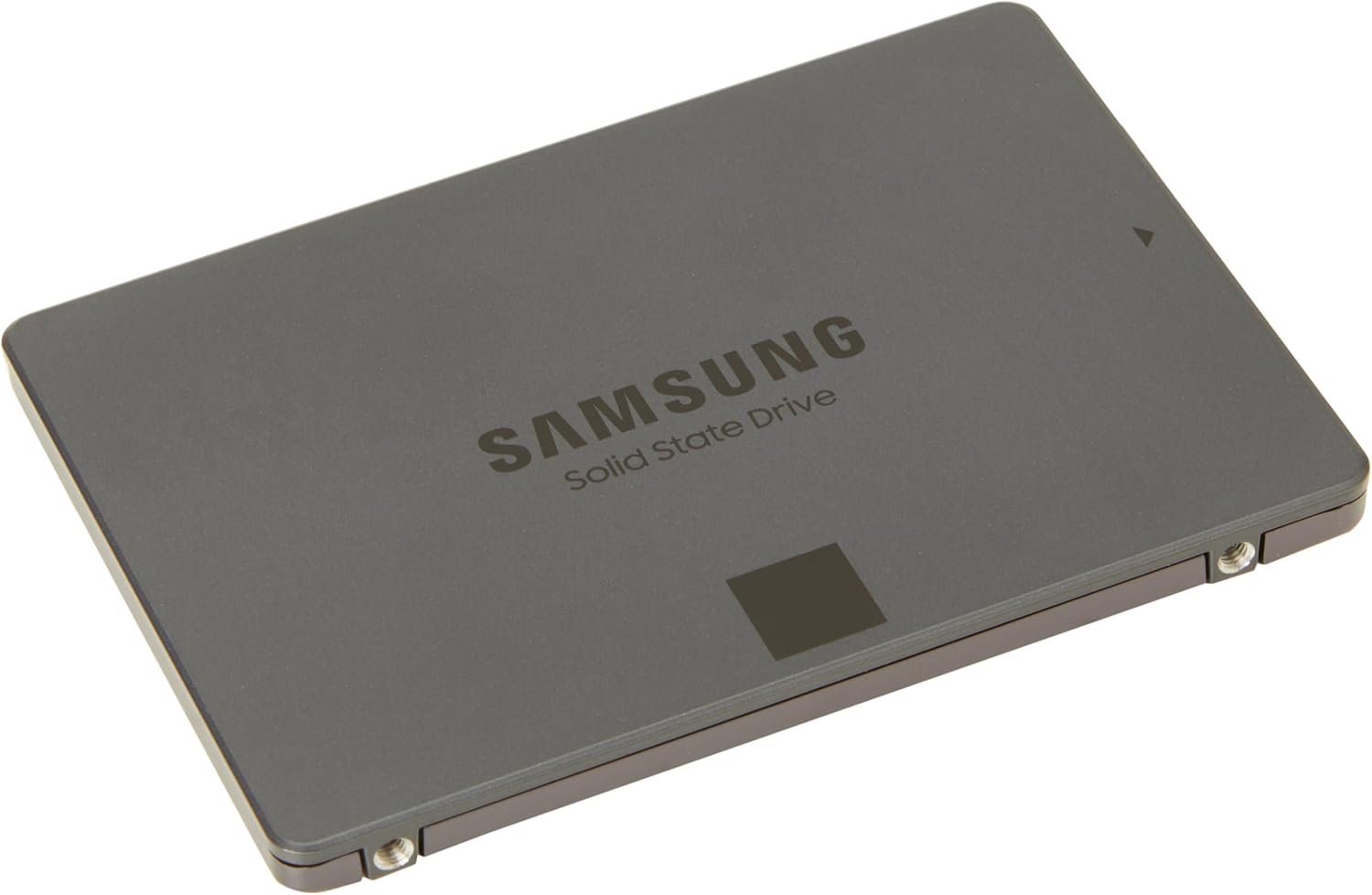
Samsung 870 QVO 8 TB SATA 2.5 Inch Internal Solid State Drive (SSD) (MZ-77Q8T0)
Bottom line: The Samsung 870 QVO 8 TB SATA 2.5 Inch Internal Solid State Drive ($1584.45 on Amazon as of 2026-10-06): 8 TB in one 2.5-inch bay, the largest capacity in the SATA SSD class; main trade-off: QLC NAND, not TLC or MLC, so sustained write performance drops on long transfers.
As an Amazon Associate, SpecPicks earns from qualifying purchases. Full disclosure →
*Price sourced from Amazon.com. Last updated 2026-10-06. Price and availability subject to change.
Pros & Cons
Pros
- ✓ 8 TB in one 2.5-inch bay, the largest capacity in the SATA SSD class
- ✓ 560/530 MB/s sequential read/write saturates the SATA 6 Gb/s ceiling
- ✓ Backward compatible with SATA 3 Gb/s and 1.5 Gb/s on older systems
- ✓ Standard 2.5-inch form factor fits laptop bays without an adapter
Cons
- ✗ QLC NAND, not TLC or MLC, so sustained write performance drops on long transfers
- ✗ SATA caps it at 560 MB/s while NVMe drives run several times faster
- ✗ No M.2 option at this capacity, so it needs a free 2.5-inch bay and cables
- ✗ Samsung positions it for mainstream PCs, not sustained server or write-heavy workloads
Manufacturer description
The Samsung 870 QVO 8 TB is the largest 2.5-inch SATA SSD Samsung builds, and it exists for one reason: replacing a shelf of mechanical drives with a single silent, shock-resistant volume. Built on Samsung's second-generation QLC NAND, it delivers sequential read and write speeds up to 560/530 MB/s over the SATA 6 Gb/s interface, which saturates what SATA can carry. Your real-world numbers will track your system hardware configuration, but on any desktop or laptop built in the last decade the jump from a spinning 7200 RPM disk is immediate in boot time, level loads, and project file opens…
SpecPicks Verdict
SpecPicks scored Samsung 870 QVO 8 TB SATA 2.5 Inch Internal Solid State Drive using a rating × review-volume × price-fit model applied to published specs and reviews across the ssds & storage category. Compare with similarly-priced alternatives in the ssds & storage category before committing. Judge it on the specification table and the price rather than on sentiment: check the figures that decide your use case, then put it side-by-side with two or three close alternatives in the Compare tool before clicking through.
Common buyer scenarios for ssds & storage of this kind: matching it to an existing build, replacing a failing part, or upgrading from a previous-generation equivalent. Check the spec table below against your current setup — particularly socket / form-factor / power-rating fields — and confirm compatibility on the retailer's listing before purchase. Prices and stock are set by the retailer and may have moved since this page was last updated.
Frequently Asked Questions
How fast is the Samsung 870 QVO 8 TB?
Samsung rates it at up to 560 MB/s sequential read and 530 MB/s sequential write. Those are SATA 6 Gb/s interface limits, and actual speeds vary based on your system hardware configuration.
Will the 870 QVO work in my older PC or laptop?
Yes. It uses the SATA 6 Gb/s interface and is backward compatible with SATA 3 Gb/s and SATA 1.5 Gb/s, so it runs on older controllers at that port's speed. It is a standard 2.5-inch drive.
Is QLC NAND a problem for gaming and everyday use?
Samsung designed the 870 QVO for mainstream PCs and laptops in personal, gaming, and business use. QLC trades sustained write endurance for capacity, so it suits read-heavy libraries better than constant large writes.
Is 8 TB really the largest capacity available?
8 TB is the top capacity in the 870 QVO line, and Samsung describes it as the largest of its kind in the 2.5-inch QLC SSD market. Lower capacities in the same family are also sold.
What warranty does the 870 QVO come with?
Warranty terms are not listed in this product's specifications. Check the current Amazon listing or Samsung's official support page for the warranty period and endurance rating that apply to the 8 TB model.
Key Features
- Sequential Read/Write speeds up to 560/530 MB/s respectively; performance varies based on system hardware configuration
- Interface: SATA 6 Gb/s, compatible with SATA 3 Gb/s and SATA 1.5 Gb/s interfaces
- Form Factor: 2.5 Inch
- Available Capacity: Up to 8 TB
- Designed for mainstream PCs and laptops for personal, gaming, and business use
Full Specifications
| Brand | Samsung |
|---|---|
| Color | Black |
| Interface | SATA 6 Gb/s, compatible with SATA 3 Gb/s and SATA 1.5 Gb/s interfaces |
| Model Name | MZ-77Q8T0 |
| Read Speed | 560 Megabytes Per Second |
| Form Factor | 2.5-inch |
| Media Speed | 530.0 |
| Model Number | MZ-77Q8T0BW |
| Built-In Media | Portable SSD |
| Item Type Name | 8000 GB internal SSD |
| Hard-Drive Size | 8 TB |
| Mfr Part Number | MZ-77Q8T0BW |
| Number of Items | 1 |
| Special Feature | Shock Resistant |
| Hardware Platform | Mac, PC, laptop |
| Installation Type | Internal Hard Drive |
| Available Capacity | Up to 8 TB |
| Compatible Devices | Desktop, Laptop |
| Data Transfer Rate | 560 Megabits Per Second |
| Enclosure Material | Cotton |
Ready to buy?
Samsung 870 QVO 8 TB SATA 2.5 Inch Internal Solid State Drive (SSD) (MZ-77Q8T0) is listed on Amazon. Price, availability, shipping and returns are set by Amazon and its sellers — check the listing for current terms. SpecPicks earns a small commission on qualifying purchases — thank you for supporting independent review work.
*Price sourced from Amazon.com. Last updated 2026-10-06. Price and availability subject to change.
Related SSDs & Storage


More guides & deep dives from the SpecPicks archive
Browse all articles & guides →- Emulation Hardware in 2026: FPGA, Software, and Cart-Reader Ecosystems
- Best Budget Gaming PC Build 2026 — ~$1,000 ($800 on Sale)
- How to Build a Windows 98 Retro PC in 2026
- RTX 4070 Super vs RX 7800 XT — Which to Buy in 2026
- The Complete Voodoo5 5500 AGP Driver Guide (2026 Edition)
- Best 1440p Gaming GPUs in 2026
- Best Retro Handhelds in 2026 — From $35 to $500
More reviews from the SpecPicks archive
Browse all reviews →- News: Mistral Enters Robotics With Robostral Navigate 8B
- 3D-Printed Retro PC Case Fits ITX Board, ATX PSU
- When OpenAI Retires a Model: Build a Local RTX 3060 Hedge
- Microsoft's Copilot Goes Agentic — Run Your Own Agent Locally on an RTX 3060
- Ryzen 7 5700X vs 5800X for a 2026 Gaming Build: Which AM4 Chip Wins?
- Building a 1999 GeForce 256 + Pentium III Win98 Rig in 2026
- Voodoo 5 6000 Lab Method: Two Motherboards, One Dead BIOS
- RTX 5090 vs RTX 4090 — is the Blackwell upgrade worth it?
- CRT PC Monitors for Retro Gaming: 2026 Buying Guide
- Best Gaming SSD for PC Builds in 2026: 5 Picks Tested
- Intel-Scaler vLLM 0.21.0: What Changes for Local Arc + Intel GPU Rigs
- AMD Ryzen AI Max 400 'Gorgon Halo': 192GB Unified Memory APU Hits $3,999
- Best Gaming Headset for PS5 and PC in 2026
- Heterogeneous GPU Weighting and Layer Splitting: Mixed-GPU LLM Inference on Consumer Hardware
- Best GPU for Ryzen 5 5500 in 2026 (Budget to 1440p)
- 768GB Intel Optane DIMMs Running a 1-Trillion-Parameter LLM: How the Build Actually Works
- Can You Run Local TTS on an RTX 3060 12GB in 2026?
- TCL 27R944K Review: 165Hz Mini LED Gaming Monitor
- Single vs. Dual Channel Memory: Intel Core Ultra 7 270K
- Best Quiet CPU Cooler for Ryzen 7 3700X Silent Builds in 2026
- Best Raspberry Pi for Local LLMs & Home Lab in 2026: Pi 4 8GB vs Pi Zero
- Best Storage for a Windows 98 Retro PC: CompactFlash vs IDE-to-USB SSD Adapters
- Claude Opus 4.8 Ships, Tops GPT-5.5 on Intelligence Index
- Best Parts for a Budget Ryzen + RTX 3060 Gaming PC Build in 2026
Earliest SpecPicks reviews
Browse full archive →- Best GPU for Llama 3.1 8B (2026)
- Best GPU for Qwen 3 14B (2026)
- Best GPU for Qwen 3 32B (2026)
- Best GPU for Llama 3.1 70B (2026)
- Best GPU for DeepSeek-R1 32B (2026)
- Best GPU for Llama 3.1 405B (2026)
- How to run Llama 3.1 8B on NVIDIA GeForce RTX 5090
- How to run Qwen 3 14B on NVIDIA GeForce RTX 5090
- How to run Qwen 3 32B on NVIDIA GeForce RTX 5090
- How to run Llama 3.1 70B on NVIDIA GeForce RTX 5090
- How to run DeepSeek-R1 32B on NVIDIA GeForce RTX 5090
- How to run Llama 3.1 8B on NVIDIA GeForce RTX 4090