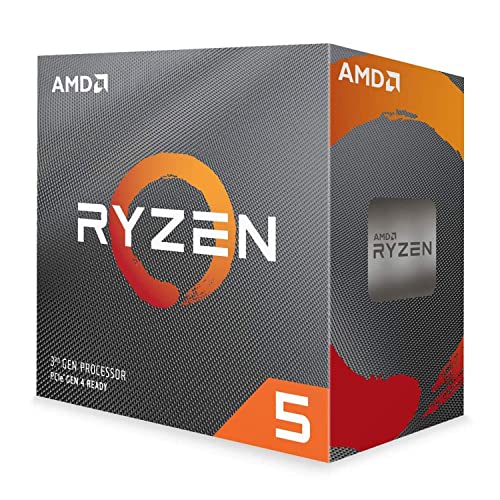
The Ryzen 5 5500 is one of AMD's most common budget AM4 upsells — a six-core, twelve-thread Zen 2 chip sold new and pulled from countless prebuilt teardowns. It has no integrated graphics, so it needs a discrete GPU from day one, and the right pairing depends heavily on target resolution, PSU headroom, and one AMD quirk that trips up a lot of first-time buyers: PCIe 3.0-only support. This guide breaks the pairing decision down by budget tier, plus what else the build needs around the GPU.
The one spec that matters before you shop: PCIe 3.0
Unlike most other chips in the Ryzen 5000 desktop lineup, the 5500 is limited to PCIe 3.0 lanes rather than PCIe 4.0. In practice this has almost no effect on budget and mid-range cards — the bandwidth difference only shows up measurably on the highest-end GPUs at 1080p, where the card can move more data per frame than a PCIe 3.0 x16 link comfortably carries. For anyone shopping in the budget-to-1440p range covered below, this is a non-issue; it only becomes relevant if you're considering a flagship-tier card, which is rarely the right pairing for this CPU anyway (see the 4K section).
Best budget GPU for Ryzen 5 5500 (1080p gaming)
At 1080p, the goal is a GPU that saturates the 5500's six cores without overspending on horsepower the CPU can't feed data to fast enough at higher frame-rate targets. This is the sweet spot for the pairing — budget-tier 8GB cards in the same generation as the CPU are a natural match, and the platform's PCIe 3.0 ceiling is irrelevant at this tier.
| Priority | GPU class | VRAM | Why it fits |
|---|---|---|---|
| Best value | Budget RDNA2-class (e.g. RX 6600 tier) | 8GB | Balanced 1080p performance without outpacing the 5500's core count |
| Best for upscaling-heavy libraries | Budget Ampere-class (e.g. RTX 3060 tier) | 8-12GB | Broader upscaling/ray-tracing feature support in newer titles |
| Budget floor | Entry-level 6GB cards | 6GB | Workable for esports titles and older libraries, tighter on newer AAA releases |
At this tier, prioritize a card with at least 8GB of VRAM — modern texture packs and shader caches lean on VRAM headroom more than raw core count, and 6GB cards are starting to show their age in newer AAA releases.
Best mid-range GPU for Ryzen 5 5500 (1440p gaming)
1440p shifts more of the workload onto the GPU, which plays to the 5500's strengths — it has enough cores to keep a mid-range card fed without becoming the limiting factor, even though the platform is still PCIe 3.0-only. A 12GB VRAM buffer is the practical target here, since 1440p texture streaming and modern shader compilation both lean on available VRAM more than raw clock speed.
| Component | Recommendation | Why |
|---|---|---|
| GPU tier | Mid-range RDNA2/RDNA3 or Ampere/Ada 12GB card | 12GB avoids VRAM-limited stutter in texture-heavy titles at 1440p |
| RAM | 16GB DDR4-3200 dual-channel | Matches the CPU's dual-channel controller; single-stick 8GB configs leave bandwidth on the table |
| PSU | 650W as a comfortable baseline | Covers most mid-range card TDPs with headroom; always confirm against the specific card's listed minimum |
For RAM, a kit like the Crucial 16GB DDR4 Kit (2x8GB), 3200MHz hits the dual-channel sweet spot this tier needs — running a single 8GB stick instead sacrifices the second channel and is worth avoiding for a GPU-forward build. Refresh the CPU cooler at the same time if it's original hardware; see our CPU cooler guide for Ryzen and Intel builds for AM4-compatible options.
Should you pair the Ryzen 5 5500 with a 4K or workstation-class GPU?
This is where the pairing starts to break down. Flagship-tier GPUs are built to be fed by higher core-count, higher clock-speed CPUs, and the 5500's six cores plus PCIe 3.0 ceiling mean a chunk of that card's headroom goes unused — you'd be paying flagship prices without a flagship result. If a 4K-capable build is the goal, it's generally more cost-effective to put the extra budget toward a stronger AM4 chip (or a newer platform) before stepping up to a flagship-class card. If you already own a high-end card and are building around it opportunistically, it will still run — just expect the CPU to hold back peak frame rates in CPU-bound scenes more than it would on a higher-tier chip.
For a build genuinely targeting 4K or heavy creator workloads, our Ryzen 7 9800X3D GPU pairing guide covers a platform better suited to that tier.
What about AI/ML or local LLM workloads on this platform?
The Ryzen 5 5500 is not the CPU to build around for local LLM or generative AI work — that workload lives almost entirely on the GPU's VRAM and compute throughput, and a budget six-core chip is a fine host for it as long as the GPU itself has enough VRAM. If that's the actual goal for the build, it's worth reading our dedicated guides on local LLM image generation on AMD GPUs and, for a much smaller/cheaper entry point, running local LLMs on a Raspberry Pi home lab rather than trying to stretch this platform toward AI workloads it wasn't built for.
How the Ryzen 5 5500 compares to the Ryzen 5 3600
The 5500 doesn't have an extensive published benchmark trail of its own in most public databases, but it shares its core architecture (Zen 2, six cores, twelve threads) with the Ryzen 5 3600 — a chip with a much longer benchmark history. The following frame rates, measured on a Ryzen 5 3600 platform per SpecPicks' hardware benchmark database, are a reasonable proxy for the performance envelope a similarly-paired 5500 build should land in, though actual results will vary by GPU, resolution, and driver version:
| Game | Ryzen 5 3600 (proxy reference) |
|---|---|
| Cyberpunk 2077 | ~39.0 fps |
| Baldur's Gate 3 | ~63.0 fps |
| Starfield | ~72.0 fps |
These numbers reflect a specific test configuration and GPU pairing rather than a universal ceiling — treat them as a directional reference for CPU-bound scenes, not a guarantee for any particular GPU choice. If you're deciding between the two chips directly, the Ryzen 5 3600 remains a known quantity with a wide benchmark base, while the 5500 is typically the cheaper option with comparable real-world gaming performance.
Rest-of-build checklist
A few supporting components matter as much as the GPU choice itself:
- RAM: 16GB dual-channel DDR4-3200 minimum for current games; the 16GB kit is the more balanced buy over a single 8GB stick for anything beyond light 1080p esports titles.
- Storage: A SATA or NVMe SSD is effectively mandatory for load times in current titles — see our SATA SSD comparison for gaming and retro builds or, on a tighter budget, budget SSDs for gaming PCs and consoles.
- Cooling: If reusing a pulled 5500 from a prebuilt, budget for a cooler refresh — see the CPU cooler guide.
- Display: A 1440p build pairs naturally with a higher-refresh monitor; a 4K-target build should check our 4K monitor comparison for console and PC gaming before committing to resolution.
Citations and sources
- Frame-rate figures for the Ryzen 5 3600 (Cyberpunk 2077, Baldur's Gate 3, Starfield) are drawn from SpecPicks' internal hardware benchmark database, compiled from published third-party GPU testing.
- PCIe generation support for the Ryzen 5 5500 reflects AMD's published product specifications for the chip.
This piece is editorial synthesis based on publicly available information. No independent first-party benchmarking is reported.