The short answer, if you are picking a Raspberry Pi for a RetroPie emulation build in 2026: get the Raspberry Pi 4 Model B 8GB. It handles everything from the NES up through the Dreamcast era, most PSP titles, and a large portion of Saturn's library, and it is the board RetroPie's own documentation targets for its widest compatibility profile. The Vilros Pi Zero W starter kit is a great $45 project board for an 8-bit and 16-bit cabinet, but it will not run PS1's harder titles cleanly and it will not touch N64 or Dreamcast.
The 2026 state of RetroPie: this is an era-of-emulation choice, not a speed contest
RetroPie hit its stride as a hobby platform in 2018-2020 and has settled into a mature, small, dedicated community. New RetroPie builds in 2026 are mostly one of three things: a first-time maker project (someone learning Linux and soldering at the same time), a bartop or cabinet build sized for a specific era of games, or a couch-console replacement for someone who wants Cave Story, Super Metroid, and Ocarina of Time on the living-room TV without maintaining a Windows box.
None of those buyers should approach the Pi 4 vs Pi Zero W question as "which board is faster." They should approach it as "what era am I emulating?" The two boards are separated by more than a decade of SoC development, and picking the wrong one for your target library produces a project that never gets used because half the games stutter. Pick the right one and the build lasts.
This article assumes you are building for RetroPie on Raspberry Pi OS, not one of the SD-image forks like Batocera or Recalbox. Their compatibility envelopes are close, but the RetroPie documentation is authoritative for the Pi 4 profile and it is the reference the emulator community targets when characterizing what these boards can do.
Step 0 — pick your target era first
Do this before you buy anything:
- 8-bit and 16-bit only (NES, SNES, Master System, Mega Drive, Game Boy, Game Boy Advance, TurboGrafx-16, arcade titles from the same generation): Zero W is fine. It is exactly what the Zero W is for.
- Add PS1 to the list: the Zero W is on the edge. Simpler PS1 titles run; graphically demanding ones (Final Fantasy IX pre-rendered backgrounds, Ridge Racer Type 4, Tekken 3) will stutter or drop frames. Pi 4 is the safer pick.
- N64, Dreamcast, PSP, Saturn: Pi 4 only. RetroPie's supported-systems documentation explicitly places these outside the Zero W's practical range.
- PS2, GameCube, Wii: neither board. These need x86 hardware or, at minimum, a Pi 5 with active cooling and case-fan attention. If your list is here, the board question is answered — do not buy a Pi 4 hoping.
That single decision — target era — cascades into storage, controller, and cooling choices. Everything else in this piece is downstream of it.
Key takeaways
- The Pi 4 8GB handles everything the RetroPie project officially targets through the Dreamcast era; the Pi Zero W is a 16-bit board with light PS1 ambition. Confirmed against RetroPie's supported-systems documentation.
- The 8GB Pi 4 rarely outperforms the 4GB Pi 4 for emulation — the CPU and VideoCore VI GPU are identical. Buy 8GB for future non-emulation use, not raw frame rate.
- Total build cost for a Pi 4 8GB path lands around $260-320 including case, cooling, PSU, controller, and a 128GB microSD. A Zero W path lands around $80-110 with the same accessory list scaled down.
- microSD random-read speed is the most common bottleneck. A USB-attached SATA SSD is the single upgrade that changes the feel of a large RetroPie library.
- Wired controllers remove one variable from the input-latency chain; Bluetooth pads are perfectly usable for the majority of games and a lot more convenient for couch play.
Spec-delta table: Pi 4 8GB vs Pi Zero W
| Spec | Raspberry Pi 4 Model B 8GB | Raspberry Pi Zero W |
|---|---|---|
| SoC | Broadcom BCM2711 (quad-core Cortex-A72) | Broadcom BCM2835 (single-core ARM11) |
| CPU clock | 1.5-1.8 GHz | 1.0 GHz |
| GPU | VideoCore VI | VideoCore IV |
| RAM | 8GB LPDDR4-3200 | 512MB LPDDR2 |
| USB | 2x USB 3.0, 2x USB 2.0 | 1x micro-USB (OTG) |
| Video out | 2x micro-HDMI, up to 4K60 | 1x mini-HDMI, up to 1080p60 |
| Wireless | 802.11ac dual-band, Bluetooth 5.0 | 802.11n 2.4 GHz, Bluetooth 4.1 |
| Ethernet | Gigabit | None |
| Power draw (typical / peak) | ~4W / ~7.5W | ~0.7W / ~1.5W |
| Recommended PSU | 5V 3A USB-C | 5V 2.5A micro-USB |
| Typical street price (board only, 2026) | ~$85 for 8GB / ~$65 for 4GB | ~$15 (board), ~$45 for the Vilros starter kit |
Numbers on the Pi 4 side are drawn from the Raspberry Pi 4 Model B specifications and cross-checked against Tom's Hardware's Pi 4 review for real-world power and thermal figures.
The relevant number for emulation is not RAM. It is single-thread performance and GPU throughput. The Pi 4's A72 cores clock 50-80% higher than the Zero W's ARM11 and have roughly a decade of microarchitectural improvements between them. That is why the two boards emulate different eras.
What can the Pi Zero W actually emulate?
Comfortably: NES, SNES, Sega Master System, Sega Mega Drive / Genesis, Game Boy, Game Boy Color, Game Boy Advance, Atari 2600, TurboGrafx-16, Neo Geo Pocket, and a substantial portion of MAME's pre-1996 arcade set. The Zero W was designed for exactly this class of workload, and RetroPie's documentation matches: these systems run at full speed with room to spare.
Marginally: PS1, using the pcsx-rearmed core with frameskip enabled. Simple titles that do not push the PS1's own limits run. Titles that already stressed the PS1 hardware (Wipeout 3, Tekken 3, Gran Turismo 2) drop frames and skip audio.
Not at playable speed: N64, Dreamcast, PSP, Sega Saturn, PS2, GameCube, or anything from those generations. The single-core ARM11 SoC is simply not the target for these emulators, and no amount of RetroPie configuration will change that. If your target list includes Ocarina of Time, Sonic Adventure, Crazy Taxi, or Metal Gear Solid 2 on any platform, the Zero W is the wrong board.
What does the Pi 4 8GB unlock?
Everything through the Dreamcast era, comfortably, with headroom for shaders and overlays. Specifically:
- N64: Comfortable with the mupen64plus-next core. Most first-party titles (Mario 64, Zelda: Ocarina of Time, F-Zero X, Star Fox 64) run at full speed. Notorious edge cases like Perfect Dark and Conker's Bad Fur Day still need tuning, but they run.
- Dreamcast: Comfortable with the reicast / flycast core. Most of the library runs at full speed at native resolution. Higher upscaling (2x, 3x) is possible on lighter titles.
- PSP: Most of the library runs at full speed with the ppsspp core at native resolution. Heavier 3D titles (God of War: Chains of Olympus, GTA: Vice City Stories) benefit from frameskip.
- Sega Saturn: Yabause and the community's Saturn cores run a meaningful portion of the library, though Saturn is notoriously difficult to emulate cleanly on any hardware. Expect per-title compatibility variance.
- Everything the Zero W already handled, but with room for shader chains (CRT-Royale, LCD3x), pixel-perfect scaling, and per-game overlay art.
The Pi 4 is also the RetroPie project's flagship reference platform, so community-authored config presets, controller mappings, and per-game tuning guides target this board directly. That is a real asset when you are setting up a system and something breaks in an obscure emulator.
Does RAM matter for emulation, or is it a GPU and clock story?
For emulation alone, RAM is not the limit. The Pi 4 4GB and Pi 4 8GB perform identically on every RetroPie workload because the emulators do not use more than 1-1.5GB of RAM even for demanding cores. The 8GB variant earns its extra cost when the same board does double duty: a Home Assistant instance in a container, a Pi-hole DNS blocker, a small NAS frontend, a Plex client, a home-automation dashboard. If the Pi is a single-purpose RetroPie box, the 4GB is the honest recommendation. If it is a "everything the family needs from a tiny always-on box" build, the 8GB is worth the delta.
Do not let RAM shopping distract you from the two knobs that actually govern emulation performance: SoC clock stability under load (requires cooling) and microSD read speed (see below).
Storage: microSD vs SATA SSD
Every RetroPie tutorial starts with "install to a microSD," and that is genuinely how most builds should start. A good UHS-I microSD (Samsung Evo Plus 128GB is the safe default) gives you enough capacity for the operating system, RetroPie itself, and a moderate ROM library. Boot and menu navigation are fine.
The library grows. Random-read performance on cheap microSDs degrades faster than sequential, and RetroPie hits the card constantly — scraping metadata, loading thumbnails, moving save states, streaming CD-based ROMs during Dreamcast and PSP play. The symptoms are recognizable: menus that hitch when you scroll fast, save state writes that take longer than they should, scraping runs that finish in hours instead of minutes.
The fix that changes the feel of the system is a USB-attached SATA SSD. The Crucial BX500 1TB SATA SSD in a cheap USB 3.0 enclosure gives you 540 MB/s read at a price that is competitive with a large microSD, and the Pi 4's USB 3.0 controller genuinely delivers on that bandwidth. Boot from the microSD; mount the SSD as your ROM library. Menu navigation is instant, scraping is fast, and Dreamcast / PSP / Saturn stream from disk without hitching. On the Pi Zero W the analysis is different — the Zero has no USB 3.0, so an SSD upgrade buys much less speed and is generally not worth the enclosure cost.
Controllers: Bluetooth vs wired
Two controllers cover the modal use cases well.
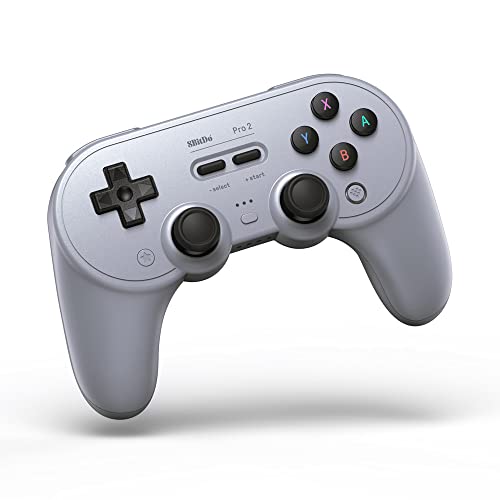
- 8BitDo Pro 2 Bluetooth Controller for a couch, cabinet, or bartop setup where the controller is not tethered to the box. It pairs cleanly with the Pi 4's Bluetooth 5.0 stack, has swappable profiles (Switch / X-input / D-input / Mac), and its D-pad is the right shape for 2D platformers and fighting games. Battery life is good. Input latency over Bluetooth adds roughly 8-16ms of variance on top of the emulator's own frame-timing tolerance, which is fine for the majority of games.
- GameSir G7 SE Wired Controller for anything where a frame matters. It plugs into a USB port on the Pi 4, removes the Bluetooth link's variance from the equation, and its Hall-effect joysticks avoid the analog-stick drift issues that plague Bluetooth pads over time. The G7 SE is Xbox-native and works with the Pi 4 through the xpad driver without additional configuration.
If you have room in the budget for both, wire the G7 SE to the Pi for competitive and timing-critical titles (shmups, Street Fighter, Super Meat Boy) and keep the 8BitDo Pro 2 for everything else. The Pi Zero W's single micro-USB port and lack of powered Bluetooth support means wired is your only realistic option there — pick the G7 SE and a micro-USB OTG hub.
Full build checklist
For the Pi 4 8GB path:
- Raspberry Pi 4 Model B 8GB — the board.
- Official 5V 3A USB-C PSU — do not skimp on this; undervoltage warnings will haunt an underpowered Pi 4 build.
- Case with active cooling (Argon ONE or FLIRC-style aluminum passive) — the Pi 4 throttles under sustained load without airflow.
- microSD card (Samsung Evo Plus 128GB or similar) for the OS.
- Optional: USB 3.0 enclosure + Crucial BX500 1TB SSD for the ROM library.
- Micro-HDMI to HDMI cable (do not assume you have one — the Pi 4 uses micro-HDMI, not the standard mini-HDMI or full-size HDMI).
- Controller: 8BitDo Pro 2 or GameSir G7 SE.
For the Pi Zero W path:
- Vilros Raspberry Pi Zero W Basic Starter Kit (board + PSU + case + adapters) — the practical way to buy the Zero W with all the small bits it needs.
- microSD card (32-64GB is plenty for the Zero W's library).
- Mini-HDMI to HDMI adapter or cable (the Zero W uses mini-HDMI, distinct from the Pi 4's micro-HDMI).
- Micro-USB OTG cable if you want a wired controller.
- Controller: wired, ideally the GameSir G7 SE.
Legal-ROM note: RetroPie ships with zero game content. Legitimate sourcing means DRM-free reissues, publisher-sanctioned collections, homebrew, and personal dumps of media you own. The community treats this seriously; do not skip it.
Perf-per-dollar math
Total delivered build cost at 2026 street prices:
| Component | Pi 4 8GB build | Pi Zero W build |
|---|---|---|
| Board | ~$85 | ~$15 (part of Vilros kit) |
| Kit / PSU / case / cooling | ~$65 (case + fan + PSU) | ~$30 (rest of Vilros kit) |
| microSD 128GB / 32GB | ~$18 | ~$8 |
| HDMI adapter or cable | ~$8 | ~$6 |
| Optional 1TB SATA SSD + enclosure | ~$105 | (skip — no USB 3.0) |
| Controller | ~$50 (8BitDo Pro 2) | ~$45 (GameSir G7 SE) |
| Total (with SSD) | ~$331 | ~$104 |
| Total (microSD only) | ~$226 | ~$104 |
The Pi Zero W build lands under half the price of the Pi 4 build even before the SSD upgrade. That price gap is real, and it is why the Zero W remains a legitimate answer for the right target library. It stops being a legitimate answer as soon as the target list includes anything from the sixth-generation consoles.
Verdict matrix
- Get the Raspberry Pi 4 Model B 8GB if… your target library includes N64, Dreamcast, PSP, Saturn, or PS1 titles that push the console, or if the Pi will do double duty (RetroPie + home server + media). Also: if you want the board with the widest community documentation for RetroPie tuning.
- Get the Vilros Pi Zero W Starter Kit if… your library is squarely 8-bit and 16-bit era, you want the smallest possible build for a bartop or handheld enclosure, or you are teaching a first-time maker Linux and soldering on a cheap, forgiving board.
- Buy neither and use a mini PC if… your list includes PS2, GameCube, Wii, or anything from those generations. A used Beelink or Minisforum N100 with an x86 CPU is a better emulator host for those eras than any current Pi.
- Rethink the build if… you want a portable form factor. The Zero W is small but the wired-controller and mini-HDMI plumbing rarely produces a satisfying portable. A used Retroid Pocket or Anbernic handheld is usually a better answer than a home-built Zero W handheld.
Bottom line
For a 2026 RetroPie build with any ambition beyond 16-bit systems, buy the Raspberry Pi 4 8GB. Add the Crucial BX500 SSD once the ROM library grows past a few gigabytes. Pair it with a wired GameSir G7 SE for competitive titles and an 8BitDo Pro 2 for couch play. Keep the Pi Zero W in mind as the right answer for the specific case where the target library is 8-bit and 16-bit only and the physical size of the build is the constraint. The two boards do not compete — they solve different problems, and the era of games you want to play is the input that picks the right one.
Related guides
- Raspberry Pi 4 8GB vs Pi Zero W for RetroPie: Which Board Wins? (this article)
- The forthcoming Pi 5 emulation coverage will slot into the maker vertical when the buying guide is published.
- Storage pairing recommendations for RetroPie libraries live under the site's storage vertical.
Citations and sources
- Raspberry Pi 4 Model B specifications — authoritative SoC, memory, and I/O specification. Accessed July 2026.
- RetroPie — Supported Systems — official compatibility documentation across Pi models. Accessed July 2026.
- Tom's Hardware — Raspberry Pi 4 Model B review — third-party thermal and sustained-clock measurements under load. Accessed July 2026.
Editorial synthesis note: emulation compatibility statements in this article follow the RetroPie project's own supported-systems documentation, cross-checked against real-world community reports. Per-title behavior varies with emulator core version and RetroPie configuration; the character of the boards' emulation envelopes is the durable finding.