Tesla P40 vs RTX 3090: Used 24GB GPUs for Local LLMs in 2026
Same 24 GB, a quarter of the price: what the P40 gives up in bandwidth, FP16 and convenience.
By Mike Perry, Founder & Editor-in-Chief · Published 2026-10-25 · Updated 2026-10-25 · 12 min read
Tesla P40 vs RTX 3090 for a used local LLM rig: 54.7 vs 158.2 tok/s on Llama 2 7B, $345 vs $1,399 used, plus cooling, power, drivers and dual-card 48GB math.
Quick Answer
In the Tesla P40 vs RTX 3090 decision, the 3090 is roughly three times faster and the P40 is roughly a quarter of the price. On the same llama.cpp build and Llama 2 7B Q4_0 model, the llama.cpp CUDA scoreboard records 158.16 tok/s generation on the RTX 3090 against 54.74 tok/s on the Tesla P40, while GPUDojo's October 2026 used-price tracker lists the cards at $1,399 and $345.
Direct answer: Buy a used Tesla P40 if the goal is the cheapest 24 GB of CUDA memory for chat-speed GGUF inference and you are willing to add a fan shroud, an EPS power lead and a separate display GPU. Buy a used RTX 3090 if the rig also has to chew through long prompts (RAG, coding agents), run PyTorch at FP16, fine-tune, or generate images. Its 936 GB/s of memory bandwidth (NVIDIA GA102 whitepaper) is about 2.7x the P40's 346 GB/s (NVIDIA Tesla P40 datasheet), and it has tensor cores the P40 does not.
Key takeaways
Same VRAM, different eras. Both cards carry 24 GB, but the P40 is a Pascal datacenter part with GDDR5 and the 3090 is an Ampere consumer card with GDDR6X.
Generation gap tracks bandwidth. The scoreboard's 2.9x generation lead for the 3090 sits close to its 2.7x bandwidth advantage.
Prompt processing gap is wider. The 3090 processes prompts about 5x faster on the scoreboard (5,175 vs 1,007 tok/s), which is where tensor cores and FP16 throughput show up.
The P40 needs work. Passive cooling, an EPS-keyed (CPU-style) power connector, no display output, and a driver branch with an end date.
Per dollar, the P40 wins on generation; the 3090 wins on prefill and on everything per watt.
Hardware at a Glance
Median generation throughput at 7–9B models (Llama 3.1 8B, Qwen 3 8B), Q4 quantization, from community-reported runs SpecPicks tracks. Each row pools runs from different sources, runtimes and models in that class, so the rows are not a matched head-to-head; where the article compares cards on the same rig, its own figures are the like-for-like result. Street price is the second-lowest listing priced within the last 24 hours at 0.5–2× launch MSRP, so no single listing sets it, and a street figure well above MSRP says so in its cell; where too few listings pass that check the cell shows a dash and the launch MSRP, which is not comparable with the street figures. Street figures are new or renewed retail listings; SpecPicks does not track a dated used-market price, so check used listings on eBay. Rows marked for comparison are not the cards this article is about — they are included so the throughput column has something to be read against.
RTX 3090 carries 24 GB of VRAM. The weights column is the range of real Q4_K_M
files on Hugging Face for the models in each size class (about 0.6 GB per billion parameters),
and the runtime plus a usable context window wants about 2 GB on top; every tokens-per-second figure is a
median over community-reported Q4 runs SpecPicks tracks for this card, with the run count and
the source beside it.
Model size
Weights at Q4
Fits in 24 GB?
Measured
Left for context
Source
3B (Llama 3.2 3B, Qwen 3 4B)Runs on almost anything with a discrete GPU, and usably on modern integrated graphics.
20-27B (Gemma 3 27B, Mistral Small)A 27B Q4_K_M file (about 16.7 GB) is more than a 16 GB card holds, so 16 GB means a Q3 quant or partial CPU offload; a 24B loads with a short context. 20 GB holds the class with a usable context window, 24 GB with a long one.
Every figure below comes from NVIDIA's own documents unless the source column says otherwise. Used prices are GPUDojo's October 2026 figures and move week to week.
RunAIHome's August 2026 snapshot put used P40s lower, at $239 to $330 (RunAIHome), so the P40's price advantage can be larger than the table shows. Full per-card benchmark histories live on the Tesla P40 benchmark page and the RTX 3090 benchmark page.
How much faster is the RTX 3090 for local LLM inference?
The cleanest comparison is one where both cards ran the same model, quant and software. Two public sources provide that: the llama.cpp CUDA scoreboard (both cards on commit c76b420) and Mozilla Builders' LocalScore, which runs a fixed model set on every accelerator.
Two patterns stand out. First, on the 7B model the 3090's generation lead (about 2.9x) is close to its bandwidth lead (about 2.7x). Token generation on a single user is mostly a memory-read problem, so the faster memory bus carries most of the difference. Second, prompt processing is a compute problem, and there the gap opens to about 5x on the scoreboard and about 6x on LocalScore's Qwen2.5 14B run. LocalScore also records time to first token on that 14B model at 3.74 seconds for the P40 versus 659 ms for the 3090 (LocalScore P40, LocalScore 3090).
For short-prompt chat, generation dominates and the P40's 50-plus tok/s on a 7B model is faster than reading speed. For RAG, coding agents and long documents, prefill dominates, and that is where the P40 feels slowest.
Other published single-card results
Different harnesses and dates; treat these as a model-fit guide, not a head-to-head.
Mixture-of-experts models are the P40's best case: only a few billion parameters are active per token, so the bandwidth penalty bites less. Dense 24B to 32B models are where the P40 slows to low double digits while the 3090 stays in the 30s.
Context length hurts both cards. The P40 owner in #25978 reports prefill falling from 982 tok/s on a 512-token benchmark to about 790 tok/s at 6K tokens and about 216 tok/s at 78K (llama.cpp #25978). Hardware Corner's 3090 table shows Qwen3 14B prefill dropping from 2,459 tok/s at 4K to 734 tok/s at 64K (Hardware Corner).
Why does the P40's missing FP16 and tensor-core support matter?
GP102 runs half precision at 1/64 of its FP32 rate (RunAIHome), and Pascal has neither tensor cores nor native bfloat16 (SarmaLinux). The card was designed around INT8 inference, which NVIDIA rates at 47 TOPS (P40 datasheet). In practice that means the P40 is a GGUF and llama.cpp card: every number in the tables above comes from llama.cpp or software built on it. RunAIHome describes PyTorch-based diffusion and fine-tuning as poor fits for the card, citing Microway's measurement that its FP16 path is effectively unusable (RunAIHome).
The RTX 3090 has 328 third-generation tensor cores and is rated at 71 dense FP16 tensor TFLOPS with FP32 accumulate, plus 35.6 TFLOPS of plain FP16 and BF16 (GA102 whitepaper). That is what lets it run FP16 PyTorch models, LoRA fine-tunes and image pipelines without workarounds, and it is the main reason its prefill numbers are so much higher.
What does it take to run a Tesla P40 in a desktop?
The P40 was built for server chassis. Three things change in a tower.
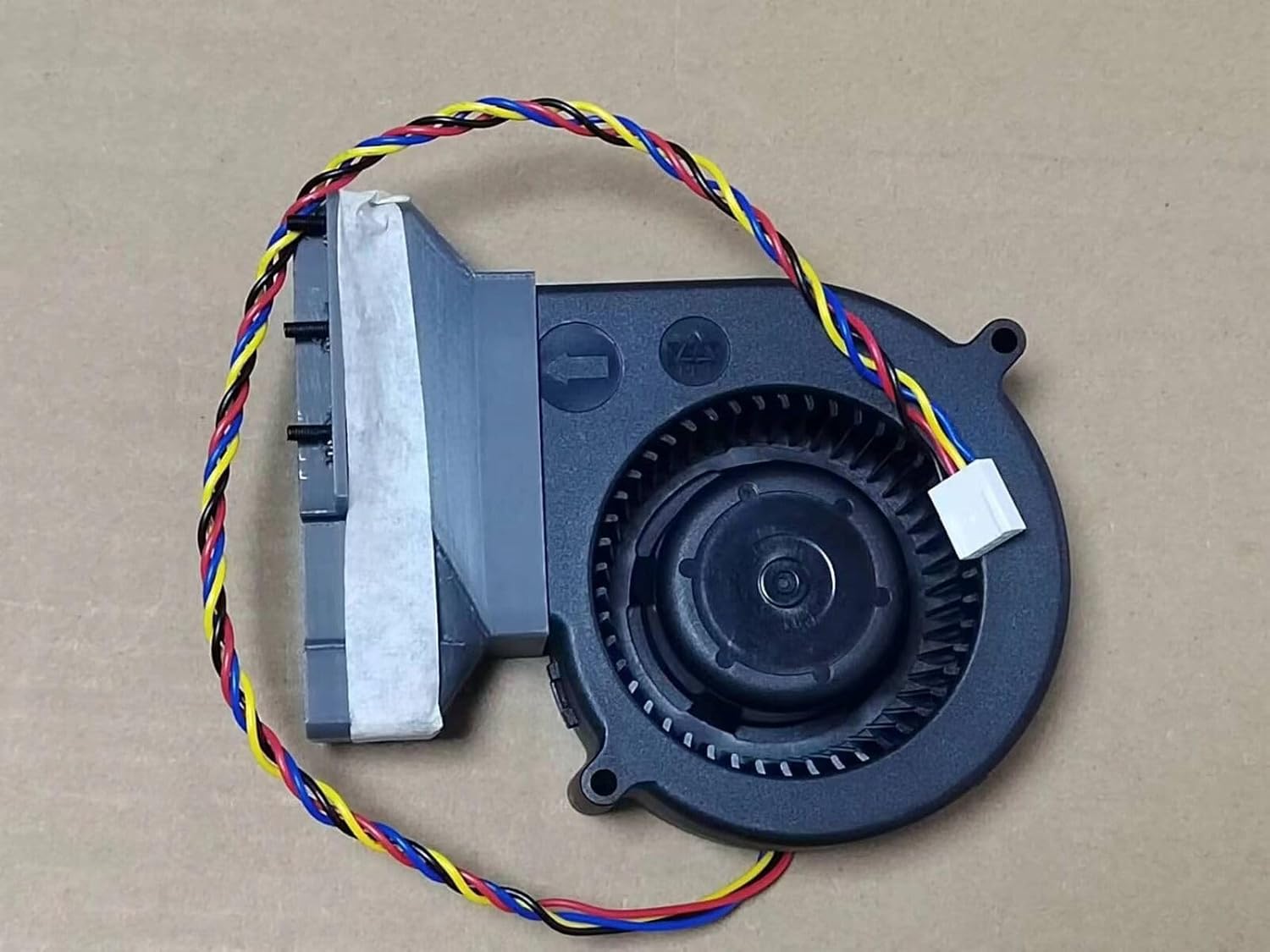
Cooling. The card is passive and expects roughly 60 CFM of forced server airflow (RunAIHome). Without a duct it throttles: SarmaLinux reports the card reaching 95 °C, with throttling at 88 °C cutting speed by 30 to 50 percent, and a 3D-printed shroud with a 60 mm fan holding it near 68 °C under sustained load (SarmaLinux). RunAIHome cites a desktop build whose generation speed rose from 3.6 tok/s to a steady 10 tok/s after a sealed duct was fitted. Free shroud designs exist, such as this 120 mm blower adapter on Printables, and bolt-on blower kits are sold for the card.
Power. The 8-pin socket on the card's edge is EPS-keyed like a motherboard CPU connector, not PCIe-keyed (RunAIHome, SarmaLinux). It needs a spare EPS lead or a dual-PCIe-to-EPS adapter, and RunAIHome warns that adapters with wrong pinouts circulate. NVIDIA rates the card at 250 W maximum (P40 datasheet); RunAIHome suggests capping it at 140 W with nvidia-smi -pl 140 to ease cooling.
Display and firmware. The P40 is compute-only, so the system needs integrated graphics or a second GPU for a monitor, and some boards need Above 4G Decoding enabled in UEFI before the card is detected (RunAIHome). The card is dual-slot, full height and 10.5 inches long (P40 datasheet), and a shroud adds length behind it.
The RTX 3090 needs none of this; its cost is power, at a 350 W TGP (GA102 whitepaper).
Is the Tesla P40 still supported by NVIDIA drivers and CUDA?
Yes, but with a clock running. NVIDIA's CUDA documentation states that Maxwell, Pascal and Volta support is feature-complete, that offline compilation and library support for them were removed in CUDA Toolkit 13.0, and that the 12.x toolkits remain supported for building for them (NVIDIA CUDA Features Archive). RunAIHome reports the 580 driver branch as Pascal's last, maintained as a long-term support branch until mid-2028, which pins a P40 box to CUDA 12.9 and driver 580.x (RunAIHome). On the PyTorch side, a September 4, 2026 notice says PyTorch 2.14 is the last release with prebuilt wheels for Maxwell, Pascal and Volta (PyTorch dev-discuss).
None of that stops a P40 running llama.cpp today, but new runtimes will increasingly target Turing and later, and the RTX 3090's Ampere architecture sits on the supported side of that line.
Dual P40 vs dual RTX 3090: which 48 GB rig makes sense?
Two 24 GB cards is the classic route to running a 70B model at 4-bit, and both cards can do it.
Dual RTX 3090. ComputingForGeeks measured Llama 3.3 70B Q4_K_M on a rented pair of 3090s in October 2026: 19.5 tok/s generation with llama.cpp's default layer split and 31.9 tok/s with tensor split, both cards capped at 290 W, on PCIe 3.0 with no NVLink bridge (ComputingForGeeks). The same test ran Qwen3 32B Q4_K_M at 35.3 tok/s on one card and 59.8 tok/s across two. RTX 3090s also support an NVLink bridge between two cards (GA102 whitepaper), but that test shows it is not required for inference. Budget for the PSU: the article's build pairs two cards with six 8-pin PCIe cables and cites Igor's Lab guidance of 460 to 500 W per card when overclocked to 400 W.
Dual Tesla P40. No reliable published llama.cpp measurement of a 70B Q4 model on exactly two P40s turned up for this synthesis, so this piece gives no number for it. Generation on a layer split is bandwidth-bound and each card has about 37 percent of a 3090's bandwidth (346 vs 936 GB/s, per NVIDIA), so a P40 pair should be expected to land well below the 3090 pair's figures. SarmaLinux reports Llama 3.3 70B at q3_K_M running at about 5 to 7 tok/s on its single-P40 setup, a model larger than one card's 24 GB, and calls it usable for overnight batch jobs (SarmaLinux).
The cost gap doubles too. At GPUDojo's October 2026 prices, two P40s cost about $690 and two 3090s about $2,798 (GPUDojo). Rated board power is 500 W for the P40 pair and 700 W for the 3090 pair (per the NVIDIA documents above), but the P40 pair also needs two EPS leads and enough airflow for two passive cards.
Which is better value per dollar and per watt?
Using the scoreboard's Llama 2 7B Q4_0 numbers (no flash attention) and GPUDojo's October 2026 prices:
Metric
Tesla P40
RTX 3090
Generation tok/s per $100
15.9
11.3
Prefill tok/s per $100
292
370
Generation tok/s per rated watt
0.22
0.45
The P40 wins generation per dollar, the 3090 wins prefill per dollar, and the 3090 is about twice as efficient per rated watt. The 3090 costs about $1,054 more per card. For short-prompt chat on 7B to 14B models, that money buys speed a reader may not notice; for agentic coding, RAG or an always-on model, the 3090's faster prefill and lower energy per token pay it back.
Who should buy the Tesla P40, and who should buy the RTX 3090?
Get the Tesla P40 if the budget is the hard limit, the workload is GGUF inference in llama.cpp, Ollama or LM Studio, the models are 7B to 14B dense or MoE models like Qwen3-30B-A3B, and you are comfortable fitting a shroud, sourcing an EPS lead, and living on CUDA 12.x.
Get the RTX 3090 if the box will run long-context or agentic workloads, PyTorch at FP16 or BF16, LoRA fine-tuning, or image generation; if it also has to drive a monitor or play games; or if you want a card that stays on current CUDA releases.
Prices quoted in this article are GPUDojo's October 2026 used-market figures; live prices may vary. As an Amazon Associate, SpecPicks earns from qualifying purchases.
Bottom line
The Tesla P40 is the cheapest way to put 24 GB of CUDA memory in a box, and for short-prompt chat on 7B to 14B models it is fast enough. The RTX 3090 is the card that does everything else: roughly 3x the generation speed, about 5x the prompt processing, real FP16 and tensor cores, a display output, and a longer support runway, for about four times the price. Buy the P40 as a budget experiment or a second inference card; buy the 3090 as the foundation of a rig you plan to keep.
As an Amazon Associate, SpecPicks earns from qualifying purchases; we also earn on qualifying eBay purchases via the eBay Partner Network. Prices shown were last tracked at crawl time and may vary — check the listing for the current price.
📹 Watch a review
Gigabyte 24GB NVIDIA GeForce RTX 3090 Turbo GDDR6X Review A Solid Choice For Professionals — Critic Review on YouTube
Frequently asked questions
Is a Tesla P40 good for local LLMs in 2026?
For budget GGUF inference, yes. The llama.cpp CUDA scoreboard records 54.74 tok/s generation on Llama 2 7B Q4_0, and LocalScore records 15.4 tok/s on Qwen2.5 14B Q4_K_M. It is a poor fit for FP16 PyTorch work, image generation and fine-tuning, because Pascal runs FP16 at 1/64 of its FP32 rate and has no tensor cores. It also needs a fan shroud and an EPS power lead.
How much faster is an RTX 3090 than a Tesla P40 for LLM inference?
On the same llama.cpp build and Llama 2 7B Q4_0 model, the llama.cpp scoreboard lists the RTX 3090 at 158.16 tok/s generation versus 54.74 tok/s for the P40, about 2.9x, and 5,175 versus 1,007 tok/s prompt processing, about 5x. The generation gap roughly tracks memory bandwidth: 936 GB/s on the 3090 versus 346 GB/s on the P40, per NVIDIA.
What power connector does the Tesla P40 use?
The P40 has a single 8-pin connector that is EPS-keyed like a motherboard CPU connector, not a PCIe graphics connector, according to SarmaLinux and RunAIHome. A desktop build needs a spare EPS lead or a dual-PCIe-to-EPS adapter with the correct pinout. NVIDIA rates the card at 250 W maximum, and RunAIHome suggests capping it at 140 W to ease cooling.
Does the Tesla P40 need a fan?
Yes. The P40 is passively cooled and expects roughly 60 CFM of server airflow, per RunAIHome. In a desktop it overheats without a duct: SarmaLinux reports temperatures up to 95 C and throttling that cuts speed by 30 to 50 percent, while a 3D-printed shroud with a 60 mm fan held the card near 68 C. Printed shrouds and bolt-on blower kits are both widely available.
Can a Tesla P40 drive a monitor?
No. The P40 is a compute-only datacenter card with no display outputs, so the system needs integrated graphics or a second GPU for a monitor. RunAIHome also notes that some motherboards need Above 4G Decoding enabled in UEFI before the card is detected. The RTX 3090 has its own display outputs and also works as a gaming card.
Is the Tesla P40 still supported by CUDA?
Partly. NVIDIA removed offline compilation and library support for Pascal in CUDA Toolkit 13.0, while CUDA 12.x toolkits can still build for it. RunAIHome reports the 580 driver branch as Pascal's last, supported until mid-2028, and a September 2026 PyTorch notice says PyTorch 2.14 is the last release with prebuilt wheels for Pascal. llama.cpp still runs on the card today.
Should I buy two Tesla P40s or two RTX 3090s for 70B models?
Two 3090s if the budget allows. ComputingForGeeks measured Llama 3.3 70B Q4_K_M at 19.5 tok/s with layer split and 31.9 tok/s with tensor split on a dual-3090 rig. No reliable published measurement of the same model on two P40s was found, and with about 37 percent of the bandwidth per card a P40 pair should be expected to be much slower. Two P40s cost about $690 versus about $2,798 for two 3090s at GPUDojo's October 2026 prices.