
TRENDnet
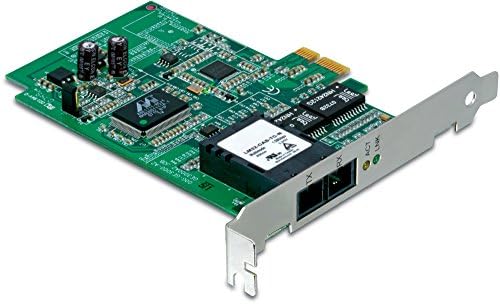
TRENDnet SC-Type Fiber PCIe Adapter
Bottom line: The TRENDnet SC-Type Fiber PCIe Adapter is a specs-and-price decision rather than a crowd-consensus one in the expansion cards category. Check the specification table below against one or two close alternatives — on price and spec fit, not on star ratings.
As an Amazon Associate, SpecPicks earns from qualifying purchases. Full disclosure →
Pros & Cons
Pros
- ✓ Converts a PCIe slot into an SC-Type Multi-Mode fiber port
- ✓ Backed by TRENDnet's warranty and support channels
Cons
- ✗ Needs a free PCIe slot — check which of your board's slots are wired for it
Manufacturer description
The Gigabit Fiber PCI Express Adapter is a high performance fiber network adapter that supports advanced management and power saving functionality and connects Multi-Mode fiber devices at distances of up to 550m (1804ft). Full-Duplex technology generates data rates of up to 2Gbps over a motherboard's high-speed PCI Express Bus architecture. Jumbo Frame support further optimizes throughput performance.SupportsSNMPv1,Pre-BootExecutionEnvironment(PXE)2.1,RemoteProgramLoad(RPL)and Wake-on-LAN(WOL). Optimize network performance with VLAN tagging and Layer 2 Priority Tagging. Increase bandwidth to…
SpecPicks Verdict
SpecPicks has no buyer-rating or benchmark data for TRENDnet SC-Type Fiber PCIe Adapter, so this read rests on the manufacturer's listed specs (how we evaluate). Compare with similarly-priced alternatives in the expansion cards category before committing. Judge it on the specification table and the price rather than on sentiment: check the figures that decide your use case, then put it side-by-side with two or three close alternatives in the Compare tool before clicking through.
Before ordering, confirm the board side: this card needs a free PCIe slot of the width the card uses. Your motherboard manual lists which slots share lanes with M.2 sockets or other slots. Prices and stock are set by the retailer and may have moved since this page was last updated.
Key Features
Quoted from the manufacturer's listing. Where it differs from the pros and cons above, those note the conditions the listing leaves out.
- Converts a PCIe slot into an SC-Type Multi-Mode fiber port
- Supports VLAN Tagging and Layer 2 Priority Tagging
- Includes standard bracket
- Windows, Mac, and Linux compatible
- 3 year TRENDnet Manufacturer’s Warranty
Full Specifications
| Brand | TRENDnet |
|---|---|
| Model Number | TEG-ECSX |
| Compatibility | Mac, Linux |
| Built-In Media | 1 |
| Mfr Part Number | TEG-ECSX |
| Number of Items | 1 |
| Compatible Devices | Desktop |
| Data Link Protocol | Ethernet |
| Data Transfer Rate | 1000 megabits_per_second |
| Hardware Interface | PCI |
| Warranty Description | no warranty |
| External Testing Certification | CE, FCC |
| Global Trade Identification Number | 00710931610093 |
| Full listing title | TRENDnet SC-Type Fiber PCIe Adapter, Convert a PCIe Slot into an SC-Type Multi-Mode Fiber Port, Supports VLAN Tagging & Layer 2 Priority Tagging, TEG-ECSX |
Ready to buy?
TRENDnet SC-Type Fiber PCIe Adapter, Convert a PCIe Slot into an SC-Type Multi-Mode Fiber Port, Supports VLAN Tagging & Layer 2 Priority Tagging, TEG-ECSX is listed on Amazon. Price, availability, shipping and returns are set by Amazon and its sellers — check the listing for current terms. SpecPicks earns a small commission on qualifying purchases — thank you for supporting independent review work.
Related Expansion Cards


More guides & deep dives from the SpecPicks archive
Browse all articles & guides →- Best 1440p Gaming GPUs in 2026
- RTX 4070 Super vs RX 7800 XT — Which to Buy in 2026
- Emulation Hardware in 2026: FPGA, Software, and Cart-Reader Ecosystems
- Best Retro Handhelds in 2026: Pocket, Mid-Tier and FPGA Picks
- How to Build a Windows 98 Retro PC in 2026
- Best Budget Gaming PC Build 2026 — ~$1,000 Parts List
- The Complete Voodoo5 5500 AGP Driver Guide (2026 Edition)
More reviews from the SpecPicks archive
Browse all reviews →- Build an Always-On Raspberry Pi Zero W Project: 24/7 FM Radio and More
- Building a Period-Correct 2003 LAN Party Rig with Athlon XP and Audigy 2 ZS
- Razer Soma Chroma Gaming Chair Review: RGB vs. Adjustability
- Gemini 3.5 Live Translate Goes Cloud-First — The Local, Private Path on a Raspberry Pi
- RTX 5090 AIO Cooler: Liquid Cooling Options in 2026
- Ex-Sega Engineer Builds a 'Super-Realistic' CRT Emulator
- Xbox Mode's PC Performance Boost Favors Nvidia GPUs
- IPEX-LLM + Ollama vs a CUDA RTX 3060 Rig
- The Pac-Man Benchmark: Testing Local Agentic Coding AI
- Gemma 4 31B Creative-Writing Finetunes on RTX 3060 12GB
- Best GPU for Running 27B-32B Local LLMs in 2026
- Genesis Mini vs SNES Classic vs a Pi RetroPie in 2026
- Best Budget SSD for Gaming and PC Upgrades in 2026
- SteamOS Boots on Intel: Enthusiast Hack Breaks Valve's AMD-Only Grip
- News: Mistral Enters Robotics With Robostral Navigate 8B
- CompactFlash as a Silent IDE Boot Drive in a Retro Windows 98 Gaming PC: Full 2026 Guide
- Blue Yeti vs HyperX QuadCast 2 S: Best USB Mic for Streaming
- Black Friday Standing Desk & Monitor Arm Deals: 5 Picks
- Run Home Assistant on a Raspberry Pi 4 8GB in 2026 (SSD Boot)
- Best Gaming SSD in 2026: 5 Picks for PS5, Steam Deck, and Custom Builds
- How to run Llama 3.1 8B on NVIDIA GeForce RTX 5090
- US Forces Anthropic to Disable Claude Fable 5: Local Fallbacks
- Best CPU Cooler for High-TDP Builds (2026)
- How to run Qwen 3 32B on NVIDIA GeForce RTX 4090
Earliest SpecPicks reviews
Browse full archive →- Best GPU for Llama 3.1 8B (2026)
- Best GPU for Qwen 3 14B (2026)
- Best GPU for Qwen 3 32B (2026)
- Best GPU for Llama 3.1 70B (2026)
- Best GPU for DeepSeek-R1 32B (2026)
- Best GPU for Llama 3.1 405B (2026)
- How to run Llama 3.1 8B on NVIDIA GeForce RTX 5090
- How to run Qwen 3 14B on NVIDIA GeForce RTX 5090
- How to run Qwen 3 32B on NVIDIA GeForce RTX 5090
- How to run Llama 3.1 70B on NVIDIA GeForce RTX 5090
- How to run DeepSeek-R1 32B on NVIDIA GeForce RTX 5090
- How to run Llama 3.1 8B on NVIDIA GeForce RTX 4090