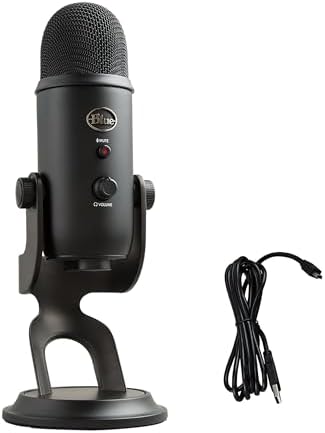
Short answer: For most streamers in 2026, either the Blue Yeti or the HyperX QuadCast 2 S is a fine choice — they're the two USB mics that show up on every streamer-rig list for good reason. The QuadCast 2 S has the better mute UX, on-camera RGB, and slightly crisper sound; the Yeti has more pickup-pattern flexibility, a more proven track record, and is often available cheaper on sale. Pick the one whose look you prefer and spend the difference on a decent boom arm.
This piece is editorial synthesis of Logitech G's product page for the Yeti, HyperX's product page for the QuadCast 2 S, and community streaming-gear reviews. No first-party measurements are reported.
Key takeaways
- Both mics are large-diaphragm USB condensers with multiple pickup patterns and a built-in headphone monitor jack.
- The QuadCast 2 S has a tap-to-mute top sensor that doubles as an RGB mute indicator — a meaningful UX win for live streamers.
- The Yeti offers four pickup patterns including stereo and bidirectional, useful for in-room interview podcasts.
- Both mics weigh roughly 1 kg with the included stand and benefit substantially from being mounted on a proper boom arm.
- Sound quality is broadly comparable in streaming use; mic technique and room treatment matter more than the mic choice.
What are these mics for?
Both the Blue Yeti and the HyperX QuadCast 2 S are large-diaphragm USB condenser microphones aimed at the streaming, podcasting, and content-creation market. "Large diaphragm condenser" means they pick up a wide dynamic range with good tonal warmth — the same general category of mic used in radio broadcast studios. "USB" means they plug directly into a computer without an audio interface or preamp, which is the whole reason they exist as a category.
The Yeti has been on the market since 2009 and has been through several minor revisions. It's the default streamer mic against which everything else gets compared. The QuadCast lineage is newer — HyperX launched the original QuadCast in 2019 and the QuadCast 2 S is the current top-of-line revision. It was designed explicitly to take on the Yeti and shows its work.
Pickup-pattern flexibility
Pickup pattern determines which direction the mic listens in. Per the Wikipedia primer on polar patterns, the four common patterns are cardioid (front), stereo (left+right), omnidirectional (all directions), and bidirectional (front+back).
| Mic | Cardioid | Stereo | Omni | Bidirectional |
|---|---|---|---|---|
| Blue Yeti | Yes | Yes | Yes | Yes |
| QuadCast 2 S | Yes | Yes | Yes | Yes |
Both mics offer all four. For 95% of streaming use, you'll set it to cardioid and never touch the dial again — cardioid is what you want for solo voice from a quiet room. The other patterns matter if you're doing in-room interviews (bidirectional), recording ambient sound (omni), or capturing a stereo source like an acoustic instrument (stereo).
Mute and on-camera UX
Here's where the QuadCast 2 S genuinely pulls ahead. The top of the mic is a capacitive sensor — tap it to mute. The RGB ring goes from lit (live) to dark (muted) as a visual confirmation. The Yeti uses a dedicated mute button on the body that, while it works fine, doesn't have the same instant visual feedback.
For live streamers, the QuadCast 2 S's mute system is meaningfully better. You can quickly mute for a cough or background interruption without fumbling for the button, and your audience can see the visual cue on camera. The Yeti's mute is functionally equivalent — it just doesn't look as good on stream.
Sound quality
Both mics are streaming-suitable out of the box with appropriate mic technique. Direct comparisons in YouTube reviews and streamer comparisons place them as broadly comparable:
- The Yeti tends toward a slightly warmer, fuller midrange. Good for deeper voices.
- The QuadCast 2 S has a touch more high-end clarity. Good for voices that need more "presence."
- Both will pick up plosives (P and B sounds) without a pop filter. Both ship with a built-in foam-style filter that helps somewhat; an external pop filter helps more.
- Both reject off-axis sound about equally well in cardioid mode. Neither is a substitute for a treated room if you have echo issues.
In an A/B blind test on a streaming codec, most viewers cannot reliably distinguish the two mics. The differences exist but are smaller than the differences caused by mic distance, room acoustics, and processing.
Mounting and accessories
Both mics ship with a desktop stand that works but is suboptimal. The single biggest improvement you can make is moving to a proper boom arm — typically a ring-light style adjustable arm or a dedicated mic boom. This lets you position the mic 4-6 inches from your mouth at the right angle, which:
- Dramatically improves signal-to-noise ratio (the proximity effect helps your voice sit louder than room noise)
- Reduces desktop vibration pickup (keyboard tapping, mouse clicks)
- Gets the mic out of your camera shot if you want a cleaner frame
- Lets you swing it out of the way when you're not streaming
Boom arms are inexpensive and the upgrade is immediately audible. Plan for one as part of the mic purchase, not as a later add-on.
Software ecosystem
| Feature | Blue Yeti (Logitech G HUB) | QuadCast 2 S (HyperX NGENUITY) |
|---|---|---|
| EQ and gain control | Yes | Yes |
| Pickup pattern switching | Hardware dial | Hardware + software |
| Mute indicator customization | No | RGB color, animation, brightness |
| Bundled noise suppression | Limited | Via NGENUITY profiles |
| OS support | Windows + macOS | Windows + macOS |
Both software stacks are functional. NGENUITY is the more polished of the two and gives the QuadCast 2 S more in-software customization. Logitech G HUB is more of a generic device manager. Neither is essential for daily streaming use — both mics work fine driver-less on Windows and macOS.
Streaming setup baseline
For a complete streaming setup beyond the mic itself, the typical 2026 baseline is:
- Mic (Yeti or QuadCast 2 S)
- Boom arm or ring-light kit for proper positioning
- USB capture device or webcam for video
- Stream Deck or hotkey controller for scene switching (optional)
- OBS or Streamlabs for production
The mic is the most-noticed part of the audio chain by viewers. After mic selection, the order of improvements is: positioning (boom arm), pop filter, room treatment (acoustic panels), then preamp/interface upgrades (XLR territory). The Yeti and QuadCast 2 S can both grow with you well past the "starting out" phase.
When to upgrade past either of these
You should move to XLR when: you specifically want a different mic capsule sound that neither USB option offers; you're recording multi-person podcasts and want separate channels per speaker; or you're building out a content-creator studio with serious processing chains (compression, gating, parametric EQ on separate hardware). For solo streaming and most podcasting, USB is fine indefinitely.
You should NOT upgrade because someone on a forum told you USB mics are "amateur." Plenty of professional creators ship daily content on USB condensers; the audience can't hear a difference your viewer-count cares about.
Verdict matrix
- Get the QuadCast 2 S if: You stream live, want the tap-to-mute UX, like the RGB on-camera presence, and prefer slightly brighter sound.
- Get the Blue Yeti if: You record solo podcasts or asynchronous content, want a slightly warmer tonal balance, find it on sale at a meaningful discount, or already have a workflow built around Logitech G HUB.
- Get either + boom arm if: You're not sure. The boom arm upgrade is bigger than the mic-choice difference.
Bottom line
The Blue Yeti and HyperX QuadCast 2 S are both excellent streaming mics in 2026. The QuadCast 2 S has a better mute UX and on-camera presentation; the Yeti has more pattern flexibility and a deeper history. Neither will let you down. Whichever you pick, mount it on a proper boom arm and spend an hour adjusting position before you go live — the placement matters more than the mic itself.
Related guides
- Is the Logitech G502 Hero Still the Best FPS Mouse in 2026?
- Best Controllers for Steam Deck and PC in 2026
Citations and sources
- Logitech G — Blue Yeti USB Microphone product page
- HyperX — QuadCast 2 S product page
- Wikipedia — Microphone polar patterns
This piece is editorial synthesis based on publicly available information. No independent first-party benchmarking is reported.