

MOZA RACING
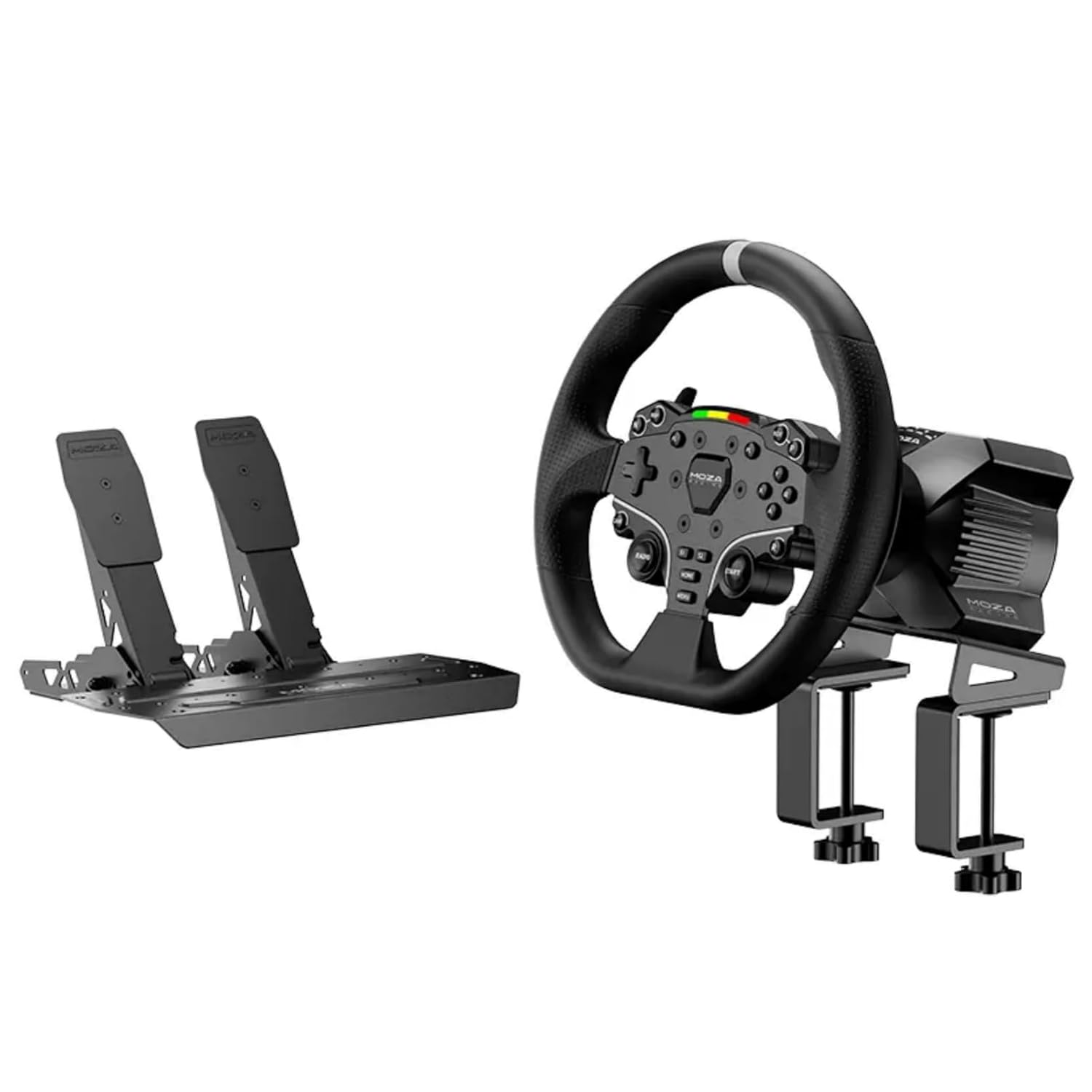
MOZA CRP2 Load Cell Sim Racing Pedals
Status: MOZA CRP2 Load Cell Pedals - 3K Carbon Fiber…: Unavailable on Amazon as of . SpecPicks has no in-stock listing with matching specs on file; the search below lists current offers. eBay sellers may still list this model new or used.
Bottom line: Best for iRacing, ACC, and rFactor 2 competitive drivers upgrading from spring/potentiometer pedals. Per Fanatec's US ClubSport V3 product page, that set retails at $429.99 as of Sep 2026 — placing the MOZA CRP2 at $329.99 roughly $100 below it, with a load-cell brake MOZA specifies at up to 100 kgf peak load. Note: PC-only (Windows with MOZA Pit House); no PlayStation or Xbox console support.
As an Amazon Associate, SpecPicks earns from qualifying purchases. Full disclosure →
Currently unavailable on Amazon. Not the same product — 3 in-stock alternatives:
Similar: MOZA CRP2 Load Cell Pedals — $361.99 on Amazon as of 2026-10-06 10:27 UTC (price may vary).
Similar: MOZA SRP2 Dual Pedals Set of Load Cell Brake and… — $169.99 on Amazon as of 2026-10-06 20:20 UTC (price may vary).
Similar: Simjack UT Load Cell Sim Racing Pedals 200KG Brake — $243.00 on Amazon as of 2026-10-06 16:28 UTC (price may vary).
The MOZA CRP2 Load Cell Pedals deliver dual-sensor sim-racing precision at $329.99 — load-cell brake (force-sensitive, not travel-based) paired with an angle-sensor throttle and clutch. At that price they sit about $100 below the Fanatec ClubSport V3, which lists at $429.99 on Fanatec’s US product page (as of Sep 2026) — a mid-priced step into load-cell braking for competitive PC sim-racers in iRacing, ACC, or rFactor 2 who have outgrown entry-level potentiometer pedals.
Pros & Cons
Pros
- ✓ Dual-sensor precision: load-cell brake + angle-sensor throttle/clutch for consistent feel
- ✓ 3K twill carbon fiber heel plate — weight and texture match real-car pedal boxes
- ✓ Adjustable pedal face positions and spring resistance to match driving style
- ✓ Direct-drive and belt-drive wheel base compatible via standard RJ12 connector
Cons
- ✗ MOZA Pit House software required for brake-curve customization (PC only) — no standalone tuning
- ✗ At $329.99, premium price may deter entry-level sim-racers new to load-cell
- ✗ Heavier than budget sets — adds noticeable mass to a rig plate
- ✗ Mac/console support limited; primarily a PC-focused peripheral
SpecPicks Verdict
The MOZA CRP2 Load Cell Pedals enter the $250–$400 mid-tier sim-racing segment where dual-sensor precision separates them from budget spring-based competitors. At $329.99 they undercut the Fanatec ClubSport V3, $429.99 on Fanatec's US product page as of Sep 2026, making them the value entry point to load-cell pedal technology for PC sim-racers.
Pros: load-cell brake precision at $329.99 — a 100 kgf peak-force rating, above the 90 kg Fanatec quotes for the ClubSport V3, at about $100 less; full PC compatibility with iRacing, ACC, and rFactor 2 out of the box; MOZA Pit House app enables per-driver brake linearity curves, dead-zone tuning, and firmware updates on Windows 10/11.
Cons: PC-only — no PlayStation or Xbox console compatibility, which rules it out for console sim-racers; higher entry cost than spring-pedal alternatives (e.g. Logitech G923 pedal set at ~$150), so the upgrade is most justifiable for drivers who already own a wheel base and are ready for the next tier.
Sensor architecture: the CRP2 uses a load-cell sensor on the brake pedal (measuring force applied, not pedal travel) paired with an angle sensor on throttle and clutch. Per the MOZA official CRP2 specifications, the brake load cell is rated for up to 100 kg of peak force — against the 90 kg Fanatec lists for the ClubSport V3, at a lower price. This combination replicates the pressure-sensitive feel of real-car brake systems — you modulate force, not distance. The result is consistent brake points lap after lap, which is the primary reason sim-racers upgrade from potentiometer-based sets. The Fanatec V3 uses load-cell only on the brake; the Heusinkveld Sprint 3 uses load-cell on all three pedals. At $329.99, the CRP2's brake-only load-cell with angle-sensor throttle/clutch is a pragmatic mid-tier compromise.
Build quality: the 3K twill carbon fiber heel plate adds significant weight (roughly 2.1 kg for the full set) and the aerospace-grade aluminum alloy construction matches the Heusinkveld aesthetic at a lower price. Pedal face positions and spring resistance are adjustable without tools. The RJ12 connector is standard across MOZA, Fanatec, and many direct-drive bases — you won't need an adapter for most wheel setups. MOZA provides a 12-month manufacturer warranty on the CRP2 through authorized resellers.
Software: the MOZA Pit House app is required to tune brake linearity curves, dead zones, and pedal sensitivity. Community feedback on r/Simracing consistently notes the app is stable on Windows 10/11 with regular firmware updates. This is standard in the category (Fanatec uses Fanalab, Heusinkveld uses SIM-DASH) but means the pedals are not plug-and-play without software on first use.
Real-world brake feel: force ratings on a spec sheet do not describe how a pedal behaves under load, so the qualitative assessment here is drawn from independent sim-racing review outlets rather than manufacturer copy. Hands-on evaluations of MOZA's load-cell pedal line by Boosted Media and the hardware coverage at Coach Dave Academy are the standard independent references in this category for brake-feel and consistency testing; both assess pedals on modulation and repeatability rather than peak-force headline numbers. Consult their current CRP2 coverage before buying — brake feel is the most preference-dependent variable in a pedal set, and no spec figure substitutes for a hands-on account.
Verdict: at $329.99 the MOZA CRP2 is a mid-priced way into load-cell braking, about $100 below the Fanatec ClubSport V3. For competitive PC sim-racers in iRacing, ACC, or rFactor 2 who are coming from a budget spring-pedal set, the brake consistency improvement will be immediately noticeable. Entry-level sim-racers new to the hobby should consider whether the pedal set cost exceeds the wheel base budget before buying in at this tier. See our full roundup of the best sim-racing pedals, wheels, and bases for ranked picks across price tiers, or browse all sim racing wheels, cockpits, and pedals on SpecPicks to compare compatible peripherals.
Sources and further reading: MOZA Racing official product page · Boosted Media — independent sim-racing hardware reviews · Coach Dave Academy — sim-racing hardware coverage · r/Simracing — community pedal comparisons · Fanatec ClubSport V3 reference specs · Heusinkveld Sprint 3 reference specs. Editorial synthesis based on publicly available specifications and third-party data; no independent first-party load-cell force testing was performed by SpecPicks.
Frequently Asked Questions
How does load-cell braking differ from spring/potentiometer pedals?
Potentiometer pedals measure pedal travel (how far you press). Load-cell pedals measure force applied (how hard you press), which matches how real car brakes operate — harder pressure equals more braking force, regardless of how far the pedal physically moves. This lets you modulate braking precisely at the same point each lap, reducing brake-point inconsistency caused by leg-position variation. The MOZA CRP2 uses a load-cell only on the brake; throttle and clutch use angle sensors.
Are the MOZA CRP2 compatible with Fanatec and Thrustmaster wheel bases?
Yes, via direct USB connection to the PC (USB-B cable included). Most sim-racing games recognise the CRP2 as a separate USB HID device alongside your wheel base. For use with MOZA wheel bases, the RJ12 connector routes the pedals through the base. For Fanatec or Thrustmaster setups, connect the pedals via USB and check your sim's device configuration. The RJ12 pin-out varies between manufacturers, so direct base-port connection with non-MOZA bases is not guaranteed without a verified adapter.
Does the MOZA CRP2 require software calibration?
Yes. The MOZA Pit House app (Windows) is required to tune brake linearity curves, dead zones, and force sensitivity. The pedals work in a basic default mode via USB plug-and-play, but optimal performance — especially the brake curve matched to iRacing or ACC braking physics — requires Pit House configuration. The app is free and regularly updated per community feedback on r/Simracing.
What is the maximum brake force on the MOZA CRP2?
MOZA specifies up to 100 kgf (kilogram-force) peak load on the brake pedal, above the 90 kg Fanatec lists for the ClubSport V3, at about $100 less. Most sim-racers configure 40–60 kgf in Pit House for a realistic pedal feel; 100 kgf is the hardware ceiling for those who prefer a very stiff real-car brake bias.
Do the MOZA CRP2 pedals work on PlayStation or Xbox consoles?
No. The MOZA CRP2 is a PC-exclusive peripheral. Configuration requires the MOZA Pit House app (Windows only), and basic USB HID mode does not include the console-compatible XInput/DirectInput profile some console wheel bases require. PlayStation 5 and Xbox Series X/S are not supported.
Key Features
- PREMIUM CONSTRUCTION - Aerospace grade aluminum frame combined with 3K carbon fiber heel plate for strength, stability and premium aesthetics.
- Realistic Load Cell Brake: Advanced load cell sensor reproduces the actual braking pressure for consistent and accurate braking performance.
- DUAL SENSOR ACCURACY: Load cell and angle sensors provide accurate input for throttle, brake and clutch control.
- CUSTOMIZABLE PEDAL CURVE - Adjust the resistance and travel to the pedal for a personalized racing experience.
- DURABLE AND RELIABLE - Designed for long running sessions without losing performance over time.
- UNIVERSAL COMPATIBILITY Works seamlessly with MOZA wheel bases and popular SIM racing setups.
Full Specifications
| Pedal Count | 3 (Gas, Brake, Clutch) |
|---|---|
| Brake Sensor | Load Cell (force-based) |
| Max Brake Force | Up to 100 kgf (per MOZA specification) |
| Throttle/Clutch Sensor | Dual Angle Sensor |
| Pedal-Face Material | Aluminum alloy (adjustable angle; interchangeable) |
| Heel Plate Material | 3K Twill Carbon Fiber |
| Frame Material | Aerospace-Grade Aluminum Alloy |
| Weight | ~2.1 kg (full pedal set) |
| Connectivity | USB-B to PC; RJ12 to MOZA wheel base |
| Tuning Software | MOZA Pit House (Windows) |
| Compatibility | PC (Windows); SimHub compatible; console not supported |
| Adjustable | Pedal face angle, spring resistance, dead zones |
| Connector | RJ12 (standard MOZA / sim-racing ecosystem) |
| Brand | MOZA RACING |
| Color | Black |
| Model | RS066 (CRP2) |
| Pedal Set | 2-pedal (throttle + brake) |
| Model Name | RS066 |
| Power Source | USB (bus-powered) |
| Controller Type | Pedals |
Ready to buy?
Amazon shows no buyable offer for MOZA CRP2 Load Cell Pedals - 3K Carbon Fiber… at the last check. A similar in-stock product is MOZA CRP2 Load Cell Pedals. SpecPicks earns a small commission on qualifying purchases — thank you for supporting independent review work.
Related Sim Racing



More guides & deep dives from the SpecPicks archive
Browse all articles & guides →- Best 1440p Gaming GPUs in 2026
- Best Retro Handhelds in 2026 — From $35 to $500
- Emulation Hardware in 2026: FPGA, Software, and Cart-Reader Ecosystems
- How to Build a Windows 98 Retro PC in 2026
- The Complete Voodoo5 5500 AGP Driver Guide (2026 Edition)
- Best Budget Gaming PC Build 2026 — ~$1,000 ($800 on Sale)
- RTX 4070 Super vs RX 7800 XT — Which to Buy in 2026
More reviews from the SpecPicks archive
Browse all reviews →- SteamOS Boots on Intel: Enthusiast Hack Breaks Valve's AMD-Only Grip
- Best Components for a Budget Local-LLM Workstation in 2026
- Asus ROG Harpe II Extreme Brings a 65K-DPI Sensor — and a Gold Price Tag
- Crucial BX500 vs Samsung 870 EVO: Best SATA SSD for Game Loads
- Best GPU for an AI rig in 2026 — the shortlist
- Why That Game Boy Clone Runs Too Fast — and the Crystal Fix
- Noctua NH-U12S vs DeepCool AK620 vs ML240L: Best Cooler for a Ryzen 7 5800X
- Ryzen AI Max LLM Test: What the Public Data Shows
- Homelab Month One: Raspberry Pi 4 or a Ryzen 5 Mini-PC?
- Best Monitor for Color Grading Under $500 in 2026
- Best GPU for Gemma 3 27B in 2026: Where 12 GB Stops Being Enough
- Best GPU for Local LLMs Under $350: Why the RTX 3060 12GB Still Wins
- Mistral Medium 3.5 Hardware Requirements: 128B Dense, 78 GB at Q4
- Best Budget PC Gaming Peripherals in 2026: 5 Picks That Punch Above Their Price
- Ollama vs LM Studio vs GPT4All on a 12GB GPU (2026)
- KOORUI 27" 4K vs Samsung Odyssey 27" 4K: Best 4K Monitor for Console & PC Gaming
- Best GPU for Training CNNs at Home in 2026: The RTX 3060 12GB Case
- SteamOS Boots on Intel Hardware: Enthusiast Hack Breaks AMD Lock-In
- What Handheld Console Should I Buy in 2026? A Decision Framework
- MSI RTX 3060 12GB in 2026: Still the Right 1080p GPU?
- Raycast FPS in COBOL: Can a 60-Year-Old Language Render 3D?
- Logitech G29 vs HORI Force Feedback Wheel: Which Entry Sim Racing Wheel Wins?
- Cisco's Open Security LLMs: Local Vulnerability Scanning on an RTX 3060
- Raspberry Pi Projects for Students (2025 Guide)
Earliest SpecPicks reviews
Browse full archive →- Best GPU for Llama 3.1 8B (2026)
- Best GPU for Qwen 3 14B (2026)
- Best GPU for Qwen 3 32B (2026)
- Best GPU for Llama 3.1 70B (2026)
- Best GPU for DeepSeek-R1 32B (2026)
- Best GPU for Llama 3.1 405B (2026)
- How to run Llama 3.1 8B on NVIDIA GeForce RTX 5090
- How to run Qwen 3 14B on NVIDIA GeForce RTX 5090
- How to run Qwen 3 32B on NVIDIA GeForce RTX 5090
- How to run Llama 3.1 70B on NVIDIA GeForce RTX 5090
- How to run DeepSeek-R1 32B on NVIDIA GeForce RTX 5090
- How to run Llama 3.1 8B on NVIDIA GeForce RTX 4090