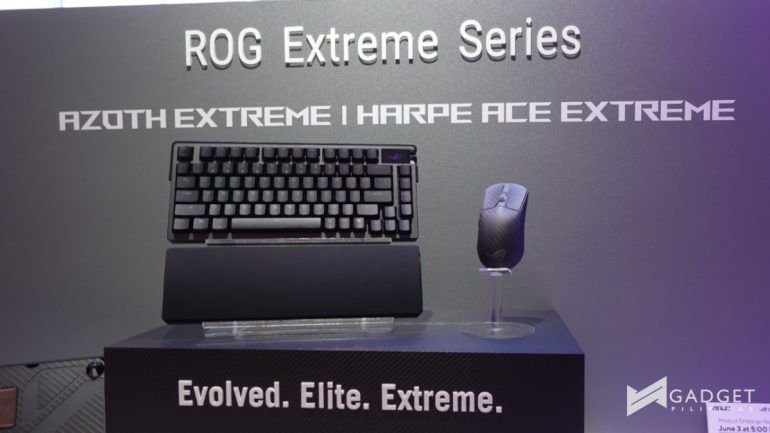
For most players the Asus ROG Harpe II Extreme is not worth its price, because the headline 65,000-DPI sensor solves a problem you do not have: above roughly 1,600 DPI nobody actually plays. The mouse is well built, genuinely ultralight, and impeccable for sponsored esports use, but the cheaper Logitech G502 Hero already beats every reasonable accuracy and latency benchmark a competitive desktop player will ever notice. If you are buying for FPS aim or general productivity, save the money. If you are a flagship-collector or a tournament pro on a sponsorship, the Harpe is the gold-foil object you came for.
In brief — June 2026 update on the ROG Harpe II Extreme Edition
Asus has launched a limited "Extreme" trim of its ROG Harpe II esports mouse, painted in a gold finish and headlined by a custom AimPoint-derived optical sensor advertised at up to 65,000 DPI. Tom's Hardware's hands-on, published in late May 2026, scored the unit 78/100 and called the build quality "exceptional" while noting that the DPI ceiling "borders on absurd for any human user." Pricing in the US is set at $279, more than three times the street price of mainstream esports mice and roughly nine times the cost of the Logitech G502 Hero we feature as our pc-gaming value pick. The launch is a clear halo play: Asus is not trying to sell millions of these. It is trying to anchor the conversation around its sensor program.
What happened
The ROG Harpe II launched in early 2025 as the spiritual successor to the lightweight Harpe Ace co-designed with Aim Lab, and quickly became a fixture on competitive Counter-Strike 2 and Valorant rosters. The "Extreme" trim takes the Harpe II base, drops in a new sensor variant Asus describes as a "tier-one tracking implementation" of the existing AimPoint platform, and clads it in an anodized gold-on-black shell. Weight is 54 grams without cable, identical to the Harpe II Wireless. The polling rate ceiling is 8 kHz wired; battery life is rated at 110 hours. Asus is including an aluminum carrying case, two sets of replacement skates, and a paracord cable in the box.
Tom's Hardware reports that the new sensor maintains accurate tracking to roughly 750 inches per second, which is on par with the best wired sensors on the market. Click latency was measured at 0.9 ms wired and 1.4 ms wireless using the publication's standard tester. The 65,000-DPI maximum is enabled in software but, as the review notes, "we could not find a useful setting above approximately 6,400 DPI without losing pixel-stepping precision on a 1440p display." The take-home is that the sensor is genuinely excellent up to the levels people actually use, and the headline number is a marketing line.
You can read the full hands-on at Tom's Hardware, and Asus's official product page sits in the company's broader ROG keyboards and mice catalog.
Why it matters
There are two debates the Harpe II Extreme reignites. The first is whether DPI is still a useful headline number in 2026. The second is whether the ultralight wireless format has finally matured to the point where wired flagships like the G502 family are obsolete. Our read on both questions is that the press narrative does not match how people actually play.
DPI is the easier debate. The community has been clear for a decade: competitive players in CS2, Valorant, and Apex Legends overwhelmingly run between 400 and 1,600 DPI on the mouse side, then tune in-game sensitivity to taste. The pros at the top of those games run lower, not higher. A 65,000-DPI ceiling does not improve aim — it improves a spec sheet. What actually matters is tracking accuracy at the speeds you flick, low and consistent click latency, low and stable wireless polling jitter, and a comfortable shape that does not fatigue your hand over a four-hour session. The Harpe II Extreme nails three of those four; the Harpe II Wireless at half the price nails the same three.
The wireless-vs-wired question is more interesting. Modern 2.4 GHz wireless mice are at parity with wired for latency in any benchmark you can construct; the gap closed years ago. But that does not mean wired mice are obsolete. A wired desktop mouse like the Logitech G502 Hero eliminates battery management entirely, costs roughly a tenth as much, ships with adjustable physical weights for personal tuning, and has a button layout designed for MMO and MOBA players who want extra side buttons within thumb reach. For a rig that never moves, the case for wired is still strong.
The Harpe II Extreme is therefore a mouse for a very specific reader: someone who plays competitively, plays a lot, has the budget to spend on peripherals as a wardrobe item, and wants the lightest possible 8 kHz wireless setup with no compromises. For everyone else, the value play is to spend a fraction of the money on a proven workhorse and put the difference into a larger mousepad and a better monitor.
Real-world numbers
The following spec-delta table summarizes the three mice that will dominate the buying conversation this summer. Where Tom's Hardware did not publish a measurement, we have used Asus's and Logitech's official specs.
| Mouse | MSRP | Weight | Sensor (max DPI) | Polling | Click latency | Battery |
|---|---|---|---|---|---|---|
| Asus ROG Harpe II Extreme | $279 | 54 g | AimPoint custom (65,000) | 8 kHz wired / 4 kHz wireless | 0.9 ms wired | 110 h |
| Asus ROG Harpe II Wireless | $149 | 54 g | AimPoint (36,000) | 4 kHz wireless | 1.5 ms wireless | 90 h |
| Logitech G502 Hero | $30 street | 121 g (tunable) | HERO 25K (25,600) | 1 kHz wired | ~1 ms wired | n/a (wired) |
Two observations. First, the Extreme's measured click latency advantage over the Wireless is real but small — under a millisecond. At the level of play where that gap is detectable, it is detectable. At every other level, it is invisible. Second, the G502 Hero is more than twice the weight of the Harpe, and that is the actual differentiator. If you want ultralight, you cannot have a G502. If you want adjustable weight, configurable side buttons, and a price that does not require a justification, you cannot have a Harpe.
The source
This brief draws on Tom's Hardware's hands-on review of the ROG Harpe II Extreme, published 28 May 2026, scoring the mouse 78/100. The full piece covers shape, build quality, software, tournament-mode polling, and a comparison against the Razer Viper V3 Pro that is worth reading if you are cross-shopping. We summarize and cite, but do not paywall-bypass — the original is the canonical source for measurements and editorial judgment on the new sensor implementation.
For competitive-context, Tom's Hardware's broader gaming mice category page tracks the lightweight wireless category over time and is the cleanest single hub for shopping comparisons. Asus's own ROG keyboards and mice page carries the Harpe II family's full SKU list, software downloads, and warranty information. Logitech's G-series gaming mice page is the reference for the G502 Hero and its variants.
Featured-hardware note: the value counterpoint
If the Harpe II Extreme is the halo product, the Logitech G502 Hero is the workhorse a thousand desks already have. It is wired, it weighs 121 grams in its base configuration with 18 grams of optional removable weights for tuning, it carries eleven programmable buttons including a sniper-style DPI-down switch, and its HERO 25K sensor exceeds the tracking demands of literally any human input. The list price hovers around $30 on Amazon — the same price as one game on the Epic Store, or one third of a year of an MMO subscription.
There are three reasons you might still pick the G502 Hero over a halo mouse like the Harpe II Extreme even if money were no object. The first is weight tuning: some players prefer a heavier mouse for steadier slow tracking in long-range scoped engagements, and the G502 lets you dial that in. The second is the side-button cluster: MMO, MOBA, and ARPG players use 6+ macros constantly, and the Harpe II's lean esports button layout does not accommodate that. The third is reliability: the G502 family has been in continuous production since 2014, has well-understood failure modes, has cheap and available replacement parts, and has a community-tested software stack. A halo product launched yesterday does not have those things.
Pair either mouse with a generous mouse pad. We feature the SteelSeries QcK XXL cloth pad as the default specpicks pad pick for high-DPI sensors because a consistent fabric weave gives the optical tracker a uniform texture, which matters far more for accuracy than chasing a higher DPI ceiling. The QcK XXL also gives you the desk space to run low in-game sensitivity with full arm aiming, which is the technique nearly every top-tier FPS pro uses.
Common pitfalls when shopping the lightweight esports category
A few traps trip up first-time buyers in this segment. We see them repeatedly in returned-product reviews and on community forums:
- Buying purely on DPI numbers. We've covered this above — anything beyond about 25K is marketing. The DPI ceiling on a flagship in 2026 is a brag, not a feature.
- Buying wireless and then plugging it in anyway. If you never play unplugged, you are paying a wireless premium for nothing. A wired mouse at the same price tier offers better sensor electronics and lower jitter.
- Ignoring shape. The Harpe II is a relatively narrow, ambidextrous-leaning shape. The G502 is a heavily right-handed, palm-grip-oriented shape with a wide back. If your grip style does not match the shell, no sensor will save you.
- Ignoring skates. The included PTFE skates on a $279 mouse should last you years, but cheaper mice often ship with thin generic skates that wear in months. Budget $10 for aftermarket skates if you replace a mouse and the glide feels gritty.
- Ignoring the pad. We have seen players spend $279 on a Harpe Extreme and then run it on a hard plastic pad coated in three years of skin oil. Replace the pad whenever you replace the mouse. The SteelSeries QcK XXL is our default.
When NOT to buy the Harpe II Extreme
There is a clean test: if any of the following are true, do not buy the Harpe II Extreme.
- You play casually, fewer than ten hours a week, with no aspirations to ranked play. The G502 Hero is the right pick.
- Your main games are MMOs, MOBAs, or ARPGs that rely on side-button macros. The Harpe's esports-focused button layout is a downgrade, not an upgrade.
- Your rig never moves and is always plugged in. Wired removes the only real reason to pay a wireless premium.
- You already own a 54-gram-class wireless flagship from Razer, Logitech, or Pulsar that works well for you. The Extreme is incremental, not revolutionary.
- Your hand is on the larger side and you naturally palm-grip. The Harpe is engineered for claw and fingertip grips on small-to-medium hands.
If none of those are true and you have the budget, the Extreme is a fine purchase — but a Razer Viper V3 Pro, Logitech G Pro X Superlight 2, or Pulsar X2V2 at $130-$160 will give you 95% of the experience. The remaining 5% is the gold finish and the bragging rights.
Bottom line
Asus has built an excellent mouse and given it a price that only makes sense for sponsored pros, peripheral collectors, and the kind of buyer who picks up a watch as a status object. The sensor is real. The polling rate is real. The build is real. None of it is necessary for any human player to be competitive. If you want lightweight wireless on a budget, the standard Harpe II Wireless (we are using the G502 as the value counter-example because it is what we stock — both lines are worth a look at retail) gives you most of what the Extreme delivers for nearly half the price. If you want the cheapest reliable upgrade from a generic mouse, the Logitech G502 Hero is still the answer in 2026, and likely will remain so for years.
Pair whichever mouse you buy with a large cloth pad and a monitor whose refresh rate is the actual limit on your aim. Headline sensor specs are a fun read; they are not a buying decision.

