
Roland
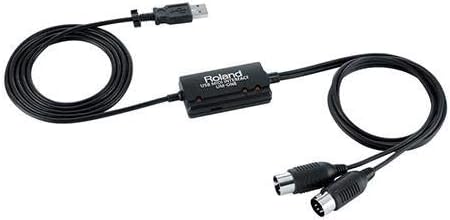
Roland UM-ONE Mk2 USB MIDI Interface
Bottom line: The Roland UM-ONE Mk2 USB MIDI Interface ($46.99 on Amazon as of 2026-10-06): FPT processing targets low latency and tighter MIDI clock timing; main trade-off: only 1-in/1-out; multi-synth rigs need several units or a hub.
As an Amazon Associate, SpecPicks earns from qualifying purchases. Full disclosure →
*Price sourced from Amazon.com. Last updated 2026-10-06. Price and availability subject to change.
Pros & Cons
Pros
- ✓ FPT processing targets low latency and tighter MIDI clock timing
- ✓ USB bus-powered, no wall adapter or extra cable to carry
- ✓ USB and MIDI cables integrated into the unit, nothing to lose
- ✓ Separate MIDI in and out data LEDs make signal-flow troubleshooting fast
Cons
- ✗ Only 1-in/1-out; multi-synth rigs need several units or a hub
- ✗ iPad use requires a separately purchased Apple Camera Connection Kit
- ✗ Fixed captive cables cannot be swapped for longer runs
- ✗ No MIDI thru port for chaining downstream gear
Manufacturer description
The Roland UM-ONE mk2 is a 1-in/1-out USB MIDI interface built by the company that pioneered the PC MIDI interface, and it stays deliberately narrow in scope: get MIDI data between your gear and your computer with tight timing. Roland's FPT processing handles the transfer, which is what the design targets for low latency and steadier clock timing when you are slaving a drum machine or sequencing an external synth. The USB and MIDI cables are integrated into the unit itself, so there is no breakout box and no separate power brick to pack; the interface runs on USB bus power alone. Input and…
SpecPicks Verdict
SpecPicks scored Roland UM-ONE Mk2 USB MIDI Interface using a rating × review-volume × price-fit model applied to published specs and reviews across the audio & midi category. Roland's audio & midi lineup sits within the broader category mid-tier; price and specs are the deciding factors over brand loyalty here. Judge it on the specification table and the price rather than on sentiment: check the figures that decide your use case, then put it side-by-side with two or three close alternatives in the Compare tool before clicking through.
Common buyer scenarios for audio & midi of this kind: matching it to an existing build, replacing a failing part, or upgrading from a previous-generation equivalent. Check the spec table below against your current setup — particularly socket / form-factor / power-rating fields — and confirm compatibility on the retailer's listing before purchase. Prices and stock are set by the retailer and may have moved since this page was last updated.
Frequently Asked Questions
Does the Roland UM-ONE mk2 work with an iPad?
Yes. Roland lists iOS iPad compatibility, but it requires the Apple iPad Camera Connection Kit, which is sold separately.
Do I need to install a driver on Mac or Windows?
The UM-ONE mk2 is listed as Mac and Windows compatible and is USB bus-powered. Check Roland's support page for the current driver for your specific OS version.
How many synths can I connect at once?
One in and one out, so one device each direction. To sequence multiple synths from one port you would add a MIDI thru box or a second interface.
Does it need a separate power supply?
No. It runs entirely on USB bus power from the connected computer or tablet, so there is no wall adapter in the box.
Is the UM-ONE mk2 reliable for vintage gear?
It uses standard 5-pin DIN MIDI, the same connector used on classic synths and drum machines.
Key Features
- One-in/one-out MIDI interface with high-performance FPT processing
- Compatible with Mac and Windows operating systems, and now with iOS on the iPad via the Apple iPad Camera Connection Kit
- Data indicators for both MIDI input and output
- Conveniently integrated USB and MIDI cables
- USB bus-powered operation
- Super compact, affordable, and easy to use
Full Specifications
| Brand | Roland |
|---|---|
| Unit Count | 1 Count |
| Audio Input | USB |
| Connectivity | USB |
| Model Number | UM-ONEMK2B |
| Compatibility | iOS, Mac |
| Item Type Name | UM-ONE-MK2 One in Two Out Midi Cable (UM-ONE-MK2) |
| Compatible Devices | Midi Devices |
| Number of Channels | 1 |
| Supported Software | ['Mac, Windows and iOS'] |
| Included Components | Owner's Manual |
| Maximum Sample Rate | 48 KHz |
| Warranty Description | Consumer limited warranty: 1 year parts, 90 days labor. |
| Connectivity Technology | MIDI |
| Manufacturer Part Number | UM-ONE-MK2 |
| Item Dimensions D x W x H | 1.2"D x 2.4"W x 0.6"H |
| Global Trade Identification Number | 00761294503829, 04957054503826 |
Ready to buy?
Roland UM-ONE Mk2 USB MIDI Interface is listed on Amazon. Price, availability, shipping and returns are set by Amazon and its sellers — check the listing for current terms. SpecPicks earns a small commission on qualifying purchases — thank you for supporting independent review work.
*Price sourced from Amazon.com. Last updated 2026-10-06. Price and availability subject to change.
Related Audio & MIDI



More guides & deep dives from the SpecPicks archive
Browse all articles & guides →- How to Build a Windows 98 Retro PC in 2026
- RTX 4070 Super vs RX 7800 XT — Which to Buy in 2026
- The Complete Voodoo5 5500 AGP Driver Guide (2026 Edition)
- Emulation Hardware in 2026: FPGA, Software, and Cart-Reader Ecosystems
- Best Retro Handhelds in 2026 — From $35 to $500
- Best 1440p Gaming GPUs in 2026
- Best Budget Gaming PC Build 2026 — ~$1,000 ($800 on Sale)
More reviews from the SpecPicks archive
Browse all reviews →- Google's Tiny Gemma 3 Board: What a $0 SBC Gemma Demo Means for Local AI
- Period-Correct 1999 LAN Rig: Pentium III, Voodoo3 3000, Sound Blaster
- CompactFlash-to-IDE Boot Drive: The Silent Win98 Build Upgrade
- Best Budget PC Gaming Upgrades Under $150 in 2026
- Run Kimi K2.7 Code Locally: Ollama vs llama.cpp on RTX 3060
- Ryzen 7 5800X vs 5700X vs 5600G for a Budget Local-LLM Rig
- Raspberry Pi Locator Shuts Down in July: Where to Buy a Pi Now
- Best Raspberry Pi 5 Projects and Kits for 2026
- Samsung's 256GB microSD Falls to $47.99 — Plus the SSD Sidegrade
- Audigy 2 ZS Won't Detect in Win98 SE: A Troubleshooting Decision Tree
- GLM-5.2: The Open-Weights Model Built for Long-Horizon Agentic Tasks
- Build a Wall-Mounted Raspberry Pi 4 Arcade Cabinet: 3D-Printed Case, SSD Boot, Real BOM
- NES Graphics Upgrade Mod Gains Community Traction
- Imaging and Restoring Vintage IDE Drives in 2026: SATA/IDE-to-USB Adapters Compared
- RTX 3060 12GB vs RTX 4060 Ti 16GB for Qwen2.5-Coder 14B (2026)
- AMD Ryzen 7 5800X3D Re-Review: DDR4's Last Gaming Champion in 2026
- Local Coding Agents: 87% HumanEval with a 4B-Parameter Model
- Ternary Text-to-Image: Running Bonsai 4B on a 12GB RTX 3060
- RetroPie Handheld 3D Print Guide: Cases, Settings & Parts
- Best budget SSD for a gaming PC in 2026: BX500 vs 970 EVO Plus vs SSD Plus
- Ryzen 7 5800X vs Ryzen 7 5700X: Which 8-Core AM4 Chip to Buy in 2026
- Inkling's 975B Open-Weight Speech Model — and the 12GB Rig That Transcribes Free
- Best Controller for Emulation and Retro Gaming on PC (2026)
- Aider vs Cline vs Cursor for Local Coding on a 12GB GPU (2026)
Earliest SpecPicks reviews
Browse full archive →- Best GPU for Llama 3.1 8B (2026)
- Best GPU for Qwen 3 14B (2026)
- Best GPU for Qwen 3 32B (2026)
- Best GPU for Llama 3.1 70B (2026)
- Best GPU for DeepSeek-R1 32B (2026)
- Best GPU for Llama 3.1 405B (2026)
- How to run Llama 3.1 8B on NVIDIA GeForce RTX 5090
- How to run Qwen 3 14B on NVIDIA GeForce RTX 5090
- How to run Qwen 3 32B on NVIDIA GeForce RTX 5090
- How to run Llama 3.1 70B on NVIDIA GeForce RTX 5090
- How to run DeepSeek-R1 32B on NVIDIA GeForce RTX 5090
- How to run Llama 3.1 8B on NVIDIA GeForce RTX 4090