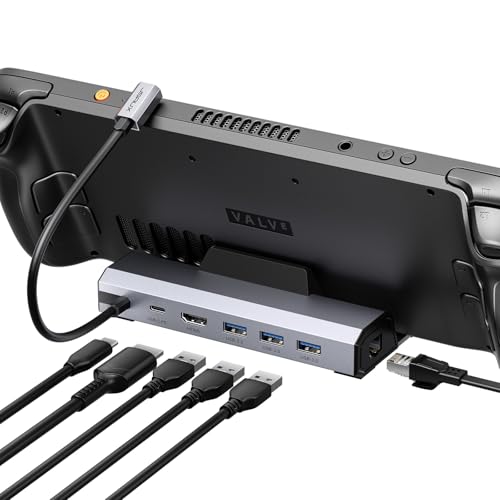
You need four things, in this order: a dock if you ever play on a TV or monitor, audio that suits how you actually play, a proper controller once you're docked, and external storage once the internal drive fills. Skip the dock entirely if you play handheld only — then storage and audio are the whole list, and you'll save about $36.
The docked half of the Steam Deck
You already own the handheld. What you're deciding now is whether to buy the second half of the product — the part that turns a portable into a small living-room PC — and how much of it you actually need.
Most accessory guides get this wrong by treating a Steam Deck like a phone, where the accessories are protective and cosmetic. It is not a phone. It is an x86 PC with a USB-C port, and the accessories that matter are the ones that extend what the PC can do: put it on a display, give it a real controller, give it more storage, and give it audio that works in the context you play in. Cases and skins are fine; they do not change what the machine is capable of.
The order matters more than the individual picks. A dock is the only accessory that changes the category of the device, and everything else on this list is more useful once you have one. Buy a display before confirming what your dock actually negotiates and you can easily end up with a panel running a mode you did not intend. Buy a controller before you have a dock and it sits in a drawer. Buy external storage first only if your internal drive is already full — which, for anyone with more than a handful of modern titles installed, it probably is.
Everything below is a product currently in our catalog with live pricing, spanning $26 to $350, so there is an entry point at every budget rather than one expensive recommendation. The dock is where we start, because it is the purchase that changes the most.
The picks at a glance
| Pick | Best For | Key Spec | Price Range | Verdict |
|---|---|---|---|---|
| JSAUX 6-in-1 Docking Station | Best overall | HDMI + gigabit Ethernet + 3× USB-A + passthrough charging | ~$36 | The one accessory that changes what the device is |
| TAGRY True Wireless Earbuds | Best value | True wireless, long total playback via charging case | ~$26 | Right for handheld and travel; latency is the trade |
| GameSir G7 SE Wired Controller | Best for docked play | Hall-effect sticks, wired USB, remappable back buttons | ~$45 | No pairing, no battery, no stick drift |
| KOORUI 27" 4K Dual-Mode Monitor | Best performance | UHD 160Hz or FHD 320Hz dual mode, 27-inch | ~$350 | Buy the FHD high-refresh mode, not the 4K number |
| Kingston 960GB A400 SATA SSD | Budget pick | 960GB, SATA III, 2.5-inch | ~$130 | Cheap library offload; needs a USB enclosure |
Top picks
🏆 Best Overall: JSAUX 6-in-1 Docking Station
Spec chips: HDMI output · Gigabit Ethernet · 3× USB-A · USB-C passthrough charging · single-cable connection · compatible with Steam Deck, ROG Ally X, Legion Go S
Pros
- Gigabit Ethernet is the standout — wired networking transforms large game downloads and stops Wi-Fi contention from wrecking remote play.
- Passthrough charging while driving a display means the Deck actually gains charge during a docked session rather than slowly draining.
- Three USB-A ports covers a wired controller, a keyboard, and an external drive simultaneously without a second hub.
- At roughly $36 it is a fraction of the first-party dock's price with a comparable port mix.
Cons
- HDMI only — no DisplayPort, which matters if your monitor's best refresh mode is DisplayPort-exclusive.
- The captive cable is short and stiff, so dock placement is less flexible than it looks in photos.
Per Valve's published Steam Deck technical specifications, the device's USB-C port carries DisplayPort alt-mode video alongside power delivery and data, which is the mechanism every third-party dock uses. That means compatibility is rarely the differentiator between docks — the differentiators are the port mix, the passthrough wattage, and how reliably the HDMI output negotiates the mode you want. Valve's own dock product page documents the first-party unit's feature set, and the useful comparison is that a 6-in-1 third-party dock at this price typically matches it on ports while costing meaningfully less.
The reason this is the best-overall pick rather than just a good dock is what it unlocks. Docked, the Deck becomes a machine you can play on a TV with a real controller, run as a light desktop with a keyboard and mouse, and load with content over wired gigabit instead of contended Wi-Fi. None of the other four picks below do anything nearly that transformative. If you buy one thing from this guide, buy this, and buy it before you buy a display.
See price & specs · Price may vary; check the live listing. · See full details
💰 Best Value: TAGRY Bluetooth True Wireless Earbuds
Spec chips: True wireless stereo · long total playback via case recharges · LED case charge indicator · IPX-rated for sweat and light rain · Bluetooth pairing to Deck, phone, and PC
Pros
- At about $26 this is the cheapest accessory here and the one you will use outside gaming most often.
- Genuinely the right answer for handheld play — no cable to snag when the Deck is in your hands on a couch or a train.
- The charging case means practical all-day use across multiple short sessions rather than one long one.
- Pairs with your phone and laptop too, so the money is not single-purpose.
Cons
- Bluetooth audio latency is real and codec-dependent, and it is more noticeable in competitive shooters than in single-player games.
- In-ear drivers give weaker positional cues than an over-ear headset, which matters for footstep audio.
- True-wireless microphones are adequate for calls and clearly behind a boom mic for team voice chat.
The honest framing: these are the best value accessory on this list and the wrong pick for ranked competitive play. Bluetooth adds an encode, buffer, and decode stage that analog audio simply does not have, and the buffer — sized to hide RF interference — dominates the delay. For single-player, handheld, and travel use, that delay is irrelevant and the convenience is decisive. For ranked shooters, plug in a wired headset; we cover that trade in detail in our wired headset versus Bluetooth earbuds latency breakdown.
The other thing to know is that many owners end up with both audio options for different contexts, and at these prices that is a rational outcome rather than a failure to decide.
See price & specs · Price may vary; check the live listing. · See full details
🎯 Best for Docked Play: GameSir G7 SE Wired Controller
Spec chips: Hall-effect analog sticks · wired USB connection · two remappable back buttons · Hall-effect triggers · Xbox-standard layout · XInput native
Pros
- Hall-effect sticks use magnetic sensing rather than physical potentiometers, which addresses the stick-drift failure mode that eventually kills most pads.
- Wired USB means no pairing step, no battery state to manage, and no Bluetooth stack to negotiate — it is recognized instantly by SteamOS.
- Two remappable back buttons put jump or crouch under your middle fingers without taking a thumb off a stick.
- A 3.5mm jack on the pad lets you run analog audio from the couch without a cable to the dock.
Cons
- Wired only — there is no wireless mode, so cable routing to the dock is part of your setup.
- Xbox-standard face-button layout, which is a downgrade if you are used to the Deck's own layout or prefer Nintendo positioning.
Once the Deck is docked, its built-in controls are behind the TV and unreachable, so a separate pad is not optional — it is a requirement of the docked configuration. The argument for wired specifically is the same one that applies to the audio pick above, only stronger: a docked session already involves a dock, a display, a power cable, and a network cable. Adding a wireless pairing variable to a stack that is already fully cabled buys you nothing and introduces a failure mode.
Hall-effect sticks are the real reason to pick this over cheaper pads. Drift is the single most common reason controllers get replaced, and magnetic sensing removes the mechanism that causes it. At $44.99 that is a meaningful longevity upgrade over a $25 potentiometer pad that will develop drift within a year of heavy use. For a full comparison against the DualSense and 8BitDo alternatives, see our PC controller for retro emulation round-up.
See price & specs · Price may vary; check the live listing. · See full details
⚡ Best Performance: KOORUI 27" 4K Dual-Mode Gaming Monitor
Spec chips: 27-inch panel · Dual mode: UHD 3840×2160 at 160Hz or FHD 1920×1080 at 320Hz · fast response panel · HDMI and DisplayPort inputs
Pros
- The dual-mode design is the feature: a native-4K high-refresh mode for a desktop GPU and a high-refresh 1080p mode for anything that cannot drive 4K.
- 27 inches at 1080p is a comfortable pixel density for couch-adjacent desk distance and forgiving of the Deck's output resolution.
- DisplayPort input means it also serves a desktop tower properly, so the purchase is not Deck-specific.
- High refresh at FHD is exactly the mode a docked handheld should target.
Cons
- At roughly $350 it is by far the most expensive item here, and it costs about ten times the dock.
- The Deck cannot render most modern titles at 4K at a playable frame rate — you are buying the FHD mode for this device, not the UHD headline.
Be clear-eyed about what you are buying. Per Valve's technical specifications, the Deck's APU is a low-power part designed around a 1280×800 internal display. It can output 4K over the dock, and a handful of light or older titles will run there, but the realistic docked target for modern games is 1080p with frame-rate headroom. That is precisely why a dual-mode panel is the correct shape of monitor for this use case rather than a fixed 4K-only display: you get the mode that actually matters for the handheld, plus a mode that will matter later for a desktop or console.
The purchasing rule that follows: buy this panel if it will also serve a desktop PC or a current console. Buy it only for the Deck and you are paying for a resolution mode the device cannot meaningfully use. If your budget is tight, a good 1080p high-refresh panel at a third of the price is the better Deck-specific choice, and our 4K monitor pairing guide covers how KOORUI's dual-mode panels behave with mid-range GPUs.
See price & specs · Price may vary; check the live listing. · See full details
🧪 Budget Pick: Kingston 960GB A400 SATA SSD
Spec chips: 960GB capacity · SATA III 6Gb/s interface · 2.5-inch form factor · TLC NAND · low cost per gigabyte
Pros
- Nearly a terabyte of game library storage for well under the price of a comparable internal NVMe upgrade.
- No disassembly required — over USB it is an external drive, so there is no warranty question and no thermal-pad surgery.
- SATA over USB is fast enough that load-time differences are modest for the large majority of titles.
- Doubles as a general-purpose backup drive when you are not gaming.
Cons
- Requires a separate USB enclosure, which is an extra purchase and an extra thing to lose.
- SATA speeds are well below the internal NVMe drive on paper, so the heaviest streaming-open-world titles are the worst fit.
The case for external storage is simple: the alternative to a slower drive is not installing the game at all. A 960GB offload drive holds a serious back catalogue and frees the internal NVMe for the handful of titles that genuinely benefit from its bandwidth. Keep the streaming-heavy open-world games internal and put everything else — indies, older titles, anything you play in short bursts — on the external.
Two practical requirements. First, buy an enclosure that supports UASP, the USB Attached SCSI Protocol; without it you are stuck on the older BOT protocol and throughput drops noticeably for no reason other than a firmware choice. Second, plan how you move the library — Steam supports multiple library folders and moving installed games between them, which is far faster than re-downloading, and doing it before the internal drive is completely full avoids a painful shuffle. Our NVMe vs SATA for a Steam library piece has the load-time picture in more detail.
See price & specs · Price may vary; check the live listing. · See full details
What to look for in Steam Deck accessories
Dock output modes and refresh limits
The single most common disappointment is buying a display and discovering the dock negotiates a lower refresh rate than the panel supports. HDMI version, cable quality, and dock firmware all participate in that negotiation, and a dock advertising "4K support" may mean 4K at 30Hz. Before buying a panel, confirm what your dock outputs at your target resolution. If a specific high-refresh mode is the reason you want the monitor, verify the dock can reach it — this is where DisplayPort-only modes bite HDMI-only docks.
Passthrough charging wattage and why it matters
Under a docked gaming load with a display attached, the Deck draws meaningfully more than at idle. If the dock's passthrough wattage is too low, the battery discharges slowly during a session even though it is plugged in — which is fine for two hours and a problem for six. Check the dock's rated passthrough and pair it with a power adapter that can actually supply it; using a low-wattage phone charger with a capable dock produces exactly the same symptom.
USB-C bandwidth versus number of ports
A dock's ports all share one upstream USB-C connection. Video, Ethernet, and every USB-A device are dividing a fixed bandwidth budget. In practice this rarely bites with a controller and a keyboard, but it can when you add a high-throughput external SSD while driving a high-resolution display. If you plan to run games directly off a docked external drive, that is the scenario where a dock with more ports is not the same as a dock with more capability.
Wireless audio latency versus convenience
Bluetooth audio adds encode, buffer, and decode stages, and the buffer dominates. The delay varies by codec and by what the two endpoints actually negotiate — a low-latency-capable earbud paired to a device that only offers SBC gives you SBC latency, silently. Docked at a desk, wired is the low-friction answer. Handheld and travelling, wireless wins on the merits. Competitive shooters are where the delay is most noticeable; single-player is where it is least.
External storage: format, enclosure, and library mechanics
Format the external drive with a filesystem SteamOS handles well, use a UASP-capable enclosure, and move games through Steam's own library-folder tooling rather than copying directories by hand. Plan the split before you need it: streaming-heavy modern titles on the internal NVMe, everything else external. And remember that a bare 2.5-inch SSD is not a finished product — budget for the enclosure in the total price.
The most-missed step
Confirm what your dock and display actually negotiate before you buy the panel.
This is the mistake that costs the most money in this category, and it is entirely avoidable. People buy a high-refresh or high-resolution monitor, connect it through a dock they already own, and get a mode well below what the panel is capable of — then blame the monitor. The negotiation involves the Deck's DisplayPort alt-mode output, the dock's conversion to HDMI, the HDMI version and cable, and the display's accepted input modes. Any weak link in that chain caps the result.
The correct order is: buy the dock, connect it to a display you already own or can borrow, verify what mode it reaches, and then buy the panel that matches. Reversing that order is how people end up with a 4K 160Hz monitor running at 4K 30Hz and a strong opinion about a product that was never the problem.
When NOT to buy any of this
If you play exclusively handheld, in bed or on a train, and you have never once wished the Deck were on a television, then the dock, the controller, and the monitor are all money spent on a use case you do not have. That is a completely legitimate way to own the device, and the accessory list for that owner is exactly two items long: storage when the internal drive fills, and audio that is comfortable to wear for an hour.
Similarly, if your Deck is a secondary machine that gets used a few times a month, resist the guide-shaped urge to build out the docked setup "for later." Buy the dock when you have a specific display and a specific reason. The accessories here are genuinely useful, and they are also genuinely easy to over-buy.
Sources
- Valve — Steam Deck technical specifications — accessed 26 August 2026. Source for APU class, native display resolution, and USB-C DisplayPort alt-mode video output.
- Valve — Steam Deck Docking Station — accessed 26 August 2026. Source for first-party dock port mix and passthrough charging behavior.
- Tom's Hardware — Valve Steam Deck review — accessed 26 August 2026. Source for the device's performance positioning as a low-power x86 handheld.
Related guides
- NVMe vs SATA for a Steam Library: 970 EVO Plus vs BX500
- Steam Deck Gyro Aiming for FPS Games: A Setup Guide
- Best 4K Monitor for an RTX 3060 12GB: KOORUI vs Samsung Odyssey
- Steam Deck Sleep Mode: Should You Leave It Plugged In?
- Best Gaming Headset in 2026 for Gaming and Music
— Mike Perry · Last verified 26 August 2026
Citations and sources
- Valve — Steam Deck technical specifications — accessed 26 August 2026.
- Valve — Steam Deck Docking Station — accessed 26 August 2026.
- Tom's Hardware — Valve Steam Deck review — accessed 26 August 2026.
Prices quoted are SpecPicks catalog listings as of 26 August 2026 and may vary; check the live listing before purchase. This piece is editorial synthesis based on publicly available information. No independent first-party benchmarking is reported.