

FORE
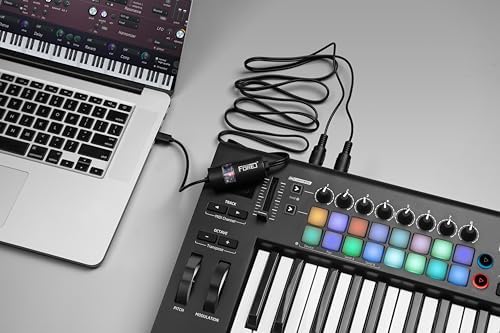
FORE S1 Wireless MIDI Interface & MIDI USB Type-C Adapter
Bottom line: The FORE S1 Wireless MIDI Interface & MIDI USB Type-C Adapter ($19.99 on Amazon as of 2026-10-06): Wireless MIDI and USB Type-C in one unit, so stage and desk rigs share the same adapter; main trade-off: sold as a 1-pack: each instrument connected at the same time needs its own S1.
As an Amazon Associate, SpecPicks earns from qualifying purchases. Full disclosure →
*Price sourced from Amazon.com. Last updated 2026-10-06. Price and availability subject to change.
Pros & Cons
Pros
- ✓ Wireless MIDI and USB Type-C in one unit, so stage and desk rigs share the same adapter
- ✓ Connects any 5-pin DIN gear, including pre-USB synths, drum machines and sound modules
- ✓ Ultra-low-latency design targets live playing, not just step sequencing
- ✓ Covers iOS, Android, Windows and macOS, so no second platform-specific purchase
Cons
- ✗ Sold as a 1-pack: each instrument connected at the same time needs its own S1
- ✗ Wireless range, battery life and power source are not stated in the listing data
- ✗ 5-pin DIN cables are not confirmed included, so budget for MIDI leads
- ✗ No published millisecond figure to verify the ultra-low-latency claim
Manufacturer description
If your MIDI keyboard still ends in a pair of 5-pin DIN jacks, the FORE S1 Wireless MIDI Interface is the bridge to your phone, tablet, or laptop. It combines a wireless MIDI link with a USB Type-C adapter, so one unit covers a cable-free stage rig and a wired desktop session without swapping hardware. FORE rates the S1 for ultra-low latency, which is what matters when you are tracking a part in real time rather than step-sequencing it. Compatibility spans iOS, Android, Windows, and macOS, so a tablet setup and a full desktop DAW can both address the same interface. Any MIDI 5-pin DIN device…
SpecPicks Verdict
SpecPicks scored FORE S1 Wireless MIDI Interface & MIDI USB Type-C Adapter using a rating × review-volume × price-fit model applied to published specs and reviews across the audio & midi category. FORE's audio & midi lineup sits within the broader category mid-tier; price and specs are the deciding factors over brand loyalty here. Judge it on the specification table and the price rather than on sentiment: check the figures that decide your use case, then put it side-by-side with two or three close alternatives in the Compare tool before clicking through.
Common buyer scenarios for audio & midi of this kind: matching it to an existing build, replacing a failing part, or upgrading from a previous-generation equivalent. Check the spec table below against your current setup — particularly socket / form-factor / power-rating fields — and confirm compatibility on the retailer's listing before purchase. Prices and stock are set by the retailer and may have moved since this page was last updated.
Frequently Asked Questions
Will the FORE S1 work with an old synth that only has 5-pin DIN MIDI?
Yes. The S1 is built for any MIDI 5-pin DIN device, which covers pre-USB synths, drum machines, sound modules and vintage controllers that a modern USB-only interface cannot address.
Does it work with an iPhone, iPad or Android phone?
FORE lists compatibility with iOS, Android, Windows and macOS, and the package includes a MIDI USB Type-C adapter for current phones and tablets. Older Lightning or USB-A hosts would need their own adapter.
Is the latency low enough to play parts live?
FORE markets the S1 as ultra low latency and positions it for real-time playing rather than offline sequencing. No millisecond figure is published in the listing data, so check the product page for the manufacturer's current specification.
How many instruments can one FORE S1 connect?
This is the black 1-pack, so you get a single interface. Running two instruments wirelessly at the same time means buying a second unit.
Full Specifications
| Brand | FORE |
|---|---|
| Color | Dark |
| Model | S1 Wireless MIDI |
| Set Name | Wireless MIDI S1 |
| Frequency | 2.4 GHz |
| Cable Type | USB |
| Model Name | S1 Wireless MIDI |
| Unit Count | 1 Count |
| Part Number | F-Wireless MIDI S1 UK |
| Connectivity | Wireless, USB |
| Compatibility | Android, iOS, Mac |
| Connector Type | 5 Pin DIN, USB Type C |
| Item Type Name | Wireless MIDI Interface |
| Number of Pins | 5 |
| Connection Type | Wireless |
| Number of Items | 1 |
| Connector Gender | Male-to-Male |
| Compatible Devices | MIDI Wireless/USB-C |
| Data Transfer Rate | 2.4 GHz |
| Indoor Outdoor Usage | Indoor |
| Full listing title | FORE S1 Wireless MIDI Interface & MIDI USB Type-C Adapter, Ultra Low Latency, Work with MIDI Keyboard & Any MIDI 5-Pin Din Device Compatible with iOS, Android, Windows/mac OS Balck 1-Pack |
Ready to buy?
FORE S1 Wireless MIDI Interface & MIDI USB Type-C Adapter, Ultra Low Latency, Work with MIDI Keyboard & Any MIDI 5-Pin Din Device Compatible with iOS, Android, Windows/mac OS Balck 1-Pack is listed on Amazon. Price, availability, shipping and returns are set by Amazon and its sellers — check the listing for current terms. SpecPicks earns a small commission on qualifying purchases — thank you for supporting independent review work.
*Price sourced from Amazon.com. Last updated 2026-10-06. Price and availability subject to change.
Related Audio & MIDI



More guides & deep dives from the SpecPicks archive
Browse all articles & guides →- How to Build a Windows 98 Retro PC in 2026
- Best 1440p Gaming GPUs in 2026
- Emulation Hardware in 2026: FPGA, Software, and Cart-Reader Ecosystems
- Best Retro Handhelds in 2026 — From $35 to $500
- The Complete Voodoo5 5500 AGP Driver Guide (2026 Edition)
- Best Budget Gaming PC Build 2026 — ~$1,000 ($800 on Sale)
- RTX 4070 Super vs RX 7800 XT — Which to Buy in 2026
More reviews from the SpecPicks archive
Browse all reviews →- Best Retro Gaming Gifts in 2026: 5 Picks for Console and PC Collectors
- Raspberry Pi Zero 2 W Powers a Privacy-First Ring-Camera Alternative
- RTX 3060 12GB vs RX 6700 XT 12GB for Phi-4 14B Under $300 (2026)
- Best Capture Device for Recording Retro Consoles and Old PCs in 2026
- Does a Gaming Mouse Pad Actually Improve Your Aim? QcK vs Generic
- Build a Raspberry Pi Zero W Cyberdeck in 2026: BOM + Wiring Guide
- Can the Ryzen 5 5600G Run Local LLMs Without a GPU?
- Qwen3.6-27B vs Coder-Next: Local Code Accuracy and VRAM on AMD Rigs
- Jellyfin NVENC Transcodes + a Local LLM on One RTX 3060 12GB
- Kingston A400 960GB vs Crucial BX500 1TB for a PS4 Pro SSD Upgrade
- Ideogram 4.0 Open Weights: Native 2K Image Gen on a 12GB GPU
- Best SSD for PS4 Pro: SATA Upgrades That Actually Help
- CompactFlash as an IDE Hard Drive for Your Win98 Retro Build
- CompactFlash as an IDE Boot Drive for Your Win98 Retro PC in 2026
- Best Hardware for Running Qwen3 Locally in 2026
- RTX 5090 and Ryzen 7 9800X3D Benchmark Showdown: 2026 Performance Deep Dive
- Intel Arc B580 for Local LLMs in 2026: 12GB for Under $300
- Best Budget Parts for a Local-LLM PC in 2026
- Can a Raspberry Pi 4 8GB Run a Local LLM? What Actually Works in 2026
- Sound Blaster Live! Restoration Guide: Period-Correct Audigy FX Bridge for Win98 Builds
- 007 First Light on Steam Deck: Performance & Best Settings
- i7-9700K vs Ryzen 7 5800X as a CPU-Offload Host for a 12GB GPU
- Best 4K Monitor for the PS4 Pro and PS5 in 2026 (Value Pick)
- RTX A6000 48GB vs RTX 3090 24GB for Production LLM Inference (2026)
Earliest SpecPicks reviews
Browse full archive →- Best GPU for Llama 3.1 8B (2026)
- Best GPU for Qwen 3 14B (2026)
- Best GPU for Qwen 3 32B (2026)
- Best GPU for Llama 3.1 70B (2026)
- Best GPU for DeepSeek-R1 32B (2026)
- Best GPU for Llama 3.1 405B (2026)
- How to run Llama 3.1 8B on NVIDIA GeForce RTX 5090
- How to run Qwen 3 14B on NVIDIA GeForce RTX 5090
- How to run Qwen 3 32B on NVIDIA GeForce RTX 5090
- How to run Llama 3.1 70B on NVIDIA GeForce RTX 5090
- How to run DeepSeek-R1 32B on NVIDIA GeForce RTX 5090
- How to run Llama 3.1 8B on NVIDIA GeForce RTX 4090