

Sedna
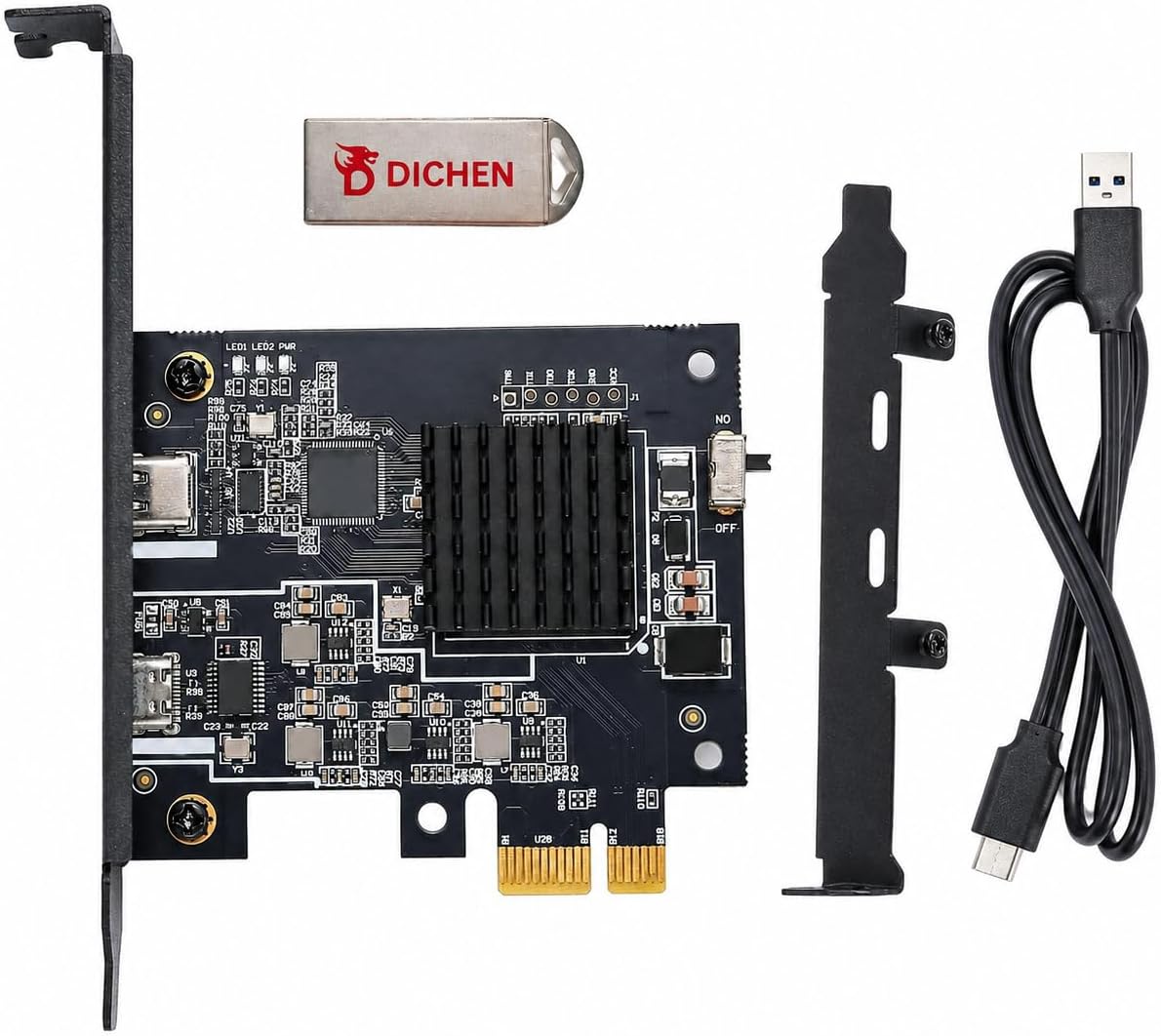
Sedna - PCIE 7 Port USB 3.1 Gen I (5Gbps) Adapter Card (6 External and 1 Internal Ports) with Low Profile Bracket
Bottom line: The Sedna - PCIE 7 Port USB 3.1 Gen I (5Gbps) Adapter Card (6 External is a specs-and-price decision rather than a crowd-consensus one in the expansion cards category. Check the specification table below against one or two close alternatives — on price and spec fit, not on star ratings.
As an Amazon Associate, SpecPicks earns from qualifying purchases. Full disclosure →
Pros & Cons
Pros
- ✓ 6 external + 1 Internal USB 3.1 Gen I ports
- ✓ Backed by Sedna's warranty and support channels
Cons
- ✗ Confirm socket / form-factor / power-rating compatibility against your build before ordering
- ✗ Price, stock, shipping and returns are set by the retailer and may have changed since this page was last updated
Manufacturer description
Features and specifications :6 external USB 3.0 ports + 1 Internal PortWith an extra Low Profile Bracket, best for Mini HTPC and Server ApplicationNewest Solution, Supports USAP (USB Attached SCSI Protocol) of Windows 8, 8.1 and !in 10Maximum speed is about 400MBps +No Driver needed for Windows 8 and Windows 10 (Do not install driver for Windows 8)PCIE X1, 2.0 standardEach port provides 5VDC 1A via USB 3.0 connectorConnect to PC power supply with SATA Power ConnectorTransfer Rate: 5Gbps, 480Mbps, 12MbpsFully compatible with USB 3.1 Gen I, USB 3.0, USB 2.0, USB 1.1 and USAPSupports Windows XP…
SpecPicks Verdict
SpecPicks scored Sedna - PCIE 7 Port USB 3.1 Gen I (5Gbps) Adapter Card (6 External… using a rating × review-volume × price-fit model applied to published specs and reviews across the expansion cards category. Sedna's expansion cards lineup sits within the broader category mid-tier; price and specs are the deciding factors over brand loyalty here. Judge it on the specification table and the price rather than on sentiment: check the figures that decide your use case, then put it side-by-side with two or three close alternatives in the Compare tool before clicking through.
Common buyer scenarios for expansion cards of this kind: matching it to an existing build, replacing a failing part, or upgrading from a previous-generation equivalent. Check the spec table below against your current setup — particularly socket / form-factor / power-rating fields — and confirm compatibility on the retailer's listing before purchase. Prices and stock are set by the retailer and may have moved since this page was last updated.
Key Features
- 6 external + 1 Internal USB 3.1 Gen I ports
- Transfer rate up to 5Gbps
- Support Win 8 / Win 10 UASP
- No Driver needed for Windows 8/10 ( Do not install driver for Windows 8 )
- Low Profile Bracket for installation in slim PC or Server
Full Specifications
| Brand | Sedna |
|---|---|
| Style | Classic |
| Style Name | Classic |
| Connectivity | USB |
| Model Number | SE-PCIE-USB3-07-6E1I-LP |
| Compatibility | PC |
| Mfr Part Number | 101669109901 |
| Compatible Devices | Personal Computer |
| Hardware Interface | SCSI, USB 3.1 Type A |
Ready to buy?
Sedna - PCIE 7 Port USB 3.1 Gen I (5Gbps) Adapter Card (6 External and 1 Internal Ports) with Low Profile Bracket is listed on Amazon. Price, availability, shipping and returns are set by Amazon and its sellers — check the listing for current terms. SpecPicks earns a small commission on qualifying purchases — thank you for supporting independent review work.
Related Expansion Cards


More guides & deep dives from the SpecPicks archive
Browse all articles & guides →- Best Budget Gaming PC Build 2026 — ~$1,000 ($800 on Sale)
- Best Retro Handhelds in 2026 — From $35 to $500
- The Complete Voodoo5 5500 AGP Driver Guide (2026 Edition)
- How to Build a Windows 98 Retro PC in 2026
- Emulation Hardware in 2026: FPGA, Software, and Cart-Reader Ecosystems
- RTX 4070 Super vs RX 7800 XT — Which to Buy in 2026
- Best 1440p Gaming GPUs in 2026
More reviews from the SpecPicks archive
Browse all reviews →- Best SSD for PS4 Pro: SATA Upgrades That Actually Help
- Build a Couch Emulation Station: Raspberry Pi 4 + 8BitDo SN30 Pro
- Zhipu ZCode vs Claude Code: Cheaper Agentic Coding, and the Rig to Run It
- Build a Self-Hosted Security Camera on a Raspberry Pi 4 8GB in 2026
- Crucial BX500 vs Samsung 870 EVO: Best 2.5" SATA SSD for a Budget Build
- 20GB Homelab Memory Left: What to Add Next
- AI-Driven Sound Blaster Driver Install on WinXP via Vision LLM
- After the Claude Code Malware Scare: Build an Isolated Local Agent Rig
- NVIDIA's AI Servers Run on Hot Tub Coolant — No Evaporators Neede
- Gemma 4 31B Abliterated on a Single RTX 3060 12GB: Quantization, VRAM, and Real Tok/s
- Kimi K3 Open Weights: What It Takes to Run It Locally
- How Companies Name Their Monitors: Brand-by-Brand Guide
- How Much VRAM Does 32k Context Use on an RTX 3060 12GB? (2026)
- How to run Llama 3.1 70B on Apple M4 Pro
- Samsung Odyssey 4K vs KOORUI 27" 4K Mini-LED: Which Wins?
- Best Hardware for Local OCR and Document AI in 2026
- Build a Live ADS-B Flight Tracker on a Raspberry Pi 4 in 2026
- Best Budget GPU for 1440p Gaming in 2026: Is the RTX 3060 12GB Still It?
- Buying Pre-Owned SSDs and HDDs: Good Idea in 2026?
- Open WebUI — self-hosted ChatGPT for your local models
- Matrox G400 MAX in 2026: Period-Correct Install, EMBM Showcase, and Pentium III Benchmarks
- Lenovo G02 Retro Handheld Ships Preloaded With Thousands of Games
- Run Home Assistant on a Raspberry Pi 4 8GB in 2026 (SSD Boot)
- vLLM vs Ollama on an RTX 3060 12GB: Which Server Wins?
Earliest SpecPicks reviews
Browse full archive →- Best GPU for Llama 3.1 8B (2026)
- Best GPU for Qwen 3 14B (2026)
- Best GPU for Qwen 3 32B (2026)
- Best GPU for Llama 3.1 70B (2026)
- Best GPU for DeepSeek-R1 32B (2026)
- Best GPU for Llama 3.1 405B (2026)
- How to run Llama 3.1 8B on NVIDIA GeForce RTX 5090
- How to run Qwen 3 14B on NVIDIA GeForce RTX 5090
- How to run Qwen 3 32B on NVIDIA GeForce RTX 5090
- How to run Llama 3.1 70B on NVIDIA GeForce RTX 5090
- How to run DeepSeek-R1 32B on NVIDIA GeForce RTX 5090
- How to run Llama 3.1 8B on NVIDIA GeForce RTX 4090