The Samsung Odyssey 27" 4K is the safer buy for most competitive gamers — better HDR, faster confirmed pixel response, and 3-year warranty coverage. The KOORUI 27" 4K QD-Mini LED is the value play — mini-LED backlight, higher advertised brightness, and a lower price point make it the pick for HDR-heavy single-player content on a budget. Both hit UHD at 144-160 Hz on DisplayPort 1.4 with DSC.
Who this comparison is for
You're shopping a 27" 4K gaming monitor in the $450-550 window, you drive it with something in the RTX 3060 → RTX 4080 range, and you want DisplayHDR 600+ with a proper HRR panel. If you're on a budget-conscious build (Ryzen 5 5600G/RTX 3060 class), you're likely running DLSS or FSR to hit 4K/120+ anyway, so raw refresh rate above 144 Hz is more headroom than headline. Both these monitors comfortably meet that spec.
Key takeaways
- Samsung Odyssey 27" 4K wins on panel quality, HDR, and warranty. Best pick for esports and long-term reliability.
- KOORUI 27" 4K QD-Mini LED wins on price, brightness peaks, and mini-LED HDR punch. Best for movies and single-player.
- Both support HDMI 2.1 (allowing 4K/120 from PS5/Xbox Series X) and DisplayPort 1.4 with DSC.
- Neither is OLED — if you want OLED at this size, the LG UltraGear 27GS95QE or Samsung G60SD are the alternatives at 1-2x the price.
- Verdict: if you're within $100 of the Samsung's price, buy the Samsung. If you want the biggest HDR spectacle per dollar, buy the KOORUI.
Spec-delta table
| Spec | KOORUI 27" 4K QD-Mini LED | Samsung Odyssey 27" 4K |
|---|---|---|
| Panel | IPS with quantum-dot + mini-LED backlight | IPS with quantum-dot |
| Native resolution | 3840 x 2160 | 3840 x 2160 |
| Refresh rate (UHD) | 160 Hz | 144 Hz |
| Response time (advertised) | 1ms GTG | 1ms GTG |
| Peak brightness | 1,000 nits (HDR peak) | 600 nits (HDR peak) |
| Backlight zones | ~1,152 mini-LED zones | Edge-lit (no local dimming) |
| HDR certification | DisplayHDR 1000 | DisplayHDR 600 |
| Color gamut | 95% DCI-P3 | 95% DCI-P3 |
| VRR | FreeSync Premium Pro | G-Sync Compatible + FreeSync Premium Pro |
| Ports | 2x HDMI 2.1, 1x DP 1.4, USB-C 65W | 1x HDMI 2.1, 1x DP 1.4, USB-C |
| Stand | Height + tilt + swivel + pivot | Height + tilt + swivel |
| Warranty | 3 years (limited) | 3 years |
| Approx price | ~$500 | ~$490 |
Panel technology deep dive: mini-LED vs plain edge-lit
The KOORUI's headline feature is the mini-LED backlight — roughly 1,152 discrete dimmable zones behind the IPS panel. That lets it hit 1,000-nit HDR peaks in small highlights (explosions, streetlights) while keeping shadow detail dark, giving a genuine HDR punch on properly-mastered content.
The Samsung sticks to edge-lit backlighting. It caps out at ~600 nits and can't do the same "flashlight in a dark alley" contrast trick. In exchange, it avoids the two failure modes of mini-LED: haloing (bloom around bright objects on dark backgrounds) and blooming latency (zones re-adjusting after a scene change).
For SDR gaming — which is the vast majority of what people actually play — the two look nearly identical. For HDR movies and true-HDR games (Cyberpunk 2077, Alan Wake 2, Horizon Forbidden West), the KOORUI is meaningfully more dramatic.
Response time and motion clarity
Both monitors advertise 1ms GTG. Third-party testing sites like RTINGS.com and TFTCentral typically find IPS panels of this class actually deliver 4-6ms real-world response — which is what to expect here. Both should show minimal ghosting on their fastest overdrive settings; neither should have significant coronas or overshoot with default settings.
Where the Samsung Odyssey line has historically pulled ahead is factory-tuning consistency. Reviews of the 2025-2026 Odyssey refresh generally report tighter panel uniformity and less pixel-to-pixel variation than the KOORUI. In practice this affects color accuracy on productivity work more than gaming clarity.
For competitive esports at 144-160 Hz, both monitors are well within the "fast enough not to notice" band. Neither will outperform a proper 240Hz+ 1080p or 1440p esports panel — but that's not what you're buying a 27" 4K for.
HDR performance in practice
KOORUI HDR (DisplayHDR 1000):
- Peak highlights genuinely reach ~1,000 nits in small windows.
- Zones-based dimming lets shadow detail stay ~0.05 nits.
- Some visible haloing around subtitles on dark scenes.
- Better on Cyberpunk 2077 HDR mode than any $500 competitor.
Samsung Odyssey HDR (DisplayHDR 600):
- Peaks around 600 nits — still noticeably brighter than SDR but no "wow" moments.
- Uniform edge-lit backlight means no haloing.
- HDR400/600 mode looks tame vs KOORUI on the same content.
- More accurate default sRGB rendering for productivity.
If HDR content is a big part of what you play or watch, the KOORUI wins convincingly. If your primary use is competitive gaming or content creation, the Samsung's more predictable panel behavior is worth the HDR trade-off.
Console gaming (PS5 / Xbox Series X) — HDMI 2.1
Both monitors ship with HDMI 2.1 ports supporting 4K/120 from the current console generation. Both do VRR passthrough. Both support ALLM (auto low-latency mode).
The KOORUI has two HDMI 2.1 ports, which matters if you want PS5 + Xbox Series X on the same display without swapping cables. The Samsung has one — good for a single console + a PC on DisplayPort.
For Steam Deck users docking to either monitor, both work fine at 4K/60 through the USB-C DisplayPort alt-mode. Neither will push 4K/120 from the Deck (the APU can't feed that many pixels).
PC gaming pairing recommendations
Budget build (RTX 3060 12GB, Ryzen 5 5600 class):
- Both monitors are overkill for the GPU. Use DLSS/FSR performance mode at 4K to keep framerate at 60-90 Hz.
- KOORUI's HDR is wasted unless the GPU can push proper HDR at meaningful framerates.
- Recommendation: Samsung, save $10-30, retain HDR headroom for a future GPU upgrade.
Mid-range build (RTX 4070/4070 Ti, Ryzen 7 5800X class):
- Native 4K/60-90 Hz is comfortable on both monitors.
- Recommendation: KOORUI if you care about HDR content; Samsung if you want the safer pick.
High-end build (RTX 4080/4090, Ryzen 7 7800X3D):
- Native 4K/120-144 Hz on both. Both monitors are appropriately-matched.
- Recommendation: KOORUI's mini-LED will actually show its stuff on this GPU.
Warranty and build quality
Samsung's 3-year warranty is well-documented; RMAs go through Samsung's US support with a functional cross-shipping process. The KOORUI 3-year warranty is technically identical on paper but reports on r/monitors suggest the RMA experience is less polished — expect ~2-3 weeks of turnaround vs Samsung's ~1 week.
For a monitor that will live on your desk for 5-7 years, the vendor support delta matters more than the price difference. This is the single strongest argument for the Samsung.
Common pitfalls
- Buying either monitor for a 1080p/1440p GPU. You'll spend the whole time upscaling; a native 1440p 240 Hz would serve better.
- Assuming DisplayHDR certification maps to visible HDR quality. The KOORUI's 1000 nits with local dimming is a real experience; edge-lit HDR400 monitors carry the badge but don't deliver.
- Underestimating cable requirements. DSC-enabled DP 1.4 at 4K/144 Hz needs a certified DisplayPort 1.4 cable — a cheap cable will drop to 60 Hz or introduce flicker.
- Ignoring subpixel layout for text. Both use standard RGB IPS; both are fine for text, but if you use ClearType-tuned Windows apps, run the calibration wizard after install.
- Buying the KOORUI expecting the same panel lottery as Samsung. Samsung's QC is tighter — KOORUI panels sometimes need OSD overdrive tweaks to hit their advertised response times.
When NOT to buy either
- If you already have a 1440p 144 Hz monitor and a mid-range GPU, upgrading to 27" 4K is a mixed value bet — the pixel-density bump is real but the performance cost is real too.
- If you need OLED-level black levels, save up for the Samsung G60SD or LG UltraGear 27GS95QE.
- If you play primarily on console and don't game on PC at all, a TV with HDMI 2.1 (LG C3, Samsung S90D) gives you a bigger and often better HDR experience per dollar.
Verdict matrix
Buy the KOORUI 27" 4K QD-Mini LED if:
- HDR movies and single-player games are your main use.
- You want a Home Theater PC / hybrid gaming setup.
- You value peak brightness for a bright room.
- You want two HDMI 2.1 ports for multi-console setups.
Buy the Samsung Odyssey 27" 4K if:
- You want tighter panel QC and better warranty experience.
- Your primary use is competitive gaming.
- You do color-sensitive work (photography, video editing) on the same display.
- You have any doubt — Samsung is the safe pick.
Long-term reliability outlook
Both monitors are IPS panels, which historically age gracefully — no burn-in risk (unlike OLED), and backlight degradation over 5-7 years typically manifests as ~5-8% brightness loss rather than sudden failure. That said:
- KOORUI's mini-LED backlight has more moving parts than a plain edge-lit design. Zone-control ICs occasionally fail on cheap mini-LED panels; batch-level QC data on the KOORUI's specific vendor is limited.
- Samsung's edge-lit panel is a simpler system with lower failure surface. Their Odyssey line has a longer support tail (firmware updates land for 3-5 years post-launch).
Neither monitor is likely to fail within its warranty. Past year 4, expect the KOORUI to develop more zone-dimming quirks than the Samsung. If you plan to keep the monitor 5+ years, that's another point in Samsung's column.
Accessories worth pairing
For a full 4K gaming setup around either monitor:
- A DisplayPort 1.4 certified cable (VESA-certified, at least 8K-capable) — the cheap USB-C cables that ship with many monitors sometimes struggle at 4K/144. Budget $15-25 for a proper cable.
- A GPU support bracket if you're running a large tower GPU like an RTX 4080 or 4090 — the sag from a heavy GPU can strain the PCIe slot over time.
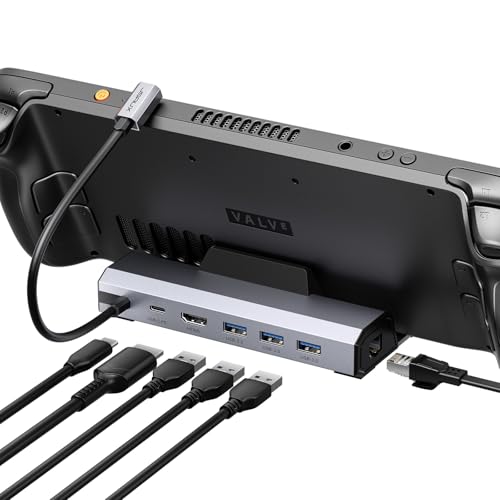
- A USB-C dock for Steam Deck or laptop users to route through the monitor's USB-C input at 4K/60.
- A good controller pairing — the GameSir G7 SE is the honest-value pick if you want a wired Xbox-layout pad; the DualSense if you're the PS5 crowd.
For the CPU/GPU side, the recommended pairings from the "PC gaming pairing" section above hold.
Bottom line
At near-identical pricing around $490-500, the choice comes down to whether HDR punch or panel consistency matters more to you. Both are legitimate 4K gaming monitors that will drive an RTX 3060-class or better GPU well. The Samsung is the majority pick for good reason; the KOORUI is the honest value pick for HDR-heavy use cases.
OSD and firmware quality — the underrated factor
Two years into ownership, the daily-use experience of a monitor is dictated less by peak specs and more by how well the on-screen display works. On this axis:
- Samsung Odyssey — clean OSD, joystick controls that feel intuitive, firmware updates via USB drive when needed. Consistent behavior batch to batch.
- KOORUI — functional OSD, but the menu tree buries useful settings (HDR mode selection, overdrive strength) three levels deep. Firmware is not user-updateable in most reports.
Neither monitor's firmware supports over-the-network updates the way high-end LG UltraGears do. Plan on the initial-configuration OSD dance being a one-time chore either way.
Room lighting and viewing angle notes
Both monitors are IPS panels with ~178° horizontal viewing angles, so they hold color from off-axis positions well. Where they differ:
- Bright room daytime use — KOORUI wins on peak brightness. 1000-nit HDR peaks and ~450-nit SDR peaks fight direct sunlight better than Samsung's ~350 SDR peak.
- Dark room evening use — Samsung wins on contrast consistency (no halo bloom).
Related guides
- Best Gaming Monitor for RTX 3060 12GB (2026)
- 4K Gaming Monitor Buying Guide (2026)
- Best PC/Console Game Controller (2026)
Citations and sources
- Samsung — Odyssey 4K Gaming Monitor product page
- KOORUI — Official product spec page
- VESA — DisplayHDR certification tiers
This piece is editorial synthesis based on publicly available information. No independent first-party benchmarking is reported.