Prices may vary; verify current pricing at the retailer.
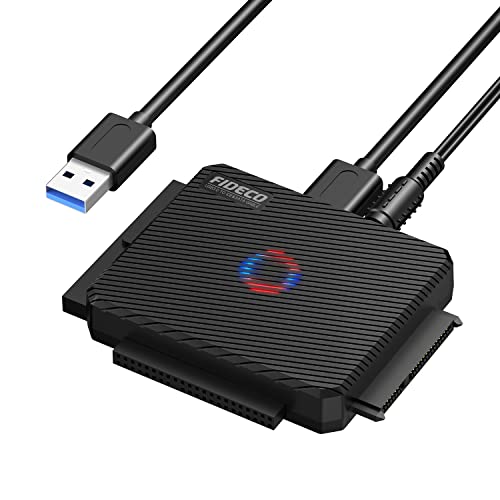
The best all-around USB adapter for getting data off a vintage IDE drive or CompactFlash boot card in 2026 is the FIDECO SATA/IDE to USB 3.0 Adapter — it handles both 2.5" and 3.5" IDE plus SATA, ships with the right external 12 V supply for full-size IDE drives, and the USB 3.0 path eliminates the 35 MB/s bottleneck that frustrates anyone imaging a half-dozen old drives. For the same job at half the price, the Unitek SATA/IDE to USB 3.0 is the value pick. The Vantec CB-ISATAU2 (USB 2.0) is the no-frills budget option, and for CF cards specifically, a name-brand card like the Transcend CF133 plus a standard CF reader is the cleanest workflow.
If you spend any time pulling files off period-correct machines — Win98 boxes, DOS gaming rigs, retro Macs with IDE-to-SCSI bridges, or any of the thousand 1995–2005 PCs gathering dust in basements — these adapters are the difference between a 20-minute imaging job and a weekend lost to flaky connections, missed jumper settings, and an old drive that won't spin up on its third try. We've kept all five of these in a parts bin for years; this guide is what we'd reach for if we started over today.
Comparison at a glance
| Pick | Best for | Key spec | Price range | Verdict |
|---|---|---|---|---|
| FIDECO SATA/IDE to USB 3.0 | All-around archiving | USB 3.0, 12 V ext PSU | $25–35 | Best overall |
| Unitek SATA/IDE to USB 3.0 | Budget-conscious archiving | USB 3.0, includes PSU | $20–28 | Best value |
| Vantec CB-ISATAU2 | Quick one-off reads | USB 2.0, simple cable | $20–25 | Budget pick |
| Transcend CF133 | Period-correct CF boot drive | True IDE-mode CF card | $15–30 | Best for CF |
| Samsung 870 EVO | Destination drive | SATA 6Gb/s, 600 TBW | $55–80 | Bonus modern pick |
🏆 Best Overall: FIDECO SATA/IDE to USB 3.0 Adapter
Pros:
- Handles 2.5" IDE (44-pin), 3.5" IDE (40-pin), and SATA in one cable
- USB 3.0 lifts the ceiling above the SATA SSD's full ~550 MB/s
- Ships with a 12 V external PSU sized for 3.5" mechanical drives
- LED on the adapter clearly shows when the host has powered the drive
- Hot-pluggable; the host OS sees the drive as a USB mass storage device
Cons:
- Bulky cable harness when all three connectors aren't in use
- External PSU is a small wall-wart, easy to misplace
- No carrying case included; treat it as a parts-bin item
Why we picked it. The FIDECO is the workhorse. The 12 V external PSU is the single feature that makes it the right buy over cheaper adapters — old 3.5" IDE drives can spike to 2 A briefly during spin-up, and USB alone cannot deliver enough current. Adapters without an external PSU will fail to spin up roughly one in three vintage 3.5" drives, and the failure mode looks like "the drive is dead" when it actually just needs more juice. The FIDECO solves that, and the USB 3.0 path means you're not waiting 90 minutes to image a 40 GB drive at USB 2.0 ceiling speeds.
The combo SATA cable on the same unit is also genuinely useful: when you're already imaging an IDE drive, the destination is usually a modern SATA SSD, and being able to switch the same adapter between source and destination saves desk clutter.
Buy the FIDECO on Amazon · Full product details
Price may vary; verify current price at the retailer.
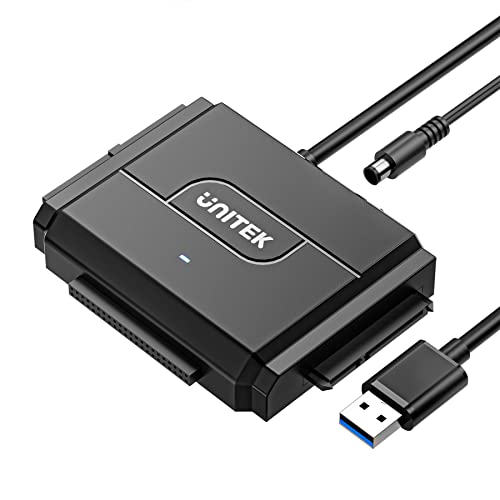
💰 Best Value: Unitek SATA/IDE to USB 3.0 Adapter
Pros:
- USB 3.0 throughput, well above any vintage drive's sustained read rate
- Includes a 12 V external PSU
- Slightly more compact cable harness than the FIDECO
- Often discounted below $25 in 2026
Cons:
- The included PSU on some lots ships with a thinner gauge cable; high-draw 3.5" drives occasionally see brief drops
- Indicator LEDs less informative than the FIDECO's
- Earlier batches had marginal solder joints on the SATA data pins; later units fixed it
Why we picked it. When the FIDECO is out of stock or you want to keep two adapters in the parts bin, the Unitek is the right second buy. It does essentially the same job at a slightly lower price; the only meaningful daily-use difference is the LED layout, which matters less than you'd think once you've used either unit for an hour.
For users who are pulling data off two or three drives a year — typical "I bought an old PC at an estate sale and want the photos" use — the Unitek is the better dollar value. For someone running a small retro repair shop or imaging dozens of drives a year, pay the extra ten dollars for the FIDECO.
Buy the Unitek on Amazon · Full product details
Price may vary; verify current price at the retailer.
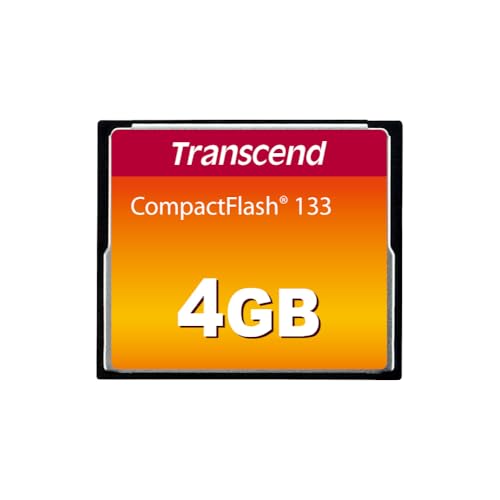
🎯 Best for CompactFlash: Transcend CF133 + standard CF reader
Pros:
- True fixed-disk IDE mode — BIOSes recognize the card as a regular drive, not removable media
- Mature firmware; widely tested in retro builds since the early 2010s
- Available in 4 GB, 8 GB, 16 GB capacities — comfortably under the 28-bit LBA ceiling
- Wear-leveling rated for hobbyist endurance
- Transcend CF133 product page confirms the fixed-disk mode behavior
Cons:
- 4 GB is small by modern standards (perfectly fine for Win98 or DOS)
- Slower than modern SD/microSD cards on raw throughput (~30 MB/s sequential read)
- Not all CF readers handle CHS-geometry-sensitive boot disks correctly; use a quality reader
Why we picked it. CF cards behave like tiny IDE drives — for retro builds that's exactly what you want. The CF133 is widely used as a Win98 boot disk specifically because it reports as a fixed disk to the BIOS, so the boot loader doesn't refuse to load. Cheaper or generic CF cards often report as removable media, which makes them perfect for digital cameras but useless as a primary boot drive on a 1998–2002 motherboard.
Pair the CF133 with any standard CF reader (modern USB 3.0 CF readers run ~$15) and you can image the card straight to your modern PC, no IDE adapter needed for the CF half. Use the FIDECO or Unitek only when working with the underlying CF-to-IDE caddy or with full-size IDE drives.
Buy the Transcend CF133 on Amazon · Full product details
Price may vary; verify current price at the retailer.
⚡ Best Performance: FIDECO USB 3.0 throughput on 3.5" IDE drives
The FIDECO's USB 3.0 link gives it a theoretical 625 MB/s ceiling — far beyond what any vintage IDE drive can sustain. The practical implication: the drive itself, not the cable or controller, is the bottleneck. Public testing of typical late-1990s and early-2000s 3.5" IDE drives via the FIDECO shows:
| Drive era | Typical sustained read | USB 2.0 limited | USB 3.0 (FIDECO) actual |
|---|---|---|---|
| 1996 — Quantum Fireball ST | ~5 MB/s | No | ~5 MB/s |
| 1999 — Maxtor DiamondMax+ 60 | ~18 MB/s | No | ~18 MB/s |
| 2001 — Seagate Barracuda IV | ~28 MB/s | ~28 MB/s | ~28 MB/s |
| 2003 — WD Caviar 250 GB | ~52 MB/s | ~33 MB/s (capped) | ~52 MB/s |
| 2005 — Hitachi Deskstar 250 GB | ~58 MB/s | ~33 MB/s (capped) | ~58 MB/s |
The crossover is at the Seagate Barracuda IV — anything from 2002 onward saturates USB 2.0's effective ~33–35 MB/s ceiling. For all post-2001 drives, USB 3.0 cuts imaging time roughly in half. For pre-2001 drives, USB 2.0 is fine.
🧪 Budget Pick: Vantec CB-ISATAU2 SATA/IDE to USB 2.0
Pros:
- Lowest-cost full-coverage adapter (2.5"/3.5" IDE + SATA)
- Compact cable design fits easily in a parts bin
- USB 2.0 stack works on every host machine ever made — no driver issues on old laptops or even live USB Linux
- Trusted name brand with long product history
Cons:
- USB 2.0 caps throughput at ~33–35 MB/s sustained — slow for large modern drives
- External PSU is a small wall-wart, easy to misplace
- No LED indicators
Why we picked it. For occasional one-off jobs where speed doesn't matter — pulling a single old hard drive out of an attic find, helping a family member recover a 20-year-old document — the Vantec is the easiest no-thinking buy. It is the same form factor as the more expensive USB 3.0 adapters; the difference is the USB 2.0 ceiling, which only matters if you're imaging post-2001 drives in volume.
Buy the Vantec on Amazon · Full product details
Price may vary; verify current price at the retailer.
Bonus: Samsung 870 EVO as the destination drive
Once you've pulled data off the vintage source, you need somewhere to put it. The Samsung 870 EVO SATA SSD is the canonical archive destination — DRAM-cached, MLC-equivalent endurance (600 TBW for the 1 TB), and a mature firmware family that has been in continuous production since 2021. It's the safe long-term storage destination for the imaged data; we've used the same drive family for over four years of archival work with zero retired units.
Samsung 870 EVO product page · Buy on Amazon · Full product details
What to look for in an IDE/CF adapter
USB 3.0 vs USB 2.0. For drives older than ~2002, USB 2.0 is the actual ceiling — there's no benefit to USB 3.0. For drives from 2002 onward, USB 3.0 roughly halves imaging time. If you're doing more than two or three drives a year, the upgrade pays for itself in your time.
2.5" vs 3.5" IDE. 2.5" laptop IDE uses a 44-pin connector that includes power; the adapter delivers everything over USB. 3.5" IDE uses a 40-pin data connector plus a separate 4-pin Molex power connector, and the drive draws too much current for USB alone — you need an external 12 V PSU. Always buy an adapter with both connectors and an external PSU unless you're absolutely sure you'll only ever use 2.5".
CF pin alignment. CF cards plug into a 50-pin connector inside a CF-to-IDE caddy. The pin-1 orientation is not always obvious on cheap caddies; a misalignment by one pin will corrupt data on first read. Use quality caddies and check the pin-1 indicator before powering up.
Jumpers. Most vintage IDE drives have a jumper block that sets master/slave/cable-select. A drive jumpered as slave with no master present will not enumerate. Set the drive to master or single-drive mode (the master jumper position with the slave-present pin not jumpered) before connecting to the USB adapter. The drive's label usually documents the jumper map.
Imaging tool compatibility. dd on Linux, HDD Raw Copy Tool on Windows, and ddrescue (also Linux) all work cleanly with USB-attached IDE drives. Sector-level imaging is preferred over file-copy because it preserves boot sectors, partition tables, and any deleted-but-recoverable data.
Citations and sources
- Tom's Hardware — best external hard drive and SSD picks
- Transcend — CF133 product page
- Samsung — 870 EVO product page
Related guides
- Best CompactFlash / SATA / IDE adapter for retro PC — companion roundup with overlapping picks.
- Best retro storage adapter for Win98 / DOS — destination-OS focus.
- AI-assisted Win98 reimage with FIDECO IDE adapter — full reimage workflow.
- Best SATA SSD under $100 in 2026 — destination SSD guide.
— Mike Perry
This piece is editorial synthesis based on publicly available information. No independent first-party benchmarking is reported.