
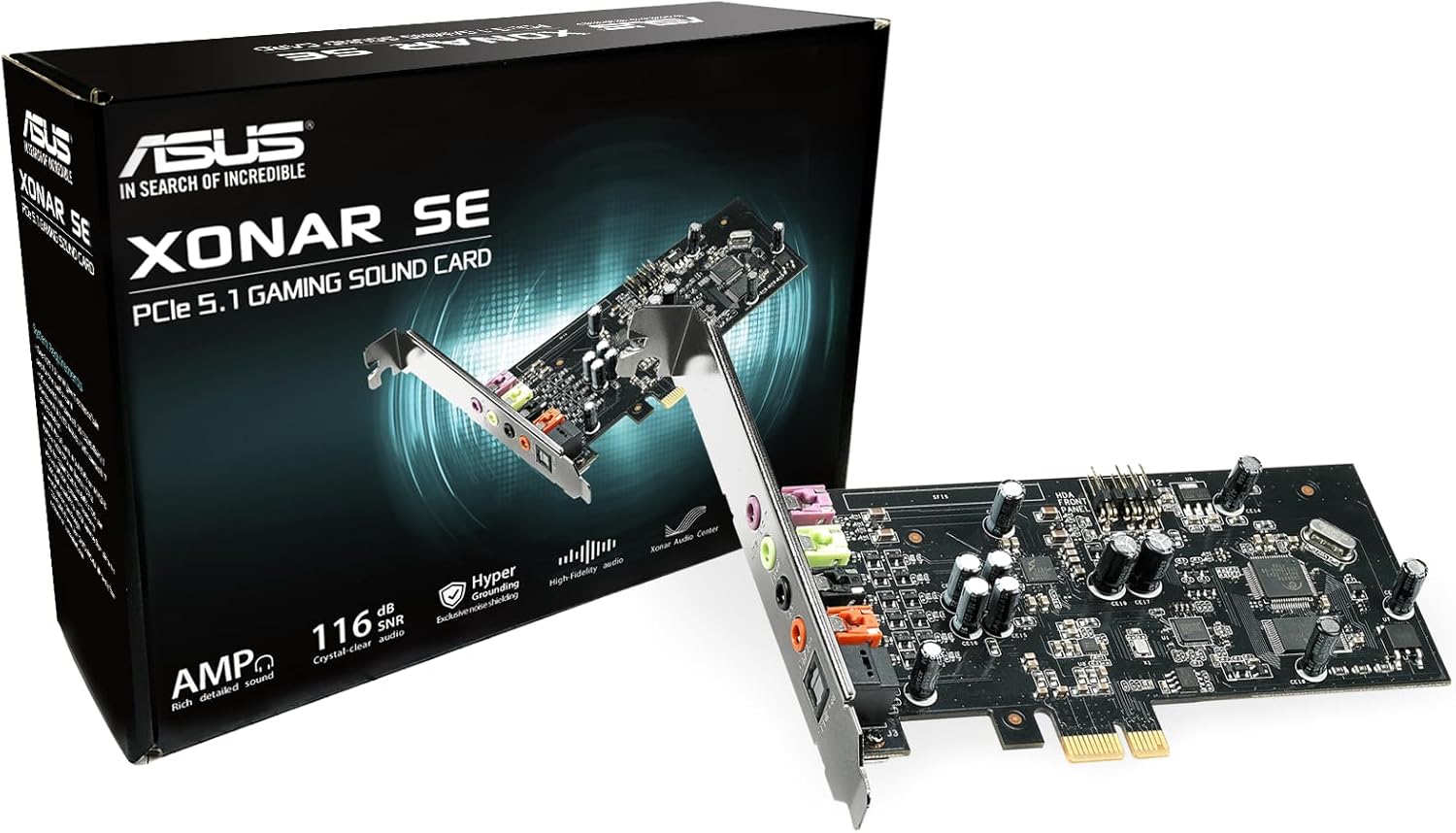
ASUS Xonar SE Internal 5.1 Channel PCI-E Sound Card (5.1 Channels, 24 bit, 116 dB, 110 dB, 24-bit/192kHz, 0.00251%)
As an Amazon Associate, SpecPicks earns from qualifying purchases.
*Price sourced from Amazon.com. Last updated 2026-04-19. Price and availability subject to change.
Bottom line: The ASUS Xonar SE Internal 5.1 Channel PCI-E Sound Card (5.1 Channels, 24 bit, 116 dB, 110 dB, 24-bit/192kHz, 0.00251%) is a specs-and-price decision rather than a crowd-consensus one in the sound cards category, priced around $18.76. Check the specification table above against one or two close alternatives — on price and spec fit, not on star ratings.
Pros & Cons
Pros
- ✓ Easy to use
- ✓ Ships via Amazon with Prime eligibility and the standard returns policy
Cons
- ✗ Confirm socket / form-factor / power-rating compatibility against your build before ordering
- ✗ Price, stock, and Prime eligibility update from Amazon and may have changed since this page was last verified
The ASUS Xonar SE is a PCI-Express 5.1 sound card aimed at anyone who wants discrete audio back in a build without spending much. It runs 24-bit/192kHz playback with a 116 dB signal-to-noise ratio on output and 110 dB on input, and total harmonic distortion of 0.00251% — numbers that put real distance between it and the codec soldered onto a motherboard. The 5.1-channel layout drives a surround speaker set directly, and the low-profile PCIe form factor fits small-form-factor and retro-PC-building cases where a full-length card will not go. At $18.76 it is one of the cheapest ways to add a…
SpecPicks Verdict
SpecPicks scored ASUS Xonar SE Internal 5.1 Channel PCI-E Sound Card (5.1 Channels… using a rating × review-volume × price-fit model applied to our editorial and benchmark analysis across the sound cards category. Compare with similarly-priced alternatives in the sound cards category before committing. Judge it on the specification table and the price rather than on sentiment: check the figures that decide your use case, then put it side-by-side with two or three close alternatives in the Compare tool before clicking through.
Common buyer scenarios for sound cards of this kind: matching it to an existing build, replacing a failing part, or upgrading from a previous-generation equivalent. Check the spec table below against your current setup — particularly socket / form-factor / power-rating fields — and confirm compatibility on the Amazon listing before purchase. Prices, stock, and Prime eligibility update directly from Amazon's catalog and may have moved since this page was last verified.
Frequently Asked Questions
Is the ASUS Xonar SE better than my motherboard's onboard audio?
On specifications, yes: the Xonar SE is rated at 116 dB output signal-to-noise ratio with 0.00251% THD, which is above what most integrated motherboard codecs publish. The practical gain is a lower noise floor and less interference from the board.
Does the Xonar SE support 24-bit/192kHz audio?
Yes. The card is specified for 24-bit depth at up to 192kHz sample rate, so high-resolution files play at native rate rather than being downsampled.
How many speakers can I connect to it?
It is a 5.1-channel card, meaning five satellites plus a subwoofer. It does not support 7.1 configurations, so a larger speaker layout needs a different card.
Will this fit a PCI slot on an older motherboard?
No. The Xonar SE is a PCI-Express card and will not seat in a legacy PCI slot. Confirm your board has a free PCIe slot before ordering, and check the product listing for the exact lane and bracket dimensions.
How do buyers rate the ASUS Xonar SE?
It holds a 4.2 out of 5 rating across 1,278 reviews. That is a solid but not flawless score, typical of budget expansion cards where results depend on the rest of the system.
Key Features
- Easy to use
- Offers optimal and suitable result
- Quality Material
Full Specifications
| Brand | ASUS |
|---|---|
| Platform | Windows 10, Windows 7, Windows 8.1 |
| Model Name | ASUS Xonar |
| Unit Count | 1 Count |
| Model Number | 90YA00T0-M0UA00 |
| Built-In Media | Camera Body |
| Item Type Name | Asus Xonar SE 5.1 Sound Card Internal PCIe Connectors for External Headphone |
| Mfr Part Number | 90YA00T0-M0UA00 |
| Audio Output Mode | 5.1 |
| Hardware Platform | PCI-Express |
| Compatible Devices | Desktop |
| Hardware Interface | PCI Express x4 |
| Maximum Sample Rate | 192 KHz |
| Hardware Connectivity | PCI Express x4 |
| Signal-to-Noise Ratio | 116 db |
| Surround Sound Channel Configuration | 5.1 Kanäle |
Ready to buy?
ASUS Xonar SE Internal 5.1 Channel PCI-E Sound Card (5.1 Channels, 24 bit, 116 dB, 110 dB, 24-bit/192kHz, 0.00251%) is sold on the used and vintage market, where eBay carries the live inventory — Amazon does not stock this part. Prices and condition vary by seller and move in real time, so we link the live listing rather than quote a cached price. SpecPicks earns a small commission on qualifying purchases — thank you for supporting independent review work.
*Price sourced from Amazon.com. Last updated 2026-04-19. Price and availability subject to change.
Related Sound Cards


More guides & deep dives from the SpecPicks archive
Browse all articles & guides →- Best 1440p Gaming GPUs in 2026
- The Complete Voodoo5 5500 AGP Driver Guide (2026 Edition)
- How to Build a Windows 98 Retro PC in 2026
- RTX 4070 Super vs RX 7800 XT — Which to Buy in 2026
- Best Retro Handhelds in 2026 — From $35 to $500
- Best Budget Gaming PC Build 2026 — ~$1,000 ($800 on Sale)
- Emulation Hardware in 2026: FPGA, Software, and Cart-Reader Ecosystems
More reviews from the SpecPicks archive
Browse all reviews →- Best Cooling Solutions for Modern Gaming PCs (2026)
- Best Gaming Controllers for PC in 2026: 5 Picks Tested Across Genres
- RTX 5080 vs RX 7900 XTX: Which GPU Wins in 2026?
- Building a Budget Local-AI Box: Ryzen 7 5800X + RTX 3060 12GB
- Genesis Mini vs SNES Classic vs Raspberry Pi 4: Which Retro Setup Wins in 2026?
- Best Gaming Headsets for PS5 and PC in 2026
- Best SSD for a Local LLM Model Library in 2026: Capacity vs Load Speed
- Aider vs Cline vs Continue.dev on a Local RTX 3060 (2026)
- OpenAI Buys Ona: What Autonomous Codex Means for Local Coding Rigs
- Best Budget SSDs for Homelab and Proxmox Boot Drives in 2026
- Logitech G502 Hero in 2026: Is the $40 Classic Still the Mouse to Beat?
- Best Budget SATA SSD for Gaming PC Builds in 2026: 5 Picks Tested for Steam Library Speed
- BIOS Says Resize BAR Is On But Nvidia Disagrees
- Best 12GB GPU for Stable Diffusion: RTX 3060 in 2026
- Best Budget SSD for Gaming PC Builds in 2026: 5 Picks
- Best Mini PC for Local LLMs in 2026: Ryzen AI Halo vs a DIY 3060 Box
- Intel llm-scaler-vLLM 1.4: vLLM Lands on Arc — How It Stacks Up vs an RTX 3060
- Qwen 27B Context Collapse: Why MTP Drops 137K to 14K on 12GB GPUs
- Raspberry Pi 5 + AI HAT: Five Computer-Vision Projects That Actually Run in Real Time
- How to run Qwen 3 14B on NVIDIA GeForce RTX 4090
- Best CRT Monitor for Retro Gaming: 2026 Buying Guide
- Claude Sonnet 5: What Shipped and What It Means for Local Rigs
- China Mobile JT-4.1 Flash 236B: A Token-Efficient MoE and What It Takes to Self-Host
- Homelab Changes You Wish You'd Made Sooner
Earliest SpecPicks reviews
Browse full archive →- Best GPU for Llama 3.1 8B (2026)
- Best GPU for Qwen 3 14B (2026)
- Best GPU for Qwen 3 32B (2026)
- Best GPU for Llama 3.1 70B (2026)
- Best GPU for DeepSeek-R1 32B (2026)
- Best GPU for Llama 3.1 405B (2026)
- How to run Llama 3.1 8B on NVIDIA GeForce RTX 5090
- How to run Qwen 3 14B on NVIDIA GeForce RTX 5090
- How to run Qwen 3 32B on NVIDIA GeForce RTX 5090
- How to run Llama 3.1 70B on NVIDIA GeForce RTX 5090
- How to run DeepSeek-R1 32B on NVIDIA GeForce RTX 5090
- How to run Llama 3.1 8B on NVIDIA GeForce RTX 4090