
zimablade
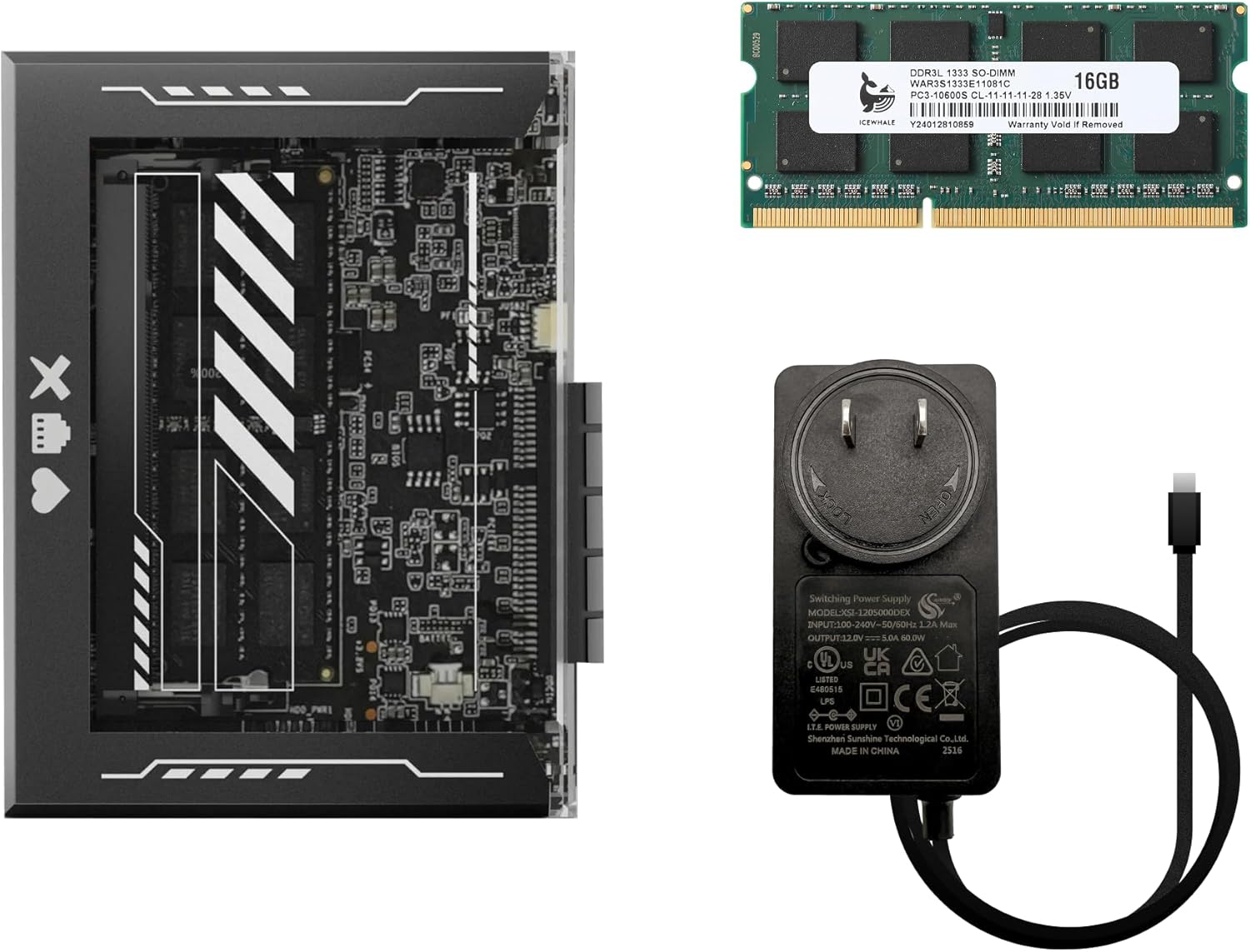
ZimaBlade 7700 Home Server Starter Kit, 16GB RAM + 32GB eMMC, Open x86 Platform, CasaOS Preinstalled,Docker & Self-Hosting Ready, Quiet Low Power, PCIe Expandable, Remote Access, 4K Media Server
As an Amazon Associate, SpecPicks earns from qualifying purchases.
*Price sourced from Amazon.com. Last updated 2026-07-21. Price and availability subject to change.
Bottom line: The ZimaBlade 7700 Home Server Starter Kit, 16GB RAM + 32GB eMMC, Open x86 Platform, CasaOS Preinstalled,Docker & Self-Hosting Ready, Quiet Low Power, PCIe Expandable, Remote Access, 4K Media Server is a specs-and-price decision rather than a crowd-consensus one in the retro motherboards category, priced around $176.60. Check the specification table above against one or two close alternatives — on price and spec fit, not on star ratings.
Pros & Cons
Pros
- ✓ Backed by zimablade's warranty and support channels
- ✓ Ships via Amazon with Prime eligibility and the standard returns policy
Cons
- ✗ Confirm socket / form-factor / power-rating compatibility against your build before ordering
- ✗ Price, stock, and Prime eligibility update from Amazon and may have changed since this page was last verified
SpecPicks Verdict
SpecPicks scored ZimaBlade 7700 Home Server Starter Kit, 16GB RAM + 32GB eMMC, Open… using a rating × review-volume × price-fit model applied to our editorial and benchmark analysis across the retro motherboards category. zimablade's retro motherboards lineup sits within the broader category mid-tier; price and specs are the deciding factors over brand loyalty here. Judge it on the specification table and the price rather than on sentiment: check the figures that decide your use case, then put it side-by-side with two or three close alternatives in the Compare tool before clicking through.
Common buyer scenarios for retro motherboards of this kind: matching it to an existing build, replacing a failing part, or upgrading from a previous-generation equivalent. Check the spec table below against your current setup — particularly socket / form-factor / power-rating fields — and confirm compatibility on the Amazon listing before purchase. Prices, stock, and Prime eligibility update directly from Amazon's catalog and may have moved since this page was last verified.
Key Features
- [Native x86 Power — Run Apps Without Limits] Powered by Intel x86 architecture, ZimaBlade runs Plex, Nextcloud, Home Assistant and more natively — no compatibility issues, no workarounds, no frustration. Enjoy full software freedom beyond ARM-based systems.
- [3-Minute Setup with CasaOS — No Learning Curve] Get your personal server online in minutes with CasaOS. Install apps with one click in a clean visual interface — no SSH, no command line, just simple and intuitive control.
- [PCIe x4 Expansion — Grow Beyond a Single Use Case] Equipped with PCIe 2.0 x4 for flexible expansion. Add NVMe storage, 2.5GbE networking, or other modules — start as a media server, evolve into something more as your needs grow.
- [Fanless Silent Design — Built for 24/7 Living Spaces] Fully passive cooling with ultra-low noise. Runs quietly around the clock with no fan wear or vibration — perfect for your desk, living room, or bedroom.
- [Your Data, Your Control — Private by Design] Keep your data local and fully under your control. No cloud dependency, no third-party access — ideal for personal files, media libraries, and self-hosted services.
Full Specifications
| Brand | zimablade |
|---|---|
| CPU Model | Core i7 |
| Model Name | ZimaBlade |
| Unit Count | 1.0 Count |
| Model Number | ZimaBlade |
| Built-In Media | other |
| Processor Brand | Intel |
| Processor Count | 4 |
| Total Usb Ports | 2 |
| Vibration/Rumble | Yes |
| Compatible Devices | Desktop |
| RAM Memory Installed | 16 GB |
| Warranty Description | 2 |
| RAM Memory Technology | DDR3L |
| Connectivity Technology | PCIe, SATA |
| Memory Storage Capacity | 16 GB |
| Smart Home Compatibility | Not Smart Home Compatible |
| Ram Memory Installed Size | 16 GB |
| Global Trade Identification Number | 06974755831131 |
Ready to buy?
ZimaBlade 7700 Home Server Starter Kit, 16GB RAM + 32GB eMMC, Open x86 Platform, CasaOS Preinstalled,Docker & Self-Hosting Ready, Quiet Low Power, PCIe Expandable, Remote Access, 4K Media Server is sold on the used and vintage market, where eBay carries the live inventory — Amazon does not stock this part. Prices and condition vary by seller and move in real time, so we link the live listing rather than quote a cached price. SpecPicks earns a small commission on qualifying purchases — thank you for supporting independent review work.
*Price sourced from Amazon.com. Last updated 2026-07-21. Price and availability subject to change.
Related Retro Motherboards



More guides & deep dives from the SpecPicks archive
Browse all articles & guides →- Best 1440p Gaming GPUs in 2026
- Emulation Hardware in 2026: FPGA, Software, and Cart-Reader Ecosystems
- RTX 4070 Super vs RX 7800 XT — Which to Buy in 2026
- The Complete Voodoo5 5500 AGP Driver Guide (2026 Edition)
- How to Build a Windows 98 Retro PC in 2026
- Best Budget Gaming PC Build 2026 — ~$1,000 ($800 on Sale)
- Best Retro Handhelds in 2026 — From $35 to $500
More reviews from the SpecPicks archive
Browse all reviews →- RTX 3060 12GB vs Arc B580 12GB for Local LLMs in 2026
- Best Gaming CPU for 1080p and 1440p Builds in 2026
- Adafruit Ships a Triple LED Matrix Bonnet for the Raspberry Pi
- Ryzen 7 5700X vs 5800X for a 2026 Gaming Build: Which AM4 Chip Wins?
- RTX 5090 vs RTX 4080: Specs, Gaming & AI Compared
- Best Budget SSDs for Gaming PC Builds in 2026
- Can a Raspberry Pi 4 8GB Run a Local LLM? Ollama Tiny-Model Benchmarks
- Ryzen 7 5800X vs 5700X for 1080p High-Refresh Gaming
- Best Mini PC for Local LLMs in 2026: Ryzen AI Halo vs a DIY 3060 Box
- How to run Qwen 3 32B on Arc B580
- How to run Llama 3.1 70B on Apple M4 Pro
- Best CPU Cooler for a Ryzen Build in 2026 (Air & AIO)
- 3dfx Voodoo2 SLI in 2026: Building a Period-Correct Windows 98 Glide Rig
- Intel llm-scaler-vLLM 1.4 with Arc Pro B70: Local Inference vs RTX 3060 12GB
- KDE Plasma 6.7 X11 vs. Wayland NVIDIA Gaming on CachyOS
- Best GPU for a NAS or Homelab Running Local LLMs (2026)
- Solar-Powered Bird Identifier: Raspberry Pi Zero 2W + AI Camera
- Anthropic Raises $65B Series H Near a Trillion-Dollar Valuation: What It Means for Local-AI Builders
- Best CPU Cooler for Gaming PCs in 2026: Air & AIO Picks
- Troubleshooting Ryzen 5 5600X No-POST: Memory, BIOS, and Cooler Mount Fixes (2026)
- Qwen 27B Context Collapse: Why MTP Drops 137K to 14K on 12GB GPUs
- Acti Brings AI Agents Into Your Smartphone Keyboard
- Qwen3.6-35B-A3B vs Gemma4-26B-A4B: Which MoE Fits a 12GB RTX 3060
- Sega Genesis Games Loaded Off a Vinyl Record: How the Hack Works
Earliest SpecPicks reviews
Browse full archive →- Best GPU for Llama 3.1 8B (2026)
- Best GPU for Qwen 3 14B (2026)
- Best GPU for Qwen 3 32B (2026)
- Best GPU for Llama 3.1 70B (2026)
- Best GPU for DeepSeek-R1 32B (2026)
- Best GPU for Llama 3.1 405B (2026)
- How to run Llama 3.1 8B on NVIDIA GeForce RTX 5090
- How to run Qwen 3 14B on NVIDIA GeForce RTX 5090
- How to run Qwen 3 32B on NVIDIA GeForce RTX 5090
- How to run Llama 3.1 70B on NVIDIA GeForce RTX 5090
- How to run DeepSeek-R1 32B on NVIDIA GeForce RTX 5090
- How to run Llama 3.1 8B on NVIDIA GeForce RTX 4090