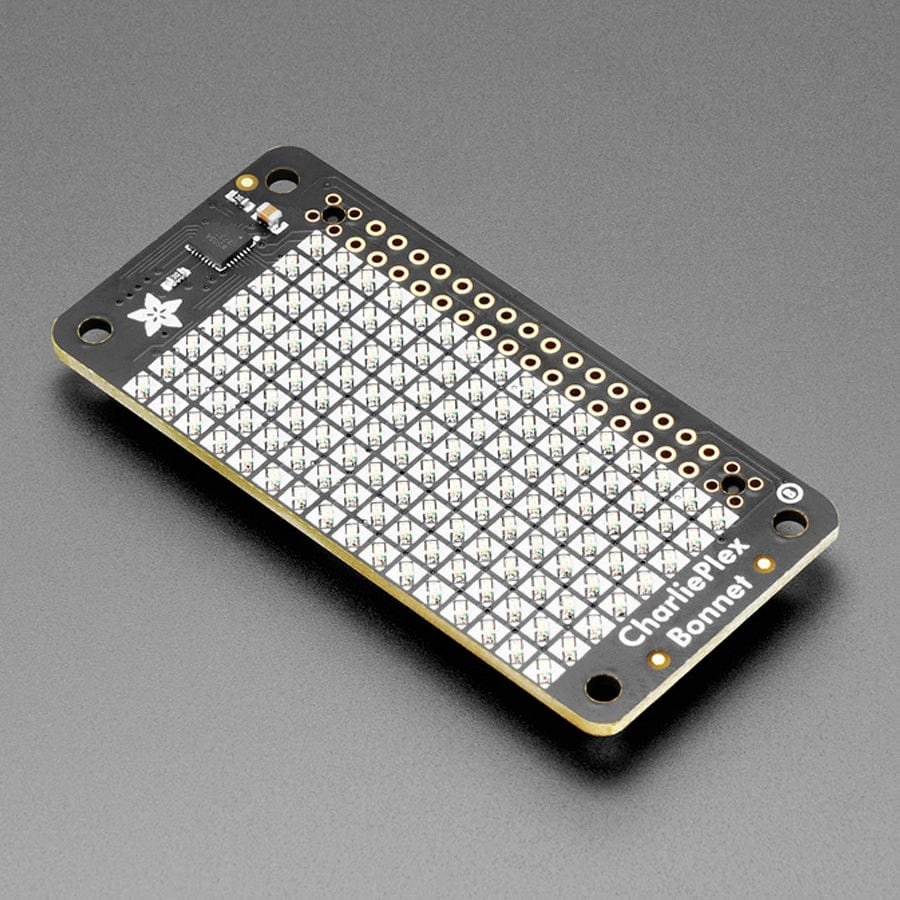
Adafruit's new Triple LED Matrix Bonnet for the Raspberry Pi lets a single Pi drive three chained 64×64 (or three 64×32) RGB LED matrix panels off a single board, with hardware-managed signal timing and a clean header for the chain. Drop it onto a Raspberry Pi 4 8GB, feed the matrices a real 5V power supply, and you can ship a 192×64 (or three side-by-side 64×64) display for weekend animations, train arrival boards, weather dashboards, or retro arcade marquees.
In brief — 2026-06-06. Adafruit's new Triple LED Matrix Bonnet lets a Raspberry Pi drive three chained RGB matrix panels for big, bright displays — a clean weekend maker project.
What happened
Adafruit has long sold a single-chain RGB Matrix Bonnet that plugs onto a Pi's 40-pin GPIO header and exposes the HUB75 connector that LED matrix panels use. The new Triple variant doubles down on the most-asked-for feature: three independent output chains, so you can drive three panel chains in parallel and assemble much bigger displays without the timing weirdness of one long chain.
For makers who have ever tried to chain four or six panels off a single output, the appeal is obvious. A single chain works fine for two panels, gets fragile at three, and starts dropping rows at four. Three parallel chains of two panels each gives you the same six-panel display with much more predictable timing — and the Pi's GPIO has enough pins to drive all three outputs without contention thanks to the bonnet's level-shifters and signal routing.
Combined with rpi-rgb-led-matrix, the de-facto open-source driver library for these panels, the Triple Bonnet gives a Pi the headroom to push large, bright displays at sane frame rates without resorting to a dedicated FPGA helper or a multi-Pi cluster.
What it connects to
Each output drives a standard HUB75 RGB matrix chain. The classic panel families:
- 64×32 at 4mm-6mm pitch — the most common starter panel size.
- 64×64 at 3mm-5mm pitch — larger active area, slightly heavier on the bus.
- 128×32 elongated panels — useful for ticker / scrolling text builds.
Mix and match within a chain (same height, varying width) and you can shape rectangular composite displays. Across three chains the Bonnet can drive symmetrical layouts (three columns, three rows, a wide ticker) or asymmetrical experiments where one chain is doing animation and another is doing static text.
Why three panels matters
A single chain of two HUB75 panels (commonly two 64×32 boards) hits the Pi's GPIO timing comfortably and is the standard "first matrix project" path. The trouble starts at the third panel: refresh rate drops, color depth halves, and tearing artifacts appear under load. The fix is to split the chain across multiple GPIO output groups, which is exactly what the Triple Bonnet exposes — three outputs, each driving a short chain, all coordinated by the same library.
For big-format builds — a 192×64 display made from six 64×32 panels arranged 2 wide × 3 tall — the Triple Bonnet is the difference between "works at 60Hz with no artifacts" and "works at 30Hz if you accept some flicker".
Why it lowers the barrier
Before the Triple Bonnet, the alternative to a single Pi was either a Pixelblaze, FadeCandy, or other dedicated controller, a Teensy plus a SmartLED Shield, or a custom helper board. Each path adds another microcontroller into the bill of materials and another firmware to learn. The Triple Bonnet keeps the project Pi-only: one board, one OS, one Python or C++ codebase, three output chains.
For a beginner-friendly weekend project, "plug Pi into bonnet, plug bonnet into three chains, write Python" is the lowest-friction path on the market.
Which Pi to use
The bonnet is compatible with any 40-pin Pi (the original 26-pin Pi B is the only exclusion). In practice the recommendations:
- Raspberry Pi 4 8GB — the safest pick. Plenty of RAM headroom for buffer flips, animation scripts, and a small web dashboard. The Pi 4 8GB is the realistic floor for sustained animation.
- Raspberry Pi 5 — fastest, drives more pixels per second, but the wider thermal envelope means you want active cooling in any enclosed sign housing.
- Pi 3B / 3B+ — works for static / low-update content. Hits limits on full-screen animation.
- Pi Zero 2 W — small form factor, OK for low-density panels, watch power.
For most builds, the Pi 4 8GB is the right answer.
Power: matrices want a real supply
LED matrix panels are power-hungry — a 64×32 panel at full white can draw 4A at 5V. Three chains of two panels each is well into "you need a dedicated PSU" territory. Plan for a 5V 30A supply minimum for a six-panel display, and run the panel power on a separate wire to the panels — not through the Pi or the Bonnet, which is signal-only.
Wire the panel power supply's ground to the Pi's ground (the Bonnet handles this on the header), but route the high-current 5V power directly from PSU to panel power pads. Use thick copper wire (16AWG or thicker for chains of three or more panels) and short runs.
Cheap LED strip lights like the KSIPZE 200ft RGB LED Strip Lights use a similar wiring philosophy — a separate beefy 5V supply, signal from a small controller — and are a useful "first big LED project" if matrices feel like too big a leap. For matrix builds, do not power matrices off USB or a Pi's GPIO 5V pin.
Storage: small but not tiny
A typical animation rig writes content to disk infrequently (the Pi reads animations off storage and pushes pixels). A 32GB or larger SD card is fine, but if you're streaming long video content or running a web dashboard alongside the matrix render loop, a SanDisk Ultra 3D 1TB SATA SSD in a USB-3 enclosure is worth it for read latency and longevity.
Is this a good beginner maker project?
Yes, with one caveat: the matrices are the easy part — the Triple Bonnet plugs onto the Pi, the matrix library installs cleanly, and example scripts work out of the box. The harder parts are mechanical (mounting a six-panel display rigidly, hiding power wiring) and electrical (sizing the PSU, making sure your house wall outlet can deliver the wattage when the display goes full-white).
If you've done a Pi project before and you have a basic understanding of "this needs a real power supply", the Triple Bonnet is approachable. If your only previous Pi project was a single LED on a GPIO pin, start with a smaller two-panel single-chain build first.
What can you build with three chained panels?
The classic showcase builds:
- Train / transit arrival board — pull the local API, render arrivals on a 192×64 chain.
- Weather dashboard — current conditions, hourly forecast, one panel per metric.
- Retro arcade marquee — animated logos, attract-mode style.
- Stock ticker / crypto board — scrolling text plus a sparkline.
- Concert / event countdown — big-digit countdown plus rotating photos.
- Home automation status panel — door states, alarm, calendar, weather.
- Game-of-Life or generative-art display — let it run, never get bored.
For a sign that runs 24/7, plan an enclosure with airflow and a panel-power switch that's easy to reach. LED matrices and a Pi at full bonnet load draw real power and dissipate real heat; you want both ventilation and a clean way to power-cycle.
Quick power-budget table
| Build | Panel count | Peak current at 5V (white) | Recommended PSU |
|---|---|---|---|
| Single chain, 2× 64×32 panels | 2 | ~8A | 5V / 10A bench supply |
| Two parallel chains, 4× 64×32 panels | 4 | ~16A | 5V / 20A automotive-style supply |
| Three parallel chains, 6× 64×32 panels | 6 | ~24A | 5V / 30A regulated supply |
| Three parallel chains, 6× 64×64 panels | 6 | ~36-40A | 5V / 40A+ regulated supply |
Most builds spend most of their time well below peak (animated content rarely lights every pixel to full white at the same time), but you size the PSU for peak, not average. A PSU that browns out mid-frame produces a flicker that you'll notice immediately.
Software: the library that does the work
The community-standard library is rpi-rgb-led-matrix. It's C++ at the core with Python bindings; you write your animation in Python and the library handles the bit-banging timing. The Triple Bonnet maps cleanly onto the library's "parallel chains" mode.
A first project usually looks like: install the library, wire up two panels, run the included example animations, get them rendering, then expand to three chains. Skipping the smaller intermediate step is the most common cause of "it doesn't work" frustration — start small, prove the wiring, then scale.
For network-driven content (transit boards, dashboards) the simplest stack is a small Python script that pulls data on a timer and pushes pixels via the library's Canvas API. For animation-driven content (generative art, attract-mode), the library's example scripts are a strong starting point.
Common pitfalls
- Underpowered PSU. The single biggest cause of "the panel flickers" complaints. Buy the bigger PSU.
- Long signal wires. Keep ribbon runs short and away from power wires. HUB75 signals are 3.3V LVCMOS-class — they don't love noise.
- No level shifters. The Triple Bonnet handles this for you, but homebrew wiring without shifters causes intermittent color drift.
- No mechanical mounting plan. Six panels are heavier than they look. Plan a frame.
- Pi running at the wall edge of CPU. Animation scripts that hit one core also lock the matrix render thread on some libraries. Profile early.
Comparison: Triple Bonnet versus alternative paths
| Path | Effort | Cost | Capability |
|---|---|---|---|
| Original RGB Matrix Bonnet (single chain) | Low | $25 + panels + PSU | Two panels well; three panels marginal |
| Adafruit Triple Bonnet | Low | ~$45 + panels + PSU | Six panels in three chains |
| Teensy + SmartLED Shield | Medium | ~$50 + Teensy + panels | Four-plus chains, very smooth |
| Dedicated LED controller (Pixelblaze, etc.) | Medium | $90+ + panels | Strips + matrices, complex animations |
| ESP32 with HUB75 library | High | $20 + custom wiring | Cheapest, requires more dev work |
The Triple Bonnet keeps the cost low, the wiring tidy, and stays Pi-only — that combination is why it tends to be the "what should I buy?" recommendation in the maker forums for builds beyond two panels.
Enclosure and mounting notes
A six-panel matrix display weighs more than people expect. Plan for:
- A rigid back panel (3mm acrylic, MDF, or aluminum sheet) sized to the full panel layout plus 2cm margins.
- Standoffs that align with the M3 mounting holes on each panel's corners.
- A front diffusion layer (~3mm clear-or-frosted acrylic) sat 5-10mm off the panels for a softer pixel look.
- A frame around the perimeter — aluminum profile is the cleanest; wood is the cheapest.
- Cable management on the back so the bonnet and Pi don't hang loose.
A typical six-panel 64×32 build measures roughly 384mm × 192mm — about the size of a 22" monitor at portrait orientation. Plan a mounting solution before you order the panels.
When NOT to do this
Skip the Triple Bonnet build if you only want one or two panels (the original Bonnet is cheaper), if you don't have room for a 30A 5V PSU, or if you need refresh rates above 100Hz for fast video — at that point you want a real LED controller, not a Pi.
Bottom line
Adafruit's Triple LED Matrix Bonnet makes three-chain RGB matrix builds approachable on a Pi 4 8GB without a second microcontroller. Pair it with a properly sized 5V supply, a clean mechanical frame, and a 1TB SSD for content storage, and you have a weekend-class large-format LED display project that runs reliably for years.
Related guides
- Best Raspberry Pi 5 Cases for Sustained Load
- Best USB-C Power Supplies for Pi Workstations
- Getting Started With Raspberry Pi Pico for Makers
Citations and sources
- Adafruit — RGB Matrix Bonnet documentation
- rpi-rgb-led-matrix — driver library on GitHub
- Raspberry Pi Foundation — Raspberry Pi 4 product page
This piece is editorial synthesis based on publicly available information. No independent first-party benchmarking is reported.


