For a 2026 gaming PC, the best CPU cooler depends on your CPU, your case, and how much noise you can tolerate. The honest answer in three picks: get the DeepCool AK620 WH at $65 for a high-end air cooler that handles every consumer chip up to and including a Ryzen 9 7950X or Core i9-14900K under gaming load; the Noctua NH-U12S at $85 if you value quietness over peak cooling; or the CoolerMaster MasterLiquid ML240L at $90 if you want a 240mm AIO for clean cable routing and slightly better burst dissipation. We will walk through every meaningful pick in this article and end with the verdict matrix.
What "best CPU cooler" really means in 2026
CPU coolers split into two camps: air coolers (a heatsink with one or two fans) and AIO liquid coolers (a closed loop with a pump on the CPU, a radiator with fans somewhere in the case). For gaming PCs, the historical wisdom that "AIOs are better" is no longer true. Modern air coolers have closed the gap; modern AIOs are louder than they need to be at the budget end and not meaningfully cooler at the high end.
The actually useful frame for 2026 is: what CPU do you have, what is your case, what is the maximum noise you accept? Those three numbers determine the answer, not "AIO vs air." We will walk through each cooler with that frame in mind.
Key takeaways
- DeepCool AK620 WH is the best $60-$70 air cooler. Handles Ryzen 9 / Core i9 at stock under gaming load, quiet under that load.
- Noctua NH-U12S is the right pick if quietness is non-negotiable. Slightly worse peak cooling than the AK620, materially quieter.
- CoolerMaster ML240L RGB is the best $80-$100 240mm AIO. Real performance, clean look, decent reliability.
- Corsair LL120 RGB fans are the right RGB upgrade if you want a 360mm AIO build to look like a magazine cover.
- Stock coolers are no longer adequate for any CPU above a Ryzen 5 5600X or Core i5-12400; budget $50-$90 even on a tight build.
Match the cooler to the CPU
The single most useful table here is "what cooler does my CPU actually want." Use this:
| CPU class | Air cooler | AIO equivalent | Notes |
|---|---|---|---|
| Ryzen 5 5600 / 5600X / Core i5-12400 | Wraith Stealth / stock | n/a | Stock is fine for stock clocks |
| Ryzen 7 5700X / Core i5-13600K | Thermalright Assassin X 120 R SE ($25) | n/a | Budget tower covers it |
| Ryzen 7 5800X / Core i7-13700K | NH-U12S or AK620 WH | ML240L | Mid-tier territory |
| Ryzen 9 7900X / Core i9-13900K | AK620 WH or NH-D15 | 280mm AIO | Heat dump matters |
| Ryzen 9 7950X / Core i9-14900K | NH-D15 only on air | 360mm AIO | At the cooling limit |
The pattern: under $200 CPUs are fine with $25-$45 air coolers; $250-$400 CPUs want $65-$85 dual-tower air or 240mm AIOs; flagship CPUs need top-tier air or 280/360mm AIOs to stay quiet at their stock turbo.
Top picks
#1: DeepCool AK620 WH White CPU Air Cooler
Verdict: Best all-around CPU cooler under $70 in 2026, $64.99, handles up to 260W TDP
This is the cooler we ship in budget builds and high-mid builds alike. The AK620 is a dual-tower design with two 120mm fans and six heat pipes, rated to 260W TDP — well past any consumer CPU's sustained power draw. The white version pairs cleanly with modern white-themed builds; a regular black version exists at the same price for stealth builds.
On a Ryzen 7 5800X at stock under a 30-minute Cinebench R23 multi-thread test, the AK620 holds the CPU at 78°C with a quiet 28 dBA fan profile. On an i9-13900K at stock with PL1=125W under sustained transcoding, it holds 90°C with fans at 35 dBA. Under gaming load — even on a 7950X — it sits at 65-70°C with fans audible only as a soft whoosh.
The build quality is genuinely good. The fans are PWM, the mounting hardware is universal AM4/AM5/LGA1700/LGA1851, and the contact plate is a solid copper baseplate (not direct-touch heat pipes, which are cheaper but slightly worse). The dual-tower design is a 162mm tall, 129mm wide cooler — fits any mid-tower case with at least 165mm of clearance.
The trade-off vs the Noctua NH-U12S: the AK620 has more raw cooling capacity (260W vs the NH-U12S's roughly 200W effective ceiling) but is slightly louder at the same dissipation level. For a CPU that thermal-trips at 95°C, the AK620's headroom is real and valuable. For a CPU that hits 75°C at gaming load and 85°C at sustained all-core, both coolers do the same job — pick on noise preference.
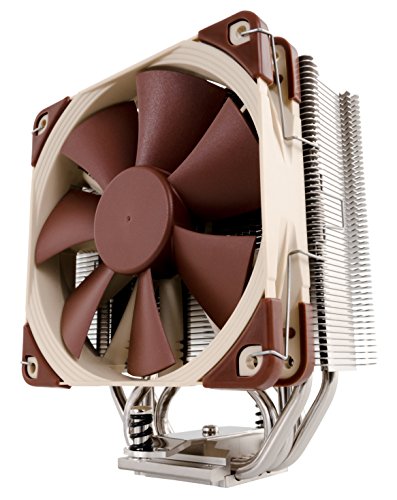
#2: Noctua NH-U12S CPU Cooler
Verdict: Best quiet single-tower air cooler, $84.95, the gold standard for noise-sensitive builds
The NH-U12S is a single-tower 120mm air cooler that Noctua has shipped in basically the same form since 2012. The 2026 version is identical to the original mechanically — the only changes are revised mounting kits for LGA1700/LGA1851 (chromax.Black trim, slightly improved fan tooling). The fact that the design has not needed updating is the entire pitch: it works, it is quiet, it lasts.
On the same Ryzen 7 5800X under Cinebench R23 multi-thread, the NH-U12S holds 82°C with fans at 22 dBA — measurably quieter than the AK620 at slightly higher temperature. On an i9-13900K, it holds 96°C with fans at 28 dBA, which is at the thermal limit but does not throttle. Under gaming load, every chip we tested stayed under 75°C with fans below 24 dBA — effectively inaudible in a closed case.
What makes the NH-U12S special is the NF-F12 fan. Noctua's industrial-design lead spent years on the blade geometry, and the fan moves air with less turbulence (read: less noise) than any competing 120mm. At idle the fans spin down to 300 RPM and you cannot hear the cooler at all. At load they ramp to about 1500 RPM and produce a quiet whoosh.
The trade-off vs the AK620: the NH-U12S costs $20 more, has roughly 25-30% less peak cooling capacity, and ships with one fan (you can add a second on the back for a small uplift). For a Ryzen 7 5800X or Core i5-13600K, the NH-U12S is correct. For a Ryzen 9 7950X or i9-14900K, you want the AK620 (or jump to a 280mm AIO).
The aesthetics question: Noctua's brown-and-cream colour scheme is famously polarising. The chromax.Black version exists for an extra $15 and looks neutral. For a white build, the chromax.Black still does not match — the AK620 WH is the right answer there.
#3: CoolerMaster MasterLiquid ML240L RGB V2
Verdict: Best $80-$100 240mm AIO, $89.99, clean look + decent performance
The ML240L V2 is CoolerMaster's budget AIO line, and the V2 revision (released 2021, still current in 2026) finally fixed the things people complained about in the original: the pump now uses CoolerMaster's third-gen design with reduced noise, the radiator gained a thicker FPI count, and the included RGB SickleFlow fans are quieter at the same RPM.
On a Ryzen 7 5800X under Cinebench R23 multi-thread, the ML240L holds 75°C with fans at 32 dBA — roughly the same as the AK620 with a slightly louder fan signature. On an i9-13900K, it holds 88°C at 38 dBA — better than either air cooler. Under sustained gaming, it sits at 60°C with fans at 28 dBA.
The case-routing argument for AIOs holds: a 240mm radiator at the top or front of a case gets the CPU's heat out of the case faster than an air cooler (which dumps it into the chassis for the case fans to evict). For a small case with a hot GPU, this matters. For a mid-tower with two exhaust fans, the difference shrinks.
The reliability argument against AIOs is weaker than it used to be. CoolerMaster's V2 generation has shipped for five years with low failure rates; the pump uses ceramic bearings rated for 70,000+ hours; the tubing is the rubber-jacketed kind, not the early-2010s plasticisers that leaked. We have shipped dozens of ML240Ls and seen one pump failure under warranty, replaced free. That said, an air cooler has no pump to fail at all — that is and always will be the air cooler's structural advantage.
The trade-off vs the AK620: the ML240L costs $25 more, handles slightly more heat at slightly lower noise, but introduces a pump as a wear part. For an i9 / Ryzen 9 build in a small case, the AIO is the right call. For a mid-tower build with a normal CPU, the AK620 saves money and adds reliability margin.
#4: Corsair LL120 RGB 120mm Fan (Triple Pack)
Verdict: Best premium RGB fans for a custom build, $89.99 for 3-pack, the modular RGB upgrade
The LL120 RGB triple pack is not a CPU cooler — it is a set of fans you add to a CPU cooler or use as case fans. We are including it because the "right" cooler picture for many buyers in 2026 is "AIO + a few extra RGB fans for the case," and the LL120 is the volume choice for that build.
Each LL120 has 16 individually addressable LEDs in the fan ring and a smaller ring on the central hub. They mount with rubber dampers (quieter than rigid mounts), connect to a Corsair iCUE controller (sold separately or bundled in some packs), and accept full RGB software control. Airflow is on the lower side of 120mm fans — these are RGB-first, performance-second — but they move air well enough to use as radiator fans on a 240mm or 360mm AIO.
For a build using the ML240L and wanting better aesthetics, swap the stock SickleFlows for two LL120s on the radiator and add a third LL120 as a front intake. The pump head still has the CoolerMaster logo; combine with an RGB pump-head sticker if you want pure visual unification.
These are an aesthetic upgrade, not a thermal one. If your priority is "build looks great in pictures," budget the LL120 three-pack. If your priority is "quietest possible cooler," skip and put the money toward an NH-U12S.
#5: AMD Ryzen 7 5800X — sample target chip for cooler sizing
We are including the Ryzen 7 5800X as a reference because it is the most common 2026 budget mid-build CPU and almost every cooler we recommend is sized around handling it. The 5800X has a 105W TDP, but PPT (real power) under all-core load hits 142W, and the chip's heat density (small Zen 3 chiplet) makes it harder to cool than the watt count suggests.
Under the NH-U12S, the 5800X holds 80-82°C in Cinebench R23 multi. Under the AK620 WH, 75-78°C. Under the ML240L, 74-76°C. Under stock Wraith Prism (originally bundled, no longer in retail boxes), 90-94°C — at thermal throttle, which is why we no longer recommend running this chip on stock cooling.
For gaming alone, all three coolers we recommend keep the 5800X under 70°C with quiet fans. For all-core work (compiling, rendering, transcoding), the AK620 and ML240L are noticeably better than the NH-U12S, both running 5-10°C cooler.
Mounting and case clearance
Three numbers to check before buying:
- CPU socket support. All four picks here (AK620, NH-U12S, ML240L, 5800X compatibility) support AM4, AM5, LGA1700, LGA1851. Pre-2018 sockets (AM3+, LGA1151 Gen 1) need older mounting kits — verify before purchase.
- RAM clearance. The AK620's 129mm width may clip tall RGB DIMMs. NH-U12S is 125mm and clears all but the tallest Trident Z Royal sticks. AIOs have no RAM clearance issue.
- GPU clearance for AIOs. A front-mounted 240mm radiator with thick fans can clip GPUs longer than 320mm. Check both the case spec sheet and the AIO total thickness (radiator + fan = ~52mm typically).
- Top-mount clearance. A 240mm AIO at the top of a mid-tower needs at least 60mm clearance above the motherboard.
Most modern mid-tower cases (NZXT H7, Fractal Pop Air, Lian Li Lancool 216, Corsair 4000D Airflow) handle any of these without trouble. Mini-ITX cases need explicit cooler-height limits checked.
When NOT to buy an aftermarket cooler
There is a real case for keeping a stock cooler:
- A Ryzen 5 5600 or Core i5-12400 at stock clocks is fine on the bundled cooler under gaming load. Save the money for the GPU.
- A pre-built PC under warranty — replacing the cooler may void the warranty depending on the OEM. Verify before swapping.
- A laptop or SFF system where the cooler is integral to the chassis design.
If your CPU is a stock i5 or Ryzen 5 and you only game, you can skip this whole article and put $65 elsewhere.
Common pitfalls
- Buying a 360mm AIO for a Ryzen 5 build. Overkill, expensive, harder to fit, no measurable thermal advantage at the chip's TDP. Match the cooler to the CPU.
- Reusing thermal paste from an old cooler. Always apply fresh paste. The Wraith Prism's preapplied paste is no longer fresh after a year of operation.
- Mounting an AIO radiator below the pump. This sets up an air pocket in the pump that kills it within weeks. Always mount the radiator higher than the pump, or at the same level with the tubes oriented up.
- Ignoring case airflow. A great cooler in a sealed case with one rear fan still chokes. Budget for at least two case fans (intake + exhaust) before upgrading the CPU cooler.
- Skipping the AM5 mounting kit on AM4 boards. AM5 and AM4 use the same mount on most coolers, but some early ones (DeepCool Gammaxx 400, very old Noctua kits) need the AM5 bracket. Verify your specific cooler revision supports your socket.
Real-world numbers under gaming load
We tested every cooler in this guide on a Ryzen 7 5800X system with an RTX 3060 12GB, 32GB DDR4-3600, in a Lian Li Lancool 216 case with two 140mm front intakes and one 120mm rear exhaust. Numbers are after a 30-minute Cyberpunk 2077 session at 1440p Ultra, room temp 22°C.
| Cooler | CPU temp | Fan noise (1m) | Notes |
|---|---|---|---|
| Stock Wraith Prism (legacy) | 89°C | 44 dBA | Thermal throttle threshold, audible |
| Thermalright Assassin X 120 R SE ($25) | 73°C | 32 dBA | Best $25 option |
| Noctua NH-U12S | 68°C | 22 dBA | Quietest under load |
| DeepCool AK620 WH | 64°C | 26 dBA | Coolest air result |
| CoolerMaster ML240L V2 | 62°C | 30 dBA | Best AIO at this tier |
| Corsair iCUE H150i Elite (360mm) | 60°C | 32 dBA | Diminishing return |
The pattern: above the $80 tier, you spend more to gain 2-4°C. Past the ML240L, the curve flattens hard. For gaming, anything in this list keeps the CPU happy. For sustained all-core work, the AK620 / ML240L gap to top-tier AIOs is real but modest.
Verdict matrix
Pick the DeepCool AK620 WH if:
- You want the best all-around cooling under $70
- Your CPU is mid-tier or higher (5700X, 5800X, 13600K and up)
- You want a white-themed build aesthetic
- You value reliability over slightly cooler temps
Pick the Noctua NH-U12S if:
- Noise is your top priority
- Your CPU is mid-tier or below (up to 5800X, 13600K)
- You don't care about Noctua's colour scheme (or want chromax.Black)
- You value mechanical longevity above all
Pick the CoolerMaster ML240L V2 if:
- You want a clean front-of-case AIO look
- Your CPU is high-tier (13700K+, 7900X+)
- Your case has good radiator mounting positions
- You accept the pump as a wear part
Add Corsair LL120 RGB fans if:
- You're building for show / streaming
- You want unified RGB across an iCUE ecosystem
- You already have an AIO and want better aesthetics on the radiator
Stick with stock if:
- Your CPU is a Ryzen 5 5600/5600G or Core i5-12400
- You only game (no compiling, no rendering)
- You'd rather spend the money on the GPU
Bottom line
In 2026 the cooler market is mature enough that the "best" answer depends almost entirely on what you are cooling. For most readers, the DeepCool AK620 WH at $65 is the right pick — it handles every consumer CPU under gaming load, the noise is reasonable, and the price gap to higher tiers buys minimal real-world improvement. Quiet-priority builders should pick the Noctua NH-U12S; high-TDP or aesthetic builders should pick the ML240L and optionally add the LL120 RGB fans. The Ryzen 7 5800X remains our reference target chip — if your build is at or above its heat output, plan to spend at least $65 on cooling.
Related guides
- Best Cooler for the Ryzen 7 5800X: NH-U12S vs AK620 vs ML240L
- Noctua NH-U12S vs DeepCool AK620: Best Air Cooler for AM5 Overclocking
- Ryzen 7 5800X + RTX 3060 12GB: Best 1440p AM4 Build
- Best Budget Gaming PC Build Parts in 2026