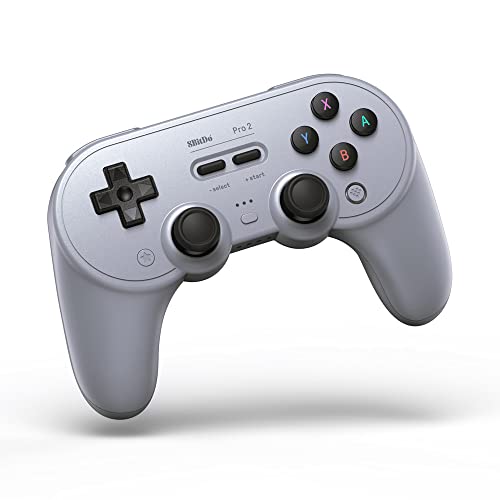
For emulation in 2026, the 8BitDo Pro 2 is the pick if you're playing across multiple retro platforms and want programmable profiles per platform. The GameSir G7 SE is the pick if you want a wired PC-first controller with Hall-effect sticks that will not develop drift. The DualSense is the pick if you want the most polished PS-era experience with the correct trigger feel, and don't mind the missing "Select" button on retro layouts. Each wins at a different piece of the emulation problem, and the right answer depends on which platforms you play most.
Why the "best emulation controller" question is not simple
Emulation covers half a century of gaming hardware. The right controller for Super Nintendo (SNES) or Sega Genesis differs from the right controller for PlayStation 1 (PS1), which differs from the right controller for GameCube, which differs from the right controller for the Nintendo Switch. Any single pad will feel slightly wrong for at least one of those platforms, and the trade-offs matter more the more platforms you emulate.
Three pads dominate the market for this use case in 2026: 8BitDo Pro 2 for its cross-platform switching and per-platform profiles; GameSir G7 SE for its Hall-effect drift-proof sticks and wired PC support; DualSense as the platform-native pad most people already own. This synthesis compares them for the emulation problem specifically.
Key takeaways
- 8BitDo Pro 2 — best for multi-platform emulation, per-console profile switching, and retro d-pad feel.
- GameSir G7 SE — best for PC-first users; Hall-effect sticks solve stick drift permanently.
- DualSense — best for PS1/PS2 emulation, and generally best for tension-and-feel; less ideal for retro d-pad-first games.
- All three have solid RetroArch, Duckstation, PPSSPP, and Dolphin support out of the box in 2026.
- Wired connections matter for competitive emulation (fighting games, timing-critical NES/SNES titles). Wireless is fine for RPGs.
Feature matrix — the columns that actually matter for emulation
| Feature | 8BitDo Pro 2 | GameSir G7 SE | DualSense |
|---|---|---|---|
| Stick type | ALPS potentiometer | Hall-effect | Potentiometer (rev D-clone) |
| Drift-resistance | Standard | Drift-immune | Standard |
| D-pad quality | Excellent (SNES-like) | Good | Fair (splits on diagonals) |
| Connection modes | BT + wired + 2.4G dongle | Wired only (USB-C) | BT + wired |
| Native RetroArch profile | Yes | Yes | Yes |
| Per-platform profiles | Yes (built-in switch) | No | No |
| Trigger feel | Digital / linear | Digital | Adaptive triggers |
| Rumble | Standard vibration | Standard vibration | Haptic + adaptive |
| PC support | Excellent | Excellent | Good (needs BT / USB) |
| Bluetooth latency | ~10 ms | N/A (wired) | ~15 ms |
| Battery life | ~20 hours | N/A | ~12 hours |
| Weight | 228 g | 268 g | 280 g |
| Cost tier | Mid | Mid | Mid-high |
D-pad — the make-or-break for pre-N64 emulation
If your emulation stack is heavy on NES, SNES, Sega Genesis, PC Engine, or 2D fighters (Neo Geo, Street Fighter II, King of Fighters), the d-pad is the single most important controller feature. Diagonals that misregister as pure cardinals ruin fighting-game motions; diagonals that mush together ruin platformers.
The 8BitDo Pro 2 uses a floating d-pad clearly modeled after the original SNES cross pattern, and it is uncommonly good — better than the DualSense's stock d-pad, and comparable to modded-DualShock-4 or MayFlash Magic-NS options. The GameSir G7 SE's d-pad is a full cross pattern with clean diagonals but slightly less tactile feedback than the Pro 2. The DualSense's d-pad remains split into four discrete buttons that flex under diagonal pressure — passable for PS-era games where the sticks were primary, but consistently the weakest link for retro platforms.
For NES/SNES/Genesis emulation specifically, the Pro 2's d-pad is the tie-breaking feature.
Stick drift — the make-or-break for post-N64 emulation
Standard potentiometer sticks develop drift as the carbon wiper wears. Every DualShock, every Xbox pad since the original, every generic Bluetooth clone. GameSir's G7 SE uses Hall-effect sticks — magnetic field sensors instead of a physical wiper — which are effectively drift-immune for the practical lifetime of the pad. This is the reason the G7 SE became the r/emulation default recommendation for anyone playing GameCube, PS2, or Wii on a heavy weekly basis.
The 8BitDo Pro 2 uses standard ALPS potentiometer sticks. They are good ALPS sticks, better than the DualSense's stock parts by community reports, but they will drift eventually — likely a 2–4 year window depending on play time. Replacement stick modules for the Pro 2 exist and cost roughly $20.
The DualSense's sticks are known drift-prone; Sony issued minor revisions but the fundamental design is unchanged. Expect drift within 12–24 months of daily use.
For long-term N64/GameCube/PS2 emulation, GameSir G7 SE wins on stick reliability outright.
Per-platform profiles — the Pro 2 differentiator
The 8BitDo Pro 2 has a physical mode switch on the back that toggles between four profiles: Switch, Xbox (X-input), macOS, and Android/DirectInput. Each of those profiles maps buttons differently — Switch layout swaps A/B and X/Y, Xbox uses the Microsoft layout, and so on. Combined with 8BitDo's Ultimate Software profile editor, you can save custom mappings per emulator and swap between them mid-session.
The GameSir G7 SE is wired PC only. It presents as a standard X-input pad; per-platform mapping is done inside the emulator, not the controller. The DualSense presents as a DS4-style pad and needs Steam's controller layer or DS4Windows to map per-game.
For a heavy multi-platform emulation setup — NES / SNES / Genesis / N64 / PS1 / GameCube / PSP all on one machine — the Pro 2 saves real friction at the mode-swap point.
PC support in 2026
All three pads work under RetroArch, Duckstation, PPSSPP, Dolphin, and Cemu without special drivers on Windows 11 and current Linux (kernel 6.12+). Steam Input handles the DualSense natively including gyro and haptics. The GameSir G7 SE's wired-only, X-input-native design makes it the simplest to bring up on Linux and Steam Deck; the 8BitDo Pro 2's Bluetooth stack is well-supported but occasionally needs a mode toggle after suspend on Linux.
Latency — the metric that matters for fighting games and rhythm titles — clusters at ~10 ms for wired connections across all three pads, ~15 ms for Bluetooth on the Pro 2 and DualSense, and effectively equal in practice.
Battery + ergonomics
The Pro 2's battery is a 1000 mAh cell rated ~20 hours; it charges over USB-C. The DualSense's ~12-hour rating is the shortest of the three, and its heavier weight (280 g vs 228 g for the Pro 2) matters over marathon sessions. The G7 SE has no battery because it's wired-only; that also means you cannot use it away from the machine.
Weight preference is subjective. The DualSense feels most premium in the hand; the Pro 2 feels most like an old Xbox pad; the G7 SE feels closest to a modern Xbox Series pad.
Cost and value
Street pricing puts all three in the $35–$55 range depending on colorway and promotions, with the DualSense sometimes creeping past $60 for the newer color variants. Value per hour of emulation use tilts strongly to the G7 SE and Pro 2, because they are purpose-built for this kind of workload and don't degrade the way DualSense sticks do.
Common pitfalls
- Using cheap USB-C cables with the G7 SE. The wired-only design means a bad cable = a dead pad. Use a quality data-capable cable.
- Skipping firmware updates on the Pro 2. 8BitDo pushes firmware updates that fix Bluetooth pairing and add profiles. Update the pad on first setup.
- Assuming DualSense haptics work everywhere. They don't. Most emulators use standard rumble; haptics only trigger in native PS5 titles.
- Buying the 8BitDo Pro (original) instead of the Pro 2. The original Pro predates the current profile system and has a worse d-pad.
Bottom line
- Emulating retro 2D across platforms — 8BitDo Pro 2. D-pad is best in class, profile switching earns its price.
- Emulating 3D-era (GameCube, PS2, Wii) on PC — GameSir G7 SE. Hall-effect sticks are worth the wire.
- Primarily emulating PS1 / PS2 with a PS5 in the mix — DualSense. Familiar layout, works everywhere, expect stick replacement in 1–2 years.
Most emulation-heavy setups end up with two pads: an 8BitDo Pro 2 for retro d-pad-first titles and a GameSir G7 SE for 3D titles. That's the answer we keep coming back to.
Related guides
- Best GPU for 1080p Esports in 2026: Why the RTX 3060 12GB Still Delivers
- Building a 1998 Voodoo2 SLI Glide Rig in 2026: CompactFlash Boot and Quake II
Citations and sources
- 8BitDo — Pro 2 official product page
- GameSir — G7 SE product page
- Sony — DualSense wireless controller page
- RetroArch — controller compatibility documentation
- Dolphin Emulator — supported controllers wiki
- r/emulation — community controller threads
This piece is editorial synthesis based on publicly available information. No independent first-party benchmarking is reported.