Before you compare a single chip, answer one question: are you upgrading an existing PC or building a new one? That decides more than any benchmark chart.
You already own an AM4 board with DDR4 memory. A drop-in chip — the Ryzen 7 5700X or the Ryzen 7 5800X — keeps your motherboard, your RAM and usually your cooler. You buy one part, not three. AMD lists the 5700X as supported on X570, X470, X370, B550, B450, B350 and A520 chipsets, per AMD's 5700X specifications.
You are building from scratch, or your current board is pre-AM4. Go AM5. The 7600X, 7700X and 9800X3D all use the AM5 socket and DDR5 memory only. The upgrade path is the point: TechPowerUp notes the 9800X3D "runs on existing Socket AM5 motherboards," so a 7600X bought this week can be swapped for an X3D chip later without a rebuild.
The most-missed step: update the AM4 BIOS before the swap. Many B450 and X470 boards (and some early B550 units) shipped with firmware that predates Ryzen 5000. Drop a 5700X into one of those and it will not POST. Check your board's CPU support list, flash the latest BIOS with your old CPU still installed (or use BIOS Flashback from a USB stick if the board has it), and only then swap chips.
Why platform cost decides the deal
Who buys a CPU on Black Friday? Mostly two groups: people finishing a new build whose GPU is already chosen, and AM4 owners who want one more upgrade before their platform retires. Both groups make the same mistake — they shop on the chip's price tag alone.
The chip is often the smaller half of the bill. An AM5 build needs a new motherboard and DDR5 memory on top of the processor. An AM4 drop-in needs neither. That is why the 5700X and 5800X stay on this list in 2026 even though the 7000 and 9000 series are faster per core: for someone with a working B550 board and 32 GB of DDR4 already in the case, an AM4 chip is a one-part upgrade, and an AM5 move is a three-part rebuild.
The opposite also holds. If you are building new, buying into AM4 now locks you into a socket with no newer CPUs coming. A slightly slower AM5 chip with an upgrade path beats a slightly cheaper AM4 chip with none.
So this guide is organized by role, not by raw speed. The Best Overall pick — the Ryzen 7 7700X — wins because it is the 8-core AM5 chip most people building a gaming or mixed-use PC should land on, and TechPowerUp lists it among the "interesting gaming CPUs" that are "considerably more affordable" than the 9800X3D while still getting the job done.
Sources: core counts, L3, TDP and memory type from AMD's spec pages for the 7700X, 7600X, 5800X, 5700X and 9800X3D. AMD lists the box cooler as "Not Included" for all five, so budget for one.
Eight Zen 4 cores give headroom for streaming, compiling or Blender work alongside games, not just gaming.
AM5 socket: the same board accepts 9000-series chips, including the 9800X3D, when you want more.
Integrated graphics — handy for troubleshooting or for running a PC before the GPU arrives.
Named by TechPowerUp's 9800X3D review as one of the sensible gaming alternatives to the X3D flagship.
Cons
Needs a new AM5 board and DDR5 memory, so the full platform costs more than an AM4 drop-in.
No cooler in the box, and at 105W it wants a capable tower cooler.
In CPU-bound 1080p games, the X3D chips pull ahead.
The 7700X is the default answer for a new build because it balances everything this list cares about. Eight cores is the sweet spot for modern games and for the background apps people actually run — Discord, a browser, OBS. The AM5 platform is the upgrade insurance: buy the 7700X now, and the socket is still current if you want an X3D chip in two years.
The one benchmark to keep in mind comes from TechPowerUp's 9800X3D review: at 4K, "even with an RTX 4090, the differences between the top processors are minimal," and the reviewer suggests opting "for a more affordable CPU and spend the savings on a faster graphics card." The 7700X is exactly that kind of chip. If your monitor is 1440p or 4K and your GPU is the limit, the 7700X delivers nearly all of the gaming experience of the flagship.
Watch the platform price, not just the chip. Prices change during the event, so check the live price button below before you buy.
Spec chips: 8 cores / 16 threads · 32 MB L3 · AM4 · DDR4 · 65W TDP · up to 4.6 GHz boost, per AMD's 5700X specifications.
The 5700X is the value pick for one reason: it upgrades the PC you already own without touching anything else. Eight cores and 16 threads in a 65W envelope means it runs cool on modest air cooling, and it drops into nearly every AM4 board from the B350 era onward (after the BIOS update covered in Step 0).
When it's right: you have a Ryzen 5 1600, 2600 or 3600 in a B450 or B550 board with DDR4 that still works fine. Swapping to a 5700X doubles or nearly doubles your core count over a 6-core chip and keeps your RAM and board.
When it isn't: you are building from scratch. Buying a new AM4 board in late 2026 puts money into a socket with no future CPUs. Go to the 7600X or 7700X instead.
Pros: 65W TDP, broad AM4 compatibility, keeps your DDR4. Cons: no cooler in the box, no upgrade path beyond the AM4 lineup, slower per core than Zen 4 and Zen 5.
The Ryzen 7 5800X is the same 8-core Zen 3 design as the 5700X with a much higher power budget — 105W versus 65W — which lets it hold higher clocks under sustained load. That extra power is also its catch: it runs hot and needs a real cooler. A dual-tower air cooler such as the Thermalright Peerless Assassin 120 SE is the sensible pairing; a stock-style low-profile cooler will hold it back.
Be honest about the math here. The 5800X only makes sense if you are keeping your AM4 board and DDR4. If its live price sits close to or above the 7700X's, the case for staying on AM4 rests entirely on what you save by not buying a board and DDR5 — compare the full platform cost before you click.
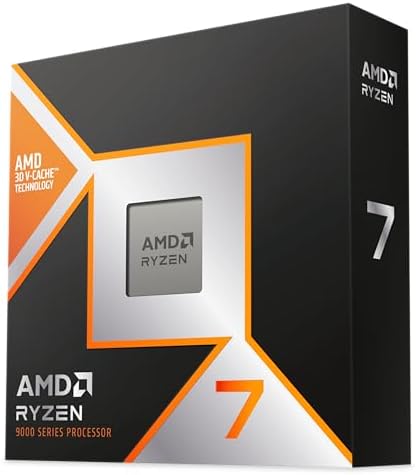
This is the gaming leader. TechPowerUp's review titled it "The Best Gaming Processor" and found it "at the top of the FPS charts in every single game" it tested. At 1080p, the review measured an 11% uplift over the 9700X and the rest of the Zen 5 family, a 13% lead over Intel's Core Ultra 9 285K, and a 3.4% lead over its predecessor, the 7800X3D. The secret is the 64 MB cache die stacked on the CPU, which grows L3 from 32 MB to 96 MB so more of a game engine's working data stays on-chip.
It is not only a gaming chip anymore, either: TechPowerUp measured application performance 18% faster than the 7800X3D.
Who should skip it: GPU-bound 4K players. The same review is blunt that at 4K, the differences between top processors are minimal. If you game at 4K on anything short of a flagship GPU, put the difference toward the graphics card.
Pros: fastest gaming CPU on the list, AM5 upgrade path, strong application performance. Cons: costliest platform here, 120W TDP, higher gaming power draw than the 7800X3D per TechPowerUp.
The 7600X is the lowest-cost way onto AM5. Six Zen 4 cores handle current games well, and the chip shares the same 32 MB L3 as the 7700X. The real value is the socket: it gets you an AM5 board and DDR5 kit today, and the CPU becomes the one part you swap later — for a 9800X3D or whatever X3D chip follows.
Pick this over the 7700X if your budget is tight and your GPU is mid-range; pick the 7700X if you stream, compile or render while you play.
Pros: cheapest AM5 entry point, same upgrade path as the 7700X, integrated graphics. Cons: six cores leaves less headroom for heavy multitasking; still needs a board, DDR5 and a cooler.
Black Friday 2026: what a good CPU price looks like
Black Friday falls on November 27, 2026, and Cyber Monday on November 30, 2026. Here's how to tell a real deal from a relabeled everyday price.
Anchor on two numbers. First, the chip's launch MSRP — for example, TechPowerUp's review noted the 9800X3D "will sell for $480" at launch. Second, and more important, the price range over the last 60-90 days on a price-history tracker. Several of these chips have sold under launch MSRP for most of their life, so "below MSRP" alone tells you nothing. A real deal beats the recent low.
Expect prices to move during the event. Listings change hour to hour across the long weekend. Treat any figure you read before the event — including on other sites — as stale, and use the live price button on each pick.
Who should wait:
Anyone who also needs a GPU this month. Settle the GPU first; it decides whether you need a 9800X3D at all. Our Black Friday GPU deals guide covers that side.
An AM4 owner already happy at 1440p or 4K whose games are GPU-bound. A CPU swap won't move your frame rate much.
Anyone weighing a full system — a Black Friday prebuilt can undercut the parts total during the event.
What to look for in a CPU
Socket and upgrade path (AM4 vs AM5)
AM4 is the end of a road: the 5000 series is its last major desktop lineup. AM5 is where AMD's current chips live, and TechPowerUp confirms the 9000-series 9800X3D runs on existing AM5 boards. If you are buying a new motherboard, buy AM5.
Cores vs cache for gaming
Eight cores is the comfortable target for modern gaming with background apps. Beyond that, cache matters more than core count for games: the 9800X3D's 96 MB of L3 is why an 8-core chip leads the charts in TechPowerUp's testing. For productivity work, more cores win instead.
TDP and cooler budget
None of these five chips ships with a cooler, per AMD's spec pages. The 65W 5700X is easy to cool; the 105W 7600X, 7700X and 5800X and the 120W 9800X3D want a dual-tower air cooler or a 240mm AIO.
Memory platform cost (DDR4 vs DDR5)
AM4 chips use DDR4; AM5 chips use DDR5 only. Keeping a working DDR4 kit is the biggest single saving an AM4 drop-in offers.
BIOS readiness on older boards
Check the board maker's CPU support list before buying. Older B450/X470 boards often need a BIOS update before they will boot a Ryzen 5000 chip, and early AM5 boards benefit from current firmware with 9000-series chips.
Common pitfalls
Buying a new AM4 board in 2026. You pay for a platform with no future CPUs. Only buy AM4 chips for boards you already own.
Skipping the BIOS update. A 5700X in an un-updated B450 board will not POST, and the fix needs a supported CPU or BIOS Flashback.
Forgetting the cooler. AMD lists the thermal solution as "Not Included" on all five chips.
Overbuying for 4K. Per TechPowerUp, top CPUs land close together at 4K; the money does more on the GPU.
Trusting "below MSRP" as a deal signal. Compare to the 60-90-day price history instead.
Worked examples
The B450 owner with a Ryzen 5 2600 and an RTX 3060. Flash the BIOS, drop in a 5700X, keep the DDR4. One-part upgrade, eight cores, and the 65W TDP means the existing tower cooler is likely enough.
The new 1440p build around a mid-range GPU. 7700X on a B650 board with 32 GB of DDR5. If the budget is tight, a 7600X now and an X3D chip later. Our $1,500 gaming PC build walks through a full parts list.
The 1080p 240 Hz esports player with a high-end GPU. This is the case the 9800X3D was built for: CPU-bound frame rates where its cache lead shows up in every game TechPowerUp ran.
When NOT to buy a CPU this Black Friday
If your current chip already keeps your GPU busy at your resolution, a new CPU adds little. Watch your GPU utilization in a demanding game: near 100% means the GPU is the limit, and the money belongs there.
As an Amazon Associate, SpecPicks earns from qualifying purchases; we also earn on qualifying eBay purchases via the eBay Partner Network. Prices shown were last tracked at crawl time and may vary — check the listing for the current price.
📹 Watch a review
One CPU To Rule Them All - Ryzen 7 9800X3D Review — Linus Tech Tips on YouTube
Frequently asked questions
Should I buy an AM4 or an AM5 CPU on Black Friday?
If you already own a working AM4 board with DDR4, a drop-in Ryzen 7 5700X or 5800X gets you eight cores without buying a new motherboard or memory, so the whole upgrade costs a lot less. If you are building from scratch, AM5 is the better bet: the 9000-series chips use the same socket, so a Ryzen 5 7600X bought now can later be swapped for an X3D chip without a rebuild.
Is the Ryzen 7 9800X3D worth it over the Ryzen 7 7700X for gaming?
It depends on where your system is limited. Thanks to its 96 MB of 3D V-Cache, the 9800X3D leads CPU-bound gaming benchmarks in TechPowerUp's review, especially at 1080p and in high-refresh esports titles. If you play at 4K, or your graphics card is the bottleneck, the gap narrows a lot. In that case the money is better spent on the GPU, and the 7700X is the sensible choice.
What counts as a good Black Friday price for a Ryzen CPU?
Compare against two things: the chip's launch MSRP and its price range over the previous 60 to 90 days. Several of these chips already sell well under MSRP, so 'below MSRP' alone does not make a deal. A real deal beats the recent low on the price history. Prices change during the event, so check the live price button before buying instead of trusting any figure quoted ahead of time.
Do I need a BIOS update before installing a Ryzen 5000 chip on an older AM4 board?
Often, yes. Early B450 and X470 boards shipped with firmware that doesn't recognize Ryzen 5000 processors, so the system won't boot until the BIOS is updated. Check the board maker's CPU support list. If your board supports BIOS Flashback, you can flash it from a USB stick with no CPU installed. Otherwise update it with your current CPU before you swap chips.
What cooler do these CPUs need, and what about returns?
The 65W Ryzen 7 5700X is fine on a basic tower cooler. The 105W 5800X, 7600X and 7700X and the 120W 9800X3D do better with a dual-tower air cooler such as the Thermalright Peerless Assassin 120 SE, or with a 240mm AIO. None of them ships with a cooler. Amazon has historically extended its return window for holiday-season purchases, but terms change year to year, so check the listing's return policy before you buy.