Dell Precision 3660 vs Lenovo ThinkStation P3 Tower for Local LLMs (2026)
Both business towers can host a 12 GB inference GPU, but the PSU range decides how far each can grow.
By Mike Perry, Founder & Editor-in-Chief · Published 2026-11-10 · Updated 2026-11-11 · 12 min read
Quick Answer
For local LLMs, pick the Lenovo ThinkStation P3 Tower. Per Lenovo's PSREF, it can be configured with a 500 W, 750 W or 1100 W 80 PLUS Platinum supply, more headroom than the 500 W unit owners report in the Dell Precision 3660. Either tower can drive an RTX 3060 12GB, whose Llama-3-8B-class Q4 median is 55 tok/s across 23 published runs (SpecPicks RTX 3060 benchmarks).
Business towers keep turning up in local-LLM searches for three reasons. Off-lease units sell well below their original quotes. They ship with vPro remote management, long warranties and quiet, conservative fan curves. And a tower with a real PCIe x16 slot can take a proper inference GPU later. This comparison is for buyers who want a quiet, always-on Ollama or llama.cpp box, are weighing the Dell Precision 3660 Tower i7-13700 against the Lenovo ThinkStation P3 Tower Ultra 9 285, and would rather not build a PC from parts.
The short version: neither CPU matters much for token generation. What decides it is the GPU each chassis can physically fit, power and cool. That comes down to the power supply, the PCIe auxiliary connectors and the card length the case accepts.
Key Takeaways - The PSU decides it, not the CPU. Lenovo lists 500 W, 750 W and 1100 W supplies for the P3 Tower Gen 2. Owners on the Dell Community forum report the 3660 with a 500 W unit, which Dell's technical guide approves for an RTX 3060 or 3070. - Check what's already installed. The catalog's i9 Precision 3660 ships with an NVIDIA RTX A4000 16GB, a card whose Llama-3-8B-class Q4 median is 64.2 tok/s across 15 published runs, ahead of the RTX 3060's 55 tok/s (SpecPicks A4000 benchmarks). The i7 config ships with a Quadro T1000, which is too small for useful inference. - CPU-only inference is a fallback. Dual-channel DDR5 tops out under 100 GB/s, a fraction of an RTX 3060's 360 GB/s. - The P3 Tiny is a different class. It takes low-profile cards only, so it suits 3-8B models, not 27B-class work. - A DIY RTX 3060 build is still the value floor if you don't need workstation warranties or vPro.
Hardware at a Glance
Median generation throughput at 7–9B models (Llama 3.1 8B, Qwen 3 8B), Q4 quantization, from community-reported runs SpecPicks tracks. Each row pools runs from different sources, runtimes and models in that class, so the rows are not a matched head-to-head; where the article compares cards on the same rig, its own figures are the like-for-like result. Street price is the second-lowest listing priced within the last 24 hours at 0.5–2× launch MSRP, so no single listing sets it, and a street figure well above MSRP says so in its cell; where too few listings pass that check the cell shows a dash and the launch MSRP, which is not comparable with the street figures. Rows marked for comparison are not the cards this article is about — they are included so the throughput column has something to be read against.
Step 0: what decides it is the GPU you can fit and power
Before comparing CPUs or RAM, run through this checklist on the exact unit you're considering. Refurb listings vary by service tag, so the spec sheet's maximums aren't a promise about the box in front of you.
PSU wattage. Read the label on the supply or look up the service tag or machine-type configuration. A 170 W card like the RTX 3060 needs a 500 W-class unit with headroom. A 225 W-plus card wants more.
PCIe auxiliary connectors. A low-wattage workstation supply may have no 6-pin or 8-pin PCIe leads at all. A forum post quoting Dell's technical guide says the 3660's stock 500 W unit offers one 6-pin and one 8-pin connector (Dell Community thread).
A real x16 slot with clearance. Both towers have a full-length PCIe x16 slot. Check whether drive cages or the front fan bracket limit card length, and whether a 2.5-slot cooler blocks the slot below it.
Card length and connector orientation. One Dell Community owner who fitted a Dell-branded RTX 4090 reported needing a short card and an angled 12VHPWR adapter to close the side panel. Assume tight clearance for top-mounted power plugs.
Airflow. Business towers are tuned for 70-140 W workstation cards. A 170-225 W consumer card with an open-air cooler dumps heat into the case, so check that the rear exhaust fan can keep up.
If a unit fails any of these checks, the CPU and RAM numbers below don't matter.
Spec delta: Precision 3660 vs ThinkStation P3 Tower
Channel count, not slot count, sets CPU inference speed
Dell / Lenovo PSREF
PSU options
500 W in owner-reported units
500 W, 750 W, 1100 W, 80 PLUS Platinum
Sets the largest GPU you can power
Dell Community / Lenovo PSREF
PCIe aux power
One 6-pin plus one 8-pin on the 500 W unit (owner-reported)
Varies by PSU tier, more leads on 750 W and 1100 W
A missing 8-pin rules out most 12-16 GB consumer cards
Dell Community / Lenovo PSREF
Top GPU Lenovo/Dell lists
Workstation RTX cards, RTX 3060/3070 approved on 500 W
Up to an RTX PRO 4500 Blackwell 32GB on the 1100 W tier
Shows how much card the chassis was designed for
Dell technical guide (quoted) / Lenovo spec sheet
Catalog config GPU
T1000 (i7) or RTX A4000 16GB (i9)
RTX 2000 Ada 16GB
What you get before any upgrade
SpecPicks catalog listings
Two numbers in the catalog listings stand out. The P3 Tower listing ships with 128 GB of DDR5, which already covers heavy CPU offload. The Precision 3660 listings ship with 64 GB.
Which tower takes a real inference GPU?
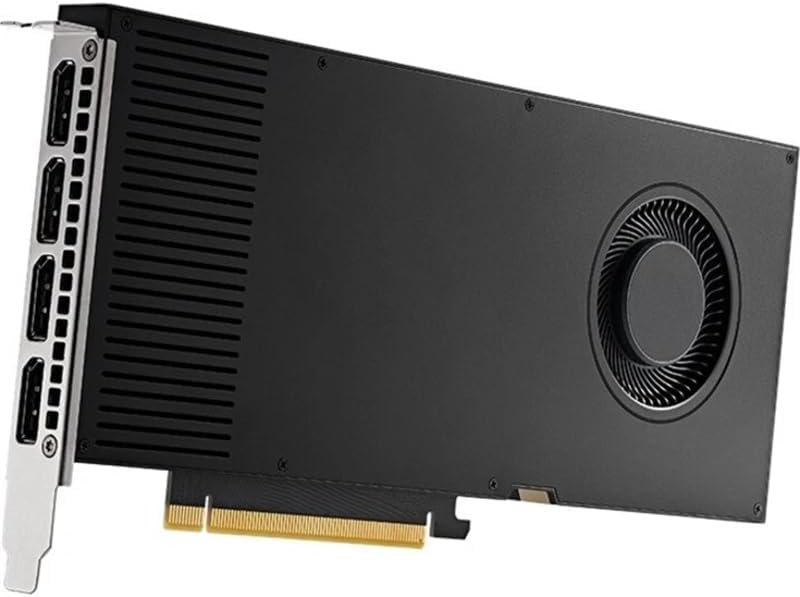
Dell Precision 3660 Tower i7-13700. As listed, it carries an NVIDIA Quadro T1000, a low-power display card that can't hold a useful model. The question is whether the supply can feed a replacement. Per a Dell Community post quoting the technical guide, the 3660's 500 W supplies are approved for the RTX 3060 and RTX 3070, with only one 6-pin and one 8-pin lead available. That fits the MSI GeForce RTX 3060 12GB, a 170 W card per TechPowerUp's spec database that uses a single 8-pin. Larger cards are where the 3660 runs out of road. One owner in the same forum bought a 750 W replacement on Dell's recommendation, but swapping a proprietary workstation PSU adds cost and warranty questions.
Lenovo ThinkStation P3 Tower Ultra 9 285. Lenovo designed the P3 Tower Gen 2 around a wider PSU range. The PSREF lists 500 W, 750 W and 1100 W supplies, and Lenovo's spec sheet offers workstation cards up to a 32 GB RTX PRO 4500 Blackwell. The catalog unit ships with an RTX 2000 Ada 16GB, a low-power card that holds 12-14B models at Q4 in VRAM, though with a narrow memory bus that caps generation speed. On a 750 W or 1100 W unit, moving to a 16-24 GB consumer card is straightforward if the length fits.
The deciding difference: the 3660 tops out around an RTX 3070-class card on its stock supply, while a P3 Tower on its larger PSU tiers has room for whatever its slot length allows.
What tok/s can you expect after a GPU upgrade?
The table below uses medians from the SpecPicks benchmark database as of November 2026. Each figure aggregates published third-party runs, and each benchmark page lists every source. The 7-9B rows are the Llama-3-8B-class Q4 medians, the same pool as the Hardware at a Glance table above; the 12-15B rows are the medians shown on each card's benchmark page.
Two takeaways. First, the A4000 that ships in the i9 Precision is the faster card at 7-9B (64.2 vs 55 tok/s) and level with the RTX 3060 at 12-15B, so if you buy the i9 config you already own a capable inference card. Second, the A4000's extra 4 GB of VRAM matters more than its speed. It fits 20B-class quantized models and longer contexts that spill out of 12 GB.
The upgrade card most buyers should consider is the MSI GeForce RTX 3060 12GB. It stays within the Dell's approved list and the P3 Tower's smallest PSU tier.
CPU-only inference: does the i9-13900 config matter?
The Dell Precision 3660 i9-13900 64GB has 24 cores to the i7-13700's 16, but core count barely moves token generation. Each new token reads every active weight once from memory, so speed is capped by memory bandwidth divided by model size.
Dual-channel DDR5 bandwidth is easy to compute: channels × 8 bytes × transfer rate. At DDR5-4800, that's 2 × 8 × 4,800 MT/s = 76.8 GB/s. At DDR5-5600, as in many Core Ultra 200S configurations, it's 89.6 GB/s. A 7-8B model at Q4_K_M weighs about 4.5-5 GB, so the theoretical ceiling is roughly 15-19 tok/s, and real CPU runs land below that. An RTX 3060's 360 GB/s of GDDR6 bandwidth (TechPowerUp) is about four to five times higher.
Where the i9 does help is prefill. Processing a long prompt is compute-bound, and more cores shorten time to first token for CPU-only runs. If you plan to offload part of a 30B-plus model to system RAM, the bigger CPU and the 64-128 GB in these configs both earn their keep. The real reason to choose the i9 listing, though, is the RTX A4000 16GB it ships with, not the CPU.
Is a ThinkStation P3 Tiny enough instead?
The Lenovo ThinkStation P3 Tiny i7-14700 is a one-liter workstation. Per its PSREF entry, it takes only low-profile workstation graphics, and the catalog unit ships with an NVIDIA T400 4GB. That puts a hard ceiling on VRAM.
The Tiny is the right call when:
You want a silent always-on host for 3-8B models on the CPU, or a small model on the low-profile card.
You already run inference on a GPU box elsewhere and want a small front end for Open WebUI, a RAG index or home-automation glue.
Desk space or power draw matters more than model size.
It's the wrong call if you want to grow into 14B-32B models, because no low-profile card in its class holds those at usable speed.
Perf-per-dollar and perf-per-watt
The value comparison that matters is a refurbished tower plus a GPU upgrade against a purpose-built DIY machine. Our 12GB-VRAM local LLM build guide covers the DIY side around the same RTX 3060.
Per dollar. A DIY RTX 3060 build is the floor for 7-14B inference, because you pay only for consumer parts. A business tower costs more up front for the same GPU throughput, and you're paying for vPro, the warranty and the chassis. That premium makes sense if you value those. Check the live price buttons on each product page rather than any quoted figure, since refurb pricing moves weekly.
Per watt. At a 170 W board power and a 55 tok/s Llama-3-8B-class Q4 median, the RTX 3060 works out to about 0.32 tok/s per GPU watt. The A4000, rated 140 W per TechPowerUp, comes out to about 0.46 tok/s per watt on its 64.2 tok/s median. These are board-power ratios, not wall measurements.
For a 24/7 box, the A4000's lower power and blower cooler are a quiet advantage that the per-dollar math misses.
Noise, idle power and 24/7 duty
Both towers come from enterprise lines built for office floors, so default fan curves are conservative and idle noise is low. The difference shows up once you add a consumer GPU:
Precision 3660. The case is tuned for workstation cards like the T1000 and A4000. A 170 W open-air RTX 3060 recirculates heat inside the case, so expect the system fans to ramp during long generation runs.
ThinkStation P3 Tower. The larger PSU tiers suggest Lenovo planned for hotter cards. On a 750 W unit with a mid-range card, it's the more relaxed always-on chassis.
Both. Idle draw is dominated by the GPU and drives, not the CPU. Use your OS power settings to keep the GPU at its lowest idle state between requests.
For an always-on Ollama server, a blower-style workstation card (A4000, RTX 2000 Ada) inside either tower runs quieter under sustained load than a consumer twin-fan card.
Common pitfalls
Buying a GPU before checking the PSU label. A refurb 3660 may have a different supply than the forum examples. Read the label first.
Assuming "16 GB" means fast. The RTX 2000 Ada in the catalog P3 Tower has 16 GB but a narrow bus. It holds larger models, but generates more slowly than a 3060 on models that fit both.
Forgetting the T1000. The i7 Precision's T1000 is a display card. Budget for a GPU from day one.
Mixing DIMM sizes. Both towers run dual channel. Fill matching pairs, or CPU-offload speed drops.
Verdict matrix
Get the Precision 3660 if… you find the i9 config with the RTX A4000 16GB already installed, or you want an i7 unit and plan to drop in an RTX 3060 12GB, the card Dell's guide approves for the stock 500 W supply.
Get the ThinkStation P3 Tower if… you want room to grow into a bigger card later, prefer a newer Core Ultra platform, or want 128 GB of RAM for CPU offload of 30B-plus models.
Get neither if… you don't need vPro or a workstation warranty. A DIY RTX 3060 build costs less for the same tok/s, and a 128 GB Strix Halo mini PC fits 70B-class models no 12-16 GB card can.
Recommended pick
The ThinkStation P3 Tower is the better long-term local-LLM host. Lenovo's 500/750/1100 W PSU range means the chassis can follow your models upward, and the catalog unit's 16 GB card and 128 GB of RAM are a usable starting point. The Precision 3660 is the better buy only in one case: the i9 listing with the RTX A4000 16GB installed, which delivers 7-15B speeds in line with an RTX 3060 at lower board power.
As an Amazon Associate, SpecPicks earns from qualifying purchases; we also earn on qualifying eBay purchases via the eBay Partner Network. Prices shown were last tracked at crawl time and may vary — check the listing for the current price.
📹 Watch a review
I'm still mad… but buy it anyway - RTX 3060 Review — Linus Tech Tips on YouTube
Frequently asked questions
Can the Dell Precision 3660 power a full-size consumer GPU like an RTX 3060 12GB?
It depends on the power supply in the unit you buy. Owners on the Dell Community forum report the 3660 with a 500 W supply offering one 6-pin and one 8-pin PCIe lead, and a post quoting Dell's technical guide says that supply is approved for the RTX 3060 and 3070. Read the PSU label on a refurb unit before you buy a GPU, and check card length against the case.
Is a business workstation a better local-LLM host than a gaming prebuilt?
For quiet 24/7 operation and long warranty support, often yes: business towers ship with conservative fan curves, vPro remote management and spare-parts availability. Gaming prebuilts usually come with a stronger GPU already installed and more PSU headroom. If your model fits in 12-16 GB of VRAM, a workstation plus a mid-range card is a sensible, quieter route.
How much system RAM do I need in either tower for local LLMs?
If the model runs entirely on the GPU, 32 GB of system RAM is plenty. If you plan to offload layers of a 30B-plus model to the CPU, 64 GB or more helps, because offloaded weights sit in system memory. Both towers support well beyond 64 GB per their spec sheets, so RAM is rarely the limiting factor. GPU power and fit are.
Does CPU-only inference on the i9-13900 config make sense?
Only for small models or batch jobs that can wait. CPU generation speed is bound by memory bandwidth, and dual-channel DDR5-4800 peaks at 76.8 GB/s, a fraction of an RTX 3060's 360 GB/s. A 7-9B model is usable on the CPU but far slower than on an RTX 3060 12GB, whose Llama-3-8B-class Q4 median is 55 tok/s across 23 published runs on the SpecPicks benchmarks page.
Should I buy the ThinkStation P3 Tiny instead to save space?
Only if you accept a low-profile GPU ceiling. The Tiny takes only small-form-factor cards, which caps VRAM and power far below a full-height 12-16 GB card. It works well as an always-on host for 3-8B models or as a front-end for a GPU box elsewhere on your network, but it cannot grow into a 27B-class inference machine.