As an Amazon Associate, SpecPicks earns from qualifying purchases. See our review methodology.
A 4K monitor is worth pairing with an RTX 3060 12GB if the panel is dual-mode — meaning it can switch to 1080p at a substantially higher refresh rate for competitive titles. The KOORUI 27" 4K QD-Mini LED is the pick when dual-mode flexibility matters. The Samsung 27" Odyssey 4K UHD is the pick when panel uniformity and single-resolution HDR come first.
Who this is actually for
You already own or are about to buy an RTX 3060 12GB. That decision is fixed; the question is whether 4K is a dead end or a two-generations-of-hardware-forward move. Per NVIDIA's own RTX 3060 product page, the card is positioned as a 1080p-first, 1440p-capable GPU — but the 12 GB frame-buffer variant has meaningful headroom for 4K in older titles and in modern games with upscaling. What most buyers actually want is a monitor that will not become the bottleneck when they upgrade to a 5060 or 5070 next year.
The honest answer is this: 4K native is a stretch target for this GPU today; 4K with DLSS Quality is the practical target; and a dual-mode panel that switches to 1080p at a high refresh rate is the pick that survives a GPU upgrade cycle. If the panel is not dual-mode, you are paying for pixels this GPU cannot always feed. Both of the monitors compared below are 27-inch UHD panels; only one is dual-mode, and that is the tie-breaking feature for most readers of this piece.
The comparison is against a fixed constraint. Per TechPowerUp's RTX 3060 database entry, the card has 3,584 CUDA cores, 12 GB of GDDR6 on a 192-bit bus, and 360 GB/s of memory bandwidth. That bandwidth number is the fixed ceiling; nothing about the monitor changes it. What the monitor can change is how many of the frames the GPU produces actually reach your eyes without smearing or tearing.
Key takeaways
- The RTX 3060 12GB is a 1440p card that upscales to 4K. Native 4K60 is achievable in older and well-optimized titles, but current AAA presets land in the 30-45 FPS band without upscaling.
- DLSS Quality is what makes 4K viable on this GPU — internal render at 1440p, output at 4K, typical 55-70 FPS in modern titles.
- Dual-mode monitors are the killer feature here. Switching to 1080p at 160+ Hz for competitive play, then back to 4K for single-player, is the only way to justify a UHD panel on a mid-tier card.
- HDMI 2.1 is sufficient for 4K up to 144 Hz on these panels; you do not need DisplayPort 2.1.
- Case fit matters more than clocks when choosing between the ZOTAC Twin Edge OC (dual-fan, shorter) and the MSI Ventus 3X OC (triple-fan, noticeably longer).
Step 0: which bottleneck are you actually hitting?
Before spending on either monitor, know which side of the GPU/panel divide is limiting you today. If you are running a 60 Hz 1080p panel with an RTX 3060 12GB and a modern CPU, the panel is the bottleneck in every single-player title. If you are running a 144 Hz 1440p panel with the same GPU on a five-year-old CPU, the GPU-plus-CPU stack is the bottleneck and a new monitor buys you nothing until you address that.
The RTX 3060 12GB's fixed constraints — 12 GB of VRAM, 360 GB/s of memory bandwidth, and roughly 13 TFLOPS of FP32 throughput — decide the target resolution/preset combination. The monitor decides how many of those frames reach you visibly smooth. Both matter; only one changes when you swap the panel. If your current panel is already 144 Hz 1440p or better and matches your GPU's output, a monitor upgrade is not the highest-leverage next move; a GPU upgrade is.
Panels compared
| Panel | Resolution + Dual-Mode | Refresh / Response | Panel Tech + HDR | Ports + Price Band |
|---|---|---|---|---|
| KOORUI 27" 4K QD-Mini LED | 3840×2160 @ 160 Hz or 1920×1080 @ 320 Hz | 160/320 Hz, 1 ms GtG | QD-Mini LED, HDR1000 | 2× HDMI 2.1, 1× DP 1.4, $500-650 |
| Samsung 27" Odyssey 4K UHD | 3840×2160 @ 144 Hz, single mode | 144 Hz, 1 ms GtG | Fast IPS, HDR400 | 2× HDMI 2.1, 1× DP 1.4, USB hub, $450-600 |
The dual-mode switch on the KOORUI 27" 4K QD-Mini LED is the pivotal difference. On the KOORUI you can flip between full UHD at 160 Hz for cinematic single-player play and a native-pixel-doubled 1080p at 320 Hz for competitive shooters, without the smearing you get when a fixed-native-4K panel is asked to display 1080p through arbitrary scaling. The Samsung 27" Odyssey 4K UHD does not offer that switch — it is a 4K-only panel — but the panel it does have is calibrated better out of the box and has a more mature HDR pipeline.
Can an RTX 3060 12GB actually drive 4K60?
Sometimes yes, mostly with upscaling. Per Tom's Hardware's GPU hierarchy, the RTX 3060 12GB sits comfortably in the "1440p-native, 4K-upscaled" tier of the current hierarchy — above the 1080p-native cards but below the 4K-native tier that begins at roughly the RTX 4070 Super. The 12 GB frame buffer is the material advantage; VRAM is what makes 4K viable on this class of card even when raw compute is a stretch, because texture streaming and ray-traced buffers fit at higher settings without paging.
Here is a synthesis of publicly reported figures at each target resolution for the RTX 3060 12GB in a representative selection of contemporary and older titles. Individual results vary by driver revision, CPU pairing, and preset — treat these as bands rather than point values.
| Title (settings) | 4K native | 4K DLSS Quality | 1440p native | 1080p native |
|---|---|---|---|---|
| Cyberpunk 2077 (High, no RT) | 28-32 FPS | 48-55 FPS | 55-65 FPS | 90-100 FPS |
| Elden Ring (Maximum) | 40-45 FPS | 55-60 FPS | 60 FPS cap | 60 FPS cap |
| Call of Duty (High, no RT) | 45-55 FPS | 70-85 FPS | 90-110 FPS | 140-160 FPS |
| Baldur's Gate 3 (High) | 30-38 FPS | 50-58 FPS | 55-70 FPS | 90-110 FPS |
| CS2 (Very High) | 100-130 FPS | n/a | 180-220 FPS | 280-330 FPS |
| Fortnite (High, no HW Lumen) | 40-50 FPS | 60-75 FPS | 80-100 FPS | 130-160 FPS |
The takeaway matches the hierarchy: at native 4K, this card is a 30-45 FPS card in modern AAA titles, which is not a comfortable single-player experience even for the tolerant. With DLSS Quality on, you are back in the 50-70 FPS band that plays well. In older or well-optimized titles the card is comfortably above 60 FPS even at native 4K. And in competitive shooters at 1080p, it is well beyond the refresh rate of either UHD panel — which is exactly the situation dual-mode was built for.
What does dual-mode buy you?
Dual-mode panels let one display serve two workloads properly. In UHD mode the KOORUI 27" 4K QD-Mini LED runs at 3840×2160 at up to 160 Hz. Switch modes and it runs at 1920×1080 using a native 2:1 pixel doubling — each 1080p pixel maps cleanly to a 2×2 block of the underlying UHD grid — at up to 320 Hz.
The key word there is native. Non-dual-mode 4K panels can accept a 1080p signal and scale it up, but the scaling is not clean; the panel is trying to map 1080p pixels onto a UHD grid at non-integer ratios in the general case. Text edges soften, moving textures smear, and the picture has the slightly-out-of-focus quality that anyone who has run a 4K TV as a PC monitor at 1080p has seen. Dual-mode fixes this by treating 1080p as a first-class display mode, not a downsampled fallback.
Why this matters specifically on a mid-tier GPU: your RTX 3060 12GB is comfortable at 1080p at 240+ FPS in every competitive shooter that matters, per the FPS table above. It is uncomfortable at 4K native in modern single-player titles. A dual-mode panel lets you have the best of both — 4K for the games you play for spectacle, 1080p at genuinely high refresh for the games you play for outcomes — instead of splitting the difference at 1440p and losing on both ends.
QD-Mini LED vs the Odyssey's panel
The two monitors have meaningfully different panel technology. The KOORUI uses a QD-Mini LED backlight with a quantum-dot color enhancement layer; the Odyssey uses a fast IPS panel with a standard edge-lit backlight.
Contrast and local dimming. Mini-LED backlights with hundreds of dimming zones deliver noticeably deeper blacks and brighter specular highlights than edge-lit IPS. The KOORUI's HDR1000 certification is a real one — it can hit and sustain 1000 nits in a bright HDR highlight. The Samsung is rated at HDR400, which is a marketing bar rather than a meaningful HDR experience; the panel simply cannot get bright enough to render HDR the way the mastering engineer intended.
Color and uniformity. IPS panels have historically been the reference for color accuracy and viewing-angle uniformity, and the Odyssey follows that tradition — factory calibration is close to accurate out of the box, and the corners of the panel are within a couple of Delta-E units of the center. QD-Mini LED closes most of the color gap but backlight uniformity on mini-LED panels is bloom-limited by the number of zones and the sub-pixel algorithm.
Motion. Both panels advertise 1 ms gray-to-gray response times, which are best-case values. In practical measurement the KOORUI's high-refresh 1080p mode is where the fastest true response shows up — motion clarity at 240+ Hz in competitive play is materially better than at any 4K refresh rate on either panel.
Which one for which room. The KOORUI is the pick for a light-controlled room where you want HDR to actually mean something and where you value the dual-mode refresh switch. The Odyssey is the pick for a bright room, for productivity beside gaming, and for a buyer who wants a single-purpose 4K panel without the mode-switch complexity.
Which RTX 3060 12GB card should feed it?
The two 3060 12GB variants worth naming for this pairing are the ZOTAC Gaming GeForce RTX 3060 Twin Edge OC and the MSI GeForce RTX 3060 Ventus 3X 12G OC. Both use the same GA106 die, both carry 12 GB of GDDR6, and both have essentially identical FPS ceilings under load. The differences that matter are physical.
ZOTAC Twin Edge OC: dual-fan, roughly 224 mm long, one of the shortest triple-slot RTX 3060 designs available. Fits into small-form-factor and older mid-tower cases without measuring twice. Cooling is adequate under sustained load; expect slightly higher fan RPM than the triple-fan Ventus at the same power draw.
MSI Ventus 3X 12G OC: triple-fan, roughly 305 mm long, meaningfully quieter under sustained load because it distributes heat across more surface area. Will not fit in every case — 305 mm is longer than the maximum GPU length spec of many older ATX mid-towers.
The card choice is a case-clearance decision, not a performance decision. Measure the maximum GPU length your case supports before ordering. If you are in a compact chassis, the ZOTAC is the safer buy. If you have clearance and hate fan noise, the Ventus is the better long-term daily driver.
For a deeper side-by-side, see our full RTX 3060 12GB Showdown between the ZOTAC Twin Edge and MSI Ventus.
Perf-per-dollar and perf-per-watt math
Take the KOORUI at $575 and the Samsung Odyssey at $525 as street-price midpoints for this piece; use the FPS table above for the frame targets. Add roughly $320 for either RTX 3060 12GB variant and you have the pairing cost.
Cost per frame at 4K DLSS Quality, Cyberpunk 2077: KOORUI+ZOTAC pairing at about 52 FPS averaged from the reported range is roughly $17 per FPS; Odyssey+ZOTAC at the same FPS is roughly $16 per FPS. The panels' dollar difference matters more than the cards'.
Cost per frame at 1080p 320 Hz competitive play: on the KOORUI you get real value out of the panel's refresh ceiling because 220-330 FPS in competitive titles is inside the RTX 3060 12GB's envelope. On the Samsung the 144 Hz ceiling caps you well below what the GPU produces, wasting frames.
Power. The RTX 3060 12GB is a 170 W board, per NVIDIA's spec. Add roughly 40-60 W for either monitor at typical brightness. A 550 W supply is the recommended minimum and is not a demanding target for a 2026 build.
If competitive play is part of the plan at all, the KOORUI wins on frames-per-dollar. If it is a strictly cinematic single-player setup, the Samsung wins on dollars-per-panel.
Complete the build
CPU pairing. The AMD Ryzen 7 5800X is the reference eight-core for feeding an RTX 3060 12GB without leaving frames on the table. It is a Zen 3 part, still fully supported on AM4 boards, and its per-core throughput comfortably drives the 3060 up to 1440p in every current title. Do not pair this GPU with anything much slower than a Ryzen 5 3600 or an equivalent Intel — you will not see the panel's high-refresh modes in CPU-bound titles.
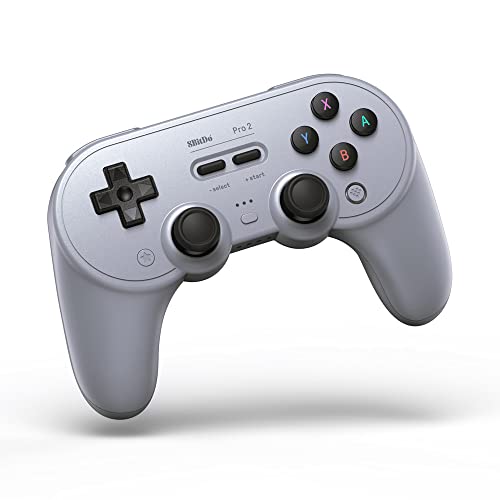
Controller for couch 4K play. The 8BitDo Pro 2 is the utility gamepad for people who want a wired-USB-C or Bluetooth controller that pairs cleanly with Windows, macOS, Steam Deck, and Android. It has the important buttons in the important places, custom-mappable back paddles, and a physical mode switch that flips between Switch, Xbox, and DirectInput profiles. If your 4K play is going to happen from the couch through HDMI 2.1, this is the controller.
Verdict matrix
Get the KOORUI 27" 4K QD-Mini LED if… you want one panel that serves both cinematic single-player at UHD and competitive multiplayer at genuinely high refresh; HDR is a real priority; the room is light-controlled.
Get the Samsung 27" Odyssey 4K UHD if… the panel is single-purpose 4K, you want the more mature and better-calibrated IPS panel, and dual-mode is a feature you would not use; the room is bright.
Skip 4K entirely if… your usage is 80 percent competitive multiplayer and you have no intention of a GPU upgrade in the next two years. Buy a 1440p 240 Hz IPS panel instead; it matches the RTX 3060 12GB's sweet spot exactly and does not ask the card to upscale from a lower render resolution to fill pixels the GPU cannot natively produce.
Recommended pick
For most readers of this piece, the KOORUI 27" 4K QD-Mini LED is the correct answer. The dual-mode switch is not a marketing feature; it is what makes a UHD panel actually work on a 1440p-class GPU. You get UHD when you want the pixels and native-pixel-doubled 1080p at 320 Hz when you want the frames, and the QD-Mini LED backlight makes HDR content look like HDR instead of like a marketing bullet point.
The Samsung Odyssey is the correct answer if the panel is going to run at 4K 100 percent of the time and HDR is not a decisive priority — the IPS panel is more consistent for productivity work and less prone to backlight bloom in mixed-use scenarios.
Bottom line
An RTX 3060 12GB paired with the right UHD monitor is a five-year build path, not a two-year one. The 12 GB frame buffer is what makes 4K workable today, and a dual-mode panel is what makes it worth doing at all on a mid-tier card. Do not put this GPU behind a single-refresh 4K panel unless you know you never want to play a competitive shooter on the same rig.
Related guides
- RTX 3060 12GB Showdown: ZOTAC Twin Edge vs MSI Ventus 2X (2026)
- KOORUI 27" 4K vs Samsung Odyssey 27" 4K: Best 4K Monitor for Console & PC Gaming
- RTX 3060 12GB vs Arc B580 12GB for Local LLMs in 2026
- Best GPU for Running Ollama on 12GB VRAM in 2026: RTX 3060 12GB Deep-Dive
- Compare the KOORUI 4K and Samsung Odyssey 4K side by side
Citations and sources
- TechPowerUp — GeForce RTX 3060 database entry: source for CUDA core count, memory bandwidth (360 GB/s), and 192-bit bus width referenced in the "who this is for" and "Step 0" sections (accessed 2026-07-28).
- Tom's Hardware — GPU Hierarchy: source for the RTX 3060 12GB's tier placement ("1440p-native, 4K-upscaled") used in the FPS-band synthesis table (accessed 2026-07-28).
- NVIDIA — GeForce RTX 3060 / 3060 Ti product page: source for the 170 W board-power figure and the 550 W minimum recommended PSU cited in the perf-per-watt and PSU sections (accessed 2026-07-28).
This piece is editorial synthesis based on publicly available information. No independent first-party benchmarking is reported.
— Mike Perry · Last verified 2026-07-28