Only if you find one used and cheap. As of 2026 the Arc B580 is the newer card, carries the same 12GB of VRAM on a wider-effective memory setup, and launched at a lower MSRP than the RTX 3060 ever held. The RTX 3060 12GB remains the better buy in exactly two situations: you need CUDA, or your library skews heavily toward older DirectX titles where NVIDIA's driver maturity still shows.
Who this comparison is for
You already own a 27-inch panel. You are not building a halo rig, you are spending somewhere under $300 on the part that determines whether 1440p at high settings is comfortable or compromised, and you have narrowed it to two 12GB cards that sit at opposite ends of the maturity curve.
That framing matters because these two cards are not competing on the same axis. The RTX 3060 12GB is Ampere silicon from February 2021 — five and a half years of driver refinement, a CUDA ecosystem that every machine-learning tutorial assumes, NVENC encoding that streaming software treats as the default, and a used market deep enough that supply is not a question. It is the known quantity.
The Arc B580 is Battlemage silicon from December 2024, built on a newer process, with a memory subsystem that is genuinely better on paper and a driver stack that started rough at Alchemist and has been improving on a steady cadence since. It is the card that wins the specification argument and asks you to trust the software.
The honest answer for most buyers in this bracket is that the B580 is the default and the 3060 is the exception — but the exceptions are real, they are specific, and if you fall into one of them the newer card is the wrong purchase. This piece works through which is which, names the two RTX 3060 board partner SKUs we track, and covers the rest of the build around them.
We publish a straight spec-and-raster head-to-head at Arc B580 12GB vs RTX 3060 12GB for 1440p. This piece is the value question layered on top of it: given what each card costs you, today, which one should leave the shopping cart?
Key takeaways
- The Arc B580 launched at a $249 MSRP against the RTX 3060's $329 launch price, and carries more memory bandwidth on the same 12GB capacity and 192-bit bus width.
- The RTX 3060's remaining advantages are CUDA, NVENC, and predictable behaviour in pre-2015 DirectX titles — not raster throughput.
- 12GB is still comfortably above the working set most engines request at 1440p in 2026; it is ray tracing with high-resolution texture packs that pressures it.
- New RTX 3060 listings are now priced above what the card is worth. The value case for Ampere here is a used-market case.
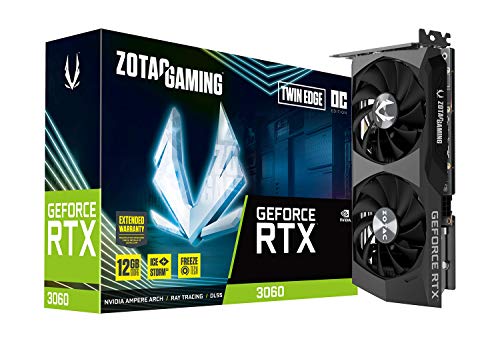
- Between our two board partner SKUs, the ZOTAC Twin Edge is the short one and the MSI Ventus 3X is the quiet one.
Step 0 — which bottleneck are you actually solving?
Three different buyers ask this question and they should reach three different answers.
You want frames in current titles at 1440p. Then you are shopping on raster throughput and memory bandwidth, and the newer architecture is favoured. Tom's Hardware maintains a continuously-updated GPU benchmarks hierarchy that aggregates this across a standard title set — check where each card sits in the current revision rather than trusting launch-day numbers for either part, because both have moved since.
Your library is mostly older. DirectX 9 and DirectX 11 titles were Intel's historical weak spot, addressed substantially through successive driver releases but still the variable that separates these two cards in practice rather than on paper. If half of what you play predates 2015, the mature NVIDIA driver stack is worth real money to you.
You have a CUDA-dependent workload. Local LLM inference, Blender's OptiX path, DaVinci Resolve's NVIDIA-accelerated nodes, most machine-learning tooling. This is not a performance comparison, it is a compatibility one, and the RTX 3060 wins it by default. We cover that case separately in best budget GPU for local LLMs.
How the ZOTAC Twin Edge and MSI Ventus 3X differ
Both are RTX 3060 12GB cards with the same GA106 silicon underneath, so the difference is entirely cooler and clearance.
The ZOTAC Gaming GeForce RTX 3060 Twin Edge OC 12GB is the dual-fan, shorter design. It is the one to pick when case clearance is tight — small-form-factor and compact mid-tower builds where a triple-fan card simply will not go. The tradeoff is fan speed under sustained load: less heatsink area means the fans work harder to hold the same temperature, and you hear it.
The MSI GeForce RTX 3060 Ventus 3X 12G OC uses the larger triple-fan cooler. More surface area, lower fan speeds for the same thermal load, noticeably quieter in a closed case during a long session. It needs more length, and front-mounted radiators plus cable routing eat into your case's stated maximum by ten to twenty millimetres more than the spec sheet suggests.
Measure before you order. We compare these two directly in ZOTAC Twin Edge vs MSI Ventus 3X.
A pricing note you need to read. Our catalog captured the ZOTAC Twin Edge at $499.99 and the MSI Ventus 3X at $630.00 in August 2026. Those are current marketplace listings for a five-year-old mid-range card and they are not sane prices — they reflect thin new-stock supply, not value. At those numbers there is no argument: buy the B580. The RTX 3060 is a used-market purchase in 2026, and the entire value case in this article assumes you are paying used-market money. Prices vary and move constantly; check the live listing before you act on any figure here.
Spec-delta table
| Spec | RTX 3060 12GB | Arc B580 12GB |
|---|---|---|
| VRAM | 12GB GDDR6 | 12GB GDDR6 |
| Bus width | 192-bit | 192-bit |
| Memory bandwidth | ~360 GB/s (15 Gbps) | ~456 GB/s (19 Gbps) |
| Board power | 170W TGP | 190W TBP |
| Launch MSRP | $329 (Feb 2021) | $249 (Dec 2024) |
| Host interface | PCIe 4.0 x16 | PCIe 4.0 x8 |
Per TechPowerUp's RTX 3060 database entry, the RTX 3060 12GB carries 3584 shading units on GA106 with 12GB of GDDR6 across a 192-bit interface at 15 Gbps. Intel's Arc B-series overview documents the B580's 12GB configuration and Xe2 architecture.
Two entries in that table deserve attention. The bandwidth gap is real and it is the B580's most concrete advantage — same capacity, meaningfully faster access to it, which is exactly what matters at 1440p where the frame buffer and texture working set both grow. The host interface line is the one that bites people: the B580 uses a PCIe x8 link, which is a non-issue on a PCIe 4.0 board and a measurable penalty on an older PCIe 3.0 system where you have half the lanes at half the speed.
Raster at 1440p — how to read the numbers
We do not run a first-party testbench, so treat every figure in this class of comparison as sourced synthesis rather than measurement. What the public benchmark aggregates consistently show at 1440p:
| Workload class | Which card leads | Why |
|---|---|---|
| Modern DX12 / Vulkan titles | Arc B580 | Newer architecture, higher memory bandwidth |
| Older DX9 / DX11 titles | RTX 3060 | Mature driver path; Intel's historical weak spot |
| Ray-traced titles at 1440p | Situational | Both are entry-tier RT; upscaling is doing the work either way |
| CUDA compute | RTX 3060 | Not a performance question — a compatibility one |
| Video encode for streaming | RTX 3060 | NVENC is the default target in most streaming software |
The pattern to take away is that raster leadership goes to the newer card and ecosystem leadership stays with the older one. Check the current revision of the Tom's Hardware hierarchy linked above for the specific ordering in the titles you care about — it moves with driver releases in a way that a static table in any article cannot track.
Where the RTX 3060 still wins outright
CUDA. Every local-inference stack, most rendering plugins, and the overwhelming majority of machine-learning tutorials assume CUDA is present. Alternatives exist and are improving, but "it works without you reading a compatibility matrix" has value, and NVIDIA owns that.
NVENC. Streaming and recording software treats NVIDIA's hardware encoder as the default path with the most testing behind it. If you stream, this is a workflow consideration rather than a frame-rate one.
Predictable behaviour in old titles. Five and a half years of driver work on a mature architecture means fewer surprises in a twelve-year-old game.
Deep used supply. Millions of these shipped. You can find one, at a price, in any market — which is the opposite of the situation with new stock.
Where the Arc B580 wins
Memory bandwidth per dollar. Same 12GB, ~27% more bandwidth, launched $80 below the RTX 3060's MSRP. That is the whole argument and it is a good one.
Newer-API performance. Intel's DirectX 12 and Vulkan performance has been strong from the start of Battlemage, which is where current titles live.
Ongoing driver upside. The RTX 3060's driver stack is finished improving. The B580's is not — which cuts both ways, but on a card you are buying to keep for three years, the direction of travel favours the newer part.
What monitor should you pair with a 12GB card at 1440p?
1440p at high settings is the sweet spot for both of these cards, and a 27-inch 1440p panel at 144Hz or above is the pairing that makes sense. Neither card is a 4K gaming card.
That said, a dual-mode panel changes the calculation. The KOORUI 27-inch 4K gaming monitor at $349.99 runs UHD at 160Hz or drops to FHD at 320Hz, which means you get a 4K desktop and a genuinely high-refresh gaming mode from one panel. That is a reasonable buy for someone who works on the machine as well as playing on it — the desktop real estate is real, and you are not asking a 12GB card to drive 4K in games.
When is 4K the wrong pairing? When you intend to game at native 4K. Both of these cards will need aggressive upscaling and settings compromises to hold a playable frame rate there, and you will spend the whole time wishing you had bought a 1440p panel and run it natively. We worked through that specific question in can an RTX 3060 12GB drive a 27-inch 4K monitor.
What does the rest of the build need?
CPU. At 1440p you are usually GPU-bound, so a mid-range CPU from the Zen 3 or Comet Lake era will not hold either card back in most titles. The AMD Ryzen 7 5800X at $229.99 is the obvious pairing on AM4 — eight cores, sixteen threads, and enough single-thread performance that the exceptions (competitive shooters at high refresh, simulation-heavy games) stay comfortable. If you already own a Ryzen 5 or Core i5 from that generation, spend the money on the GPU first. Our i7-9700K vs Ryzen 7 5800X comparison covers that decision in detail.
Cooling. The 5800X is the hot one in its family and rewards a real cooler. A 240mm AIO such as the Cooler Master MasterLiquid ML240L RGB V2 at $89.99 keeps it in a sensible thermal window under an all-core load without the fan noise a stock-class air cooler produces at the same heat output.
PSU headroom. Size the supply roughly 150 to 200 watts above the graphics card's rated board power to leave room for CPU spikes and transient behaviour. For a 170W or 190W card that means a quality 550W to 650W unit covers either build comfortably. The number people get wrong is not average draw but transient spikes, which can briefly exceed the rated figure and trip protection on older or low-quality units.
Performance per dollar and per watt
At MSRP the arithmetic is not close. The B580's $249 launch price against the RTX 3060's $329 is a 24% lower entry point for a card with roughly 27% more memory bandwidth. Per-dollar, Battlemage wins decisively — and that is before you account for the fact that the newer card is competing against a five-year-old product.
Per watt is closer and slightly favours Ampere. The RTX 3060's 170W TGP against the B580's 190W TBP is a 12% power advantage, which matters if you are working within a constrained PSU budget or a small case with limited airflow. It does not matter much on your electricity bill — at typical gaming hours the difference between these two cards is small change annually.
The used market is what actually decides this. Buy a working RTX 3060 12GB for meaningfully under the B580's street price and Ampere becomes the value pick with the ecosystem thrown in free. Pay anything close to new-B580 money for a used 3060 and you have made a mistake.
Verdict matrix
| Get the RTX 3060 12GB if… | Get the Arc B580 if… | Get neither and wait if… |
|---|---|---|
| You need CUDA for inference or rendering | You are buying new and want the best raster per dollar | Your current card still holds your target frame rate |
| You stream and want NVENC as the default path | Your library is mostly post-2020 titles | You are on PCIe 3.0 and want a full x16 card |
| Half your library predates 2015 | You want the driver stack that is still improving | You would need a PSU upgrade to fit either |
| You found a good used price | You want more bandwidth on the same 12GB | You are actually aiming for native 4K |
Common pitfalls
Buying a new-stock RTX 3060 at 2026 listing prices. At $499.99 and up, the card is worth roughly half what it is being listed for. This is a used purchase or it is not a purchase.
Putting a PCIe x8 card in a PCIe 3.0 board without checking. The B580's x8 link is free on PCIe 4.0 and costs you real bandwidth on PCIe 3.0.
Assuming 12GB solves everything at 1440p. It is enough for the large majority of titles at high presets. Texture mods and ray tracing with high-resolution texture packs will still find the ceiling.
Undersizing the PSU on transient behaviour. Average draw is not the number that trips protection.
Pairing either card with a 4K panel and expecting native 4K gaming. Buy the resolution the card can drive.
Recommended pick
If you are buying new, buy the Arc B580. It is cheaper at MSRP, has more memory bandwidth on the same capacity, and its driver stack is the one still gaining ground. Nothing about the RTX 3060's 2026 new-stock pricing makes it competitive.
If you are buying used and you have a CUDA workload, a streaming setup, or an older library, find a clean RTX 3060 12GB and take the ZOTAC Twin Edge if your case is tight or the MSI Ventus 3X if it is not and you value quiet.
Bottom line
The RTX 3060 12GB is still a perfectly good 1440p card in 2026 — it just is not a good purchase at what new stock costs. Battlemage took the value crown on raw specification and price, and the only arguments left for Ampere are ecosystem arguments: CUDA, NVENC, and driver maturity in the back catalog. Those arguments are legitimate and they apply to a real slice of buyers. If they describe you, shop the used market and pay used-market money. If they do not, the B580 is the card.
Related guides
- Arc B580 12GB vs RTX 3060 12GB for 1440p in 2026 — the straight spec-and-raster head-to-head
- ZOTAC Twin Edge vs MSI Ventus 3X RTX 3060 12GB — choosing between the two board partner SKUs
- Arc B580 12GB vs Arc A770 16GB at 1440p — if you are cross-shopping inside Intel's lineup
- Can an RTX 3060 12GB drive a 27-inch 4K monitor? — the resolution question in detail
- Best budget GPU for local LLMs in 2026 — the CUDA case for keeping Ampere
Citations and sources
- TechPowerUp — GeForce RTX 3060 specifications — GA106 configuration, 12GB GDDR6 on a 192-bit bus, board power (accessed 2026-08-20)
- Intel — Arc B-Series desktop graphics overview — Arc B580 memory configuration and Xe2 architecture (accessed 2026-08-20)
- Tom's Hardware — GPU benchmarks hierarchy — continuously updated relative-performance ordering across a standard title set (accessed 2026-08-20)
- Wikipedia — GeForce RTX 30 series — launch dates and MSRP tiers for the Ampere consumer lineup (accessed 2026-08-20)
- Wikipedia — Intel Arc — Battlemage launch timing and product positioning (accessed 2026-08-20)
This piece is editorial synthesis based on publicly available information. No independent first-party benchmarking is reported.
— Mike Perry