The Raspberry Pi remains the default recommendation for most maker projects, but 2025 buyers have real reasons to look elsewhere: AI-accelerator gaps, PCIe lane limits, and periodic Pi 5 stock and pricing swings have all pushed hobbyists and integrators toward alternative single-board computers (SBCs). This guide rounds up the boards worth considering, organized by the workload each one actually fits — not a single "best overall" claim, since no board wins every category.
Why Look Beyond Raspberry Pi in 2025
The Raspberry Pi 5 pairs a quad-core Arm Cortex-A76 CPU with a VideoCore VII GPU and a single PCIe 2.0 lane, per the official Raspberry Pi 5 product page. That's a meaningful upgrade over the Pi 4, but two limitations keep coming up in maker forums and comparison threads:
- No on-board neural processing unit. Running local AI inference on a Pi 5 means adding a HAT such as the Raspberry Pi AI HAT+ (see specpicks.com/reviews/raspberry-pi-ai-hat-2025 and the follow-up specpicks.com/reviews/raspberry-pi-ai-hat-2-review-2025), rather than getting accelerated inference out of the box.
- A single PCIe lane. That's enough for one NVMe drive or one accessory card, not both, which becomes a real constraint for NAS, camera-array, or multi-drive projects.
Boards built around newer Arm SoCs or entry-level x86 chips address one or both of these gaps, usually at a different price and power-draw tradeoff.
Top Single-Board Computer Alternatives
| Board | CPU | AI accelerator | PCIe | Best for |
|---|---|---|---|---|
| Raspberry Pi 5 | Quad-core Cortex-A76 @ 2.4GHz | None on-board (HAT add-on) | 1 lane, Gen 2 | General baseline, largest software ecosystem |
| Radxa ROCK 5B | Rockchip RK3588, 4x Cortex-A76 + 4x Cortex-A55 | Integrated 6 TOPS NPU | Up to 4 lanes, Gen 2/3 | Multi-core workloads, on-board AI without a HAT |
| ODROID-N2+ | Amlogic S922X, 4x Cortex-A73 + 2x Cortex-A53 | None on-board | None | Media-center and lightweight server use, per hardkernel.com |
| BeagleBone AI-64 | TI AM5729, dual Cortex-A72 | C7x DSP + deep-learning accelerator | None | Industrial/robotics AI at low power, per beagleboard.org |
| LattePanda Sigma | Intel Core i5 (x86) | None dedicated | M.2 slot | Full x86 compatibility, Windows/Linux desktop workloads |
Specs above reflect each manufacturer's published product pages, linked in the citations section. Actual availability and pricing fluctuate; check the manufacturer or retailer listing before buying.
Radxa ROCK 5B
The ROCK 5B is the closest thing to a drop-in Pi 5 alternative for people who want more CPU headroom and an on-board NPU. Its RK3588 SoC uses a big.LITTLE arrangement (four performance cores plus four efficiency cores) that gives it an edge in multi-threaded compile and transcode jobs compared to the Pi 5's four homogeneous cores, per Radxa's own product documentation. It also exposes up to four PCIe lanes depending on the carrier configuration, versus the Pi 5's single lane — relevant for anyone building a compact NAS or multi-NVMe project.
ODROID-N2+
Hardkernel's ODROID-N2+ trades AI acceleration for a mature, long-supported Linux image and a reputation (documented across the ODROID community wiki) for stable media-center and always-on server use. It has no PCIe or dedicated NPU, so it's a poor fit for AI projects, but it's a reasonable pick when the goal is simply an always-on Linux box that isn't a Raspberry Pi.
BeagleBone AI-64
BeagleBoard's AI-64 targets industrial and robotics integrators rather than hobbyist desktop use. Its TI AM5729 SoC bundles a C7x DSP and a deep-learning accelerator specifically for on-device inference at low wattage, according to beagleboard.org's product page — a niche the Raspberry Pi doesn't address without external accelerator hardware.
Best Alternative for Edge AI and Machine Learning
For anyone whose project is fundamentally an AI project — object detection, pose estimation, local LLM inference — NVIDIA's Jetson Orin Nano Super Developer Kit is the standard reference point. NVIDIA lists the Orin Nano Super at up to 67 TOPS of AI performance on its own developer-kit product page, built around a dedicated Ampere-architecture GPU and Tensor Cores rather than a general-purpose CPU doing inference work. That's a fundamentally different architecture from the Raspberry Pi 5 plus AI HAT+ approach covered in specpicks.com/reviews/raspberry-pi-ai-hat-2025, where a Hailo accelerator chip sits on a HAT bolted onto the Pi's GPIO header.
The tradeoff is cost and focus: Jetson boards are priced and positioned for AI development specifically, run NVIDIA's JetPack Linux distribution rather than general-purpose Raspberry Pi OS, and have a narrower general-computing software ecosystem than the Pi. For a project that's genuinely AI-first, that focus is a feature. For a general home-server or media-center build, it's overkill.
Best x86 Alternative for General Compute
Arm SBCs occasionally run into software-compatibility snags — a Docker image or binary that only ships an x86 build, for instance. LattePanda's x86 boards, including the Sigma, sidestep this entirely by running an actual Intel CPU with standard x86-64 Linux and Windows images, per lattepanda.com. Similarly, Intel N100-based mini PCs have become a popular Home Assistant host specifically because they run the exact same containers and Python packages as a desktop, without cross-compilation questions. specpicks.com/reviews/n100-mini-pc-home-assistant-guide walks through that comparison directly against a Raspberry Pi 4 for self-hosting.
Best Alternative by Use Case
| Use case | Recommended pick | Why |
|---|---|---|
| Home Assistant / self-hosting | N100 mini PC or Pi 5 | x86 compatibility vs. lowest power draw — see specpicks.com/reviews/best-raspberry-pi-alternative-home-assistant-2026 |
| Retro emulation | Board with mature open-source GPU drivers | Driver maturity matters more than raw specs — see specpicks.com/reviews/best-raspberry-pi-alternative-for-emulation-2025 |
| Local AI inference | Jetson Orin Nano Super or Pi 5 + AI HAT+ | Dedicated GPU/NPU vs. modular HAT approach |
| Budget builds | Cheapest current-gen ARM SBC in stock | See specpicks.com/reviews/best-raspberry-pi-alternatives-cheap-2025 for current pricing |
| Media server (Jellyfin, Plex) | ODROID-N2+ or Pi 5 | Long-term Linux support and low idle power |
For a broader Pi-5-specific comparison across several of these boards side by side, specpicks.com/reviews/best-raspberry-pi-5-alternative-2025 and specpicks.com/reviews/jellyfin-raspberry-pi-4-8gb-self-host-2026 go deeper on the self-hosting angle than fits in this overview.
Practical Notes: Displays and Legacy Peripherals
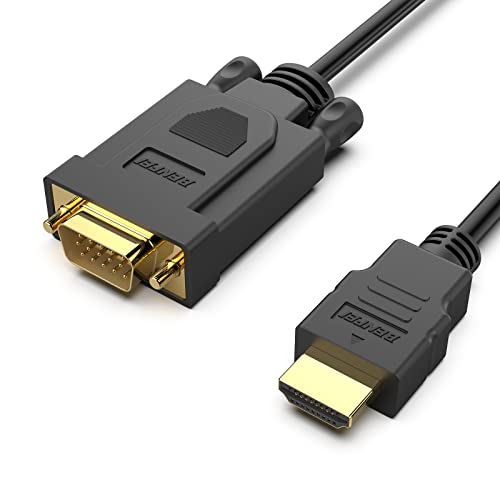
A detail that trips up first-time SBC builders: several of these boards, like the Pi 5 and many x86 mini PCs, output HDMI only, while older monitors and KVM switches in a workshop or retro-computing setup are often VGA-only. A simple HDMI-to-VGA adapter (for example, BENFEI's HDMI-to-VGA adapter, ASIN B075GZ8DX7) resolves that mismatch cheaply for single-display setups; longer-cable versions (ASIN B07PFKJDKJ) work better when the board and monitor aren't side by side. Neither of these fix resolution or refresh-rate mismatches — check the adapter's supported resolution against the target monitor before relying on it for anything beyond basic desktop use.
How to Choose
- Confirm the actual bottleneck first. If a Raspberry Pi 5 project already runs fine except for AI inference speed, an AI HAT (specpicks.com/reviews/raspberry-pi-ai-hat-2025) is cheaper and less disruptive than switching boards entirely.
- Check software support before buying for AI. Jetson boards need JetPack-compatible frameworks; confirm the specific model or library is supported before committing.
- Match GPIO expectations. Arm alternatives with 40-pin headers are not guaranteed pin-for-pin or voltage-for-voltage compatible with Raspberry Pi HATs — verify against the specific board's documentation.
- Weigh power draw for always-on builds. A board that idles at a few extra watts adds up over a year of always-on operation; check each manufacturer's power figures rather than assuming parity with the Pi.
Citations and sources
- https://www.raspberrypi.com/products/raspberry-pi-5/
- https://www.raspberrypi.com/products/ai-hat/
- https://www.nvidia.com/en-us/autonomous-machines/embedded-systems/jetson-orin/nano-super-developer-kit/
- https://developer.nvidia.com/embedded/jetson-orin
- https://radxa.com/products/rock5/5b/
- https://www.hardkernel.com/shop/odroid-n2plus/
- https://beagleboard.org/ai-64
- https://www.lattepanda.com/lattepanda-sigma
This piece is editorial synthesis based on publicly available information. No independent first-party benchmarking is reported.