Local-LLM PC Build on a 16GB Card: What r/LocalLLaMA and r/buildapc Concluded (2026)
Which 16GB card, how much RAM and which CPU the local-LLM build threads keep landing on, with the benchmark numbers behind each pick.
By Mike Perry, Founder & Editor-in-Chief · Published 2026-10-09 · Updated 2026-10-09 · 14 min read
RTX 5060 Ti 16GB or RX 9060 XT 16GB, 64GB RAM for MoE offload and an AM4 Ryzen host: the 16GB local-LLM build Reddit threads converge on in 2026.
Quick Answer
For local LLMs on a 16GB card in 2026, the build that community threads keep converging on is an RTX 5060 Ti 16GB (or an RX 9060 XT 16GB if you accept ROCm/Vulkan setup), 64GB of system RAM for MoE offload, and a reused AM4 Ryzen 7 5800X host. Per Hardware Corner's local-LLM GPU ranking, the RTX 5060 Ti 16GB generates 51.41 tok/s on Qwen3 8B at 16K context.
Hardware at a Glance
Median generation throughput at 7–9B models (Llama 3.1 8B, Qwen 3 8B), Q4 quantization, from community-reported runs SpecPicks tracks. Each row pools runs from different sources, runtimes and models in that class, so the rows are not a matched head-to-head; where the article compares cards on the same rig, its own figures are the like-for-like result. Street price is the second-lowest listing priced within the last 24 hours inside a sane band of MSRP, so no single listing sets it; where too few listings pass that check the row shows launch MSRP instead.
The table below maps each slot to the pick that the cited threads lean toward. Where the threads disagree, the row says "community split". Threads are referenced by title only; the summaries are paraphrases of what each thread is about, not quotes.
Introduction: why 16GB is the tier threads keep landing on in 2026
The 2026 question on r/LocalLLaMA is no longer "can I run a local model at all?" It is "can I run a model that is actually useful for coding and long documents without buying a 24GB or 32GB card?" Two workloads drive that question.
The first is 27B-class dense models at 4-bit quantization. The r/LocalLLaMA thread What's the best setup for Qwen 3.8 27B for a 16 gig VRAM (surfaced 2026-10-02) asks exactly this. A 27B model at roughly 4.5 bits per weight needs about 15–16GB just for the weights, using the arithmetic 27 billion × 4.5 bits ÷ 8 bits per byte. That fills a 16GB card before you add any KV cache, so context length and quant choice decide the experience.
The second is mixture-of-experts (MoE) models in the 30–35B range with only ~3B active parameters, the "35B-A3B" class. The thread titled RTX 5080 16GB: Qwen3.6 35B MoE at 128K context, 56 tok/s shows why these models matter for 16GB owners. The poster reports 56 tok/s at a 128K context on a 16GB card, a model the card could never hold entirely in VRAM.
The 12GB tier struggles with the first workload, and the 24GB tier costs a step up most buyers don't want to pay. That leaves 16GB as the tier where the build questions cluster. SpecPicks already covers the 12GB build; this piece is its 16GB companion.
Key Takeaways
16GB, not 8GB. Both r/buildapc comparison threads (9060XT 16GB vs 5060Ti 8GB, RTX 5060 8GB vs RX 9060 XT 16GB) frame the choice as VRAM capacity against brand. For LLM work, capacity is the hard ceiling, so the 8GB variants drop out.
The two 16GB cards are close on small models. SpecPicks' benchmark database puts the 7–9B generation median at 59.1 tok/s for the RTX 5060 Ti 16GB and 55.1 tok/s for the RX 9060 XT 16GB (medians of published third-party runs, as of 2026-10-09).
64GB of system RAM is what makes 16GB punch above its weight. MoE offload keeps attention on the GPU and expert weights in system memory, per the single 16GB GPU + 64GB RAM thread.
AM4 reuse is fine. Once the model is on the GPU, the CPU is not the bottleneck. Spend the platform money on RAM capacity instead.
Sources: memory specs from NVIDIA's RTX 5060 family page and StorageReview's RX 9060 XT review. Medians are computed from published third-party runs on 7–9B models logged in SpecPicks' benchmark database, which mix quantizations and runtimes. Treat them as directional, not head-to-head.
That last caveat matters. The RTX 3060's pooled median sits level with the 5060 Ti's, which most likely reflects differences in the models, quants, contexts and runtimes each pool contains rather than equal hardware. On a single, controlled methodology the gap is clear. Hardware Corner's ranking measures the RTX 5060 Ti 16GB at 51.41 tok/s generation on Qwen3 8B at 16K context, against 41.97 tok/s for the RTX 3060 under the same settings. Prompt processing at 16K is 1,447.92 tok/s against 1,119.23 tok/s. The same page calls the 5060 Ti "the top value pick for budget builders."
For the AMD card, the llama.cpp ROCm scoreboard discussion lists an RX 9060 XT 16GB result of 67.58 tok/s generation (tg128) and 1,419.67 tok/s prompt processing (pp512) on Llama 2 7B Q4_0 under ROCm without flash attention. That is a competitive number on paper. StorageReview's review, however, says the card "lags behind in text generation tasks" relative to the NVIDIA cards it tested. The two sources use different software, which is the RX 9060 XT story in one sentence: the hardware is capable, and results depend heavily on which backend you run.
Why the 8GB variants are rejected. Both r/buildapc threads, by their titles, pit an 8GB NVIDIA card against the 16GB RX 9060 XT. For gaming that can be a real trade-off. For LLMs it isn't. An 8GB card cannot hold a 14B model at Q4 with useful context, and every layer that spills to system RAM runs at system-memory speed. If local inference is a primary use, the 8GB SKUs are off the list.
Community verdict: NVIDIA when you want the fewest setup problems, AMD when the price gap is wide and you are comfortable on Linux with ROCm or on the Vulkan backend.
Why do the threads say 64GB of system RAM matters on a 16GB build?
MoE models change the arithmetic. A 35B-A3B model has about 35 billion total parameters but activates only about 3 billion per token. Runtimes such as llama.cpp and ik_llama.cpp let you pin the dense, always-used tensors (attention, shared layers, KV cache) to the GPU and leave the expert feed-forward weights in system RAM. Only the handful of experts each token routes to are read from RAM, so generation stays fast even though most of the model sits outside VRAM.
Why 64GB rather than 32GB? Do the capacity arithmetic. A 35B model at roughly 4.5 bits per weight is about 20GB of weights. Add the OS, a browser, an IDE and the runtime's own buffers, and a 32GB system is already tight before you load a second model or raise context. With 64GB you have room for the model, a long context, and a second smaller model for autocomplete, which is the coding workflow that thread describes.
DDR4 or DDR5 for a local-LLM build?
This is a community split. The r/buildapc thread DDR5 vs DDR4, which is worth it comes from a general build forum, where the debate is usually about gaming. The LLM case differs in one way: memory bandwidth directly sets the speed of any layers you offload.
The theoretical peak bandwidth is simple arithmetic (transfer rate × 8 bytes × channels):
Configuration
Theoretical peak bandwidth
Dual-channel DDR4-3200
51.2 GB/s
Dual-channel DDR4-3600
57.6 GB/s
Dual-channel DDR5-6000
96.0 GB/s
RX 9060 XT 16GB VRAM (StorageReview)
320 GB/s
Two conclusions follow. First, offloaded layers run several times slower than layers in VRAM on either memory generation. That is why MoE models, which read only a few experts from RAM per token, are the offload workload that works. Second, DDR5 roughly doubles offload throughput compared with DDR4-3200, but getting it means a new board and CPU.
The practical rule: if you already own an AM4 system, buy 64GB of DDR4 and put the savings into the GPU. If you are building from nothing, AM5 + DDR5 is the better long-term platform, and the extra bandwidth is a bonus on offload-heavy setups.
Which CPU do the threads pair with a 16GB card?
Once a model is fully in VRAM, token generation is limited by GPU memory bandwidth, not by the CPU. The CPU matters for three things: prompt handling when layers are offloaded, feeding the PCIe bus, and whatever else the machine does.
AMD Ryzen 7 5800X: 8 Zen 3 cores and 16 threads. This is the comfortable AM4 pick when you run MoE offload, because the CPU computes the offloaded expert layers and more cores help.
AMD Ryzen 5 5600X: 6 cores and 12 threads. Fine when the model lives on the GPU and you rarely offload.
When AM4 reuse is right: you already own the board, it has a PCIe x16 slot and four DIMM slots, and your plan is "16GB GPU + 64GB RAM". When it isn't: you are building from scratch (AM5 costs about the same and has an upgrade path), or you plan to offload heavily and want DDR5 bandwidth.
Either way, check that your board runs four DIMMs at the speed you buy. Four-DIMM DDR4 setups sometimes need a lower XMP profile, so check the board's memory QVL before ordering two kits.
Is a 12GB card still enough?
The honest answer is "often, yes", and two threads make that counter-case.
The 110 tok/s with 12GB VRAM on Qwen3.6 35B A3B and ik_llama.cpp thread reports that generation rate in its title on a 12GB card, using the ik_llama.cpp fork's MoE offload. If your main models are MoE, a 12GB card plus 64GB of RAM covers much of what a 16GB card does.
The $400 Qwen 3.6-27B setup: dual RTX 3060 / 3050 thread takes a different route: split a 27B dense model across two cheap cards. It works because llama.cpp can spread layers across GPUs. The cost is a second PCIe slot, more power, and more tuning.
Step up to 16GB when: you mainly run 27B-class dense models, need 32K+ context on dense models, or don't want to depend on MoE offload tuning.
Cooling, storage and PSU: the unglamorous rows
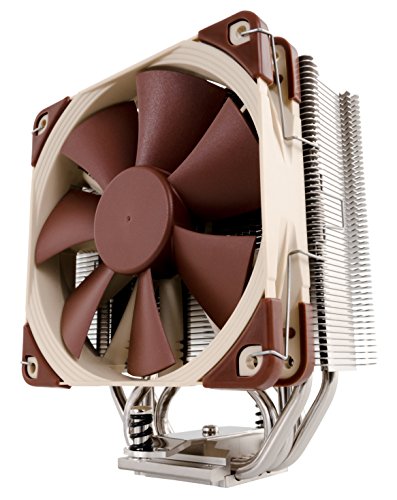
Cooling. LLM inference is a sustained load: long agentic sessions keep the GPU and, during offload, the CPU busy for minutes at a time. A single-tower air cooler like the Noctua NH-U12S fits the 5800X class without needing an AIO. Check case clearance for a tower cooler and keep a front-to-back airflow path for the GPU.
Storage. Model files add up fast. A 27B Q4 GGUF is roughly 15–16GB and a 35B-A3B Q4 roughly 20GB, and most people keep several quants and models. Plan on 1–2TB of NVMe dedicated to models. Load time from NVMe is a one-time cost per session, so a fast PCIe 4.0 drive is a convenience, not a requirement.
PSU. Size from the parts. NVIDIA lists the RTX 5060 Ti's total graphics power at 180W. StorageReview gives the RX 9060 XT a 160W typical board power and a 450W minimum PSU. Add the CPU's package power, plus drives, fans and transient spikes. A quality 650W unit leaves comfortable headroom for either 16GB build and room for a second card later. Always follow the GPU vendor's required-system-power figure on its spec page.
What you'll need checklist
Runtime build that matches the card: a CUDA build of llama.cpp (or Ollama/LM Studio, which bundle it) on NVIDIA. On AMD, a ROCm build on supported Linux distros or the Vulkan backend elsewhere. Compare the llama.cpp ROCm scoreboard against your own card before assuming a figure.
ik_llama.cpp if you plan to push MoE offload hard, which is the fork behind the 110 tok/s 12GB thread.
BIOS: XMP/EXPO enabled. Out of the box, DDR4 often runs at its JEDEC default speed, well below the kit's rated speed, which throttles offloaded layers.
BIOS: Resizable BAR / Above 4G Decoding on.
GPU in the primary x16 slot, with nothing sharing its lanes.
Quant plan: Q4_K_M or similar for 27B dense on 16GB, with context sized to what's left.
Common pitfalls
Buying the 8GB variant to save money. VRAM cannot be upgraded later, and 8GB rules out 14B-plus models at useful context.
Running 64GB at JEDEC speed. Forgetting XMP/EXPO cuts offload bandwidth by a third or more.
Maxing out context on a dense 27B model. The KV cache grows with context. A model that loads at 4K context can fail or spill to RAM at 32K.
Assuming the AMD benchmark you saw will reproduce on your OS. ROCm and Vulkan results differ, as the gap between the llama.cpp scoreboard and StorageReview's figures shows.
Undersizing the PSU for a future second card. The dual-3060 path in the $400 thread only works if the PSU and board allow it.
Verdict matrix
Get the RTX 5060 Ti 16GB build if… you want CUDA tooling that just works (vLLM, ExLlama, Ollama, LM Studio), you run 27B dense models at Q4, or you value Hardware Corner's measured lead over the RTX 3060.
Get the RX 9060 XT 16GB build if… the price gap at your retailer is meaningful, you run Linux with ROCm or are happy on Vulkan, and your workloads are mainstream llama.cpp GGUF models.
Stay on a 12GB RTX 3060 if… your models are 7–14B or MoE models that run well with offload, and you would rather put the difference into 64GB of RAM.
Recommended pick
The best-supported parts list from these threads is an ASUS Dual RTX 5060 Ti 16GB on a reused AM4 platform with an AMD Ryzen 7 5800X. Add 64GB of DDR4-3200 (two CORSAIR Vengeance LPX 32GB kits, checked against your board's QVL), a Noctua NH-U12S, a 1–2TB NVMe drive for models and a quality 650W PSU. That build runs 27B dense models at Q4 with moderate context. It also runs 35B-A3B MoE models with expert offload, and if prices shift you can drop to an RX 9060 XT 16GB or an RTX 3060 12GB without changing anything else.
Spec comparison
Each related SpecPicks piece covers a different angle:
As an Amazon Associate, SpecPicks earns from qualifying purchases; we also earn on qualifying eBay purchases via the eBay Partner Network. Prices shown were last tracked at crawl time and may vary — check the listing for the current price.
📹 Watch a review
Friendly Fire: AMD Ryzen 7 5800X CPU Review & Benchmarks vs. 5600X & 5900X — Gamers Nexus on YouTube
Frequently asked questions
Is 16GB of VRAM enough for 27B-class local models in 2026?
For 27B dense models it is workable at 4-bit quantization with a modest context window, which is why the r/LocalLLaMA thread on running Qwen 3.8 27B on 16GB centres on quant choice and context length rather than on whether it fits at all. Longer contexts push the KV cache past the card's limit, so expect to trade context for quality or move some layers to system RAM.
Why do community builds pair a 16GB card with 64GB of system RAM?
Mixture-of-experts models such as Qwen3.6 35B-A3B activate only a small fraction of their weights per token, so builders keep the attention layers on the GPU and park expert weights in system RAM. The single-16GB-GPU-plus-64GB-RAM thread describes this split for autocomplete and agentic coding. With 32GB of RAM there is little left once the OS and runtime take their share.
Should I pick the RTX 5060 Ti 16GB or the RX 9060 XT 16GB for local LLMs?
On small models the two are close: SpecPicks' benchmark database puts the published 7-9B generation medians at 59.1 tok/s for the RTX 5060 Ti 16GB and 55.1 tok/s for the RX 9060 XT 16GB, pooled across mixed quants and runtimes. The difference that matters is software. CUDA builds of llama.cpp, vLLM and most tooling work on NVIDIA with no setup, while AMD needs ROCm or Vulkan, so pick NVIDIA if you want the fewest setup problems.
Can I reuse an AM4 platform with DDR4 for a local-LLM build?
Yes. Community build threads routinely keep an AM4 board with a Ryzen 7 5800X or Ryzen 5 5600X and add a 16GB card, because generation speed is decided mostly by the GPU once the model fits in VRAM. DDR5's extra bandwidth only starts to matter when a large share of the layers is offloaded to system memory. Even then, buying more RAM capacity usually beats switching platforms.
When is a 12GB RTX 3060 still the smarter buy than a 16GB card?
When your models are 7-14B, or MoE models that run well with offload, a 12GB RTX 3060 covers most of the same work for less money. The '110 tok/s with 12GB VRAM on Qwen3.6 35B A3B' thread shows how far tuned MoE offload can go on 12GB. Move up to 16GB if you mainly run 27B-class dense models or need long contexts.