The build is a skeleton, a witch or a talking pumpkin that hears a trick-or-treater and answers in character. Inside, five stages run in a loop. A USB mic captures the kid's question. A speech-to-text model such as OpenAI Whisper turns it into text. A small language model writes a one- or two-sentence reply in the character's voice. A local text-to-speech engine such as Piper speaks it. Then a powered speaker, and maybe a servo jaw, plays it back.
Why run it all on the board instead of calling a cloud API? Porches have bad Wi-Fi. A cloud round-trip adds latency you can't control. And if the router drops at 7:30 p.m., a cloud-backed prop goes silent at the busiest point of the night. An on-device stack has no network dependency, no per-request cost and no audio leaving the yard. That makes the board's own inference speed the whole question.
Qwen3 4B is a sensible default brain for the job. Per its model card, it has 4.0B parameters (3.6B non-embedding), 36 layers and grouped-query attention with 32 query and 8 KV heads. It supports 32,768 tokens of context natively and 131,072 with YaRN. Qwen ships an official GGUF build whose Q4_K_M file is 2.50 GB, small enough for either board.
This piece is synthesis: every speed figure below comes from a published benchmark linked inline or from the aggregated medians on SpecPicks' benchmark pages.
Key Takeaways
The GPU sets the gap. Per the Turing Pi Orin Nano benchmark, Qwen3 4B Q4_K_M generates 19.53 tok/s on the Orin Nano Super in its 25W mode, with a 1.26 s time to first token.
The Pi 5 has no published Qwen3 4B run. Other 3.8-4B Q4_K_M models land between about 3 and 9.5 tok/s on the Pi 5 in community measurements. That is enough for short lines, not for banter.
Prompt processing matters more than generation. The Orin Nano Super processes the prompt for Qwen3 4B at 609.7 tok/s per Turing Pi. For 3B models on the Pi 5, pi5-llm-arena logged 28.89 tok/s in llama.cpp. A long character prompt costs seconds on the Pi and fractions of a second on the Jetson.
Memory isn't the problem on either board. Turing Pi recorded 2,913 MiB of memory use for Qwen3 4B Q4_K_M on the 8GB Jetson. That leaves room for a small Whisper model and a Piper voice.
Step 0: How fast does a talking prop actually need to be?
A prop doesn't need chatbot speed. It needs a reply that starts before the kid walks to the next house. Three stages add up to that delay:
Speech-to-text. Whisper's README lists the tiny (39M parameters) and base (74M) models at about 1 GB of VRAM each, and the small model (244M) at about 2 GB. Tiny and base are the realistic picks on an SBC, and the whisper.cpp port is the usual way to run them on Arm and Jetson boards.
Language model. This stage has two parts: processing the prompt (persona instructions plus the transcribed question), then generating the reply.
Text-to-speech. Piper is built for small local devices and can start speaking the first sentence while the model is still writing the second.
Streaming is what makes a slow board usable. If the LLM streams tokens and you hand each finished sentence to Piper, the kid hears speech as soon as the first sentence exists. So the number that matters is time to the first complete sentence, not time to the whole reply.
A one-sentence line like "Who dares to knock on my crypt tonight?" is roughly 10-15 tokens. At the Pi 5's 1-4B median of 7.5 tok/s that's about 2 seconds of generation. At the Orin Nano Super's Qwen3 4B rate of 19.53 tok/s it's well under one second. Both are fine for a single creepy line. The difference shows up in three places: long persona prompts, multi-sentence replies, and conversations where the prop has to remember what the kid said earlier.
When a 1-2B model is enough: if the prop only needs to pick a canned theme and riff one sentence on it, Qwen3 1.7B is the better match. Turing Pi measured it at 39.42 tok/s generation and 1,408.3 tok/s prompt processing on the Orin Nano Super. The OpenClaw Pi deployment notes settled on Qwen3 1.7B Q4_K_M as the primary model on a Pi 5 8GB after the 4B model proved unstable under load. Same SoC, same lesson.
Spec delta table
Board
Memory
Inference path
Power mode / PSU
Launch MSRP
Jetson Orin Nano Super Developer Kit
8GB 128-bit LPDDR5, 102 GB/s, shared CPU+GPU
1,024-core Ampere GPU via CUDA; 67 sparse INT8 TOPS
7W / 15W / 25W modes
$249
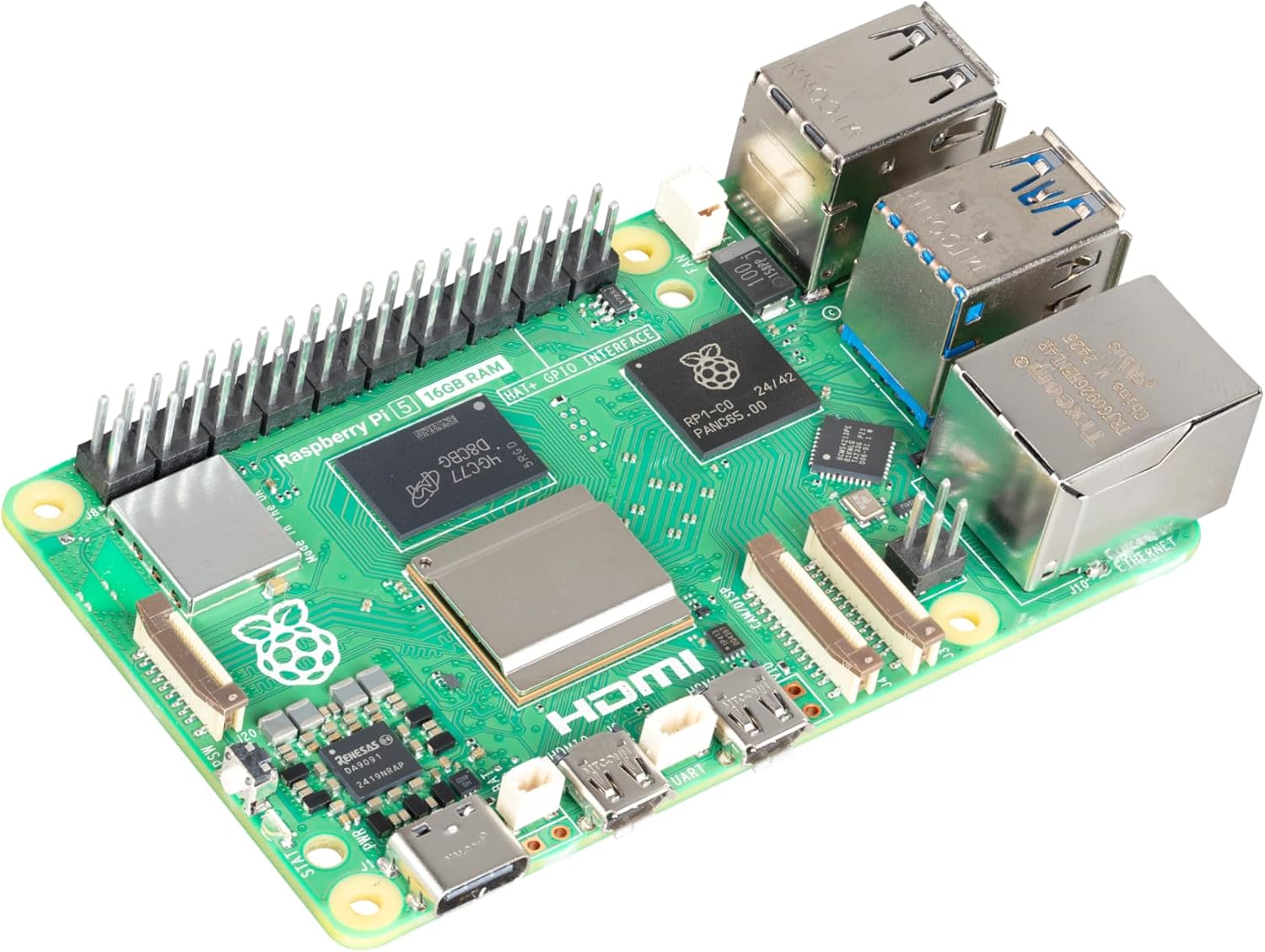
Raspberry Pi 5 16GB
16GB LPDDR4X
Quad-core Arm Cortex-A76 at 2.4 GHz, CPU-only
Official 27W USB-C supply
$120
Raspberry Pi 4 Model B 8GB
8GB LPDDR4
Quad-core Arm Cortex-A72, CPU-only
USB-C supply
$75
Sources: Jetson figures and price from NVIDIA's Super-boost post. Pi 5 clock from the Tom's Hardware Pi 5 16GB review, price from the Raspberry Pi 16GB launch post. Pi 4 8GB price from the Raspberry Pi 4 8GB launch post. The Super upgrade raised the module's memory bandwidth from 68 GB/s to 102 GB/s and added the 25W mode. That bandwidth is the main reason token generation sped up, since generating each token means streaming the model's weights from memory.
File sizes come from Qwen's official Qwen3-4B-GGUF repository. The BF16 size is derived from the 4.0B parameter count on the model card at 2 bytes per weight. "Fits" means the weights fit with room left for a short context and the speech stack. It is not a claim that anyone ran that combination.
Quant
Approx. file size
Fits Pi 5 16GB?
Fits Orin Nano Super 8GB shared?
Published tok/s
Q4_K_M
2.50 GB
Yes, easily
Yes
Orin Nano Super: 19.53 gen / 609.7 prompt (Turing Pi); Pi 5: no published run
Q5_K_M
2.89 GB
Yes
Yes
no published run
Q6_K
3.31 GB
Yes
Yes, with less speech-stack headroom
no published run
Q8_0
4.28 GB
Yes
Tight once STT, TTS and the OS are loaded
no published run
BF16
~8.0 GB (derived)
Yes, slowly
No; it fills the whole 8GB pool
no published run
For a prop, Q4_K_M is the right call on both boards. Generation speed on both is limited by memory bandwidth, so a bigger file generates more slowly. A slightly better word choice from Q6_K or Q8_0 isn't worth the slower reply when the line is "Muahaha, take two."
How many tokens per second does each board really get?
These are medians across every published 1-4B run in SpecPicks' benchmark database, with the per-run sources listed on each benchmark page:
The median mixes 1B and 4B models and several runtimes (llama.cpp, Ollama, MLC). So it is a class figure, not a Qwen3 4B figure. The one direct Qwen3 4B measurement on the Jetson, 19.53 tok/s, is about half the class median, which is what you'd expect for a model at the top of the size range.
For the Pi 5, the closest stand-ins are other ~4B models at Q4_K_M:
A fair expectation for Qwen3 4B on the Pi 5 is the 3-9 tok/s band. Treat that as an inference from neighboring models, not a measurement.
The Pi 4 has no 1-4B runs in the database. The nearest public figure is the Pi 400, which uses the same BCM2711 chip as the Pi 4. Per Jeff Geerling's benchmark commit, it runs Llama 3.2 3B at 1.60 tok/s. That rules the Pi 4 out for a 4B conversational prop.
Does context length or the speech stack eat the memory?
Prompt processing is the hidden cost. Every reply begins by processing the system prompt (character name, backstory, rules like "never break character, keep it under 20 words") plus the transcribed question. A 300-token persona prompt works out like this:
Orin Nano Super: about half a second at Turing Pi's 609.7 tok/s for Qwen3 4B.
Pi 5: roughly 10 seconds at the 28.89 tok/s that pi5-llm-arena logged for a 3B model in llama.cpp. Ollama runs in the same repository logged faster prompt rates on 3B models (178.39 tok/s for Qwen2.5 3B), so runtime and caching matter a lot.
The practical fix on either board is to keep the persona prompt short and let the runtime cache it between turns. llama.cpp and Ollama both reuse the KV cache for an unchanged prompt prefix.
Longer context costs speed and memory. Turing Pi pushed Qwen3 4B to a filled 16k-token context on the Orin Nano Super. Prompt processing fell to 436.0 tok/s and generation to 12.03 tok/s. The run failed at 32k when it tried to allocate a larger FP16 KV buffer. A prop that forgets everything after each kid needs a few hundred tokens of context, not 16k. Cap num_ctx / -c at 2,048-4,096.
The speech stack fits. On the 8GB Jetson, Turing Pi's 2,913 MiB figure for Qwen3 4B, plus about 1 GB for Whisper tiny or base per the Whisper README, plus a Piper voice and the OS, still leaves headroom. On the Pi 5 16GB, memory isn't a constraint at all. The OpenClaw notes give a useful warning for 8GB Pis, though: Qwen3 4B at an 8,192 context allocated about 4.2 GB, which left only about 1.5 GB of headroom and caused hangs under load. The 16GB Pi avoids that failure mode entirely.
Which board for which prop?
Budget: Raspberry Pi 4 Model B 8GB. Best for scripted props. Have it handle a PIR motion sensor, a servo jaw and a library of pre-recorded or pre-generated lines. If you want some variety, run Qwen3 0.6B or 1.7B to pick and lightly remix a line, and keep each reply to one sentence. Given the Pi 400's 1.60 tok/s on a 3B model, don't ask it to hold a conversation.
Mid: Raspberry Pi 5 (16GB). Runs Qwen3 4B at Q4_K_M for slow, short replies. Expect a pause of a couple of seconds before each answer, which a spooky character can sell ("Hmmmm... who goes there?"). Pair it with Whisper tiny through whisper.cpp and a Piper voice. If the pauses feel too long, step down to Qwen3 1.7B.
Performance: Jetson Orin Nano Super kit. Choose the Waveshare kit or the Yahboom Super board. This is the real-time option: Qwen3 4B starts its reply in about 1.3 seconds and generates near 20 tok/s, so back-and-forth conversation feels natural. Whisper can also run on the GPU, which shortens the speech-to-text stage.
Power, heat and weatherproofing on a porch for one night
Power. Per NVIDIA, the Super module runs in 7W, 15W or 25W modes. The Turing Pi measurements above were taken in the 25W profile, so run the bundled barrel-jack adapter and select that mode. For the Pi 5, Raspberry Pi sells an official 27W USB-C power supply (5.1V/5A). Weaker phone chargers trigger undervoltage warnings and throttling, and that will show up as slower replies mid-evening.
Heat. Sustained inference keeps the CPU cores (Pi) or GPU (Jetson) under steady load for hours. The Jetson kit ships with an active fan heatsink. On the Pi 5, add the official Active Cooler or a fan case. pi5-llm-arena logged peak temperatures around 56-58°C on cooled 1.5-7B runs.
Enclosure mistakes buyers often make:
Sealing the board in a plastic pumpkin with no airflow.
Running an indoor power strip in the rain.
Putting the mic right next to the speaker, so the prop hears itself and answers its own lines.
Vent the enclosure from below, shield it from rain from above, use an outdoor-rated extension cord, and mount the mic away from the speaker grille.
Storage. A cheap microSD card can corrupt if power drops. Use a good card or an NVMe drive, and make the prop's service start automatically at boot so a power blip recovers on its own.
Perf-per-dollar and perf-per-watt math
Price basis is launch MSRP only: $249 for the Orin Nano Super Developer Kit (NVIDIA) and $120 for the Pi 5 16GB (Raspberry Pi). Third-party kits like the Waveshare and Yahboom bundles are priced differently; check the live price buttons on this page. Power basis is the rated power budget (Jetson's 25W mode; the Pi's 27W supply rating). These are ceilings, not measured wall draw, so the per-watt column compares budgets, not efficiency measured at the wall.
Metric
Jetson Orin Nano Super
Raspberry Pi 5 16GB
1-4B median tok/s
38.1
7.5
tok/s per $100 (1-4B median)
15.3
6.2
Qwen3 4B tok/s per $100
7.8
no published run
tok/s per rated watt (1-4B median)
1.52 (25W mode)
0.28 (27W PSU rating)
Even with the Pi's lower price, the Jetson delivers about 2.5× the tokens per dollar on this class of model. It also does far more work per watt of budget. The Pi 5 wins only if you already own one, or if the prop truly needs nothing more than one short line per visitor.
Common pitfalls
Qwen3's thinking mode. Qwen3 models think out loud by default. The OpenClaw notes recorded Qwen3 4B spending 147+ internal reasoning tokens on a simple request, using up its output budget before any visible reply. On a prop, that's a long silence. Disable thinking (think: false in Ollama, or /no_think in the prompt) for every request.
Context set too high. The default context in some front ends allocates far more KV cache than a prop needs. Cap it at 2,048-4,096 tokens.
Feedback loops. If speech-to-text hears the prop's own speaker, the prop answers itself. Mute the mic while TTS plays.
The 7W/15W default on the Jetson. Published Jetson numbers assume the 25W mode. A kit left in a lower mode will undershoot them.
When NOT to build this
If your prop plays the same three lines all night, skip the LLM entirely. A Pi 4 with a motion sensor and pre-rendered Piper audio is cheaper, cooler and nearly impossible to break. And if the porch has no power outlet, neither board is a good fit for a night on a battery pack without careful power planning.
Verdict matrix
Get the Raspberry Pi 5 16GB if… you want an open-ended Qwen3 4B prop under the lowest launch price, you're fine with two- to five-second pauses, and you'll keep replies to one sentence.
Get the Jetson Orin Nano Super if… you want real back-and-forth: a reply that starts in about 1.3 seconds and generates near 20 tok/s on Qwen3 4B, with GPU headroom for Whisper too.
Stick with the Raspberry Pi 4 8GB if… you already own one and the prop mostly plays scripted lines, optionally picked or remixed by a sub-2B model.
Recommended pick: for a prop built this week for Halloween 2026, the Jetson Orin Nano Super is the board that makes an LLM prop feel alive rather than laggy. The 19.53 tok/s Qwen3 4B measurement and the 1.26 s time to first token are the numbers that matter. If budget is the constraint, a Pi 5 16GB running Qwen3 1.7B is the honest fallback.
As an Amazon Associate, SpecPicks earns from qualifying purchases; we also earn on qualifying eBay purchases via the eBay Partner Network. Prices shown were last tracked at crawl time and may vary — check the listing for the current price.
Can a Raspberry Pi 5 run Qwen3 4B fast enough to hold a conversation?
It runs, but slowly. SpecPicks' benchmark aggregate puts the Raspberry Pi 5 16GB at a median of 7.5 tok/s for 1-4B models across 24 published runs, and no published run covers Qwen3 4B itself on the Pi 5. Neighboring 3.8-4B models land around 3-9.5 tok/s. That works for short in-character lines; long replies leave a noticeable pause, so keep prompts tight or step down to Qwen3 1.7B.
How much faster is the Jetson Orin Nano Super for a 4B model?
In the 1-4B class, the Orin Nano Super's median across 32 published runs is 38.1 tok/s, roughly five times the Pi 5 16GB median. For Qwen3 4B Q4_K_M specifically, Turing Pi measured 19.53 tok/s generation and a 1.26 second time to first token in the 25W mode. The gap comes from running the model on the board's CUDA GPU instead of Arm CPU cores.
Will 8GB of shared memory on the Orin Nano Super fit the model plus speech recognition and TTS?
Yes at Q4_K_M. Qwen's official Qwen3 4B Q4_K_M file is 2.50 GB, and Turing Pi recorded 2,913 MiB of memory use running it on the 8GB Jetson. Whisper's tiny and base models need about 1 GB each per the Whisper README, and a Piper voice is small. Q8_0 at 4.28 GB gets tight, and BF16 at roughly 8 GB does not fit beside the speech stack.
What power supply does each board need for an all-night porch prop?
Per NVIDIA, the Orin Nano Super module offers 7W, 15W and 25W power modes, and published benchmarks use the 25W mode, so use the bundled adapter and select it. Raspberry Pi sells an official 27W USB-C supply for the Pi 5. Both boards throttle when underpowered, and an outdoor-rated extension cord plus a vented, rain-shielded enclosure prevents most mid-night failures.
Is a Raspberry Pi 4 8GB still useful for a Halloween talking prop?
Yes, for simpler props. A Pi 4 8GB handles motion sensors, servo control and pre-recorded or scripted lines well, and it can run sub-2B models to pick or remix short replies. Jeff Geerling's benchmarks show the Pi 400, which shares the Pi 4's BCM2711 chip, at 1.60 tok/s on a 3B model, so it should not be asked to hold open conversations with a 4B model.
Should I turn off Qwen3's thinking mode for a talking prop?
Yes. Qwen3 models reason internally before answering by default, and the OpenClaw Pi deployment notes recorded Qwen3 4B spending more than 147 reasoning tokens on a simple request, exhausting its output budget before producing a visible reply. On a prop that means silence. Send think false in Ollama or add the no_think switch to the prompt so every token becomes spoken dialogue.