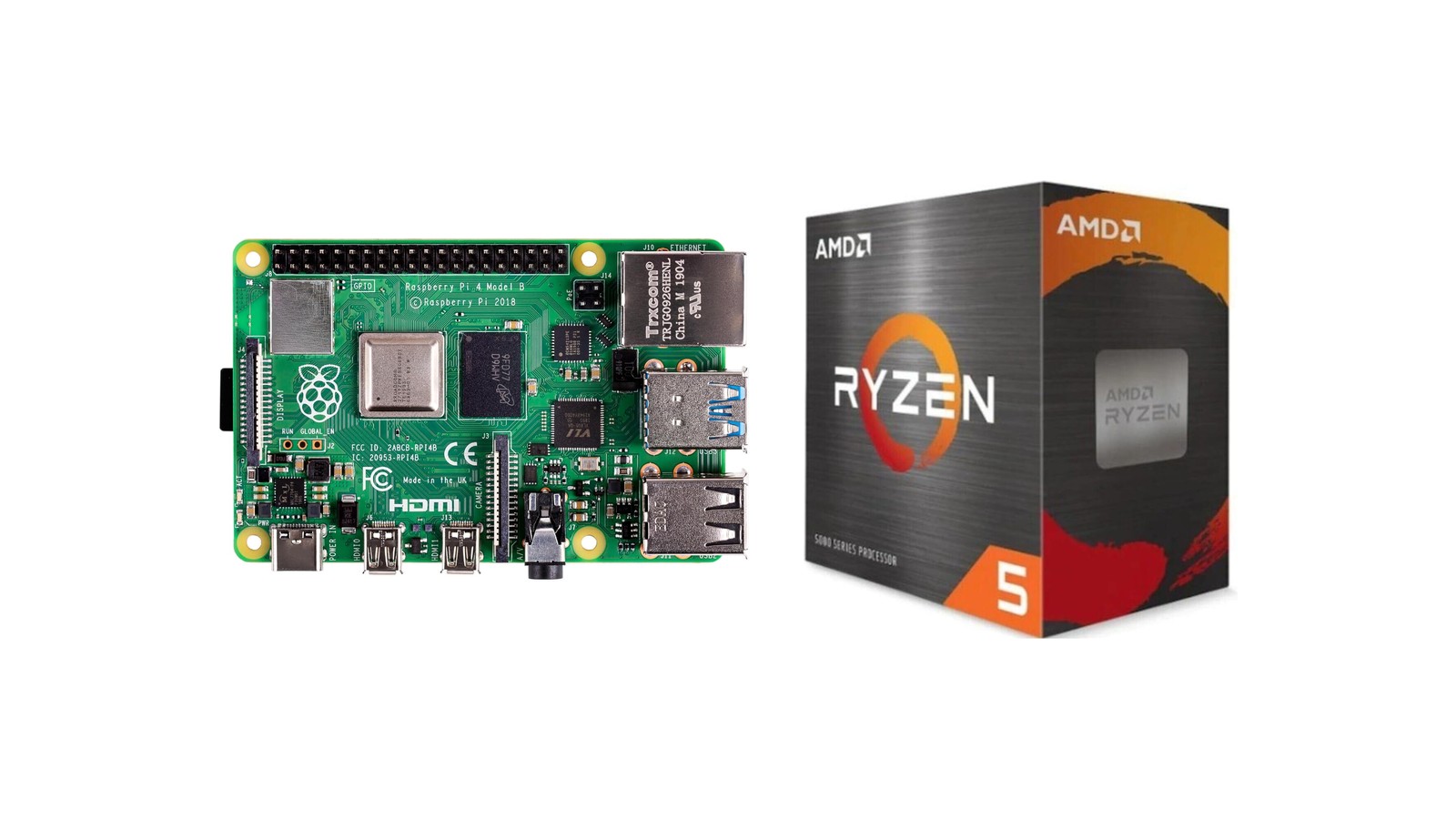
A Raspberry Pi 4 serves a 1B-class model at roughly 5 tokens per second — Jeff Geerling's llama-bench run on a Pi 4 measured TinyLlama 1.1B Q4_K_M at 5.63 tok/s generation and 8.70 tok/s prefill, at 2.7 W idle. A Ryzen 5 5600X runs the same model class at 32.4 tok/s per LocalScore. If your assistant answers a webhook, the Pi is enough. If a person is reading the output, it is not.
That six-times gap is the whole decision, and it is worth understanding before you spend anything, because the two machines are not competing on the same axis. One is a 3-watt appliance; the other is a desktop.
The use case that makes this comparison worth running is the always-on local assistant: a small model sitting behind a home-automation stack, a notification router, a text classifier, or a webhook that has to answer in under a second and then go back to sleep for an hour. For that job, idle power and reliability matter more than peak throughput, and a board that draws single-digit watts around the clock is a genuinely different proposition from a desktop that idles an order of magnitude higher. Gemma 3 1B is a reasonable target model for this: Google's QAT Q4_0 build is a 1.00 GB file, and community Q4_K_M quantizations come in at 0.81 GB, so it fits in RAM on literally anything with a gigabyte free. The question was never whether it fits. It is whether it is fast enough, and whether the power bill justifies the choice.
One honesty note up front: there is no published Gemma 3 1B measurement on a Raspberry Pi 4 that this synthesis could verify. Every Pi figure below is a measured 1B-class proxy — TinyLlama 1.1B, Llama 3.2 1B, Qwen2 1.5B — with the source named on each row, plus one clearly-labelled derived estimate. Treat the proxies as the right order of magnitude, not as a Gemma 3 datasheet.
Key takeaways
- Pi 4, TinyLlama 1.1B Q4_K_M: 5.63 tok/s generation, 8.70 tok/s prefill at 512 tokens, falling to 6.82 at 4,096 (Geerling, sbc-reviews #110).
- Ryzen 5 5600X, Llama 3.2 1B Q4_K_M: 32.4 tok/s generation, 302 tok/s prefill, 4.93 s time to first token (LocalScore #1018).
- Pi 4 power, measured at the wall: 2.7 W idle, 5.0 W under
stress-ng, 6.2 W during a Geekbench multicore run — the whole board, not just the SoC. - Pi 4 measured memory throughput is 2,778 MB/s on tinymembench's standard memcpy. That, not the CPU, sets the token ceiling.
- Ollama's default tag matters more than the hardware: on a Pi 4,
llama3.2:1b(which pulls Q8_0) managed 2.6 tok/s whiletinyllamaat Q4 hit 5.6 (lemonade-benchmark CSV).
Step 0: what latency does your use case actually need?
Split your workload into two buckets before comparing any hardware.
Bucket one — machine-to-machine. A webhook classifies an incoming message, routes a home-automation intent, extracts a field from a log line, or decides whether a notification is urgent. The output is 10 to 40 tokens and nothing human is waiting on it. At 5 tok/s, a 30-token answer takes six seconds. If your automation can absorb six seconds, the Pi is fine, and the electricity math below will make it the obvious choice.
Bucket two — human-in-the-loop. Someone types a question and reads the reply as it streams. Comfortable reading speed is around 4 to 5 words per second, which is roughly 6 to 8 tokens per second — so a Pi 4 at 5.63 tok/s is just below the threshold where text stops feeling like it is being typed out slowly. A 5600X at 32.4 tok/s is comfortably past it. The perceived difference is much larger than the six-times ratio suggests, because one side of the line feels like waiting and the other does not.
The rest of this article assumes you have picked a bucket. If you have not, pick bucket one and buy the Pi — it is the reversible decision.
What you'll need
- The board or the CPU. A Raspberry Pi 4 Model B 8GB, or an AM4 platform with a Ryzen 5 5600X.
- A 64-bit OS on the Pi. The 64-bit Raspberry Pi OS build exposes the ARMv8 paths llama.cpp's ARM backend relies on. A 32-bit userland silently costs you a large fraction of your throughput. Per the Raspberry Pi 4 product brief, the board is a Broadcom BCM2711 with a quad-core Cortex-A72 (ARM v8) at 1.8 GHz and 1, 2, 3, 4 or 8 GB of LPDDR4 with on-die ECC — so the 64-bit userland is also what lets a single process address more than 4 GB.
- An SSD instead of a microSD card. Geerling's Pi 4 run measured the official 64 GB microSD at 40.84 MB/s sequential read and 13.08 MB/s on 4K random reads. That is model-load time, and it is also the wear-out failure mode that kills 24/7 boards. A Kingston A400 960GB or Crucial BX500 1TB over a USB 3 bridge fixes both.
- Active cooling on the Pi. Sustained inference is a 100 percent duty cycle, not a bursty load.
- Headroom in the desktop's PSU if you plan to add a GPU later.
Spec delta: Pi 4 8GB vs Ryzen 5 5600X
| Spec | Raspberry Pi 4 Model B 8GB | Ryzen 5 5600X desktop |
|---|---|---|
| Cores | 4x Cortex-A72 | 6 cores / 12 threads, Zen 3 |
| Memory | LPDDR4, 2,778 MB/s measured memcpy | Dual-channel DDR4-3200, 51.2 GB/s theoretical |
| Idle power (measured at wall) | 2.7 W | Tens of watts, board and PSU dependent |
| Load power | 5.0-6.2 W | 65 W CPU TDP plus platform |
| Platform cost | ~$158 board (SpecPicks catalog) | ~$174 CPU, plus board, RAM, PSU, case |
The Pi figures are from sbc-reviews #110, which reports 2.7 W idle, 5.0 W under stress-ng --matrix 0, and 6.2 W during a Geekbench multicore run, all measured at the wall. The 5600X's DDR4-3200 specification is AMD's, from the 5600X product page; 51.2 GB/s is the arithmetic ceiling for two channels at that speed, not a measurement.
Note the memory row, because it is the row that predicts everything else. The Pi's measured 2,778 MB/s memcpy is a copy operation — it reads and writes — so effective read bandwidth for weight streaming is roughly 5.5 GB/s. Against the desktop's 51.2 GB/s theoretical, that is a factor of nine. The measured token gap is a factor of six, which is what you would expect once the desktop's real-world efficiency is discounted.
How fast is a 1B model on each?
No public Gemma 3 1B figure exists for the Pi 4, so this table uses the closest measured 1B-class models with sources attached per row.
| Hardware | Model / quant | Prefill tok/s | Generation tok/s | Source |
|---|---|---|---|---|
| Pi 4 | TinyLlama 1.1B Q4_K_M | 8.70 (pp512) | 5.63 (tg128) | sbc-reviews #110 |
| Pi 4 | TinyLlama 1.1B Q4_K_M, 4K prompt | 6.82 (pp4096) | — | sbc-reviews #110 |
| Pi 4 (4GB) | tinyllama via Ollama | — | 5.58-5.60 warm | lemonade CSV |
| Pi 4 (4GB) | llama3.2:1b via Ollama (Q8_0) | — | 2.58-2.62 warm | lemonade CSV |
| Pi 4 (4GB) | qwen2:1.5b via Ollama | — | 3.45-3.60 warm | lemonade CSV |
| Pi 4 (4GB) | gemma2:2b via Ollama | — | 1.98-2.00 warm | lemonade CSV |
| Ryzen 5 5600X | Llama 3.2 1B Q4_K_M | 302 | 32.4 | LocalScore #1018 |
| Ryzen 7 5800X | Llama 3.2 1B Q4_K_M | 263 | 40.8 | LocalScore #1070 |
| RTX 3060 12GB | Llama 3.2 1B Q4_K_M | 6,042 | 185 | LocalScore #43 |
A third caveat on the Pi rows: the board in Geerling's issue reports its cores at 1.3 GHz, while the current product brief specifies the BCM2711 at 1.8 GHz. Later Pi 4 revisions clock higher than the unit measured here, so treat these figures as a conservative floor rather than the ceiling of the platform.
Two things to draw out.
First, the Ollama rows are noisy and tag-dependent. The same CSV records the first run of each model as much slower than the subsequent three, because the first run is cold, and its llama3.2:1b row is slow for a reason that has nothing to do with the Pi: Ollama's default tag for that model pulls a Q8_0 build, roughly 1.3 GB, against TinyLlama's ~0.64 GB Q4. On a bandwidth-bound machine, doubling the file size halves the speed. Check what quantization your tag actually pulls before blaming the board.
Second, LocalScore's figures are averages across nine prompt-and-generation mixes, while Geerling's are llama-bench pp512/tg128 rows. They are not like-for-like methodologies. The six-times ratio between them is directionally sound and corroborated by the bandwidth math; do not quote the exact ratio as a controlled measurement.
For Gemma 3 1B specifically at Q4_K_M (0.81 GB, against the 636 MiB TinyLlama Q4_K_M file llama-bench reports), scaling the Pi's measured TinyLlama result by the file-size ratio gives roughly 4.6 tok/s as a derived estimate. That is arithmetic on a bandwidth-bound workload, not a measurement, and it should be treated as such.
Quantization matrix for a 1B model
File sizes are the published artifact sizes from the bartowski Gemma 3 1B GGUF repo.
| Quant | File size | Fits a 4GB Pi? | Relative speed on a bandwidth-bound host | Notes |
|---|---|---|---|---|
| Q3_K_M | 0.72 GB | Yes | Fastest | Quality loss is real at 1B; the model has little margin |
| Q4_K_M | 0.81 GB | Yes | Baseline | The sensible default |
| Q5_K_M | 0.85 GB | Yes | ~5% slower | Cheap upgrade over Q4 |
| Q6_K | 1.01 GB | Yes | ~20% slower | Near-lossless |
| Q8_0 | 1.07 GB | Yes | ~25% slower | Where Ollama's default tags often land you |
| bf16 | 2.01 GB | Yes | ~60% slower | No practical reason at this size |
The interesting property of a 1B model is that you can afford a higher quant than you think. The entire ladder from Q4_K_M to Q8_0 spans 0.26 GB. On a 14B model that jump costs you gigabytes and half your throughput; here it costs a quarter of your speed and fits on any board in the comparison. If quality matters more than the last tokens per second, run Q6_K.
Google also ships a quantization-aware-trained Q4_0 build at 1.00 GB, which is the better choice than a post-hoc Q4 if you are quality-sensitive at this size.
Time to first token, and why prefill breaks long prompts first
Geerling's Pi 4 numbers show the shape clearly: prefill falls from 8.70 tok/s at a 512-token prompt to 6.82 tok/s at 4,096 tokens, and the combined pp4096+tg128 figure lands at 6.34.
Work through what that means. A 512-token system prompt plus context takes about a minute to ingest on the Pi before a single output token appears. A 4,000-token prompt takes roughly ten minutes. The 5600X, at 302 tok/s prefill, ingests the same 4,000 tokens in about thirteen seconds.
This is the failure mode that catches people who tested with a one-line prompt and then deployed with a 1,500-token system prompt and a few retrieved documents. The Pi's generation speed is survivable; its prefill is what makes a RAG pipeline unusable. If your design involves stuffing context, the board is the wrong machine regardless of model size.
Mitigations that actually work on a Pi: keep the system prompt short, cache the prompt prefix so it is only processed once per session, and retrieve two chunks rather than ten.
Watts per token, not tokens per second
This is the metric that decides an always-on box, and it is the one the Pi wins outright.
Using the measured figures — 5.63 tok/s at roughly 6 W under load on the Pi, 32.4 tok/s on a 65 W-TDP desktop CPU before accounting for the board, drives and PSU losses:
| Platform | Tokens/s | Power under load | Tokens per watt-second |
|---|---|---|---|
| Raspberry Pi 4 | 5.63 | ~6 W (measured at wall) | ~0.94 |
| Ryzen 5 5600X | 32.4 | 65 W CPU TDP alone | ~0.50 |
The Pi is roughly twice as efficient per joule while doing work, and the gap widens dramatically at idle, which is where an always-on assistant spends almost all of its time. At 2.7 W continuous, a Pi 4 costs a few dollars a year to run. A desktop idling at 45 to 60 W with board, drives and PSU inefficiency costs an order of magnitude more, and over three years that difference typically exceeds the price of the Pi itself.
The honest caveat: the Pi figure is measured at the wall for the whole board, while the 5600X figure is AMD's CPU TDP rating with no platform overhead included. The real desktop number is worse than shown, not better — so the conclusion holds with margin.
Storage matters more than you expect
Geerling's Pi 4 disk results on the official 64 GB microSD card:
| Benchmark | Result |
|---|---|
| iozone 4K random read | 13.08 MB/s |
| iozone 4K random write | 10.37 MB/s |
| iozone 1M sequential read | 40.84 MB/s |
| iozone 1M sequential write | 33.64 MB/s |
At 40.84 MB/s sequential, loading a 0.81 GB Gemma 3 1B Q4_K_M takes about twenty seconds from cold. Once the weights are resident in page cache, the card goes idle and steady-state generation is unaffected — so if your service starts once and runs forever, this does not matter.
It matters a great deal if your service restarts often, swaps between several models, or runs on a box you reboot for updates. It matters even more as a reliability question: microSD cards are the single most common failure on 24/7 Pi deployments, because continuous small writes wear them out. A Kingston A400 960GB or Crucial BX500 1TB on a USB 3 SATA bridge cuts load time several-fold and removes the wear-out mode entirely.
What if you add a GPU instead?
Once 1B stops being enough, the answer is not a faster CPU — it is VRAM.
The RTX 3060 12GB runs Llama 3.2 1B Q4_K_M at 185 tok/s with a 232 ms time to first token, per LocalScore #43 — 33 times the Pi's generation speed. More importantly, the same card holds 8B-class models at Q4 and 14B-class models with a modest KV cache, which is the actual reason to buy it. NVIDIA's RTX 3060 family page lists 170 W of graphics card power and a 550 W system requirement, so it is not an always-on-appliance part — but as the machine you escalate to when the 1B model stops answering well, it is the obvious step. Benchmark data lives on the RTX 3060 12GB page.
Common pitfalls
- Running a 32-bit Raspberry Pi OS. It costs you the ARMv8 code paths llama.cpp needs, and the resulting slowdown looks like a hardware limit.
- Trusting the Ollama default tag.
llama3.2:1bpulls Q8_0. On a bandwidth-bound board that is roughly half the speed of the Q4 you assumed you were running. - Benchmarking the cold run. Every model's first run in the lemonade CSV is far slower than its warm runs. Discard run one.
- Deploying with a long system prompt. Pi prefill drops to 6.82 tok/s at 4K tokens. Prompt length, not model size, is what breaks Pi deployments.
- Leaving the model on a microSD card in a 24/7 box. It works until the card wears out, which it will.
When NOT to use the Pi
Do not use a Raspberry Pi 4 if a person is waiting on the output, if your prompts routinely exceed a thousand tokens, if you need tool-calling reliability, or if you expect to grow past a 1B model within the year. In all four cases you will replace the board within months, and the second purchase costs more than buying the right machine first.
Do not use the 5600X desktop if the box will idle 23 hours a day doing nothing, if noise matters, or if the machine exists solely to answer webhooks. The electricity difference alone will exceed the hardware saving.
Verdict matrix
| Situation | Pick |
|---|---|
| Webhook, classifier or router; 24/7 duty; latency budget of seconds | Raspberry Pi 4 8GB |
| Interactive chat with a human reading the stream | Ryzen 5 5600X |
| Prompts regularly over 1,000 tokens | 5600X — Pi prefill is the binding constraint |
| Noise or idle power is a hard requirement | Pi 4, every time |
| You already own a spare AM4 box | Use it; the marginal cost is electricity only |
| You expect to grow past 1B models this year | Skip both, budget for a 12GB GPU |
Recommended pick
For a first always-on box, buy the Raspberry Pi 4 Model B 8GB and run Gemma 3 1B at Q4_K_M or Q6_K. At roughly 5 tok/s generation and 2.7 W idle, it handles the machine-to-machine work that 1B models are genuinely good at — classification, routing, short summarization, structured extraction — at an electricity cost close to zero. Pair it with a Kingston A400 SSD over USB 3 rather than a microSD card, and keep the system prompt short.
Buy the Ryzen 5 5600X instead only if a human reads the output, or if your prompts are long. It is six times faster on generation and roughly 35 times faster on prefill, and those are the two numbers that decide whether a local assistant feels usable — but you will pay for that speed every hour the box sits idle.
Live price comparison
- Raspberry Pi 4 Model B 8GB — the always-on option
- AMD Ryzen 5 5600X — the desktop option
- Kingston A400 960GB SSD — the microSD replacement
- Crucial BX500 1TB SSD — larger alternative
- MSI RTX 3060 12GB — the upgrade path past 1B models
Prices shown on SpecPicks are captured at scrape time and may vary; check the live listing before ordering.
Related guides
- Raspberry Pi 4 8GB local LLM tokens per second
- Qwen3 0.6B: Raspberry Pi 4 8GB vs Ryzen 5 5600G
- Ryzen 5 5600X vs Ryzen 5 5600G: CPU-only Gemma 3 12B
- Which LLMs fit in an RTX 3060 12GB?
- RTX 3060 12GB benchmark data
Frequently asked questions
Does the Raspberry Pi 4's 8GB model actually help for a 1B LLM?
Not for holding the weights — a Q4_K_M 1B model is well under a gigabyte, so the 4GB board fits it comfortably. The extra memory matters for everything running alongside the model: a home-automation stack, a vector store, a web front end, and the page cache that keeps model load times short. If the Pi is doing one job only, the 4GB board saves money with no throughput penalty.
Should I run a 64-bit OS on the Pi for inference?
Yes. The 64-bit Raspberry Pi OS build exposes the ARMv8 NEON paths that llama.cpp's ARM backend relies on, and the difference against a 32-bit userland is large enough to change the recommendation. Also confirm your build was compiled with the right ARM flags rather than pulled from a generic binary — a mismatched build silently falls back to a slower kernel and looks like a hardware limitation when it is not.
Will a microSD card slow down inference?
It slows model loading, not token generation. Once weights are resident in RAM the card is idle, so steady-state throughput is unaffected. Where it hurts is a service that restarts often, loads several models, or swaps between them — there, moving to a SATA SSD over a USB 3 bridge cuts load time substantially and removes the wear-out failure mode that kills microSD cards on 24/7 boxes.
How much power does each option draw at idle?
This is the number that decides a 24/7 deployment. The Pi 4 idles at a measured 2.7 W at the wall and peaks around 6 W under load, while an AM4 desktop with a 65 W CPU idles an order of magnitude higher once the board, drives and PSU inefficiency are counted. Over a year, that gap is usually larger than the price difference between the two platforms, so run the electricity math before buying.
When is a 1B model not enough?
A 1B model handles classification, routing, short summarization and structured extraction well. It fails at multi-step reasoning, long-context recall and code generation, and it hallucinates more readily than a 7B-class model on open questions. If your prompts run past a few thousand tokens or need reliable tool-calling, skip straight to a 12GB GPU rather than trying to squeeze a larger quantization onto the Pi.
Citations and sources
- geerlingguy/sbc-reviews — Raspberry Pi 4 1.25 GHz edition, Issue #110 (accessed 23 September 2026) — llama-bench, power and disk figures
- LocalScore — Ryzen 5 5600X submission #1018 (accessed 23 September 2026)
- LocalScore — Ryzen 7 5800X submission #1070 (accessed 23 September 2026)
- LocalScore — NVIDIA GeForce RTX 3060 submission #43 (accessed 23 September 2026)
- BillulloNex/lemonade-benchmark — Raspberry Pi 4 Ollama results CSV (accessed 23 September 2026)
- Raspberry Pi — Raspberry Pi 4 product brief (PDF) (accessed 23 September 2026)
- AMD — Ryzen 5 5600X product specifications (accessed 23 September 2026)
- NVIDIA — GeForce RTX 3060 family specifications (accessed 23 September 2026)
- bartowski — Gemma 3 1B Instruct GGUF file sizes (accessed 23 September 2026)
- Google — Gemma 3 1B QAT Q4_0 GGUF (accessed 23 September 2026)
This piece is editorial synthesis based on publicly available information. No independent first-party benchmarking is reported.


