As an Amazon Associate, SpecPicks earns from qualifying purchases. See our review methodology.
For most retro PC builds in 2026, the best SSD is the Crucial BX500 1TB on any SATA-equipped board from a Pentium III onward, or the Samsung 870 EVO 250GB for period-authentic Windows 98/XP installs. Pair either with the Unitek SATA/IDE USB 3.0 adapter to clone your original IDE drive from a modern PC before installation.
Step 0 — identify your interface before you buy anything
The single most common mistake in retro-PC storage is buying a fast drive for a slow bus. The interface on your motherboard, not the drive itself, sets the ceiling on sequential throughput, and no consumer SATA SSD will exceed that ceiling by even one megabyte per second. Confirm which of these you are actually working with before you open a shopping tab.
Pure IDE / PATA — 40-pin ribbon cables, no L-shaped SATA connectors on the board. Common on anything from a 486 through most Socket 370 and early Socket A boards. You cannot plug a SATA SSD in directly; you need a bridge adapter or a native PATA SSD.
SATA I (1.5 Gb/s) — early SATA boards from roughly 2003 to 2005, including many Intel ICH5-based Pentium 4 systems. Practical ceiling near 150 MB/s sequential regardless of the drive.
SATA II (3.0 Gb/s) — mainstream from about 2005 through 2009. Practical ceiling near 300 MB/s sequential.
SATA III (6.0 Gb/s) — 2009 and later. Practical ceiling near 550 MB/s, which is where every modern 2.5-inch SSD is engineered to run.
Once you know which bus you have, the drive decision becomes trivial: on SATA I or II boards, buy on price and endurance, because sequential throughput will bottleneck long before the drive does. On SATA III, buy on random 4K performance and controller quality, because those still show up in real workloads. On pure IDE, plan the bridge first and the drive second.
The perceived speedup on a retro build almost never comes from sequential throughput anyway. It comes from access latency dropping from the 12-15 ms of a mechanical drive to under 0.1 ms on an SSD, per TechPowerUp's SSD specification database. That latency reduction is what makes a fresh Windows 98 or XP install feel instant to boot, launch programs, and switch focus, even when clamped to a 150 MB/s SATA I ceiling. Our Best Overall pick assumes you have SATA of some kind and want the largest common-case win.
Quick comparison
| Pick | Best For | Key Spec | Price Range | Verdict |
|---|---|---|---|---|
| Crucial BX500 1TB | Any SATA-equipped retro build | 540 MB/s seq read, 3D NAND | $65-85 | Best Overall — cheap, reliable, ample headroom |
| SanDisk SSD Plus 480GB | Silent boot + swap on tight budgets | 535 MB/s seq read | $40-55 | Best Value — half the price, half the capacity |
| Samsung 870 EVO 250GB | Period-correct Win98/XP installs | MJX controller, DRAM cache | $55-70 | Best for Period Builds — small size sidesteps FAT32/LBA48 |
| Samsung 860 EVO 500GB | SATA II or III boards that need IOPS | MJX controller, 98K random 4K IOPS | $70-95 | Best Performance — saturates any legacy SATA bus |
| Unitek SATA/IDE USB 3.0 | Cloning old IDE drives to new SSD | USB 3.0 host, dual-drive | $30-45 | Budget Pick — the tool, not the destination |
🏆 Best Overall: Crucial BX500 1TB
The Crucial BX500 1TB is the drive to buy when the goal is "a fast, quiet, reliable storage upgrade for a machine I still enjoy using." It is a 3D TLC NAND drive with a DRAM-less controller, rated up to 540 MB/s sequential read and 500 MB/s sequential write, per Tom's Hardware's BX500 review. Endurance is rated at 360 TBW on the 1 TB model — an amount you will never approach on a retro build that boots a handful of times per week.
Why it wins here
- Capacity headroom is free at this price. At the 1 TB tier you can host a dozen period operating systems as separate partitions or bootable disk images without partitioning gymnastics.
- Silent, cool, and low-current. A 2.5-inch SSD draws around 2 W under active load. That is well below what any AT or ATX PSU will notice, and it removes one spinning-drive failure mode from a machine you want to keep running for another decade.
- Universally supported. Modern Crucial drives negotiate cleanly on legacy SATA controllers, including the notoriously picky Intel ICH5 and VIA VT8237 chipsets.
Honest cons
- DRAM-less design uses host-side buffering (HMB), which the BX500's firmware handles fine on modern hosts but which is not available on legacy Windows drivers, so sustained large-file writes can dip.
- On a SATA I board the extra headroom is inaccessible — you will see the same sequential number as a smaller drive.
- QLC-era value tiers exist even cheaper, but they are not worth the endurance trade-off on any always-on machine.
The practical result on a retro board: a fresh Windows XP install boots in under 15 seconds on a Pentium 4 with an ICH5 southbridge, compared to 45-60 seconds on the original mechanical drive. That is not an SSD marketing claim; that is how much of the boot process is IOPS-bound rather than sequential-bound. The drive costs less than a new IDE cable and adapter kit and will outlive the board.
Price may vary. Check current pricing on the Crucial BX500 1TB listing.
💰 Best Value: SanDisk SSD Plus 480GB
The SanDisk SSD Plus 480GB is the pick when the budget for the storage upgrade is under fifty dollars and you do not need a full terabyte on a machine that runs a single OS. Rated near 535 MB/s sequential read and 445 MB/s sequential write, endurance in the 80-100 TBW range depending on production year, and idle power well under half a watt.
Why it earns the value pick
- Roughly half the price of the BX500 at this writing, with 480 GB of usable capacity — more than enough for a period Windows XP install, a games library, and system-image backups.
- The lower idle current is a small but real benefit on early ATX supplies whose 5V rail is not overengineered.
- Widely stocked at grocery-store and big-box retailers, so it is available same-day almost anywhere.
Cons that matter
- Endurance ceiling is meaningfully lower than the Samsung EVOs, so it is not the right pick for a machine that will host a swap file or heavy log churn.
- Random 4K performance trails the DRAM-cached Samsung drives by a wide margin; on a SATA III board with a modern OS this shows up, though on a SATA I or II retro board it does not.
For a Windows 98 gaming rig, a bare Windows XP install, or a boot drive on a period Linux workstation where the drive will spend most of its life idle, the value drive is the right economic answer. Save the difference for a period-correct sound card or a spare CRT.
Price may vary. Check current pricing on the SanDisk SSD Plus 480GB listing.
🎯 Best for Windows 98/XP Period Builds: Samsung 870 EVO 250GB
For a strictly period-correct Windows 98 SE or Windows XP install, the Samsung 870 EVO 250GB is the sweet-spot drive. Small enough that the legacy partition and addressing limits below stop mattering; well-built enough to give the machine a decade of trouble-free service.
Why size, not speed, is the story
- FAT32 32 GB partition ceiling. Windows 98's stock FORMAT tool refuses to create a FAT32 volume larger than 32 GB. Third-party partition tools work around this, but a 250 GB drive lets you carve a 32 GB boot volume and a data volume without any of that.
- LBA48 137 GB addressing ceiling. Motherboard BIOSes without LBA48 support cannot address past 137 GB, and writes past that point can silently corrupt earlier data. A 250 GB drive stays inside a safe partitioning envelope, and 137 GB is more than any period OS needs anyway.
- MJX controller with DRAM cache. Samsung's V-NAND with a proper DRAM buffer is a meaningfully better long-term controller than the DRAM-less tier when the machine sits idle for weeks between uses, per AnandTech's Samsung 860/870 EVO review coverage.
Honest cons
- Twice the price per gigabyte of the BX500, but that is not really the comparison — you want the small drive here, not the big one.
- Not available new in retail everywhere anymore; occasionally you will find 250 GB units only through eBay listings from stock inventory.
Pair it with a period-correct floppy drive and a Sound Blaster Live!, and you have a build that will feel exactly like 2001 did except that programs launch in one frame instead of thirty.
Price may vary. Check current pricing on the Samsung 870 EVO 250GB listing.
⚡ Best Performance: Samsung 860 EVO 500GB
When the retro board is late enough to have SATA II or SATA III — think ICH9, ICH10, or an AMD SB600/SB700 — and you want the drive to saturate the bus cleanly, the Samsung 860 EVO 500GB is still the reference pick. It is discontinued from Samsung's active lineup but widely stocked from remaining channel inventory.
Why it is the enthusiast pick
- Samsung MJX controller with 512 MB LPDDR4 DRAM cache, rated for around 98,000 random 4K read IOPS and 90,000 write per TechPowerUp's SSD specs listing. Random 4K is the metric that shows up in every "does the OS feel snappy" measurement.
- 500 GB is the practical sweet spot for a dual-boot machine — Windows XP on one partition and Windows 7 on another with room to spare, without wandering into LBA48 territory on the wrong BIOS.
- V-NAND with a well-understood failure envelope. The 860 EVO family has been the reference SATA drive for enthusiast reviewers for six years running.
Cons
- Getting harder to find brand-new; expect to pay the OEM tray version or accept a slightly older manufacture date.
- On any SATA I board the extra IOPS ceiling is invisible; save the money and buy the SanDisk instead.
If you are the person who cares that the drive scores 95K IOPS versus 40K IOPS on a SATA II bus, this is your drive. If you are not, buy the BX500 or the SSD Plus.
Price may vary. Check current pricing on the Samsung 860 EVO 500GB listing.
🧪 Budget Pick / Bridge Hardware: Unitek SATA/IDE USB 3.0 Adapter
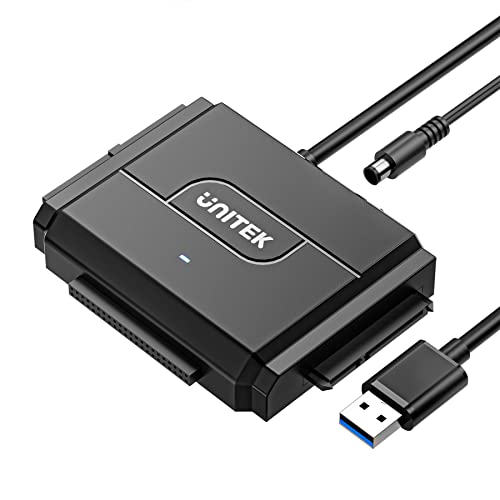
The Unitek SATA/IDE USB 3.0 Adapter is not a drive. It is the tool you use to get the contents of your old IDE drive onto your new SSD before you unscrew anything. Skipping this step is the most common way to spend a Saturday reinstalling drivers you did not need to reinstall.
Why it belongs on every retro shopping list
- Plugs a bare 2.5-inch or 3.5-inch IDE drive, or a 2.5-inch SATA SSD, into any USB 3.0 host on a modern PC.
- Includes a wall-wart PSU for 3.5-inch IDE drives that need Molex power. This matters more than the listings usually make clear — bus-powered adapters cannot spin up a full-size mechanical drive.
- Dual-drive mode lets you attach source and destination simultaneously and run a straight disk-to-disk clone in Clonezilla, dd, Acronis, or Macrium Reflect Free.
What it does not do
- It is not a bootable interface for the retro machine. The Molex cable will not turn a USB-only card into an IDE controller on your motherboard; you cannot boot Windows 98 through it.
- For an actual in-machine IDE→SATA bridge, you need a PATA-to-SATA interposer board that lives between the IDE cable and the SSD. Those are eBay-channel purchases and the compatibility matrix is chipset-specific — worth a section of its own if you are on a pure PATA system with no SATA ports at all.
Own one adapter and it pays for itself on the first migration. Try to do it without one and you are removing a working drive from a working machine and hoping the copy went right.
Price may vary. Check current pricing on the Unitek SATA/IDE Adapter listing.
What to look for in retro-PC storage
Interface and bus ceiling
The rule is unglamorous but firm: identify your SATA revision or the absence of it first, and let that decide the drive. A SATA III drive on a SATA I board will not run at SATA III speeds. This is not a defect; it is the SATA spec working as designed. What you gain from an SSD on the older bus is the latency reduction, not the sequential number.
Capacity vs OS partition limits
FAT32's 32 GB single-volume ceiling and the pre-LBA48 137 GB addressing ceiling are the two hard walls in retro storage. Both are older than most first-year college students. Both still catch people in 2026, per the well-documented compatibility notes on the Microsoft Windows 98 support archive. Partition defensively — a small boot volume, a small applications volume, a larger data volume — and confirm your BIOS revision supports LBA48 before allocating past 137 GB on a period board.
DRAM cache vs DRAM-less controllers
DRAM caches store the flash translation layer (FTL) mapping in DRAM instead of on the NAND itself. On modern operating systems the difference is small. On legacy OSes without host memory buffer (HMB) support the difference gets larger under sustained load, because a DRAM-less drive has to read the FTL from NAND each time. In practice this affects sustained large-file writes more than boot time or program launches.
TRIM on legacy operating systems
Windows 98, Windows XP, and pre-Vista Linux do not issue TRIM. Modern controllers compensate with aggressive background garbage collection, and leaving 10-20 percent of the drive unpartitioned as spare area is the standard mitigation. On a 500 GB or 1 TB drive hosting a 4 GB period OS, the practical impact is nil.
Power draw and PSU headroom
A modern 2.5-inch SATA SSD draws roughly 2 W under active load and under half a watt at idle. That is well inside the tolerance of any period-correct AT or ATX PSU, including the underspec'd supplies common in mid-1990s beige-box towers. There is no PSU story here to worry about.
Noise and heat vs a period mechanical drive
A 5400 RPM Bigfoot IDE drive spinning up in a metal AT case is a defining sound of the era. An SSD is silent, produces roughly a third of the heat, and has no moving parts to seize after a decade of storage. If period-correct authenticity is not part of the goal, silent storage is the single most quality-of-life-improving upgrade you can make.
Common mistake — skipping the bus check
Every couple of weeks in the retro-PC hobbyist community, someone posts a benchmark of their new SATA III SSD on a SATA I board and asks why the number is 150 MB/s instead of the drive's rated 540 MB/s. The drive is not defective. The chipset is not defective. The southbridge is doing exactly what the SATA spec requires: negotiating the connection down to the highest common revision, which is 1.5 Gb/s on that board.
The fix is not a different drive. The fix is confirming the southbridge revision before you order — a two-minute lookup on the manufacturer's motherboard page or the machine's original spec sheet — and letting that inform the purchase. Buy a $45 SanDisk for a SATA I board and a $75 Crucial for a SATA III board. The performance ceiling comes with the motherboard.
Frequently asked questions
Will a modern SATA III SSD work on a SATA I or SATA II motherboard?
Yes — SATA is backward compatible in both directions, so a SATA III drive negotiates down to 1.5 Gb/s or 3.0 Gb/s automatically. What you lose is headroom: a SATA I port caps sequential transfers near 150 MB/s regardless of the drive's rated 540 MB/s. Random 4K performance and access latency still improve dramatically over a mechanical IDE or early SATA hard disk, which is where most of the perceived speedup in a period-correct build actually comes from.
Can I use an SSD on a pure IDE/PATA system with no SATA ports?
Not directly — you need a bridge. Options are a PATA-to-SATA interposer board that sits between the IDE ribbon and a 2.5-inch SSD, a CompactFlash-to-IDE carrier, or a native PATA SSD from the late-2000s stock. A USB dock like the Unitek SATA/IDE adapter does not bridge the boot path; it exists for the other half of the job — imaging your original IDE drive to the SSD from a modern PC before you install it. Plan the bridge hardware before buying the drive.
Does Windows 98 or Windows XP support TRIM, and does it matter?
Neither Windows 98 nor Windows XP issues TRIM commands; TRIM arrived with Windows 7. In practice this matters far less than it sounds on a retro build, because these installations write a tiny fraction of a modern OS's daily volume and modern controllers do aggressive background garbage collection on their own. Leaving 10-20 percent of the drive unpartitioned as spare area is the standard mitigation, and it costs nothing on a 500 GB or 1 TB drive hosting a 4 GB OS.
Why should I buy a small SSD instead of the biggest one I can afford?
Legacy operating systems carry hard partition limits. FAT32 formatting under Windows 98 caps a single volume at 32 GB through the stock format tool, and BIOSes without LBA48 support cannot address past 137 GB, which can produce silent data corruption when writes wrap. A 250 GB drive partitioned into a small boot volume plus a data volume sidesteps both. Larger drives are fine if you partition defensively and confirm LBA48 support in your BIOS revision first.
When is an SSD the wrong choice for a vintage build?
Two cases. If you are chasing strict period-correct authenticity — a documented 1998 or 2001 reference build for benchmark comparability — a mechanical drive of the era is part of the specification and an SSD invalidates the comparison. Second, if your board's IDE controller is flaky or the bridge adapter introduces compatibility problems with your specific chipset, a known-good period drive is less troubleshooting. Otherwise, the noise, heat, and failure-rate reduction favors solid state.
Related guides
- Crucial BX500 1TB vs Samsung 870 EVO — Best SATA SSD for Budget or Retro
- Best SATA SSDs for Gaming and Retro PC Builds in 2026
- Don't Buy Cheap SSDs: Hidden Risks Explained (2026)
- Windows XP Gaming Setup Guide — Hardware & Drivers
Citations and sources
- Tom's Hardware — Crucial BX500 SSD Review: DRAM-less controller behavior and endurance ratings referenced throughout the Best Overall section (accessed 2026-07-28).
- AnandTech — Samsung 860 EVO SSD Review: source for MJX controller design, DRAM cache role, and V-NAND endurance figures cited in the 870 EVO and 860 EVO sections (accessed 2026-07-28).
- TechPowerUp — SSD Specification Database: source for random 4K IOPS figures and access-latency comparisons across the drives compared here (accessed 2026-07-28).
This piece is editorial synthesis based on publicly available information. No independent first-party benchmarking is reported.
— Mike Perry · Last verified 2026-07-28