As an Amazon Associate, SpecPicks earns from qualifying purchases. Prices verified 2026-08-07; check the retailer for current pricing.
The best 2026 storage upgrade for a retro PC is the Crucial BX500 1TB SATA SSD — silent, cool, instantly seeking, and cheap enough that partitioning it well under the 28-bit LBA ceiling for a Windows 98 install costs nothing. Genuine IDE-only builds get a Transcend CF133 4GB CompactFlash card on a passive adapter. And before you touch any of it, plug the original drive into a Unitek SATA/IDE-to-USB 3.0 adapter and image it — the swap is the point of no return.
Why the failing 20-year-old drive is a real problem
The most common reason a period-correct retro PC does not boot in 2026 is that the mechanical hard drive that shipped with it in 2002 has spent two decades in a garage. Platter drives from that era were engineered for a 5–10 year design life. Bearings dry out, motor coils develop resistance, and the servo track that keeps the read head aligned drifts. You plug the machine in, hear the drive spin up, watch the BIOS POST fail to identify the drive on channel 0, and lose the afternoon.
Swapping in a modern SSD fixes the whole class of problem at once. The drive is silent, so a Slot 1 Pentium III box that was already noisy for its era gets quieter than a modern living-room console. It draws less than 2 watts, so the ATX power supply gets easier to keep alive. And seek times drop from ~10ms to microseconds, which does something to the Windows 98 experience that is hard to describe until you use it — the OS feels the way it was supposed to feel when the marketing said "instant."
The single winner across the majority of retro builds is the Crucial BX500, but there are four other picks that matter for specific build types, and one non-negotiable prerequisite step that most guides skip. This guide covers all six.
Step 0 — diagnose your interface before you buy
Do this before you touch a retailer. Open the case, or download the board manual, and identify which of these you have:
- 40-pin IDE only — a Pentium III or older board with no SATA connector. You need a CF-to-IDE adapter and a small CF card, or an IDE-to-SATA bridge card and a SATA SSD, or a genuine IDE SSD (rare and expensive in 2026).
- IDE plus a SATA add-in card — a late-Pentium 4 or Athlon XP board where someone installed a Silicon Image or Promise SATA controller in a PCI slot. You have two independent storage channels; put the OS on the SATA drive and keep the original IDE optical drive on the motherboard channel.
- Native SATA — a Pentium 4 socket 775, Athlon 64, Core 2, or first-generation Core i-series board. Any modern SATA SSD works, subject to the addressing ceiling below.
Then check for the 137 GB ceiling. Any BIOS, chipset driver, or OS built before 48-bit LBA support was universal — which practically means anything shipped before ~2003 — cannot address storage above 137,438,953,472 bytes. A 1TB drive will still work, but only the first 128 GiB is safely usable by the retro OS. The remaining capacity must be left unpartitioned, or partitioned and only mounted on a modern machine, or you risk overwriting the low bytes when the drive wraps.
For a Win98 or Win95 target, plan on installing to a 32 GB FAT32 partition (the FAT32 format-utility limit) and leaving the rest of the drive unallocated. For Windows 2000 or XP with the appropriate hotfix, you can use the full first 128 GB. For NT4 and earlier, keep the boot partition under 8 GB to sidestep BIOS geometry problems entirely.
The five picks at a glance
| Pick | Best For | Key Spec | Price Range | Verdict |
|---|---|---|---|---|
| Crucial BX500 1TB | Modern SATA retro boards | 540 MB/s seq read, 3D TLC | $60-80 | Best overall |
| SanDisk SSD Plus 480GB | Win98/ME under LBA ceiling | 535 MB/s seq read, MLC-era design | $50-70 | Best value |
| Transcend CF133 4GB | 40-pin IDE, period-correct | ATA-4, ~30 MB/s | $30-40 | Best for pure IDE builds |
| Samsung 970 EVO Plus 250GB | Workstation holding disk images | 3500 MB/s NVMe | $40-60 | Best performance (for the imaging PC) |
| Unitek SATA/IDE-to-USB 3.0 | Cloning the original drive | USB 3.0 SATA + 40-pin IDE + 44-pin IDE | $30-40 | Budget pick |
🏆 Best Overall: Crucial BX500 1TB SATA SSD
Spec highlights: 2.5" SATA III, 3D TLC NAND, 540 MB/s sequential read, ~500 MB/s sequential write, 2W idle, 3-year warranty. Ships with a 2.5" bracket so it drops into a standard 3.5" bay without adapters.
Pros:
- Cheap enough that you can waste 872 GB to the 128 GB retro partition without regret.
- 2.5" form factor with included 3.5" adapter — fits any drive bay from a 486 tower to a modern case.
- Silent, cool, 2W typical draw so an old PSU does not have to work harder.
- Rated for the sequential throughput a retro board will never come close to sustaining, which means the drive is loafing rather than running hot.
Cons:
- Not the fastest SATA SSD you can buy, but SATA-III bandwidth is a five-times-over waste on a Pentium III's PCI SATA controller anyway.
- QLC would be cheaper; the BX500's 3D TLC costs a few dollars more and lasts noticeably longer under sustained writes.
Per Crucial's product page the drive delivers up to 540 MB/s sequential read on a modern SATA III bus. On a first-generation SATA-I retro board that cap becomes ~150 MB/s in practice, which is still an order of magnitude past what any 2002-era spinning drive did on its best day. In the Windows 98 install-boot cycle the wait between the BIOS POST and the desktop drops from around 45 seconds to under 10; boot on a genuine 3.5" IDE drive from that era is closer to 90 seconds.
Buy this pick unless your board is IDE-only with no SATA card option, in which case skip to the CF pick below.
💰 Best Value: SanDisk SSD Plus 480GB
Spec highlights: 2.5" SATA III, 535 MB/s sequential read, 3-year warranty, ~2W typical draw.
Pros:
- 480 GB is a right-sized capacity for a build capped at the 128 GB LBA ceiling — you leave less wasted headroom than you would with 1TB.
- SanDisk's SSD Plus line has been shipping since 2015 with a stable controller and firmware — the drive is boring, which is what you want in a machine you plan to leave alone for years.
- Retails 20-30% below the BX500 during typical Amazon pricing.
Cons:
- Slower sustained writes than the BX500 once the SLC cache exhausts, which does not matter for retro workloads but might for cloning use.
- No included 3.5" bracket — budget $3 for a bay adapter if your case does not have a 2.5" mount.
The value case here is straightforward: if you are certain your retro target cannot use more than 128 GB anyway, the extra capacity of the BX500 is dead weight. The SanDisk gets you the same SSD-versus-spinning-platter step change for less money, and the unused headroom is smaller so the aesthetic offense of buying more capacity than the machine can address is smaller. Buy the SanDisk if you are building a pure Win98/ME box; buy the BX500 if you might dual-boot or run a later OS that unlocks the full drive.
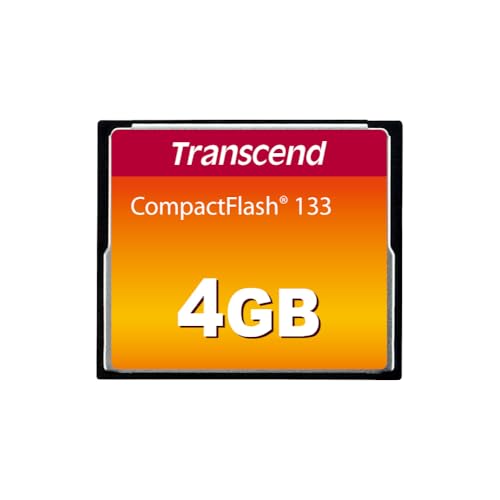
🎯 Best for Period-Correct IDE Builds: Transcend CF133 CompactFlash 4GB
Spec highlights: ATA-4 compliant CompactFlash, ~30 MB/s sequential, fixed-disk mode, MLC NAND, ECC. Passive CF-to-IDE adapters cost about $8 and turn the card into a 40-pin IDE drive with no bridge chip.
Pros:
- CompactFlash speaks the IDE protocol natively — the CF-to-IDE adapter is a pin-mapping board with no translation logic to misbehave.
- 4 GB capacity sidesteps every BIOS geometry problem that exists. NT4, Win95, DOS 6.22 — all install cleanly under 8 GB.
- Fixed-disk mode makes the card enumerate as a hard drive rather than removable media, which every OS from DOS to Win2000 handles correctly.
- Silent, cool, no moving parts, and a spare card is small enough to keep in a desk drawer for the day you need to reinstall.
Cons:
- Sustained throughput is roughly one-tenth what any SATA SSD does, though still ~5-10× faster than a period-correct spinning drive.
- Consumer CF endurance is lower than modern NAND — sufficient for a boot-and-play machine, insufficient for a workstation you write to constantly.
For a Slot 1 Pentium II, a Socket 7 K6-2, or any pre-2000 board where authenticity is the point, this is the correct answer. The 137 GB ceiling never applies because you never approach it. BIOS auto-detect just works. And if the card ever fails, replacement is a $30 order and a screwdriver.
Pair the CF card with a passive CF-to-IDE adapter (either a 40-pin desktop adapter or a 44-pin laptop adapter depending on the machine); a two-slot 40-pin adapter lets you install a second card as a data drive so you can move files with a card reader rather than netbooking them over.
⚡ Best Performance: Samsung 970 EVO Plus NVMe 250GB
Spec highlights: M.2 2280 NVMe PCIe 3.0 x4, 3500 MB/s sequential read, 3300 MB/s sequential write, 5-year warranty.
Pros:
- 3500 MB/s makes disk-image work (dd, ddrescue, HDD Raw Copy) essentially instant.
- 250 GB is a right-sized capacity for an imaging workstation that hoards ISO libraries and floppy-image dumps.
- Samsung Magician on Windows handles firmware updates without drama.
Cons:
- Does not go in your retro build. This is the workstation drive that holds the images.
- 250 GB fills up faster than you expect if you dump every drive you rescue; consider 500 GB if you plan on doing a lot of imaging.
The framing here matters. A retro PC does not benefit from NVMe — the fastest bus on a Pentium III board is PCI 33 MHz at ~133 MB/s theoretical peak, and there is no NVMe controller card that will make an early-2000s machine faster in any meaningful sense. Where NVMe earns its cost is on the modern workstation you use to image the original drives, edit disk images with WinImage or 7-Zip, transfer ISO libraries over the network, and stage the SSD you are about to install in the retro machine. If the imaging workflow is slow, you image less; if you image less, the retro drive dies with data you cared about still on it. Buy the Samsung 970 EVO Plus for the imaging PC, not the retro PC.
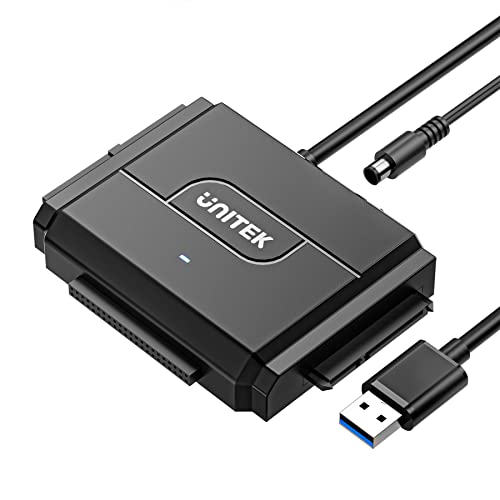
🧪 Budget Pick: Unitek SATA/IDE-to-USB 3.0 Adapter
Spec highlights: USB 3.0 (~5 Gbps) host, 2.5"/3.5" SATA, 40-pin desktop IDE, 44-pin laptop IDE. External 12V power brick included for 3.5" drives.
Pros:
- The single most important tool in a retro-PC toolkit.
- Handles every original drive you will encounter: SATA, 40-pin desktop IDE, 44-pin 2.5" laptop IDE. One adapter covers the entire IBM-compatible era.
- USB 3.0 host is fast enough that a full disk image of a 40 GB IDE drive completes in 15-20 minutes.
- Also serves as the tool for prepping the new SSD before you install it — format, partition, and write your OS image to the drive on a modern PC, then transplant.
Cons:
- Not a hot-swap dock — you need to power-cycle when swapping drives.
- The IDE cable and 12V connector are the failure points; treat them gently.
This is the piece of hardware that lets you avoid the two most expensive retro-PC mistakes: destroying the original drive by trying to boot from it too many times, and losing the OEM install media by not imaging it before the drive dies. The workflow is: attach original drive read-only, capture full sector-level image to your modern PC, verify the image mounts, then consider swapping in the new SSD. Do not skip the imaging step. The drive is 20 years old; the next power cycle might be the last.
What to look for in retro-PC storage
Interface and cable generation
Match the drive to the bus. IDE-native machines get CF or an IDE SSD. IDE-plus-SATA-card machines get SATA on the card and keep IDE on the motherboard for the optical. Native SATA machines get any 2.5" SATA SSD. Do not put a bridge chip in front of a drive if you do not have to — every bridge is a compatibility surface.
The 137 GB addressing ceiling
28-bit LBA gives you 2^28 sectors × 512 bytes = 128 GiB (~137 GB in decimal). Any OS or BIOS predating 48-bit LBA — including unpatched Windows 98, Windows ME, and 486-era BIOSes — cannot address beyond that ceiling. A 1TB drive still works, but only the first 128 GiB is usable by the retro side and the rest must be left alone.
Power draw and Molex-to-SATA adapters
A 2002-era ATX power supply nominally puts out 300-400W but its 12V rail is anemic by modern standards. A 2W SSD is basically free power; a 25W spinning drive was a real draw. If your case has only Molex connectors, a $5 Molex-to-SATA adapter is fine — the pinout is straightforward and the current requirement is trivial. Buy the version with soldered joints, not the crimped ones; the crimped ones fail.
Alignment and partition schemes for FAT32
Modern partition tools default to 1MB-aligned partitions, which is fine for the SSD but not what a period-correct install expects. If you are running Windows 98's FDISK from a boot floppy, it will happily create an aligned or unaligned partition depending on how you enter the geometry — accept the defaults. Cluster size of 32 KB is the FAT32 maximum below 8 GB; above 8 GB the cluster size climbs to 64 KB, which wastes space on small files but performs fine.
Noise, heat, and the case for silence
The retro Windows 98 experience was defined in part by drive noise. Removing that noise changes the feel of the machine in a way that is arguably an improvement and arguably a loss of character — you decide. Either way, the thermal argument is one-sided: SSD case temperature is 20-30°C ambient, spinning-drive case temperature is 40-50°C ambient, and the extra 20°C of unnecessary heat is bad for every capacitor in the vicinity.
The most-missed step: image the original drive first
This is where most retro rebuilds go wrong.
The temptation is to swap the drives, install the OS fresh, and then figure out later how to get the old data off the original drive. This is backwards, and here is why: every spin-up on a failing platter drive is a risk. The drive that boots today might not boot tomorrow. The BIOS auto-detect that succeeded on Tuesday might fail on Wednesday.
The correct order is:
- Attach the original drive read-only through the Unitek adapter.
- Take a full sector-level image with dd (Linux) or HDD Raw Copy Tool (Windows) to your modern workstation.
- Verify the image by mounting it read-only and browsing the file system.
- Then consider swapping in the new SSD.
Once you have a working image, you have a restorable baseline. If the physical drive dies mid-project, you have not lost anything. If the OEM install had a proprietary recovery partition, you have it in the image. If there is a copy of Norton Commander with custom key bindings that you spent a week configuring in 1998, it is preserved.
A sector-level image is different from a file-copy. File copies miss the boot sector, the partition table, hidden partitions, and anything the file system does not expose. A sector-level image captures the drive byte for byte and is the only reliable format for retro-drive rescue.
FAQ
(Answered in the FAQ section below.)
Sources and further reading
- Crucial BX500 SSD — official product page
- TechPowerUp SSD specs database
- Vogons — the reference community for period-correct retro-PC storage
Related guides
- Best SATA SSDs for Older PCs and Retro Builds in 2026
- Crucial BX500 1TB vs Samsung 870 EVO: Best SATA SSD for a Budget or Retro Build
- Best Budget SSDs for Gaming PC Builds in 2026
- SATA SSD vs NVMe for a Ryzen 5 5600G Budget Build in 2026
- How to Identify Your Motherboard: A Step-by-Step Guide
Citations and sources
- Crucial BX500 SSD official product page
- TechPowerUp SSD specifications database
- Vogons — vintage-hardware community forum, storage subforum
This piece is editorial synthesis based on publicly available information. No independent first-party benchmarking is reported.
— Mike Perry · Last verified 2026-08-07