Getting emulation running on Steam Deck for the first time usually comes down to one tool: EmuDeck. It's the community-built installer that configures RetroArch and a set of standalone emulators, builds the right folder structure, and adds everything to your Steam library automatically. The rest of this guide covers the install itself, what to expect performance-wise across different console generations, and how to avoid the mistakes that trip up most first-time setups.
Before going further, one clarification worth making up front: some circulating guides describe the Steam Deck as running an "AMD Ryzen Z1" chip with an RDNA 3 GPU. That's actually the chip inside the ASUS ROG Ally and Lenovo Legion Go, not the Steam Deck. Per Wikipedia's Steam Deck entry, both the original Steam Deck (LCD) and the Steam Deck OLED use a custom AMD APU with a 4-core/8-thread Zen 2 CPU paired with an RDNA 2 GPU. That distinction matters for emulation, because performance guidance written for a Ryzen Z1/RDNA 3 handheld (like the ROG Ally or Legion Go) will overstate what a stock Steam Deck can do on demanding cores.
How to Install EmuDeck on Your Steam Deck
EmuDeck runs from Desktop Mode, not Gaming Mode. The basic flow, per EmuDeck's own setup documentation, looks like this:
- Switch to Desktop Mode — hold the Power button and select "Switch to Desktop," or do it from Settings.
- Open the Discover software store or a browser and download the EmuDeck installer from the official site. Avoid third-party mirrors; installer tampering is the most common source of malware complaints in emulation communities.
- Run the installer and choose your storage target — internal storage, a microSD card, or both. EmuDeck will ask this early, and it's worth deciding before you start dumping ROMs (more on storage below).
- Let EmuDeck build the folder tree. It creates a standardized structure for every supported platform, plus a BIOS folder with a checklist of which files each emulator core needs.
- Return to Gaming Mode. EmuDeck uses Steam ROM Manager in the background to scan your ROM folders and generate non-Steam shortcuts with box art, so populated platforms show up as normal library tiles.
Common first-run mistakes
- Running the installer from Gaming Mode file managers or unofficial app stores instead of the official EmuDeck package — this is the most common cause of broken installs.
- Skipping a SteamOS system update first. An outdated SteamOS build is a frequent cause of Vulkan-related crashes in Dolphin, PCSX2, and other GPU-accelerated cores.
- Not creating the BIOS folder correctly. PS1, PS2, and Saturn cores in particular require console-specific BIOS files that EmuDeck will tell you about but does not supply — see the legal note below.
Emulator and Platform Overview
EmuDeck doesn't install one emulator — it installs RetroArch (a multi-system front-end using "cores" for each platform) alongside dedicated standalone emulators for systems that run better outside RetroArch. Per RetroArch's own project documentation, the front-end approach lets one interface and one control scheme cover dozens of older systems, while standalone apps like Dolphin (GameCube/Wii) and PCSX2 (PS2) get their own dedicated, more actively tuned builds.
| Platform tier | Typical Steam Deck experience | Emulator path |
|---|---|---|
| 8-bit/16-bit (NES, SNES, Genesis, Game Boy) | Runs with wide performance headroom | RetroArch cores |
| 32-bit era (PS1, Saturn) | Generally stable; BIOS files required | RetroArch cores |
| PS2 / GameCube / Wii | Solid on most titles, some demanding games vary | PCSX2, Dolphin (standalone) |
| Wii U / Switch | Performance and legal status both unsettled | Community forks, shifting availability |
The Wii U and Switch tier is where first-time users hit the most confusion, because it's also where the legal ground has moved the most recently.
The Switch Emulation Legal Situation (Read This First)
A lot of trending searches about Steam Deck emulation are prompted by wanting to play specific Switch titles — including newer Nintendo published games. It's worth being direct about where that stands. Per Wikipedia's entries on Yuzu) and Ryujinx, both projects' official repositories were taken down in 2024 after legal action from Nintendo, including a settlement in Yuzu's case. Community forks of both projects continue to circulate, but their legal footing, update cadence, and long-term availability are all considerably less certain than they were before 2024.
For a first Steam Deck emulation setup, the practical takeaway is: build your library and your habits on older, legally uncontested platforms first (NES through GameCube/Wii covers an enormous back catalog), and treat Switch emulation as a separate, higher-risk decision rather than the default starting point.
Legal ROM and BIOS Sourcing
Emulator software itself has a long history of surviving legal challenges — Wikipedia's background on the format notes multiple US court decisions that found emulators themselves lawful to distribute. What isn't protected is downloading copyrighted ROM files for games you don't own. The generally accepted legally defensible path is:
- Dump ROMs from cartridges or discs you physically own, using dedicated dumping hardware appropriate to that console.
- Extract BIOS files only from consoles you own, following the specific extraction method for that platform. EmuDeck's setup wizard tells you which BIOS filenames each core expects — it does not, and should not, distribute the files itself, since BIOS firmware is proprietary Sony/Nintendo/Sega code, not open-source software.
- Treat any site offering bulk ROM downloads for games you don't own as outside the legal boundary, regardless of how the emulator software itself is licensed.
Troubleshooting Common Steam Deck Emulation Issues
Most first-week problems fall into three buckets:
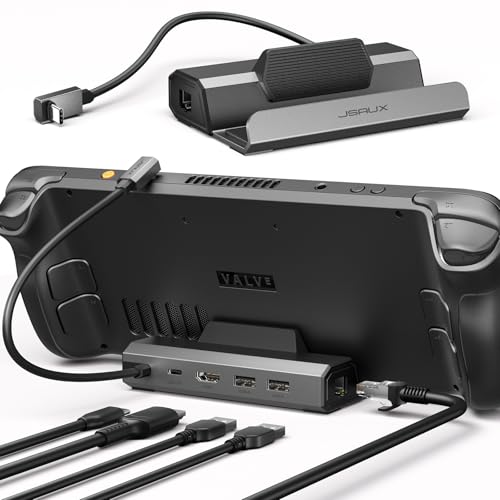
Controller mapping. Steam Deck's built-in controls (gyro, trackpads, back buttons) aren't recognized identically across every emulator core. If you plan to play with an external controller or on a TV, a 4K@120Hz docking station is the accessory most first-time Deck emulation users add first. RetroArch and standalone emulators each have their own input configuration screen — check the per-core controller config inside RetroArch's Quick Menu before assuming a game is broken.
Audio desync. This is usually a sign the core is dropping frames rather than an audio-specific bug. Lowering internal resolution or disabling non-essential shaders on GPU-intensive cores (Dolphin, PCSX2) is the standard first fix, since it's the render pipeline — not the audio path — that's usually the bottleneck.
Storage. ROM libraries add up fast once you're past 8-bit/16-bit systems: PS2 and GameCube titles commonly run several gigabytes each. EmuDeck lets you point storage at internal space, a 512GB microSD card, or both during setup — plan this before you have hundreds of gigabytes to migrate later, since moving an established library is far more tedious than choosing correctly on day one.
Expanding Your Emulation Library Over Time
Once the base install is stable, most users expand in this order: fill out 8-bit/16-bit systems first (cheap in storage, near-zero performance risk), add PS1/Saturn once BIOS files are in place, then move to PS2/GameCube/Wii as storage allows. Community-run wikis for RetroArch and for each standalone emulator (Dolphin, PCSX2) are the most reliable places to check per-game compatibility notes before assuming a title should run at full speed — compatibility varies game-by-game even within a well-supported platform.
If handheld emulation performance and battery life are the deciding factor for a purchase rather than an accessory decision, it's also worth comparing the Deck against newer handhelds directly: see how the Steam Deck OLED stacks up against the Legion Go S, the ROG Xbox Ally X, and the standard ROG Xbox Ally, or the reverse comparison from ROG Ally X's perspective. If you're deciding whether the Deck is worth it for native AAA gaming as well as emulation, RE Requiem and the AAA case for Steam Deck and the 007: First Light Steam Deck review cover that side of the hardware. For anyone questioning newer retail units, there was also a minor stir about the Steam Deck's box design changing in 2024 — cosmetic only, with no internal hardware change tied to it.
Citations and sources
- EmuDeck — official installer and documentation
- Steam Deck — Wikipedia
- RetroArch — Wikipedia
- Yuzu (emulator) — Wikipedia)
- Ryujinx — Wikipedia
For traveling with an emulation setup, a ProCase Steam Deck OLED/LCD carrying case with front-cover protection is the most-purchased accessory alongside the Deck itself.
This piece is editorial synthesis based on publicly available information. No independent first-party benchmarking is reported.