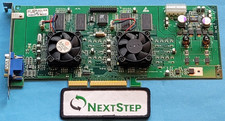
Key takeaways
- The original 6000: four 166 MHz VSA-100s behind a HiNT HB1-SE66 PCI bridge, 128 MB of SDRAM, an external "Voodoo Volts" brick — about 50 W against a 25 W AGP 2x budget.
- It never shipped: cancelled November 13, 2000, its 4-way SLI licensed to Quantum3D, the $112 million NVIDIA asset sale agreed December 15, 2000. A prototype fetched $15,000 in 2023.
- The zx-c64 "Strange God" rebuilds it on genuine VSA-100 silicon for about $1,500–1,600, with a 6-pin PCIe input and a 128/256 MB dual-VBIOS switch: "Same BIOSes, same drivers, same bugs."
- The lab's card carries the 6000 subsystem ID
0001121A(a 5500 reads0002121A) and the HiNT bridge atVEN_3388&DEV_0021. It ran in 128 MB mode, in two motherboards. - Three rules for every later part: the driver's chip-count labels are quotes; FSAA was requested, never delivered; the two hosts are never compared.
What was the Voodoo 5 6000 supposed to be?
3dfx announced the VSA-100 line on November 15, 1999: full-scene anti-aliasing, texture compression, T-buffer effects and built-in scan-line interleaving. The 6000 topped four boards — AGP, four VSA-100s, 128 MB, 1.33–1.47 billion pixels per second, $599 — and CTO Scott Sellers argued that smaller processors meant higher yields than one big die (The Register).
Each VSA-100 was a 0.25-micron, 14-million-transistor chip at 166 MHz with a 128-bit bus to its own memory — 2.67 GB/s and 333 megapixels per second per chip. Its SLI split the frame into bands of 1 to 128 lines, and its anti-aliasing was rotated-grid supersampling through the T-buffer (x86-secret).
Two chips could share a dedicated link; four could not. So the 6000 exposed each VSA-100 as its own PCI device behind a 4-to-1 PCI-to-PCI bridge — first an Intel part with stability problems, finally the HiNT HB1-SE66, which x86-secret later called "the biggest death cause for the Voodoo 5 6000 cards in the world" (x86-secret). It also needed the "Voodoo Volts" external supply: the AGP 2x specification allowed 25 W, the card pulled about 50 W, and one of its two brick designs was a monitor power supply pulled from STB's stock, the early units wearing 3dfx stickers over the STB logo (TDG FAQ).
Even the Comdex '99 board that started the legend was a dummy with no traces, carrying four Voodoo3-3500 chips under VSA-100 decals — the same generation as the Voodoo3 3000 (TDG FAQ).
Why did it never ship?
The board had a flaw no clock change could fix. On the board the internal PCI traces between bridge and VSA-100s ran against the 2.9 V core plane with no reliable signal return, and the result was instability in anti-aliasing modes. Dropping the chips from 183 to 166 MHz did not help — as 3dfx engineer Hank Semenec put it, "the problem was not on memory but on secondary PCI bus, so going lower did not help." The last revision, a small 3900-A run, was made on October 25, 2000, 45 days before 3dfx closed its doors (TDG FAQ).
The company ran out of road first. The two-chip Voodoo 5 5500 shipped on June 22, 2000 (Wikipedia); the 6000 never did. On November 13, 2000 3dfx announced it would not reach consumers and licensed 4-way SLI to Quantum3D for visual simulation, claiming "43 percent better Quake 3 graphics performance over leading competitive solutions" (NuAngel). On December 15, 2000 it agreed to sell its graphics assets to NVIDIA for $112 million — $70 million cash plus one million shares — and dissolve (3dfx press release, SEC).
What survived is disputed, and expensive. x86-secret guessed in 2005 "around 150 Voodoo 5 6000 models in the world and around 30 working ones" (x86-secret); VoodooAlert's registry lists 52 known Rev.A 3700 boards (VoodooAlert). Semenec later spent about 60 hours over three months on a resistor-level "PCI rework" that made FSAA stable at last, on a margin so fine that a clock shift "as small as 1 nano-second would render the board non-functional" (TDG FAQ). A Rev 3700A sold on eBay in February 2023 for $15,000 (Tom's Hardware). No 6000 is listed in this site's catalog.
What did period reviewers measure?
Quake III Arena was the benchmark of the age, and the 6000's numbers in it were second-hand from the start. Tom Pabst wrote in April 2000: "If the Voodoo5 6000 should ever become reality, which I still doubt, then GeForce2 would have been beaten, however for double its price" (Tom's Hardware). At 3dfx's September demo Quake III ran at 1600×1200×32 with 4-sample AA — behind a sticker placed "so that viewers couldn't see the game's frame rate counter" (AnandTech forums). What did get published:
| Test | Result | Source |
|---|---|---|
| GeForce2 GTS, Quake 3 Arena 1600×1200 16-bit, April 2000 | 57.2 fps, "the very respectable" highlight of the review | Tom's Hardware |
| x86-secret 2005, real 3700A, Athlon XP 2800+, 3DMark2001SE | GeForce2 Ultra ~25% faster without FSAA, 6% at 2× | x86-secret |
| x86-secret 2005, Quake III 1.32, 8× FSAA via the 3dfx Tools panel | 43.9 fps at 640×480, 27.8 at 800×600, 14.2 at 1024×768 | x86-secret |
| Reworked 3700A, Intel D815EEA2, Pentium III-S, 3DMark2001SE | 2,380 | Vogons |
| GamersNexus 2023, Strange God AGP, Athlon XP 2600+, Win98SE, Quake III 1024×768 | 117 fps vs GeForce2 GTS 81 fps | GamersNexus |
x86-secret's verdict is the era's honest summary — of 8× FSAA, "it's almost a pure marketing feature because the framerate is really too low" — while from 1024×768 upward the 3dfx cards showed roughly "2x more GPU = 2x more performance" (x86-secret).
Who rebuilt it, and what is a "Strange God"?
There is no retail Voodoo 5 6000; GamersNexus says so plainly (GamersNexus). What exists is the work of Anthony ZXCLXIV — "ZXC-64", a Russian electronics hobbyist — who borrowed an original from collector Hard1k, recreated the PCB by "placing all the design blocks around the board and solving the puzzle", and runs the original BIOS and drivers unmodified (Custom PC).
The first version — PCI, 128 MB, internal Molex, VGA pass-through — appeared in February 2021 with the line this series keeps returning to: "Performance is exactly the same as on V56K. Same BIOSes, same drivers, same bugs." The VSA-100 chips themselves cost about $20 apiece (HotHardware). The AGP boards followed: "Strange God AGP 256MB" in matte black at a last price of $1,600, described as "AGP (1.5/3.3V)" while it "still remains a PCI device" (zxc64), and "Snow White" at $1,500, only 15 made (zxc64). All carry a "128/256MB memory config/dual BIOS switch". The lab's card is an AGP board; the dataset does not record its colour, so this series names no variant.
One claim from the maker's side matters later: the project FAQ says RGSSAA 2×/4×/8× "functions correctly in all AA modes (unlike original V5 6K issues)" (ModLabs).
Original versus reproduction, on paper
| Item | Original Voodoo 5 6000 | zx-c64 Strange God AGP | Sources |
|---|---|---|---|
| Rasterizers | 4 × VSA-100 at 166 MHz | 4 × "VSA100 220" at 166 MHz | x86-secret, zxc64 |
| Memory | 16 × 8 MB SDRAM = 128 MB, 32 MB per chip | 16 × 16 MiB SDR ≈ 256 MB; dual VBIOS selects 128 or 256 MB | x86-secret, GamersNexus |
| Bridge | HiNT HB1-SE66; an Intel bridge on the 0700/1500 boards | HiNT HB1-SE66 — the lab's card enumerates PCI\VEN_3388&DEV_0021 | TDG FAQ, campaign dossier |
| Power | External Voodoo Volts brick; 3.97 A on 12 V, about 50 W, at 8× FSAA | 6-pin PCIe input; about 80 W board | x86-secret, GamersNexus |
| Bus | AGP 2x at 3.3 V; the bridge runs in PCI66 mode | "AGP 1.0 (3.3V)" on Snow White; "AGP (1.5/3.3V)" on matte black | TDG FAQ, x86-secret, zxc64 |
| Price | $599 announced; never sold | $1,500–1,600 | The Register, zxc64 |
What arrived at the SpecPicks Retro Lab?
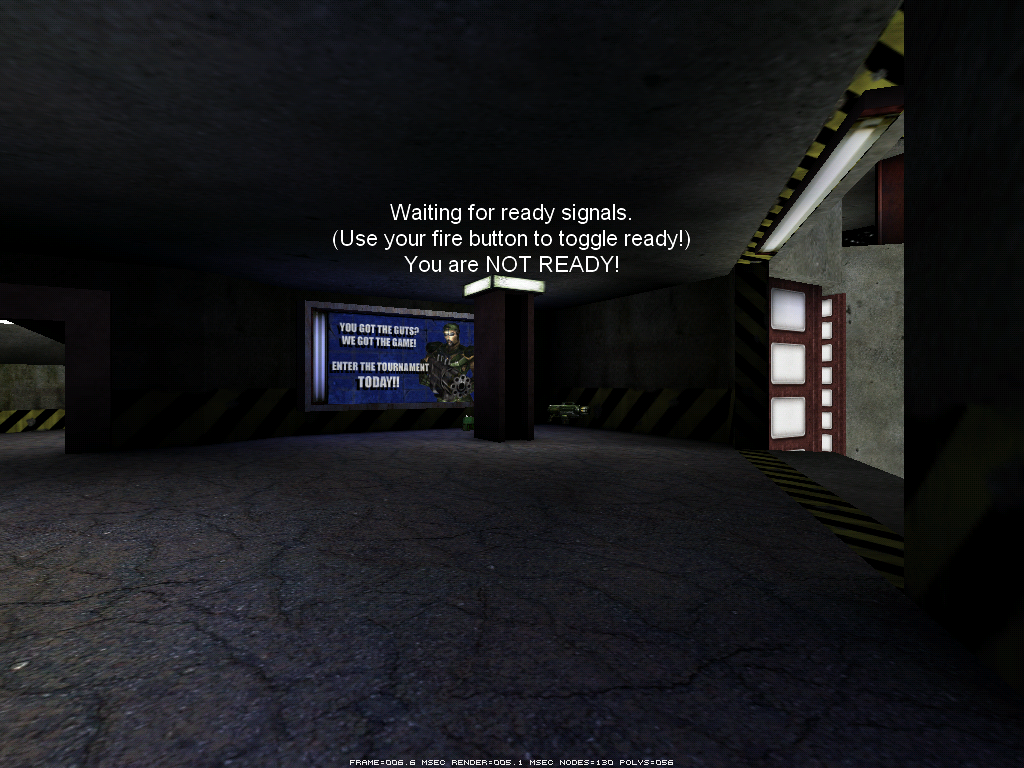
Unreal Tournament in native Glide on host 2, 8× AA requested and not delivered.
One card, shipped to the lab, tried in two motherboards for this campaign. It enumerates as PCI\VEN_121A&DEV_0009&SUBSYS_0001121A&REV_01; both drivers the lab has run name the device only "Voodoo5", so the 6000 identity rests on the subsystem ID 0001121A, where the lab's Voodoo 5 5500 reads 0002121A. Beside it sits PCI\VEN_3388&DEV_0021, the HiNT HB1-SE66 bridge. Glide reports GR_HARDWARE "Voodoo5 6000 (tm)", GR_NUM_BOARDS=1 and GR_NUM_FB=4 — the last of those for every configuration, including the one labelled "Single Chip Only": chips present, not chips ganged.
The card ran in the 128 MB mode it shipped in — MemorySize=0x08000000, 32 MB per chip, as read on host 1; host 2 reported 128 MB of video RAM under AmigaMerlin. The 256 MB mode was exercised once before this campaign, on 2026-08-12, on a third machine — a dual Pentium III — under the lab's in-house driver stack: Quake III at 1024×768 read 61.4 fps either way, and UT99's Glide texture space went from 15.9 to 32.4 MB. Under AmigaMerlin, on either host, it is untested.
Host 1 was an EPoX EP-8RDA+ (nForce2) with an Athlon XP-class processor and 511 MB; its BIOS was dying, and on 2026-09-13 it stopped booting with no video. Host 2 is an Athlon XP 2400+ at 2004 MHz, 255 MB, Windows XP SP3; both drove a Gateway VX1120 4:3 CRT. The driver throughout was AmigaMerlin 3.1-R11 "For Voodoo 5 6000 AGP", 5.1.2605.5 — the 2005 community release targeting the 6000 (VoodooAlert) — whose OpenGL ICD reports GL_RENDERER "Mesa Glide v0.63 Voodoo5 6000 (tm)". Host 2 arrived on Microsoft's in-box XP driver, with no Glide and no ICD; AmigaMerlin is what made it render at all.
How should this series be read?
Three rules govern every number that follows; the dossier numbers its retractions, and they are content, not embarrassment (campaign dossier).
The driver's chip labels are quotes. The whole SLI/AA axis is one registry value, SSTH3_SLI_AA_CONFIGURATION, whose values 0–8 a Mesa-era README lists as one, two or four chips with no AA or 2-, 4- or 8-sample AA (README.3DFX); AmigaMerlin's control panel labels them "Single Chip Only", "Dual Chip, Fastest Performance", "Quad Chip, Fastest Performance". The lab could not confirm the labels: cfg 2 (the setting the driver labels "Dual Chip") beat cfg 5 (the setting labelled "Quad Chip") at every resolution, by 1.11 to 1.17×, so this series writes the cfg number and quotes the label. The publishable claim is the spread: at 1600×1200 on host 2, cfg 0 gave 25.1 fps and cfg 2 gave 87.0, 3.47× from one registry value (cfg 2 measured in one boot, not yet repeated).
FSAA never engaged. Every AA figure is "requested, not delivered". Three Quake III frames at 1024×768 — no AA, 4× requested, 4× plus a forced sample count — are byte-identical, md5 6361acdebeb7dec0e2396aa436a9a18a; cfg 1, the setting labelled "Single Chip, 2-Sample AA", cost 0.99× against cfg 0 at 1024×768 (58.2 versus 58.6 fps); and UT99 in native Glide rendered faster with 8× requested, RENDER 5.1 ms versus 5.4 ms, with staircased edges (evidence README).
Hosts are never compared. Host 1 contributed 640×480 data only under this campaign's harness, and its CPU clock is unreliable; host 2 has the full ladder. Same card, different machine — separate tables, always, per the site's methodology.
Bottom line
The Voodoo 5 6000 is the most famous graphics card never sold: a $599 four-chip flagship undone by its PCI routing, its power appetite and its parent company's collapse, all inside twelve months. Anthony ZXCLXIV's Strange God puts real VSA-100 silicon back into that shape for about $1,500, and the SpecPicks Retro Lab has one, run in two motherboards under AmigaMerlin 3.1-R11 — one dead BIOS later. What it does is the next five parts, told with the labels in quotes and the retractions in the open.
Related guides
- Why Nvidia killed 3dfx
- A period-correct Voodoo3 Windows 98 build
- Voodoo2 SLI build guide
- Glide wrappers: dgVoodoo2 and nGlide
- The Voodoo 5 6000 benchmark page
The Voodoo 5 6000 that finally shipped — a SpecPicks Retro Lab series
- Part 1 — The card that never shipped, reproduced
- Part 2 — Test systems and method: two motherboards, one dead BIOS
- Part 3 — Quake III benchmarks at five resolutions
- Part 4 — FSAA: the feature that never engaged
- Part 5 — Hangs, wedges, retractions and a bricked board
- Part 6 — Verdict, and what the lab tests next
Citations and sources
- Host 2 results CSV: https://nscagentstorage.blob.core.windows.net/article-images/voodoo5-6000-strange-god/dataset/host2-124-results.csv (accessed 2026-09-16)
- Campaign dossier: https://nscagentstorage.blob.core.windows.net/article-images/voodoo5-6000-strange-god/dataset/campaign-dossier.md (accessed 2026-09-16)
- FSAA evidence README: https://nscagentstorage.blob.core.windows.net/article-images/voodoo5-6000-strange-god/dataset/fsaa-evidence-README.md (accessed 2026-09-16)
- The Register, VSA-100 launch: https://www.theregister.com/1999/11/15/3dfx_launches_voodoo/ (accessed 2026-09-16)
- x86-secret, VSA-100 architecture: http://www.x86-secret.com/articles/divers/v5-6000/v56kgb-4.htm (accessed 2026-09-16)
- x86-secret, 6000 hands-on: http://www.x86-secret.com/articles/divers/v5-6000/v56kgb-6.htm (accessed 2026-09-16)
- x86-secret, benchmarks: http://www.x86-secret.com/articles/divers/v5-6000/v56kgb-7.htm (accessed 2026-09-16)
- The Dodge Garage, V5-6000 FAQ: http://www.thedodgegarage.com/3dfx/v6k_faq.htm (accessed 2026-09-16)
- Wikipedia, Voodoo 5: https://en.wikipedia.org/wiki/Voodoo_5 (accessed 2026-09-16)
- NuAngel, cancellation report: https://nuangel.net/2000/11/3dfx-cancels-voodoo-5-6000-my-thoughts/ (accessed 2026-09-16)
- 3dfx press release, SEC: https://www.sec.gov/Archives/edgar/data/1010026/000103221000002365/0001032210-00-002365-0001.txt (accessed 2026-09-16)
- Tom's Hardware, GeForce2 GTS review: https://www.tomshardware.com/reviews/tom,184-22.html (accessed 2026-09-16)
- VoodooAlert, 3700 serial registry: https://www.voodooalert.de/board/forum/index.php?thread%2F23949-voodoo5-6000-rev-a-3700-liste-mit-seriennummern%2F=&pageNo=5 (accessed 2026-09-16)
- Vogons, reworked 3700A: https://www.vogons.org/viewtopic.php?t=51006 (accessed 2026-09-16)
- Tom's Hardware, $15,000 sale: https://www.tomshardware.com/news/3dfx-voodoo-5-6000-sold-for-15000-dollars (accessed 2026-09-16)
- AnandTech forums, 2000 preview: https://forums.anandtech.com/threads/voodoo-5-6000-preview.349187/ (accessed 2026-09-16)
- GamersNexus, Strange God AGP review: https://gamersnexus.net/gpus/back-dead-3dfxs-unreleased-voodoo5-6000-quad-gpu-card (accessed 2026-09-16)
- Custom PC, the recreation: https://www.custompc.com/retro-tech/3dfx-voodoo-5-6000-recreated (accessed 2026-09-16)
- HotHardware, first PCI recreation: https://hothardware.com/news/3dfx-voodoo-5-6000-recreated-by-enthusiast-vsa-100 (accessed 2026-09-16)
- zxc64, Strange God AGP Matte Black: https://www.zxc64.com/vsa100_based/0_62911_strange_god_agp_256mb_matte_black_voodoo_5_6000_alike/ (accessed 2026-09-16)
- zxc64, Snow White AGP: https://www.zxc64.com/vsa100_based/0_62925_snow_white_agp_256mb_3dfx_voodoo_5_6000_alike/ (accessed 2026-09-16)
- ModLabs, project FAQ: https://www.modlabs.net/forum/topic/60674/ (accessed 2026-09-16)
- VoodooAlert, Amigamerlin 3.1 R11 release thread: https://www.voodooalert.de/board/forum/index.php?thread/9135-amigamerlin-3-1-r11-erschienen/ (accessed 2026-09-16)
- Mesa README.3DFX, SLI/AA values: https://github.com/nobled/mesa-ics/blob/master/docs/README.3DFX (accessed 2026-09-16)
This is a first-party lab report: the measurements above were taken by the SpecPicks Retro Lab on its own hardware. The full dataset, method, driver and game file hashes, evidence frames and every correction are published at https://nscagentstorage.blob.core.windows.net/article-images/voodoo5-6000-strange-god/dataset/campaign-dossier.md. It is not editorial synthesis of third-party sources.
— SpecPicks Retro Lab · Last verified Sep 16, 2026