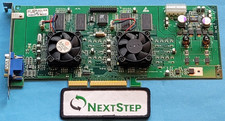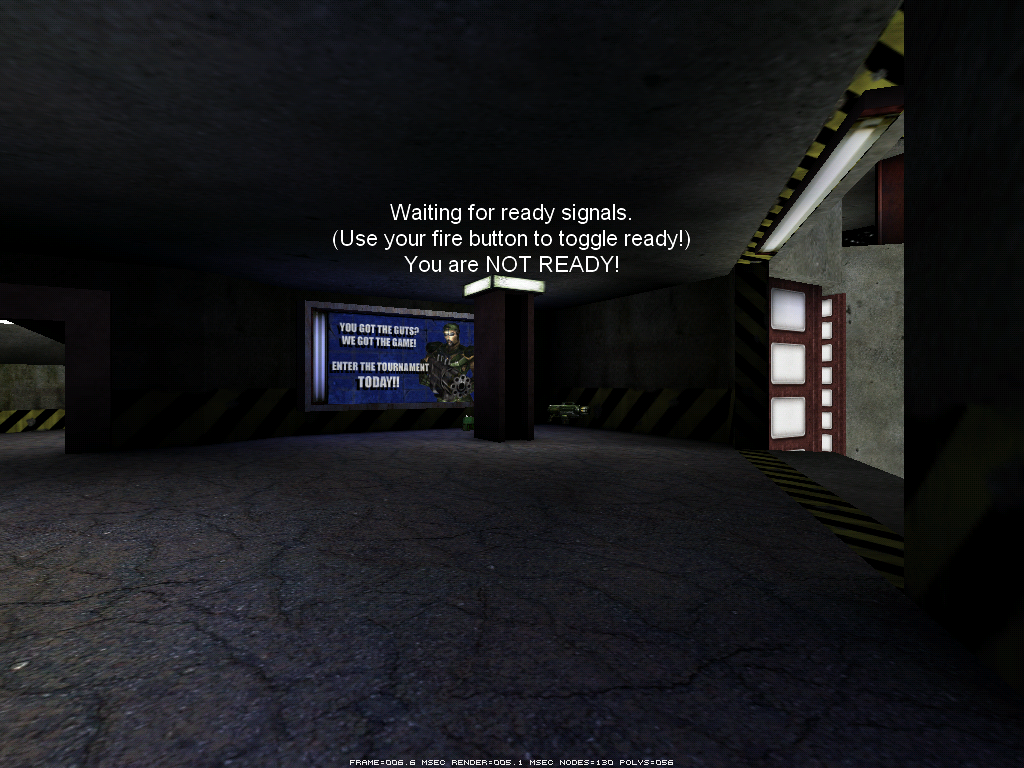
Key takeaways
- The verdict: buy the reproduction for the spread one registry value delivers, not for anti-aliasing — which, on AmigaMerlin 3.1-R11, never engaged.
- The driver's chip labels cannot all be right and none is established; the series publishes ratios, not chip counts.
- Stability is a discipline, not a property: one configuration per clean boot lets a run finish, and a hang can still need a power cycle.
- The first test next is the one the lab has never run — the 3dfx Tools control-panel route to FSAA, with the display driver's own enables.
- The catalog holds no 6000 listing; the Voodoo 5 5500 is the card that shipped and the one a buyer can order.
What did the campaign actually establish?
Five days, two boards, one card, seven retractions. Host 1 opened the campaign on 2026-09-12 and died with a corrupted BIOS on 2026-09-13; the card moved to host 2 (Athlon XP 2400+ @ 2004 MHz, 255 MB, Windows XP SP3), where the cfg 0 and cfg 5 ladders were re-measured after a scratchpad deletion took 14 rows; cfg 1's 800×600 re-run hung, so its first-run 86.4 survives only in the dossier. The campaign dossier carries method and retractions; this matrix is the honest sum.
| Claim | Status | Evidence |
|---|---|---|
| One registry value spreads Quake III 1600×1200 from 25.1 to 87.0 fps (3.47×) | Established | cfg 0 vs cfg 2 on host 2; GL_RENDERER "Mesa Glide v0.63 Voodoo5 6000 (tm)" on every row |
| The "Single / Dual / Quad Chip" labels describe the card | Not established | they cannot all be right: cfg 2 beats cfg 5 at all five resolutions (1.11–1.17×); GR_NUM_FB reads 4 for every config |
| FSAA engages when the registry value requests it | Refuted | three Quake III frames share md5 6361acde…; "2× AA" costs 0.99× (58.2 vs 58.6); UT99 8× requested renders in 5.1 ms vs 5.4 ms |
| FSAA is reachable by another route | Not established | 3dfx Tools panel and the SSTH3_ANTIALIAS / SSTH3_DIGITAL_SLI_AA enables untried |
| cfg 2 and cfg 8 are "box-killers" | Refuted | cfg 5, the default, wedged identically as a third topology write; six false verdicts on 2026-09-15 |
| One topology write per boot prevents wedges | Not established | cfg 1 wedged at its second cell after a clean boot |
| GPU-bound cells repeat | Established | cfg 0 38.8 → 38.8 and 25.1 → 25.1; cfg 5 78.5 → 78.7 (first run quoted from the dossier, rows lost) |
| The CPU-bound 640×480 cell repeats | Not established | cfg 5 122.8 → 108.1 (−12.0%), cfg 0 105.3 → 97.4 (−7.5%); watchdog installed between runs |
The spread is real; the labels are not
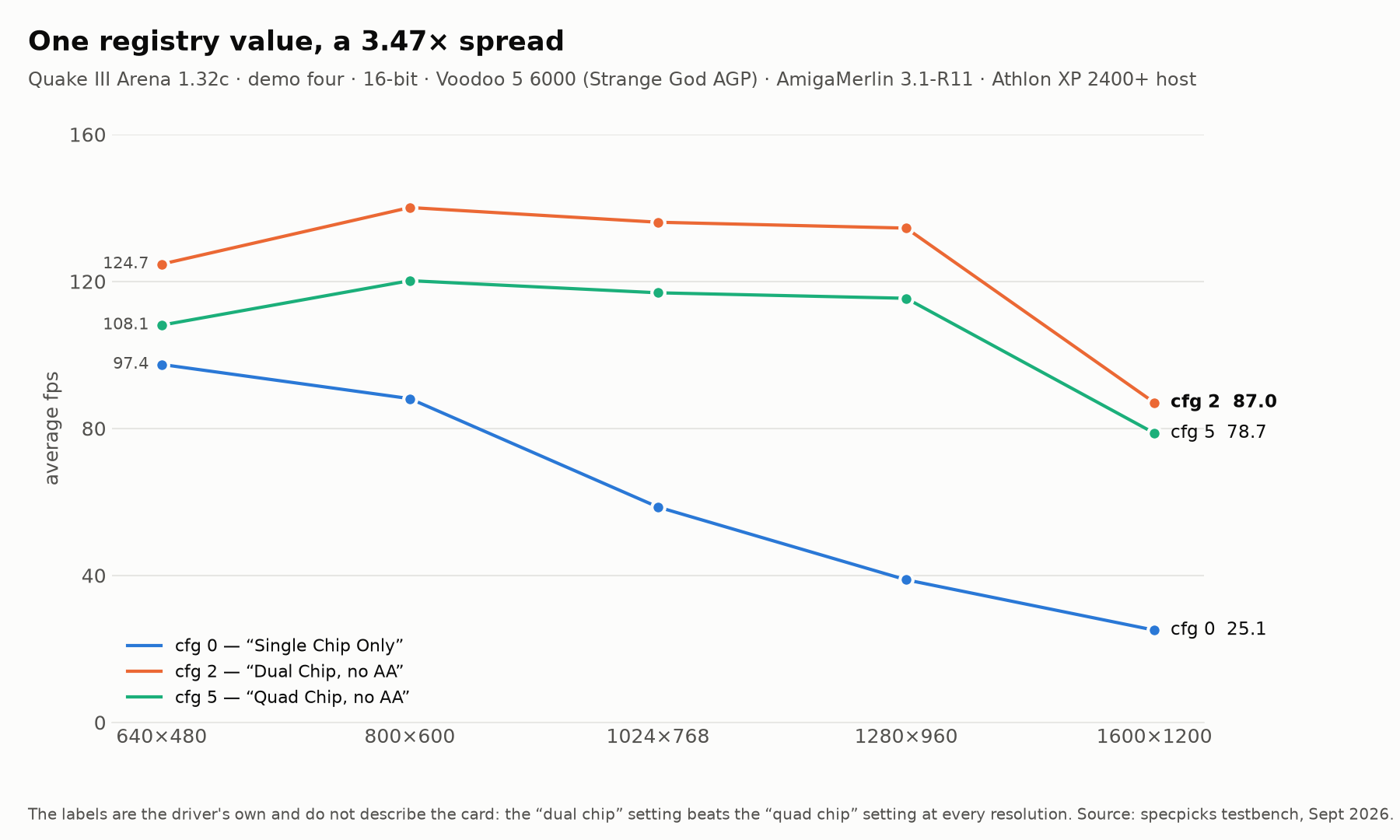
Quake III, demo four, 16-bit, host 2: cfg 0 falls from 97.4 to 25.1 fps; cfg 2 holds 124.7 to 87.0. The legend's chip names are the driver's words.
Read the ratios, not the names. From the re-run CSV, cfg 5 ÷ cfg 0 runs 1.11 / 1.36 / 1.99 / 2.97 / 3.14 from 640×480 to 1600×1200; cfg 2 ÷ cfg 0 runs 1.28 / 1.59 / 2.32 / 3.47 / 3.47. cfg 2 — the setting the driver labels "Dual Chip, Fastest Performance" — beats cfg 5, the "Quad Chip" default, everywhere, including fill-limited 1600×1200 (87.0 vs 78.7). The labels come from 3dfx Tools' descriptor subkeys, the same Tweak Map that produced the inert AA labels, and the dossier leaves three explanations open: the labels are permuted; cfg 0 is not one chip; or cfg 2 and cfg 5 drive the same silicon and differ in SLI band height, a knob glide3x.dll exposes as FX_GLIDE_SLI_BAND_HEIGHT. GR_NUM_FB cannot settle it — it reads 4 for every configuration, "Single Chip Only" included. cfg 2 was measured in one boot, unrepeated.
The repeatability claim is narrow but clean. GPU-bound cells returned within 0.2% for cfg 0 and 1.7% for cfg 5 about eight hours later; the CPU-bound 640×480 cell did not, by 7.5% and 12.0% (matrix above). The first-run rows survive only in prose — the dossier, the findings log and commit messages — and the agent watchdog — a cmd loop running tasklist every 30 s — went in between the runs. Noise is the hypothesis; the watchdog is the candidate cause; re-measurement is pending, host 2 having gone offline before the scheduled run.
Why is the missing FSAA the whole verdict?
Because FSAA was the pitch. When 3dfx cancelled the 6000 on November 13, 2000 and licensed 4-way SLI to Quantum3D, it still claimed "43 percent better Quake 3 graphics performance over leading competitive solutions" (NuAngel). Supersampling was the argument for four VSA-100s on one board — each chip computes two sub-samples, so four-sample AA already needs two (Beyond3D) — and only the 6000 offered 8×. x86-secret's 2005 test of a rev-3700A called 8× "almost a pure marketing feature because the framerate is really too low" (x86-secret). In 2026, on the community-default driver, it is not slow. It is absent.
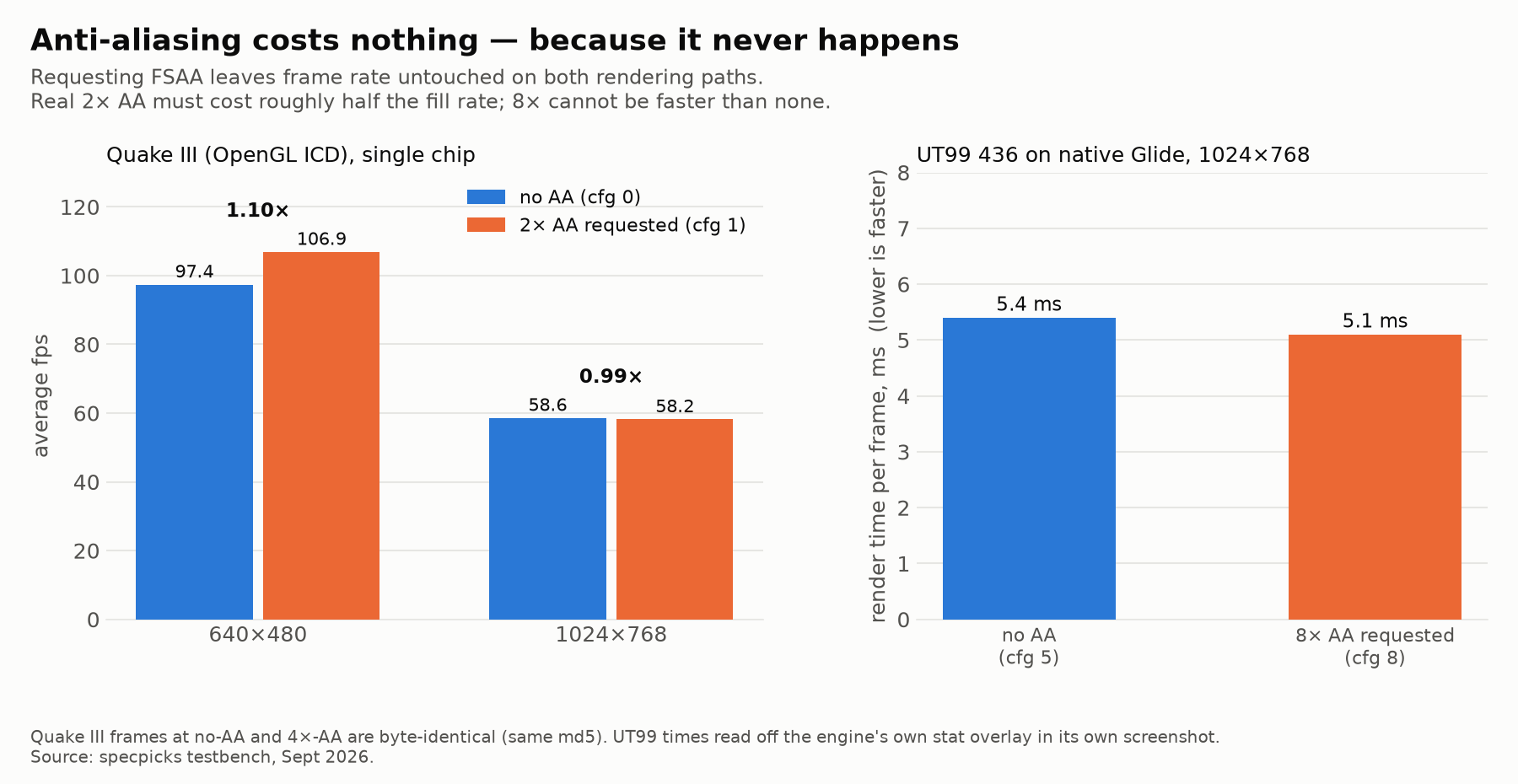
Anti-aliasing that costs nothing is anti-aliasing that is not happening.
The FSAA evidence README has the proof. Three Quake III 1024×768 engine screenshots of one frame — cfg 5 (no AA), cfg 7 (4× requested), cfg 7 plus FX_GLIDE_AA_SAMPLE=4 — share md5 6361acdebeb7dec0e2396aa436a9a18a, per-channel difference (0,0) (0,0) (0,0). "2× AA" on cfg 1 costs 0.99× at fill-bound 1024×768 (58.2 vs 58.6 fps), where real supersampling must roughly halve fill rate. UT99 in native Glide rendered in 5.1 ms with 8× requested against 5.4 ms with none, and on the cfg 4 frame 257 of 328 edge columns across the terrain horizon carried no blended pixel.
Why it fails is not established. glide3x.dll reads the value and asks the miniport through HWCEXT_SLI_AA_REQUEST; 3dfxvs.dll owns separate enables, SSTH3_ANTIALIAS and SSTH3_DIGITAL_SLI_AA, the registry/env route never touched. The best lead dates from 2005: x86-secret ran its 3700A under Windows XP with AmigaMerlin 3.1 R6 and got 2×, 4× and 8× through the 3dfx Tools control panel (x86-secret), and its benchmark page records 8× Quake III at 43.9 fps at 640×480, 27.8 at 800×600 and 14.2 at 1024×768 (x86-secret). The harness kills 3dfxMan.exe before every run, so the control-panel route has never had a chance; letting it live is the first test below.
How stable is the reproduction under AmigaMerlin 3.1-R11?
One topology write per boot — necessary, not sufficient. The lab paid three times in one afternoon for an agent that could not restart itself, which is why the Run-key watchdog went in. On host 1, cfg 8 hung during vid_restart on 2026-09-12 (the log ends "Shutting down OpenGL subsystem"; the agent died, the OS stayed up) and cfg 2 hung the same day. On host 2, a screening pass on 2026-09-15 returned six false "wedges the driver" verdicts for cfg 2, 3, 4, 5, 7 and 8, because cfg 5, the default, had wedged as a third write within one boot while the agent survived. The harness now gives each configuration a clean boot, checks board_alive() with a Glide probe after any failed cell, and restarts its own agent from a Run key. Even so, on host 2 cfg 1 got a clean boot, ran 640×480 at 106.9, and wedged at 800×600; one hang at cfg 1 left the game on screen and needed a physical power cycle. Only cfg 0, cfg 5 and cfg 2 have completed all five resolutions.
Two distinctions matter. These are driver wedges under repeated Glide context creation, not proven board faults: host 1 stayed on the network with its agent dead, whereas the lab's own clean-room open Glide hard-froze that same box on 2026-09-04, NIC dead. And the reproduction inherits a history. An owner of an original rev-3700A wrote that the 6000 "never reached a fully stable state when FSAA was applied (especially 8x, involving all four VSA-100 chips), over all PCB revisions" until ex-3dfx engineer Hank Semenec's resistor-level rework (VOGONS); the maker of this board says of his recreation, "Same BIOSes, same drivers, same bugs" (HotHardware). Whether the wedges belong to AmigaMerlin, the board, or the pairing is what one-config-per-boot cannot tell you. It only lets a run finish.
Who should buy what in 2026?
Three doors, and the SpecPicks catalog opens none of them onto a 6000. No Voodoo 5 6000 listing exists there; prototypes and reproductions trade privately and at auction, so these prices are the maker's and the auction's. The lab has not recorded which variant it holds; the dossier records an AGP board and nothing more, so none of these rows can be tied to the measurements.
| Option | Price and status | Source |
|---|---|---|
| Strange God AGP 256 MB, Matte Black | $1,600 last price, out of stock; listed as AGP (1.5/3.3V), 12-month warranty | zxc64 |
| Strange God AGP 256 MB, Glossy Red | $1,500 last price, out of stock; AGP 1.0 (3.3V) | zxc64 |
| Snow White AGP 256 MB | $1,500, out of stock; 15 units made | zxc64 |
| Strange God PCI 256 MB, Matte Black | $1,600, available, new batch of 5; PCI 33/66 MHz | zxc64 |
| Original Rev 3700A prototype | $15,000, February 2023 | Tom's Hardware |
| Voodoo 5 5500 AGP 64 MB | the card that shipped; 1999 launch price $299 against the 6000's $599 — see the current listings below | The Register |
Thomas Pabst wrote in April 2000 that if the 6000 "should ever become reality, which I still doubt, then GeForce2 would have been beaten, however for double its price" (Tom's Hardware); the reproduction now asks $1,500–$1,600. Our advice splits three ways. Buy the reproduction if the spread is the point and one configuration per boot with no FSAA on R11 is tolerable. Buy a 3DFX Voodoo 5 5500 64MB AGP, a Voodoo 5 5500 AGP 64MB Dual GPU or, for a PCI-only build, the Voodoo 5 5500 PCI Mac Edition if you want the VSA-100 card that actually shipped. Buy a 3dfx Voodoo3 3000 AGP if you want Glide without the archaeology.
What the lab tests next
The not-yet-run matrix, straight from the dossier's own list. Each row is a test the campaign named and did not finish.
| Test | What is already known | Status |
|---|---|---|
| 128 MB / 256 MB VBIOS switch under AmigaMerlin | flipped once before this campaign, on a third machine (dual Pentium III) under the in-house H5 stack, 2026-08-12: Quake III 1024×768 61.4 fps unchanged; UT Glide texture space 15.9 → 32.4 MB | untouched this campaign |
| Making FSAA engage | 3dfx Tools control-panel route and the SSTH3_ANTIALIAS / SSTH3_DIGITAL_SLI_AA enables; only registry/env tried | first priority |
| Resolving the chip labels | SLI band height experiment via FX_GLIDE_SLI_BAND_HEIGHT; cfg 2 repeatability | not run |
| SFFT and the official 3dfx 1.04.00 Windows 2000 driver | SFFT 1.9 requires SSE2 (VOGONS) and host 2 has none, so an older non-SSE2 build or another host | not run |
| The two in-house stacks under this harness | clean-room MesaFX + open Glide hard-froze host 1 on 2026-09-04; the vintage H5 tree ran with a scanout-skew defect under a different harness | not run |
| 32-bit colour | every row is 16-bit | not run |
| Quake II (MiniGL), GLQuake, RtCW, Serious Sam TFE/TSE, Deus Ex, Unreal Gold, a Direct3D title | the old runner planned 96 rows across eight titles and measured zero | not run |
| Remaining AA configs | cfg 3 has no fps row; cfg 4 a UT99 edge frame only; cfg 6 untouched; cfg 7 a Quake III screenshot only; cfg 8 a UT stat line only; cfg 1 at 1280×960 and 1600×1200 | not run |
| UT99 as an fps table | -benchmark never exits on this build; only stat-overlay milliseconds exist | not run |
| Host 1 board repair | EP-8RDA+ BIOS 8RDA4729 recovery floppy built and read back, "all 2880 sectors match"; flash outcome unrecorded; board written off | unrecorded |
Ten lessons for other retro benchmarkers
- Agent liveness is not board liveness: six false verdicts came from a harness that trusted a PING while the card was wedged.
- A value that reads back is not a feature that works.
- Free anti-aliasing is a measurement bug; any AA cell retaining ≥97% of its no-AA frame rate is "not applied".
- A driver's labels are claims; quote them and publish the ratio.
- One topology write per boot is necessary, not sufficient, and a retry is earned only by a pass that measured something.
- A results path that can vanish is worse than none; 14 measured rows died with a scratchpad.
- Record what ran on the row by md5, not version resource; AmigaMerlin ships rebranded 3dfx binaries.
- The engine takes the picture; a GDI grab of a Glide surface is dark noise.
- A deterministic scene is the hard part: two UT99 spawns differ by 74% before any setting changes.
- Read the binary, not the forum: glide3x.dll's strings named the FSAA mechanism, and awdflash's
/Fis not "force".
Bottom line
The Strange God Voodoo 5 6000 is a real, working reproduction the SpecPicks Retro Lab can recommend for one thing it measured — a registry value that takes Quake III 1600×1200 from 25.1 to 87.0 fps — and cannot recommend for the thing 3dfx built it to do, because on AmigaMerlin 3.1-R11, as of 2026-09-16, full-scene anti-aliasing is requested and never delivered. We think the 3dfx Tools route will change that, and the lab will publish the answer either way. Until then the benchmark page says what the dataset says, retractions attached.
Related guides
- Why Nvidia killed 3dfx and how Voodoo still shapes every GPU launch
- Glide on modern PCs: dgVoodoo2 and nGlide for 3dfx-era games
- Building a period-correct 1999 3dfx Voodoo3 Windows 98 PC
- Part 3 — the Quake III ladders behind this verdict
- Part 4 — the FSAA evidence
- How SpecPicks sources its benchmarks
The Voodoo 5 6000 that finally shipped — a SpecPicks Retro Lab series
- Part 1 — The card that never shipped, reproduced
- Part 2 — Test systems and method: two motherboards, one dead BIOS
- Part 3 — Quake III benchmarks at five resolutions
- Part 4 — FSAA: the feature that never engaged
- Part 5 — Hangs, wedges, retractions and a bricked board
- Part 6 — Verdict, and what the lab tests next
Citations and sources
- Host 2 results — https://nscagentstorage.blob.core.windows.net/article-images/voodoo5-6000-strange-god/dataset/host2-124-results.csv (accessed 2026-09-16)
- Campaign dossier — https://nscagentstorage.blob.core.windows.net/article-images/voodoo5-6000-strange-god/dataset/campaign-dossier.md (accessed 2026-09-16)
- FSAA evidence README — https://nscagentstorage.blob.core.windows.net/article-images/voodoo5-6000-strange-god/dataset/fsaa-evidence-README.md (accessed 2026-09-16)
- NuAngel, Nov 2000 — https://nuangel.net/2000/11/3dfx-cancels-voodoo-5-6000-my-thoughts/ (accessed 2026-09-16)
- Beyond3D, Apr 2000 — https://www.beyond3d.com/content/articles/37/5 (accessed 2026-09-16)
- x86-secret, benchmarks — http://www.x86-secret.com/articles/divers/v5-6000/v56kgb-7.htm (accessed 2026-09-16)
- x86-secret, hands-on — http://www.x86-secret.com/articles/divers/v5-6000/v56kgb-6.htm (accessed 2026-09-16)
- VOGONS, PCI rework — https://www.vogons.org/viewtopic.php?t=51006 (accessed 2026-09-16)
- HotHardware, Feb 2021 — https://hothardware.com/news/3dfx-voodoo-5-6000-recreated-by-enthusiast-vsa-100 (accessed 2026-09-16)
- zxc64, AGP Matte Black — https://www.zxc64.com/vsa100_based/0_62911_strange_god_agp_256mb_matte_black_voodoo_5_6000_alike/ (accessed 2026-09-16)
- zxc64, AGP Glossy Red — https://www.zxc64.com/vsa100_based/0_62936_strange_god_agp_256mb_glossy_red_voodoo_5_6000_alike/ (accessed 2026-09-16)
- zxc64, Snow White — https://www.zxc64.com/vsa100_based/0_62925_snow_white_agp_256mb_3dfx_voodoo_5_6000_alike/ (accessed 2026-09-16)
- zxc64, PCI Matte Black — https://www.zxc64.com/vsa100_based/0_62910_strange_god_pci_256mb_matte_black_voodoo_5_6000_alike/ (accessed 2026-09-16)
- Tom's Hardware, Feb 2023 — https://www.tomshardware.com/news/3dfx-voodoo-5-6000-sold-for-15000-dollars (accessed 2026-09-16)
- The Register, Nov 1999 — https://www.theregister.com/1999/11/15/3dfx_launches_voodoo/ (accessed 2026-09-16)
- Tom's Hardware, Apr 2000 — https://www.tomshardware.com/reviews/tom,184-22.html (accessed 2026-09-16)
- VOGONS, XP drivers — https://www.vogons.org/viewtopic.php?t=67025 (accessed 2026-09-16)
This is a first-party lab report: the measurements above were taken by the SpecPicks Retro Lab on its own hardware. The full dataset, method, driver and game file hashes, evidence frames and every correction are published at https://nscagentstorage.blob.core.windows.net/article-images/voodoo5-6000-strange-god/dataset/campaign-dossier.md. It is not editorial synthesis of third-party sources.
— SpecPicks Retro Lab · Last verified Sep 16, 2026