Key takeaways
- One registry value,
SSTH3_SLI_AA_CONFIGURATION, takes Quake III at 1600x1200 from 25.1 to 87.0 fps on host 2 — a 3.47x spread. - cfg 2, labelled "Dual Chip", beats cfg 5, labelled "Quad Chip", at all five resolutions (1.11x to 1.17x). A setting really made of two chips should not reach 3.47x; the labels do not describe the card.
- Below 1024x768 the Athlon XP 2400+ sets the number; above it the card does, and every cell there repeats to within 0.7%. Host 1's 640x480 numbers are a different motherboard and not comparable; no figure here measures anti-aliasing.
What was measured, and how
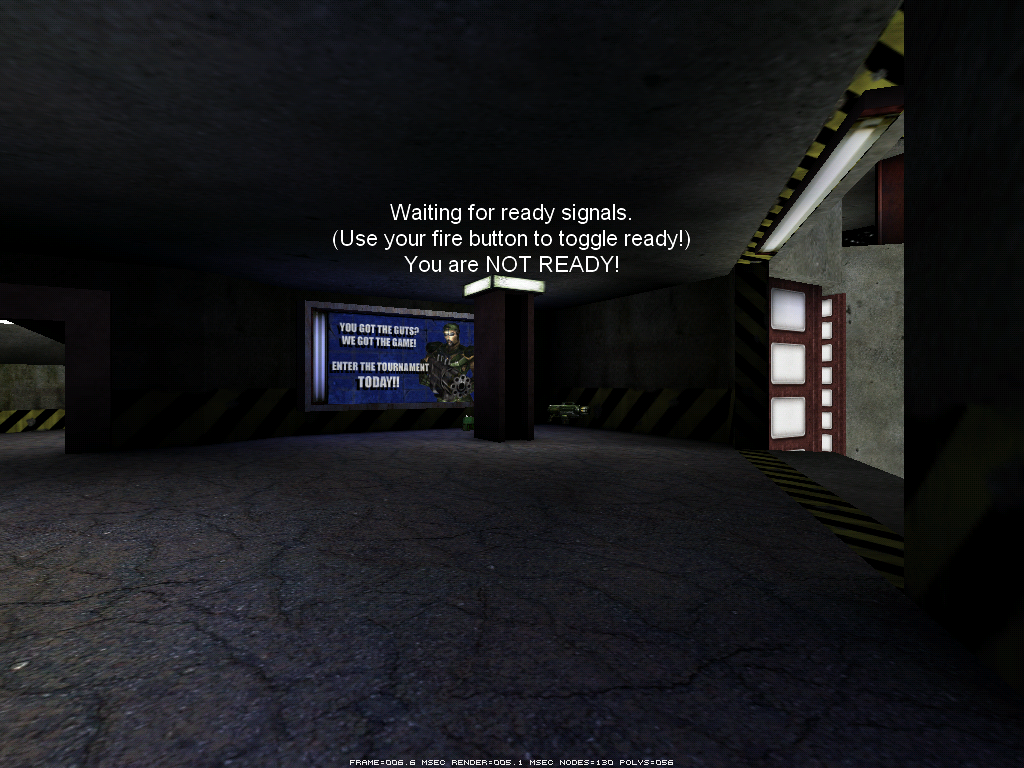
Quake III Arena, retail 1.32c (quake3.exe, 872,448 bytes), timedemo 1, demo four, 1260 frames, 16-bit colour, Z and textures, fullscreen, 60 Hz per the MODE line — the same four demo x86-secret ran on a rev-3700A prototype in 2005 (x86-secret), so the curves compare in shape, never in number.
The OpenGL path is AmigaMerlin's ICD, 3dfxOGL.dll, reporting GL_VENDOR "Brian Paul" and GL_RENDERER "Mesa Glide v0.63 Voodoo5 6000 (tm)" — MesaFX on glide3x.dll. The driver is "AMIGAMERLIN 3.1-R11 For Voodoo 5 6000 AGP", 5.1.2605.5, dated 6-9-2005; every file's md5 is in the versions record; AmigaMerlin ships rebranded 3dfx binaries.
Host 2 is an Athlon XP 2400+ at 2004 MHz, 255 MB, Windows XP SP3, on a Gateway VX1120 4:3 CRT — hence 1280x960, not 1280x1024 — with the card in its 128 MB VBIOS mode.
The one variable is a REG_SZ value under the display class key's Settings\Glide; Mesa's README.3DFX documents its nine values (0 = SLI and AA off, 2 = "2-way SLI", 5 = "4-way SLI"), and the lab's cfg numbers are those values. Each configuration got one clean boot and one write (Part 2).
The five-resolution table
Three settings completed the ladder on host 2; the labels are the driver's, quoted, not endorsed.
| Setting | Driver label | 640x480 | 800x600 | 1024x768 | 1280x960 | 1600x1200 |
|---|---|---|---|---|---|---|
| cfg 0 | "Single Chip Only" | 97.4 | 88.1 | 58.6 | 38.8 | 25.1 |
| cfg 5 | "Quad Chip, Fastest Performance" | 108.1 | 120.2 | 116.9 | 115.4 | 78.7 |
| cfg 2 | "Dual Chip, Fastest Performance" | 124.7 | 140.1 | 136.1 | 134.5 | 87.0 |
Frames per second from the engine's timedemo line. cfg 2 was measured in one boot, with no repeat. cfg 1, "Single Chip, 2-Sample AA", reached 106.9 at 640x480 and 58.2 at 1024x768, timed out at 800x600 and never reached the two largest modes — AA requested, not delivered.
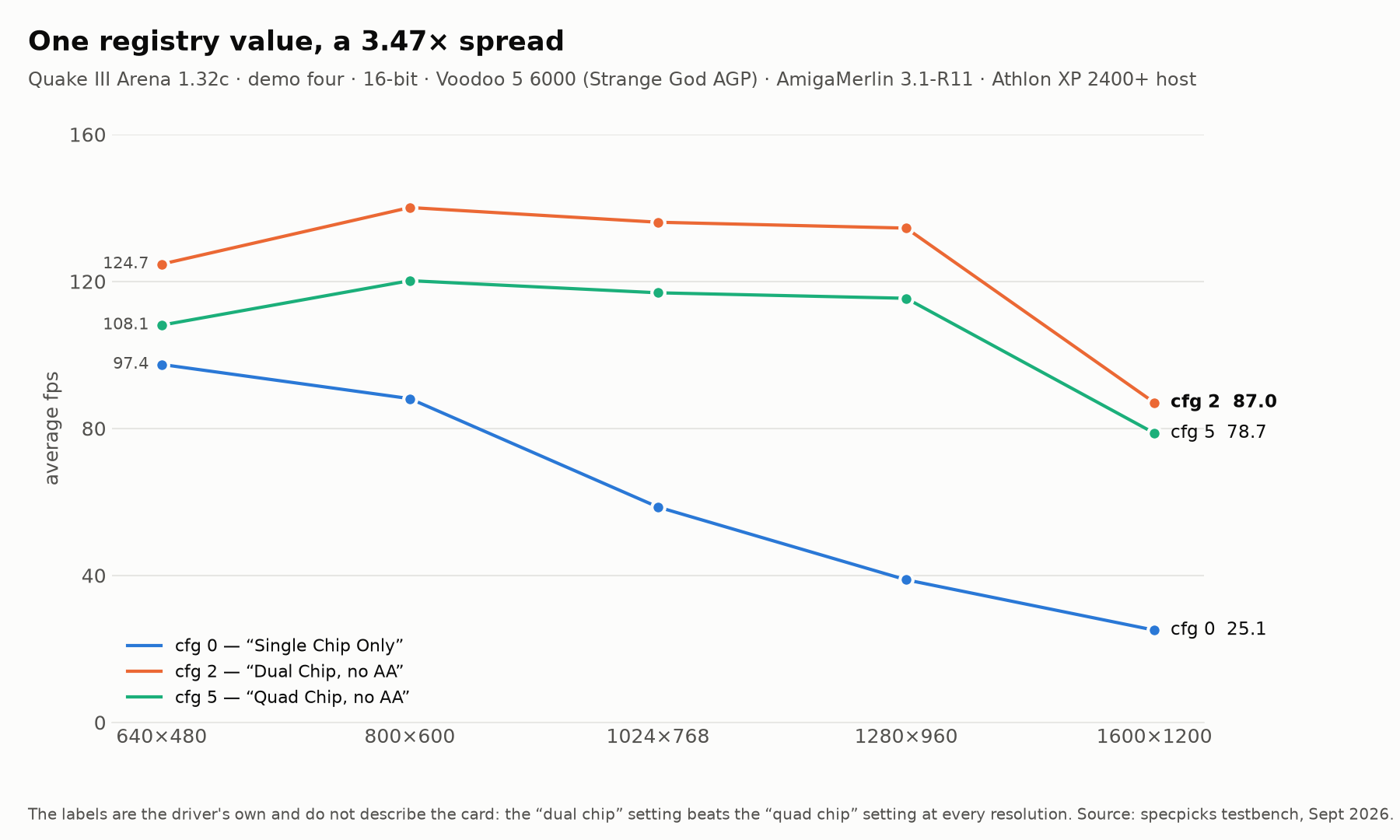
Host 2, demo four, 16-bit: cfg 0 collapses with resolution; cfg 2 and cfg 5 plateau until 1600x1200.
Every row renders on the card's benchmark page.
How fast is the Voodoo 5 6000 in Quake III at 1600x1200?
25.1, 78.7 or 87.0 fps, depending on one registry value. The 1260-frame demo took 50.2 seconds at cfg 0, 16.0 at cfg 5 and 14.5 at cfg 2 — a 3.47x spread decided before the game loaded.
The 87.0 is the figure 2000 would have set in bold. Tom Pabst's April 2000 GeForce2 GTS verdict singled out "the very respectable 57.2 fps in Quake 3 Arena at 1600x1200 and 16-bit color" as its one highlight, on a $300-350 card (Tom's Hardware). A 2004 MHz Athlon and a 2005 driver make that no like-for-like comparison, and this report offers none; the point is the shape. At 1600x1200 a VSA-100 card is fill-limited, and this one carries four rasterisers.
The 25.1 matters as much: the floor at the setting labelled "Single Chip Only", and it reads like a Voodoo4 4500 — what x86-secret concluded from the prototype, "2x more GPU = 2x more performance" from 1024x768 up (x86-secret). Whatever cfg 2 engages makes this a 6000 rather than a 4500.
Where does the CPU stop mattering?
At 1024x768 on this host — the ratios say so more clearly than the raw numbers.
| Resolution | cfg 5 ÷ cfg 0 | cfg 2 ÷ cfg 0 | cfg 2 ÷ cfg 5 |
|---|---|---|---|
| 640x480 | 1.11 | 1.28 | 1.15 |
| 800x600 | 1.36 | 1.59 | 1.17 |
| 1024x768 | 1.99 | 2.32 | 1.16 |
| 1280x960 | 2.97 | 3.47 | 1.17 |
| 1600x1200 | 3.14 | 3.47 | 1.11 |
At 640x480 the three settings are 97.4, 108.1 and 124.7 fps, everything within 1.28x: the Athlon XP is the limit, and more rasteriser cannot help. cfg 2 even rises from 640x480 to 800x600, 124.7 to 140.1, which no fill-bound card does. cfg 5 then plateaus — 120.2, 116.9, 115.4 — through 1280x960, cfg 2 higher at 140.1, 136.1, 134.5, before both bend at 1600x1200. cfg 0 sheds frames at every step, 88.1, 58.6, 38.8, 25.1: across the exact fourfold pixel step from 640x480 to 1280x960 it falls from 97.4 to 38.8 while cfg 2 goes from 124.7 to 134.5.
thedodgegarage saw the same shape on a Celeron 1000: every 3dfx card in its 21-card shootout topped out "around 80 fps" in Quake 3 while a T&L GeForce2 MX pulled clear (thedodgegarage). The VSA-100 has no geometry engine; the CPU is, and a 2004 MHz Athlon lifts that ceiling from around 80 to the 120.2 and 140.1 fps plateaus measured here.
Why "Dual Chip" beats "Quad Chip"
The labels come from 3dfx Tools, not the silicon. Its descriptor Tweak Maps route the value through three lists: QuadChipAASLI (0, 5, 6, 7, 8 — "Single Chip Only", "Fastest Performance", then 2-, 4- and 8-sample AA), DualChipAASLI (0, 2, 3, 4) and SingleChipAASLI (0, 1). Read literally, cfg 2 is two chips and cfg 5 four.
The measurements refuse that reading. cfg 2 beats cfg 5 at every resolution — 1.15x, 1.17x, 1.16x, 1.17x, 1.11x — including fill-limited 1600x1200 (87.0 versus 78.7), and is 3.47x cfg 0 at 1280x960 and 1600x1200. If cfg 2 really were two rasterisers, 3.47 times the fill of one is not possible. The dossier records three candidate explanations and chooses none:
- The labels are permuted; cfg 2 is the real four-chip mode.
- cfg 0 is not one chip, which would scale every ratio by a constant.
- Both drive four chips and differ in SLI band height —
glide3x.dllcarriesFX_GLIDE_SLI_BAND_HEIGHTandFX_GLIDE_FORCE_SLI_BAND_HEIGHT, and VSA-100 SLI has the master cut each frame into zones "from 1 to 128 lines" (x86-secret) — cfg 5 being the less efficient split.
Glide cannot settle it: GR_NUM_FB reads 4 under every configuration, "Single Chip Only" included — chips present, not chips ganged. And cfg 2 was measured once. So the publishable claim is the spread; this report never writes "two chips give X, four give Y", and we think any VSA-100 review that does so from driver labels is guessing.
Does it repeat? First run versus re-run
Yes where the card is the limit; less so where the CPU is. cfg 0 and cfg 5 were each measured twice on host 2, about eight hours apart, same files, same boot discipline. The first run's rows were lost with a deleted scratchpad and survive in the dossier; the lab re-measured rather than reconstructed.
| Resolution | cfg 5: first → re-run | cfg 0: first → re-run |
|---|---|---|
| 640x480 | 122.8 → 108.1 (−12.0%) | 105.3 → 97.4 (−7.5%) |
| 800x600 | 122.3 → 120.2 (−1.7%) | 88.0 → 88.1 (+0.1%) |
| 1024x768 | 117.9 → 116.9 (−0.8%) | 58.7 → 58.6 (−0.2%) |
| 1280x960 | 114.6 → 115.4 (+0.7%) | 38.8 → 38.8 (0) |
| 1600x1200 | 78.5 → 78.7 (+0.3%) | 25.1 → 25.1 (0) |
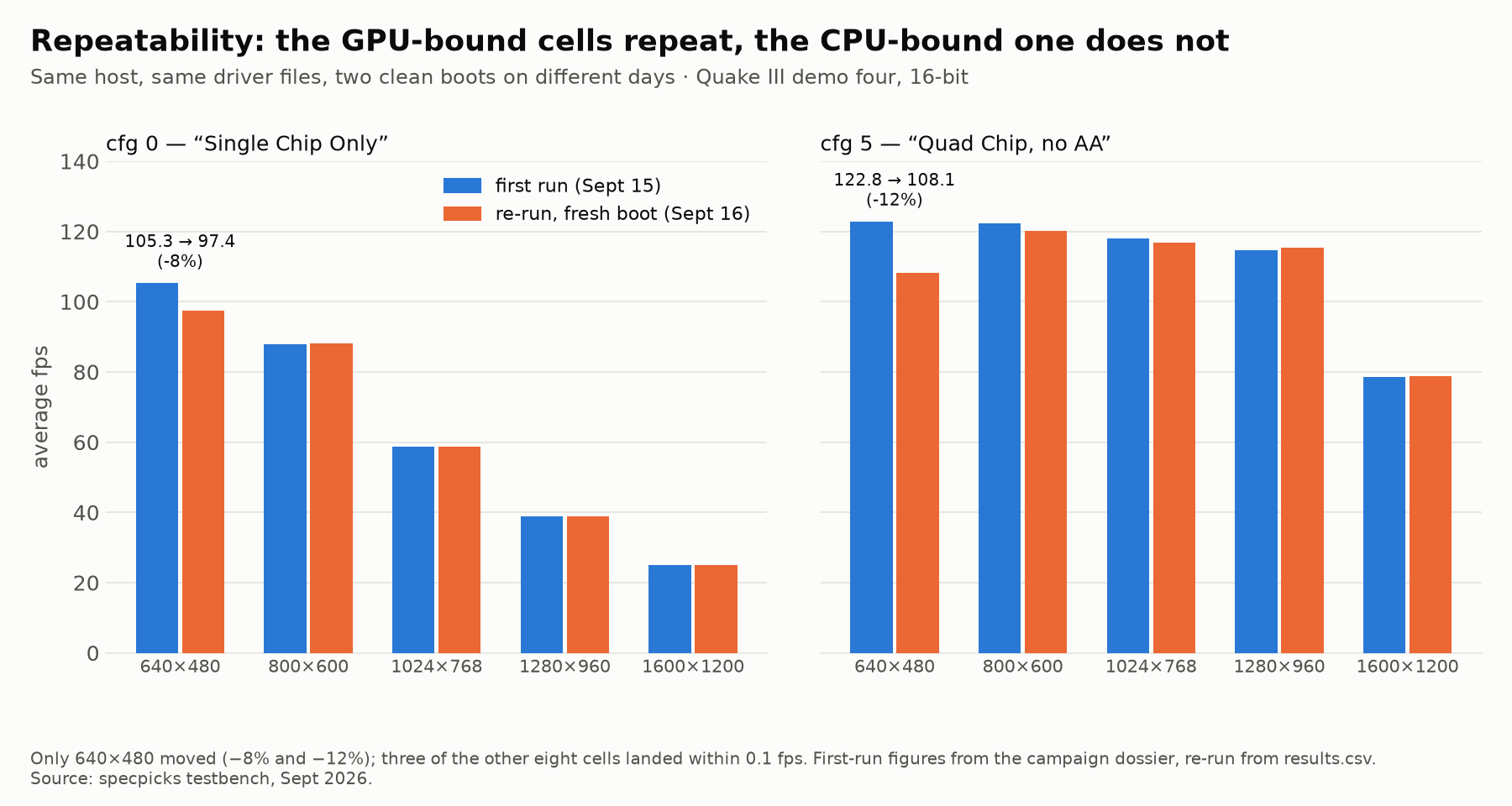
Two runs, eight hours apart: only 640x480 moved by more than 2%.
Four cfg 0 cells repeated to within 0.1 fps, two of them exactly — the fill-bound regime behaving like the fixed-function pipeline it is. Only 640x480 moved, the same direction on both settings. Noise is the hypothesis; the candidate cause is an agent watchdog, a cmd loop polling tasklist every 30 seconds, installed between the runs — exactly where a CPU-bound cell would show it. A re-measurement with the loop paused is pending; host 2 went offline before it ran.
cfg 1 repeated its 640x480 cell exactly, 106.9 both times; its 1024x768 cell, 58.2 against cfg 0's 58.6, is a 0.99x cost for "2-sample AA" where real supersampling must roughly halve fill — Part 4's first hint.
Host 1: four bars at 640x480, not comparable
The same card lived first in an EPoX EP-8RDA+ nForce2 board with an Athlon XP-class CPU and 511 MB, whose BIOS was losing its FSB, MAC and RTC state and which stopped booting a day after these runs (Part 5). No clock is printed for it; the box reported two on two days.
| Stamp (UTC, 2026-09-12) | Setting | Driver label | fps | Status |
|---|---|---|---|---|
| 13:57:42 | cfg 0 | "Single Chip Only" | 126.6 | ok |
| 13:58:08 | cfg 5 | "Quad Chip, Fastest Performance" | 150.2 | ok |
| 15:19:30 | cfg 0 | "Single Chip Only" | 127.8 | ok |
| 15:19:56 | cfg 1 | "Single Chip, 2-Sample AA" (not delivered) | 126.9 | ok |
| 15:27:56 | cfg 2 | "Dual Chip, Fastest Performance" | — | hung; agent died |
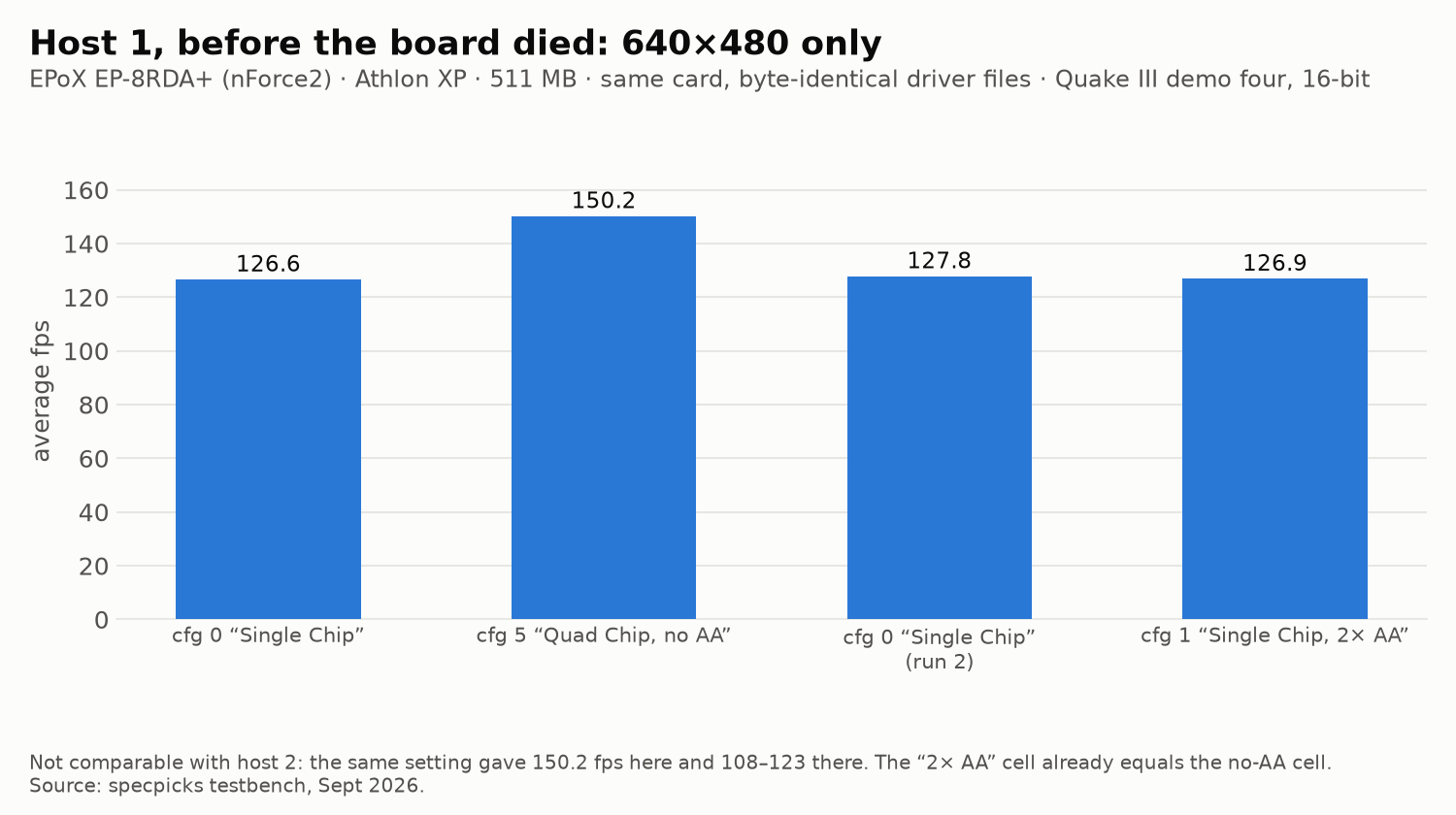
Host 1, 640x480x16 only: a different motherboard, different RAM, an unreliable clock.
Two rows survive only in a pre-migration CSV: a cfg 5 repeat of 151.4 at 14:56:19Z and a cfg 8 ("Quad Chip, 8-Sample AA") hang at 14:58:52Z during a vid_restart; a hand-run cfg 5 repeat gave 154.2, about 2.6% spread; the four verified cells are in the host 1 results CSV, the rest in the dossier.
Why the rule exists. Same card, byte-identical driver files, cfg 5 at 640x480: 150.2 fps here, 122.8 and then 108.1 on host 2. The machine explains that, not the card. And cfg 2, which completed five resolutions cleanly on host 2, hung this box outright.
What the year 2000 measured
3dfx showed the 6000 running Quake III in public with the frame counter covered. In September 2000 it ran Quake III at 1600x1200, 32-bit, 4-sample AA — stuttering in big fights, "silky smooth" at 1024x768 — with a sticker over the fps counter (AnandTech forums). On November 13, 2000 the card was cancelled, 3dfx claiming "43 percent better Quake 3 graphics performance over leading competitive solutions" (NuAngel).
The two-chip Voodoo 5 5500 that did ship set the reference, and Tom Pabst, doubting the 6000 would ever exist, wrote that if it did, "GeForce2 would have been beaten, however for double its price" (Tom's Hardware). For anyone who had bought a Voodoo3 3000 the year before, that was the whole question.
Since then: x86-secret's 2005 prototype test, on an Athlon XP 2800+ with AmigaMerlin 3.1 R6 — this lab's driver lineage — found "almost no performance difference" against a GeForce2 Ultra at 2x FSAA and called 8x "almost a pure marketing feature" (x86-secret); GamersNexus ran a Strange God AGP under Windows 98 SE on an Athlon XP 2600+: 117 fps at 1024x768 against 81 for a GeForce2 GTS (GamersNexus). Different CPUs, operating systems, drivers and demos — none are this report's numbers. All share with this ladder the plateau, then the cliff.
Bottom line
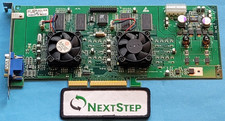
On a 2004 MHz Athlon XP, this Voodoo 5 6000 reproduction runs Quake III's four demo at 87.0 fps at 1600x1200 in 16-bit colour — and at 25.1 fps with one registry value set to the driver's "Single Chip Only". That 3.47x spread, renderer string on every row, is this part's result. What it is made of is not established: "Dual Chip" beat "Quad Chip" everywhere, so a label is wrong somewhere, and the lab says so rather than print a chip count. No figure here measures anti-aliasing. There is no Voodoo 5 6000 in the site's catalogue — prototypes and reproductions trade privately and at auction — and the nearest buyable thing is the two-chip Voodoo 5 5500 AGP or its PCI Mac edition.
Related guides
- Why Nvidia killed 3dfx and how Voodoo still shapes every GPU launch
- 3dfx Voodoo2 SLI in 2026: build guide, Glide setup, CF storage
- Glide on modern PCs: dgVoodoo2 and nGlide for 3dfx-era games
- Building a period-correct 1999 3dfx Voodoo3 Windows 98 PC
The Voodoo 5 6000 that finally shipped — a SpecPicks Retro Lab series
- Part 1 — The card that never shipped, reproduced
- Part 2 — Test systems and method: two motherboards, one dead BIOS
- Part 3 — Quake III benchmarks at five resolutions
- Part 4 — FSAA: the feature that never engaged
- Part 5 — Hangs, wedges, retractions and a bricked board
- Part 6 — Verdict, and what the lab tests next
Citations and sources
- SpecPicks Retro Lab, host 2 results CSV — https://nscagentstorage.blob.core.windows.net/article-images/voodoo5-6000-strange-god/dataset/host2-124-results.csv (accessed 2026-09-16)
- SpecPicks Retro Lab, host 2 software-under-test record — https://nscagentstorage.blob.core.windows.net/article-images/voodoo5-6000-strange-god/dataset/host2-124-versions.json (accessed 2026-09-16)
- SpecPicks Retro Lab, host 1 results CSV — https://nscagentstorage.blob.core.windows.net/article-images/voodoo5-6000-strange-god/dataset/host1-191-results.csv (accessed 2026-09-16)
- SpecPicks Retro Lab, campaign dossier — https://nscagentstorage.blob.core.windows.net/article-images/voodoo5-6000-strange-god/dataset/campaign-dossier.md (accessed 2026-09-16)
- Mesa README.3DFX, SSTH3_SLI_AA_CONFIGURATION values — https://github.com/nobled/mesa-ics/blob/master/docs/README.3DFX (accessed 2026-09-16)
- x86-secret, Voodoo 5 6000 benchmarks (2005) — http://www.x86-secret.com/articles/divers/v5-6000/v56kgb-7.htm (accessed 2026-09-16)
- x86-secret, VSA-100 architecture and SLI — http://www.x86-secret.com/articles/divers/v5-6000/v56kgb-4.htm (accessed 2026-09-16)
- Tom's Hardware, GeForce2 GTS review conclusion (April 27, 2000) — https://www.tomshardware.com/reviews/tom,184-22.html (accessed 2026-09-16)
- thedodgegarage, 21-card 3dfx shootout — http://www.thedodgegarage.com/3dfx/bench.htm (accessed 2026-09-16)
- AnandTech forums, Voodoo 5 6000 preview discussion (September 2000) — https://forums.anandtech.com/threads/voodoo-5-6000-preview.349187/ (accessed 2026-09-16)
- NuAngel, 3dfx cancels Voodoo 5 6000 (November 2000) — https://nuangel.net/2000/11/3dfx-cancels-voodoo-5-6000-my-thoughts/ (accessed 2026-09-16)
- GamersNexus, Back from the Dead: 3dfx's Unreleased Voodoo5 6000 (December 2023) — https://gamersnexus.net/gpus/back-dead-3dfxs-unreleased-voodoo5-6000-quad-gpu-card (accessed 2026-09-16)
This is a first-party lab report: the measurements above were taken by the SpecPicks Retro Lab on its own hardware. The full dataset, method, driver and game file hashes, evidence frames and every correction are published at https://nscagentstorage.blob.core.windows.net/article-images/voodoo5-6000-strange-god/dataset/campaign-dossier.md. It is not editorial synthesis of third-party sources.
— SpecPicks Retro Lab · Last verified Sep 16, 2026