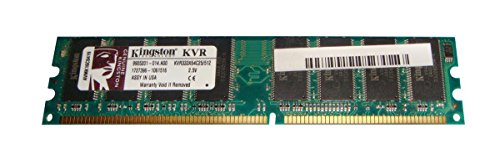
Start with the part number on the label. A Kingston "2GB" DDR1 product is almost always a kit of two 1GB modules — KVR400X64C3AK2/2G is exactly that — not a single 2GB stick. Decode the string, confirm your chipset supports the chip density, and check whether your board's stated maximum is a per-slot or a total figure before you buy.
You are holding an unlabeled stick, or looking at an eBay photo
This is the actual situation. Somebody is staring at a green PCB with eight or sixteen chips on it, a sticker that reads something like KVR400X64C3A/1G, and a motherboard manual that says "2GB maximum" — and needs to know whether pressing this into the slot will produce a POST beep or a blank screen.
Vintage memory is the component where guessing is most expensive, because a mismatch does not fail politely. A module with the wrong chip density will POST and report half its capacity, or refuse to POST at all with no diagnostic beyond a dead machine, and the eBay listing you bought it from has a 30-day window you will discover you have already missed.
The good news is that Kingston's part-number scheme is unusually legible once you know the fields, and DDR1-era compatibility is governed by a small number of hard rules rather than a compatibility matrix. If you can read the sticker and identify the chipset, you can answer the question before spending money.
This guide is for period-correct builders working with 2003-2005 hardware — the Socket 478, Socket A, and Socket 754/939 era where DDR-333 and DDR-400 were the mainstream. It covers decoding the part number, understanding why a board's stated maximum lies to you, the Windows 98 memory ceiling that traps people who add RAM to a 9x machine, and the honest question of whether DDR1 is worth buying at all in 2026 or whether the money belongs elsewhere in the build.
If you need the general vintage-memory identification method across SIMM, SDRAM, and DDR generations, our old RAM identification guide covers the broader decoding approach. This piece narrows to Kingston DDR1 specifically.
Key takeaways
- A Kingston DDR1 part number ending in
K2/2Gis a two-module kit, not a 2GB module. Single 2GB unbuffered DDR1 DIMMs are rare and frequently incompatible with period chipsets. - Board "maximum memory" figures are almost always a total across all slots, and the memory controller separately limits chip density and rank count.
- DDR1 DIMMs are 184-pin and run at 2.5V nominal. They are keyed so they will not seat in a DDR2 slot — if it does not go in, do not push.
- Windows 98 breaks above roughly 512MB because of the disk cache allocator, and the fix is a configuration cap, not removing memory.
- On most retro builds, replacing the mechanical drive moves the experience more than adding memory does.
Step 0 — what does your board actually accept?
Three limits stack, and any one of them will stop a module working.
The stated total. A board that says "supports up to 2GB" with four DIMM slots is telling you 4 × 512MB, not 4 × 2GB. This is the most common misreading. Check the manual for a per-slot figure; if it does not give one, divide the total by the slot count as your working assumption.
Chip density. The memory controller understands a specific set of DRAM chip densities and no others. A 1GB module built from higher-density chips than the chipset was designed for will either fail to POST or report a fraction of its real capacity — and this is why two modules with identical printed capacity can behave completely differently in the same slot. Intel publishes memory compatibility guidance for its platforms; the chipset datasheet is the authoritative source for what densities are supported.
Rank count. Each slot supports a limited number of ranks, and a double-sided module counts as two. Populating four slots with double-sided modules exceeds what many period controllers will drive, which shows as instability rather than a clean failure — random reboots, memory errors under load, a machine that passes POST and fails a memtest run.
Registered versus unbuffered. Registered (buffered) modules add a register between the controller and the chips and are used in servers and workstations. They are electrically incompatible with desktop boards. Kingston marks these with an R in the part number, as in KVR266X72RC2512. If a listing is unusually cheap for its capacity, check for that R first.
How to decode a Kingston part number
The ValueRAM scheme reads left to right in fixed fields.
| Field | Example | Meaning |
|---|---|---|
| Prefix | KVR | ValueRAM line. KTD/KTH/KTC/KTM are system-specific modules built for a particular OEM machine |
| Speed | 400 | 400MHz effective — DDR-400, marketed as PC3200 |
| Width / ECC | X64 | 64-bit non-ECC. X72 means 72-bit ECC |
| Buffering | (absent) | Unbuffered. An R here means registered — server only |
| Latency | C3 | CAS latency 3. C25 reads as CL2.5 |
| Revision | A | Die revision. Different revisions can behave differently on picky boards |
| Kit | K2 | Kit of two modules. Absent means a single module |
| Capacity | /2G | Total capacity of the product — for a K2 kit, split across both modules |
Worked example: KVR400X64C3AK2/2G is a ValueRAM kit of two DDR-400 non-ECC unbuffered CL3 modules totalling 2GB — so 2 × 1GB. That is the Kingston 2GB KIT 400MHz DDR PC3200, listed at $59.99 in our catalog in August 2026.
Second example: KVR400X64C3A/1G drops the K2, so it is a single 1GB DDR-400 module — the Kingston ValueRAM 1GB PC3200 DIMM at $41.52. This is the module to buy when you are filling one remaining slot rather than rebuilding the whole memory configuration.
Third: KVR400X64C3A/512 is the 512MB PC3200 CL3 module at $23.97, and KVR333X64C25/512 is the 512MB PC2700 CL2.5 module at $33.35 — same capacity, one generation slower on the bus, tighter on latency. Kingston's own memory search tool resolves part numbers against original system compatibility if the sticker is legible.
Catalog prices captured August 2026 and may vary — check current listings before buying.
Spec-delta table
| DDR1 (PC2700/PC3200) | DDR2 | DDR3 | |
|---|---|---|---|
| Pin count | 184-pin DIMM | 240-pin DIMM | 240-pin DIMM |
| Nominal voltage | 2.5V | 1.8V | 1.5V |
| Typical module capacity | 256MB - 1GB | 512MB - 2GB | 1GB - 8GB |
| Common speeds | 266 / 333 / 400 MHz | 533 / 667 / 800 MHz | 1066 / 1333 / 1600 MHz |
| Board era | 2002 - 2005 | 2005 - 2009 | 2008 - 2015 |
The pin counts and voltages are the practical safety net: DDR1 and DDR2 modules are keyed differently and will not seat in the wrong slot. The DDR SDRAM specification family documents the electrical and mechanical differences across generations, and they are why a physical fit is meaningful evidence you have the right generation.
Why a 2GB module fails to POST in a board that claims 2GB support
Because the two numbers describe different things.
The board's "2GB maximum" is a total. The memory controller's limit on chip density is a separate, unstated constraint that comes from the chipset, not the board. A period DDR1 controller designed around 256Mbit and 512Mbit DRAM chips has no logic for addressing a module built from 1Gbit chips, and what happens next depends on the specific controller: some POST and report half the capacity, some report a quarter, some hang before video initialisation.
This is also why single 2GB unbuffered DDR1 DIMMs are a bad bet for period hardware. They exist, but building 2GB from unbuffered DDR1 requires high-density chips and often double-sided high-rank layouts — precisely the combination period desktop chipsets handle worst. The two-module kit is not a compromise; it is the configuration those boards were designed to run.
Rank count compounds it. If your board has four slots and you fill all four with double-sided modules, you may be presenting eight ranks to a controller rated for four. The symptom is not a clean refusal — it is a machine that boots, works for twenty minutes, and then throws errors under memory pressure.
Practical sequence: find the chipset (northbridge marking on the board, or use our motherboard identification guide), find the datasheet, read the supported densities and rank limits, then buy modules that fit inside all three constraints.
What breaks in Windows 98 above 512MB
This one traps people who do everything else right.
Windows 98 sizes its disk cache from total physical memory, and above roughly 512MB the cache allocator can exhaust the address range available to it. The result is an "insufficient memory to initialize Windows" error, or out-of-memory failures in applications, on a machine that visibly has memory free. It is not a hardware fault and adding more RAM makes it worse.
The remedy is to cap the cache explicitly in system.ini under the [vcache] section with a MaxFileCache value, rather than pulling memory out of the machine. Setting a bounded cache size restores stability while keeping the extra RAM installed and usable. If you would rather not edit configuration files on a period install, the alternative is simply to populate fewer slots — but capping the cache is the better outcome, because the memory is still there for applications.
Windows 2000 and Windows XP do not have this behaviour. If your build targets XP, ignore this section entirely.
How much RAM does a 2004-era XP gaming build actually need?
| Configuration | What it feels like |
|---|---|
| 256MB | XP boots and swaps constantly. Unusable for gaming. |
| 512MB | The period-typical baseline. Playable, with loading pauses. |
| 1GB | The sweet spot. Most 2003-2005 titles stop touching the page file. |
| 2GB (2 × 1GB) | Headroom. Helps with later XP-era titles and heavy multitasking. |
| More than 2GB | Diminishing returns on this platform, and increasingly hard to source. |
The honest answer for a period-correct 2004 gaming build is 1GB, with 2GB as the comfortable configuration if the chipset and your budget both allow it. Beyond that you are spending collector-market money for headroom that era's software cannot use.
Is DDR1 worth buying in 2026?
Prices for common unbuffered DDR1 modules have stayed accessible because supply from decommissioned machines still exceeds retro-builder demand. Our catalog's DDR-400 examples run from $23.97 for 512MB to $59.99 for a 2GB kit, which is reasonable money for a functioning build.
Where the economics flip is at the high-capacity and low-latency end. Enthusiast DDR1 kits from that era — tight-timing matched pairs, high-density modules — carry a genuine collector premium, and it is easy to reach a point where one matched pair costs more than a complete later-platform board and CPU. That is the moment to ask what you are actually building.
Decide up front. If the goal is period-correct — the exact machine, the exact era, running the software of its time on the hardware of its time — then DDR1 at $40 a gigabyte-ish is part of the deal and it is fine. If the goal is "a retro-feeling machine that plays old games well," a later platform does that for less money with far better parts availability, and there is no shame in it. For repurposing sticks you already own rather than buying more, see best uses for old RAM sticks.
What to buy instead when the goal is speed
If the machine is still booting from its original mechanical drive, memory is the wrong upgrade. Storage latency dominates every interactive operation on a period machine, and moving the volume to solid-state is the single change that makes the largest difference to how the build feels. Our best SSDs and storage adapters for retro PC builds covers the options.
The order that gets the best result: image the old drive, replace it with solid-state, confirm the machine is stable, and only then revisit the memory configuration.
Image the volume before you touch the memory config
This is not optional advice. A memory change that produces an unstable POST can corrupt a filesystem that was mid-write, and recovering a period-correct install with its original drivers and registry intact is far harder than restoring from an image you took first.
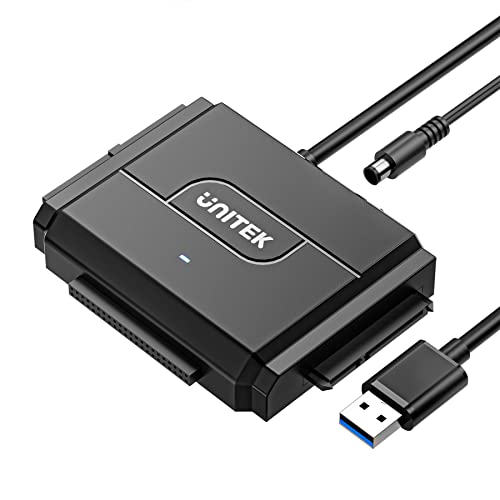
Pull the drive and bridge it to a modern machine with the Unitek SATA/IDE USB 3.0 Adapter at $29.74 — it handles 2.5-inch IDE, 3.5-inch IDE, and SATA from one unit, and it ships with the external power supply that 3.5-inch spindles require. Take a sector-level image rather than a file copy, verify the checksum, and store it somewhere that is not the machine you are about to experiment on. The full procedure is in USB-to-IDE adapter vs CF-to-IDE for imaging retro PC drives.
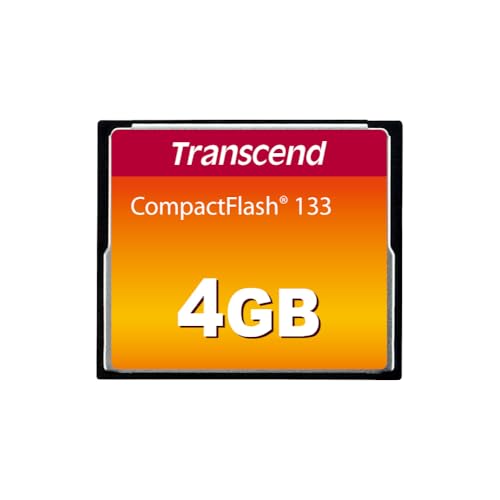
For the replacement volume on a pre-2001 board, a Transcend 4GB CompactFlash card at $10.99 in a passive carrier is driverless, silent, and sits under the period BIOS addressing walls. For an XP-era machine behind an IDE-to-SATA bridge, a Kingston 480GB A400 or the 960GB A400 is the archive destination and the replacement drive both — capacity you will not run out of, at a price where keeping two copies of every image is not a decision you have to think about.
If you conclude mid-project that the migrate-forward path is the honest answer, the modern reference point for what that money buys is something like a ZOTAC RTX 3060 12GB in a current build — a useful sanity check when a matched DDR1 pair starts approaching three figures.
Verdict matrix
| Buy the DDR1 module if… | Skip it and migrate forward if… | Buy neither if… |
|---|---|---|
| The build is period-correct by design | You just want old games to run well | The original mechanical drive is still in it |
| The chipset supports the density you need | A matched pair costs more than a later board and CPU | You have not identified the chipset yet |
| You are filling an empty slot, not replacing all of them | Parts availability is already a problem for the platform | The machine is unstable for reasons you have not diagnosed |
| You are at 512MB and want to reach 1GB | You are chasing frame rates rather than authenticity | You have not imaged the drive |
Common pitfalls
Reading the board maximum as a per-slot figure. It is nearly always a total. Divide by slot count.
Buying a registered module because it was cheap. The R in the part number means server hardware. It will not work in a desktop board.
Filling every slot with double-sided modules. Exceeds the rank budget on many period controllers, and fails intermittently rather than cleanly.
Adding RAM to a Windows 98 machine without capping the cache. Produces out-of-memory errors on a machine with memory free. Cap MaxFileCache in system.ini.
Upgrading memory before replacing a twenty-year-old mechanical drive. The drive is what you are actually feeling.
Related guides
- Old RAM identification: decode part numbers and specs — the general vintage-memory decoding method across SIMM, SDRAM, and DDR
- How to identify your motherboard — find the chipset before you buy modules
- USB-to-IDE adapter vs CF-to-IDE for imaging retro PC drives — image the volume first
- Best SSDs and storage adapters for retro PC builds in 2026 — the upgrade that beats more RAM
- Best uses for old RAM sticks — what to do with the modules you already have
Bottom line
Read the sticker, not the listing title. K2/2G means a kit of two, X72 means ECC, an R means registered and therefore useless to you, and the number after the slash is the total across the product rather than per module. Confirm the chip density against the chipset datasheet, respect the rank limit, and buy the two-module kit rather than hunting a single 2GB DDR1 stick that period hardware was never designed to address. Then — before you change anything — image the drive. The memory upgrade is reversible. The Windows 98 install that has been running since 2004 is not.
Citations and sources
- Kingston — memory search and part-number lookup — resolving ValueRAM and system-specific part numbers against original system compatibility (accessed 2026-08-20)
- Intel — processor and platform memory compatibility guidance — supported memory types and controller limits by platform (accessed 2026-08-20)
- Tom's Hardware — RAM and memory upgrade guidance — capacity and configuration tradeoffs on desktop platforms (accessed 2026-08-20)
- Wikipedia — DDR SDRAM — pin counts, operating voltages, and speed grades across DDR generations (accessed 2026-08-20)
- Wikipedia — Windows 98 — documented memory-handling limitations of the 9x kernel (accessed 2026-08-20)
This piece is editorial synthesis based on publicly available information. No independent first-party benchmarking is reported.
— Mike Perry