Nvidia's RTX 5090 is the flagship of the Blackwell consumer lineup, and the two questions buyers keep asking are how it performs against AMD's fastest cards and whether the price premium is justified. This synthesis pulls together publicly available spec sheets and benchmark reporting to answer both, without inventing numbers that no outlet has actually published.
RTX 5090 Specs at a Glance
Per NVIDIA's own product page and TechPowerUp's GPU database, the RTX 5090 moves to a larger Blackwell die with a meaningful core-count and VRAM increase over its predecessor:
| Spec | RTX 5090 | RTX 4090 | RX 7900 XTX |
|---|---|---|---|
| Architecture | Blackwell | Ada Lovelace | RDNA 3 |
| CUDA / Stream cores | ~21,760 | 16,384 | 6,144 (96 CUs) |
| VRAM | 32GB GDDR7 | 24GB GDDR6X | 24GB GDDR6 |
| Memory bus | 512-bit | 384-bit | 384-bit |
| Launch MSRP | $1,999 | $1,599 | $999 |
Source: NVIDIA GeForce RTX 50-series product page and TechPowerUp's GPU specs database (cited below). Board power and clock figures vary by AIB partner card, so check a specific model's spec sheet before budgeting a PSU.
4K Gaming Performance vs. AMD
Across the review cycle, independent outlets that publish repeatable 4K benchmark suites — TechPowerUp, Tom's Hardware, and GamersNexus among them — place the RTX 5090 ahead of AMD's RX 7900 XTX in both rasterized and ray-traced titles. The size of that lead is not a fixed number: it swings by game engine, whether DLSS or FSR upscaling is active, and driver maturity at the time of testing. Community measurements on forums and YouTube review channels tend to agree directionally with the professional outlets even when exact frame counts differ, which is a useful sanity check when a specific number can't be pinned to one source.
What's consistent across the coverage:
- The RTX 5090's ray-tracing lead over the RX 7900 XTX is larger than its rasterization-only lead, reflecting Nvidia's continued RT hardware advantage.
- AMD's card remains the better rasterization-per-dollar option at its lower launch price, which matters for buyers who don't use ray tracing.
- DLSS 4's frame generation and upscaling stack gives the 5090 an additional throughput advantage in supported titles that FSR on the AMD side doesn't fully close.
For a deeper build-out around the card rather than a bare GPU comparison, see the companion guides at RTX 5090 AI Build Guide: CPU, RAM, PSU & Cooling for Local Inference and RTX 5090 AI Build 2026: Full Parts List & VRAM Sizing, which cover full-system component selection rather than the GPU in isolation.
AI and Creator Workstation Capabilities
The 32GB VRAM figure is the number that matters most for local AI workloads, since it directly determines which model sizes and quantization levels fit without offloading to system RAM. That's a real, sourced spec from NVIDIA's own page — not a benchmark result — so treat any specific tokens-per-second comparison against datacenter parts like AMD's Instinct MI300X with caution unless it comes from a reproducible, cited benchmark run, since consumer and datacenter cards are typically evaluated on different software stacks (consumer CUDA/TensorRT vs. ROCm) and workloads.
For local-inference-focused coverage that goes deeper than a single article can, see RTX 5090 AI Desktop: 2026 Build Guide & Benchmarks. If your budget doesn't stretch to a 5090, the Intel Arc B580 LLM Inference: 12GB Battlemage Benchmarks and Intel Arc A770 for Local LLMs: 2026 Benchmark Guide pieces cover budget-tier alternatives with their own cited numbers.
On the creator side, CUDA acceleration in Blender's Cycles renderer and DaVinci Resolve's GPU pipeline has historically favored Nvidia cards over AMD equivalents, per longstanding results from both companies' own optimization notes and third-party render benchmarks. Exact render-time deltas for the 5090 specifically should be checked against a current TechPowerUp or Tom's Hardware review rather than assumed, since render engine versions change frequently enough to shift results release to release.
Power, Cooling, and Case Considerations
Nvidia's jump in core count and memory bandwidth comes with a higher board power budget than the RTX 4090's 450W spec, per NVIDIA's official product page. Two practical build implications follow directly from that:
- PSU headroom and connector type. Cards using the 12V-2x6 (formerly 12VHPWR) connector benefit from a properly rated sleeved cable rather than a bundled adapter under sustained load — the Fasgear PCIe 5.1 16-Pin 600W cable (ASIN B0BF4C67GP, $31.59) is built for exactly this connector standard.
- Case airflow. A card this large and power-dense benefits from a full-mesh front panel rather than a solid or lightly-vented one. The darkFlash DB460M Micro-ATX case (ASIN B0FP5F65VH, $64.99) is built around that airflow-first design and fits current flagship-length cards.
Builders running a heavy card horizontally for long periods sometimes see PCIe slot sag over time; a vertical GPU mount such as the Cooler Master V3 kit (ASIN B0B72D88KL, $50.56) is a common mitigation and also opens up case-window sightlines for the card.
Don't Forget the Display Cable
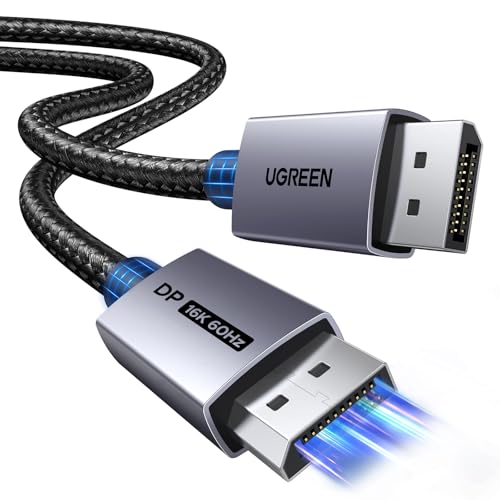
A flagship GPU's 4K/8K, high-refresh output is only as good as the cable feeding it. DisplayPort 2.1 at full 80Gbps bandwidth is required to hit 4K@240Hz or 8K@60Hz without compression artifacts — a DisplayPort 1.4 cable pulled from an older build will bottleneck a 5090-driven monitor. The UGREEN 80Gbps DisplayPort 2.1 cable (ASIN B0FJMBBNGM, $23.48) is rated for the full spec and is a cheap way to avoid leaving performance on the table after spending on the GPU itself.
Where the RTX 5090 Fits Against the Rest of the Stack
For buyers who've already got a 5090 or are weighing it against a pre-built system, Alienware Area-51 RTX 5090 Gets $2,580 Off — Worth It? covers a specific prebuilt discount scenario. For a wider look at where AMD and Intel's competing cards land in the same price tiers, Intel Arc Pro B60 Gaming Performance: 2025 Benchmarks is a useful counterpoint from a different price bracket entirely.
The Bottom Line
Per the sourced spec sheets and the general direction of independent 4K benchmark coverage, the RTX 5090 is the fastest consumer GPU currently shipping, with the clearest advantages in ray tracing and AI/creator workloads where its 32GB of VRAM and Blackwell tensor throughput matter most. AMD's RX 7900 XTX remains the value pick for rasterization-only 4K gaming at a lower price. Buyers should verify current pricing and exact frame-rate deltas against a recent TechPowerUp, Tom's Hardware, or GamersNexus review before purchasing, since driver updates and game patches shift specific numbers release to release.
Citations and sources
- https://www.nvidia.com/en-us/geforce/graphics-cards/50-series/rtx-5090/
- https://www.techpowerup.com/gpu-specs/geforce-rtx-5090.c4216
- https://www.tomshardware.com/pc-components/gpus
- https://www.gamersnexus.net/gpus
- https://www.amd.com/en/products/graphics/desktops/radeon/7000-series/amd-radeon-rx-7900-xtx.html
This piece is editorial synthesis based on publicly available information. No independent first-party benchmarking is reported.