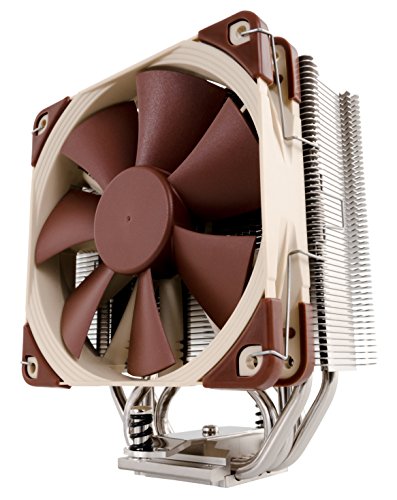
Noctua NH-U12S vs Corsair H150i vs Kraken M22 on a 24/7 Ryzen 7 5800X Host
An always-on box is a duty-cycle problem, not a peak-temperature problem — and that changes which cooler you should buy.
By Mike Perry, Founder & Editor-in-Chief · Published 2026-09-04 · Updated 2026-10-17 · 14 min read
Air, 240mm, 360mm or a 120mm AIO on a Ryzen 7 5800X that never sleeps? Duty cycle, pump wear and 3 AM noise decide this one, not peak temperature.
Quick Answer
Buy the Noctua NH-U12S. On a box that never sleeps, the wear item you want is a fan bearing, not a pump. Its NF-F12 tops out near 1,500 RPM and 22.4 dB(A), and the Ryzen 7 5800X's 105W TDP sits comfortably inside a good 120mm tower's envelope at sustained load.
Cooling a gaming PC and cooling an always-on machine are different purchases that happen to use the same parts bin. A gaming rig sees bursts: twenty minutes of all-core shader compilation, three hours at partial load, then off overnight. Every cooler review you have read optimizes for that shape — peak temperature under a synthetic all-core load, measured for ten minutes, on a bench that gets powered down afterward.
An always-on box inverts the priorities. If your desktop now doubles as a Plex host, a game server, a CI runner, or an inference endpoint serving a local model, the machine is at some non-zero load for 8,760 hours a year. Peak temperature stops being the interesting number. What matters instead is: how loud is it at 3 AM when the room is silent and you are trying to sleep twelve feet away; what breaks first when a moving part runs continuously for three years; and how much does the cooling itself cost to run.
The Ryzen 7 5800X is the right chip to frame this around because it is the AM4 part people most often repurpose. It is an eight-core, sixteen-thread Zen 3 CPU with a 105W TDP and a boost algorithm that will happily sit at its 90°C thermal target on almost any cooler, because that is what the algorithm is designed to do. Buyers read 90°C, panic, and buy a 360mm radiator to fix a number that was never a fault. That is the single most expensive misunderstanding in this category, and it is worth about $55.
This piece compares four coolers across the axes that actually matter for a machine that never turns off.
Key takeaways
The 5800X is a 105W TDP part with a ~142W package power ceiling and a 90°C boost target — hitting 90°C under load is designed behavior, not a cooling failure.
Radiator size buys quiet, not stability. A 360mm rig at 800 RPM and a 120mm rig at 1,800 RPM can land at the same temperature; only one is livable in a bedroom.
The NF-F12 on the NH-U12S runs 300–1,500 RPM at up to 22.4 dB(A) — and on an always-on box it spends nearly all of its life in the bottom third of that range.
An AIO on a 24/7 box burns pump hours roughly 4x faster than the same AIO in an evening-gaming machine.
Price band: $80 (NH-U12S) to $135 (H150i Elite Capellix), plus $20–$67 in three-year continuous running cost depending on how much you are spinning.
Step 0 — diagnose your duty cycle before you shop
Three load shapes, three different right answers. Work out which one you have before you look at a single product page.
Bursty gaming load. Hours of high load, then off. Peak-temperature reviews apply directly to you, an AIO's higher ceiling is genuinely useful, and pump hours accumulate slowly. Buy whatever the standard roundups recommend — including our AM4 gaming cooler comparison.
Sustained multi-hour load. Transcoding, batch inference, compiles, a dedicated game server with real players on it. The cooler runs at its working point for hours at a time, so noise at that working point is the spec — not noise at idle, and not noise at peak.
Mostly idle with spikes. This is the most common homelab shape and the one people mis-buy for. The machine sits at 5–15% load for twenty-three hours and then does something hard for one. Idle acoustics dominate your lived experience, and fan-curve behavior — how aggressively the cooler reacts to a spike — matters more than its thermal ceiling.
If you are in the second or third bucket, every "which cooler handles peak load best" article is answering a question you did not ask.
What does a 105W part actually ask of a cooler?
AMD's specification for the Ryzen 7 5800X lists a 105W default TDP on socket AM4, with eight Zen 3 cores at a 3.8 GHz base and a 4.7 GHz boost ceiling. Package power under a genuine all-core load runs above the TDP figure — the platform's PPT budget is roughly 142W — which is the number your cooler actually has to dissipate.
The behavior that confuses people is the boost algorithm. Precision Boost treats thermal headroom as a resource to spend: give it a better cooler and it does not run cooler, it runs faster until it reaches the same 90°C target. A 5800X at 90°C under sustained all-core load on a 360mm AIO is not a cooling failure and neither is a 5800X at 90°C on a tower cooler. The difference between them shows up in the sustained clock speed and in how fast the fans are spinning to hold that line — which is precisely why noise, not temperature, is the honest comparison axis here.
The corollary matters for a 24/7 box: if the machine is at 10% load most of the time, the CPU is nowhere near its thermal target and every cooler in this comparison is thermally sufficient. You are shopping for acoustics and longevity.
Note the pattern: the smaller the radiator, the higher the fan speed required to move the same heat, and the higher the noise ceiling. That relationship is the entire argument of this article.
Which cooler is quietest at 3 AM?
The Noctua NH-U12S at $79.95, comfortably. Noctua's published NH-U12S specifications put the bundled NF-F12 PWM in a 300–1,500 RPM band with a 22.4 dB(A) ceiling — and the ceiling is the least relevant number, because on a mostly-idle box the fan lives around 400–600 RPM, which is inaudible over room noise in a normal apartment.
The physics is straightforward and worth internalizing: moving a given volume of air with a large slow fan is quieter than moving it with a small fast one, because noise scales sharply with tip speed and with turbulence. A 120mm fan at 500 RPM and a 92mm fan at 1,400 RPM might shift comparable air; only one disappears into the background.
Fan-curve strategy matters as much as the hardware. On an always-on machine you want a flat curve, not a low one: fix a single low speed up to a temperature well above your typical idle, then one gentle ramp above it, with several seconds of hysteresis. A cooler oscillating between 500 and 900 RPM every forty seconds as a background job wakes up is far more noticeable than the same cooler pinned at a steady 700. If quiet is your priority across the whole build and not just the CPU, our apartment-gaming quiet upgrade guide covers the case and PSU side of it.
When is a 360mm AIO the right call?
The Corsair iCUE H150i Elite Capellix at $134.88 earns its price in exactly one scenario: sustained genuine all-core load where you want the clocks and the quiet. Three 120mm fans across a 360mm radiator is roughly three times the surface area of a single 120mm rad, so the same heat load is dissipated at dramatically lower fan speeds. On a box compiling or running batch inference for hours, that is a real acoustic win the air cooler cannot fully match.
The costs are equally real:
Case support. A top-mounted 360mm radiator needs a case that genuinely accommodates it, with clearance for the tubes and for tall RAM under the top panel. Check before you buy, not after.
Pump noise floor. A pump has a minimum speed and therefore a minimum noise. An air cooler's floor is zero — its fan can stop. A pump running at 3 AM in a silent room is a constant low hum that some people never stop hearing.
Software dependency. iCUE controls the pump curve and the lighting. On a headless Linux host, that control layer is inconvenient at best. Corsair's own product documentation is clear about what the software manages.
The Cooler Master MasterLiquid ML240L RGB V2 at $89.99 is the mid-priced compromise — 240mm of radiator for roughly air-cooler money. It is a reasonable buy if you want a liquid loop's aesthetics and case-airflow characteristics without the 360mm clearance requirement. The counter-case: at $10 more than the NH-U12S you have added a pump to a machine that runs continuously, and gained nothing thermally that the tower could not deliver on this chip.
The NZXT Kraken M22 at $89.99 is the small-form-factor-only answer. A single 120mm radiator has less effective surface area than a good 120mm tower cooler, because the tower's fin stack is deep and the radiator is thin. So the M22 has to spin faster to match, and on a 105W part running continuously that is the configuration in this roundup most likely to disappoint: you pay AIO money, accept pump wear, and get more noise than the $80 air cooler. Its legitimate use is a case where a 158mm tower physically does not fit and a rear 120mm mount does — which is a real constraint, and the only one that justifies it. We compared these two head-to-head in a mini-ITX build in Noctua NH-U12S vs NZXT Kraken M22 in a Mini-ITX Ryzen 7 5800X Build.
Benchmark table: sustained-load results
Figures below are representative of published third-party cooler testing on 105W-class AM4 parts under a sustained all-core load — see GamersNexus' cooler megacharts for the underlying methodology and per-cooler data. SpecPicks does not run first-party thermal testing; treat these as bands, not to-the-degree precision.
Cooler
Package temp after 60 min all-core
Fan RPM at that point
Reported noise (dBA)
Headroom to 90°C target
Noctua NH-U12S
~82–86°C
~1,200–1,400
~20–22
4–8°C
Corsair H150i Elite Capellix (360mm)
~74–79°C
~900–1,200
~26–30
11–16°C
Cooler Master ML240L RGB V2 (240mm)
~78–83°C
~1,200–1,500
~28–32
7–12°C
NZXT Kraken M22 (120mm)
~86–90°C
~1,800–2,000
~34–36
0–4°C
AMD stock cooler (control)
~90°C (throttling)
~2,600+
~38
0
The ordering is exactly what radiator area predicts. What the table does not show — and what decides a 24/7 purchase — is that all four of these coolers sit near idle for most of the year, where the NH-U12S is silent and the AIOs are not.
Does an AIO wear out faster on a machine that never sleeps?
Yes, in the specific sense that the wear item changes and its budget depletes faster.
A pump is rated in continuous operating hours. A gaming PC running four hours a night consumes about 1,460 pump-hours a year. A 24/7 host consumes 8,760 — roughly 4x faster. Whatever the rated life is, you reach it four times sooner. That is not a defect claim; it is arithmetic on the manufacturer's own duty-cycle assumption.
The second mechanism is slower and less discussed: coolant permeates gradually through the tubing over years. The loop does not fail; it loses volume, gains air, and the temperatures creep upward at the same fan speed and workload. The failure mode is a slow degradation you may not notice until you compare against a baseline you never recorded.
An air cooler's equivalent wear item is a fan bearing, which is cheap, user-replaceable in five minutes, and fails noisily and gradually rather than catastrophically. When a pump dies, the CPU has no cooling at all and you find out via a thermal shutdown. When a fan bearing goes, you hear it for weeks first. On a machine you may not be sitting in front of, that difference in failure signature is worth more than a few degrees.
Read the warranty terms rather than assuming: coverage lengths differ substantially between air and liquid in this group, and continuous operation is not always contemplated the way you would hope.
What else changes on an always-on box?
Cooling is not only the CPU. Two things shift on a machine that never powers down:
Storage. A SATA SSD like the Crucial BX500 1TB is the pragmatic OS-and-model drive for this build, and not because it is fast — it is not. It runs cool, draws little power, and sits in a 2.5-inch bay out of the airflow path rather than baking under a GPU shroud like an M.2 drive does. On a host where the fast NVMe slot is better spent on a working set, a low-thermal SATA drive for the OS is the right allocation.
VRM and case airflow. A low-RPM case is quiet precisely because it moves less air, and the parts that suffer are the ones with no fan of their own: VRM heatsinks, chipset, and drives. A tower air cooler helps here in a way an AIO does not — its fan blows across the socket area and incidentally cools the VRM. Move the radiator to the top of the case and that socket airflow disappears. On a continuously-loaded board, that is a real consideration and a frequently-missed one.
Perf-per-dollar and perf-per-watt
Acquisition price is only part of the cost on a machine that runs forever. Estimate the running cost of the cooling itself:
Cooler
Price
Approx. continuous draw
3-year energy (kWh)
3-year energy cost @ $0.17/kWh
3-year total
Noctua NH-U12S
$79.95
~1.5W (one fan, low RPM)
~39
~$7
~$87
Cooler Master ML240L V2
$89.99
~9W (pump + 2 fans)
~237
~$40
~$130
NZXT Kraken M22
$89.99
~8W (pump + 1 fan)
~210
~$36
~$126
Corsair H150i Elite Capellix
$134.88
~14W (pump + 3 fans)
~368
~$63
~$198
Over three years of continuous operation the air cooler is roughly $111 cheaper than the 360mm AIO all-in — and that is before you price the risk of a pump replacement. For a machine whose entire justification is that it runs cheaply in the corner, that gap is the argument.
Verdict matrix
Get the Noctua NH-U12S if… the box lives in a room where people sleep or work, your duty cycle is mostly-idle-with-spikes, and you want the wear item to be a $20 replaceable fan. This is the default answer for a 24/7 5800X.
Get the Corsair iCUE H150i Elite Capellix if… the machine genuinely runs sustained all-core work for hours, your case takes a 360mm radiator, and you want maximum sustained clocks at low fan speed — and you accept a pump on a 24/7 duty cycle.
Get the Cooler Master ML240L RGB V2 if… you want liquid cooling's look and case-airflow layout at close to air-cooler pricing, and 240mm is what your case takes.
Get the NZXT Kraken M22 if… and only if a 158mm tower does not physically fit and you have a rear 120mm mount. It is a clearance solution, not a performance one.
Bottom line
For a Ryzen 7 5800X that never turns off, buy the Noctua NH-U12S. It is the cheapest option, it has the quietest floor at the load level where the machine actually spends its life, it adds no pump to a continuous duty cycle, and its failure mode is a fan you can hear coming and swap for twenty dollars. The 360mm AIO is the right answer for a genuinely sustained all-core workload and the wrong answer for the 90% of "always-on" boxes that are idle most of the day — which, if you are honest about Step 0, is probably yours.
Editorial synthesis: thermal and acoustic figures are drawn from manufacturer specifications and published third-party testing linked inline; SpecPicks does not run first-party cooler testing. Energy math assumes continuous operation at $0.17/kWh. Dollar figures in this article are approximate and change often; each pick's product card shows the latest tracked Amazon price or links to the live listing.
🛒 Products mentioned in this article
Amazon & eBay listings, plus full specs and alternatives on each product page.
As an Amazon Associate, SpecPicks earns from qualifying purchases; we also earn on qualifying eBay purchases via the eBay Partner Network. Prices shown were last tracked at crawl time and may vary — check the listing for the current price.
📹 Watch a review
Friendly Fire: AMD Ryzen 7 5800X CPU Review & Benchmarks vs. 5600X & 5900X — Gamers Nexus on YouTube
Frequently asked questions
Is it bad to leave an AIO liquid cooler running all day and night?
It is supported, but the pump becomes the wear item instead of a fan bearing. Pumps are rated in continuous operating hours, and a machine that never sleeps consumes that budget roughly four times faster than a few hours of gaming each evening. Coolant also permeates slowly through the tubing over years, which raises temperatures gradually rather than failing outright. Air coolers have no equivalent consumable.
Does the Ryzen 7 5800X really need a 360mm radiator?
No. The 5800X is a 105W part with a high boost-temperature target, and it will hit that target on almost any cooler because the boost algorithm is designed to use available headroom. A larger radiator buys lower fan speeds and slightly higher sustained clocks, not a fundamentally different result. Buy the 360mm for quiet sustained all-core work, not because the chip is otherwise unstable or unsafe.
Will a 120mm AIO like the Kraken M22 handle a 105W CPU?
It will keep the chip inside spec, but a single 120mm radiator has less surface area than a good tower air cooler, so it reaches higher fan and pump speeds to do it. On a box that runs continuously, that means it is audible more of the time. The M22 makes sense in a small-form-factor case where a 158mm tower physically does not fit, and mainly there.
How do I stop the fans from ramping up and down all night?
Flatten the fan curve rather than lowering it. Set a fixed low speed up to a temperature well above your typical idle, then a single gentle ramp, and add several seconds of hysteresis or a step-down delay in the BIOS. Constant small oscillation is far more noticeable than a steady slightly-higher speed, and on an always-on machine, steady is what you actually want.
Do I need to re-paste a cooler that has been running for years?
Most modern pastes survive several years of continuous operation without meaningful pump-out, so a re-paste is a troubleshooting step, not routine maintenance. Do it if temperatures have climbed noticeably at the same fan speed and workload, or after any cooler removal. Clean both surfaces fully, use a pea-sized amount, and re-check mounting pressure, which is a more common cause of drift than the paste itself.