One Desk, Two Sims: Swapping a G29 Wheel and an Extreme 3D Pro Stick
The wheel wants the desk edge and the stick wants the surface, which is exactly why one desk can hold both.
By Mike Perry, Founder & Editor-in-Chief · Published 2026-09-04 · Updated 2026-09-25 · 14 min read
A wheel clamps at the desk edge, a stick sits on the surface — they never compete. What to measure first, where the TH8A goes, and the two-minute swap.
Quick Answer
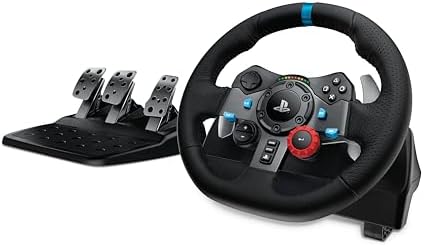
Yes, on one condition: the wheel clamps at the desk edge and the stick sits on the surface, so they never compete for the same real estate. The Logitech G29 turns 900 degrees lock to lock and mounts via a front-edge clamp per Logitech's product page. Below roughly 24 inches of usable desk depth, you are unclamping something every session.
By Mike Perry · Published September 4, 2026 · 14 min read
If you own both hobbies and one room, the problem is not which wheel or which stick. You already know that answer, or you can get it from a dozen comparison pieces including our own. The problem is that a racing wheel is a clamped, high-torque device that wants the front edge of your desk, and a flight stick is a free-standing device that wants desk surface — and if the changeover between them takes fifteen minutes and a hex key, you will simply stop doing one of the two hobbies.
That is not hypothetical. It is the most common way a second sim peripheral ends up in a closet: not because it was bad, but because the friction of setting it up exceeded the appeal of a casual hour on a Wednesday.
So the success criterion for this piece is a two-minute changeover. Wheel off, stick on, sim launched, controls already bound, no tools, no crawling under the desk to re-route a cable. Two minutes is roughly the threshold where a swap stops feeling like a project and starts feeling like changing a channel. Everything below — the mounting layout, where the shifter lives, the mat, the cable plan, the software profiles — exists to get you under that number.
Two things are working in your favor before you spend anything. First, the geometry is genuinely complementary: the wheel wants the edge, the stick wants the surface, and they are on opposite sides of your body if you are right-handed with a stick. Second, most desktop flight sticks do not clamp at all, so there is no competition for the one clamping surface you have. The hard parts are the shifter, the pedals, and the software.
Key takeaways
Measure four dimensions before buying anything: desk thickness, front-lip depth, knee clearance, and monitor distance.
The G29's 900-degree rotation is the spec that decides how much clearance the rim needs; check it against your desk edge.
The shifter, not the wheel, is what breaks most shared desks — leave it clamped permanently if you can.
A lighter, lower-clamp-force wheel is the right answer for a thin or hollow-core desk, at a real cost in feedback.
The swap fails in software more often than in hardware; save per-device control profiles once and the problem disappears.
This section decides everything downstream, and it takes five minutes with a tape measure.
Desk thickness at the front edge. Every clamp has a published thickness range, and the failure modes at both ends are bad: too thin and the clamp does not grip, so the wheel rocks under load; too thick and it will not close at all. Measure at the actual clamping point, not in the middle of the desk — many desks have a thicker front lip or an edge banding that changes the number.
Front-lip depth and obstructions. Look under the front edge. A drawer, an apron rail, a crossbar or a cable tray in the first three inches will stop a clamp dead regardless of thickness. This is the single most common surprise, because nobody looks under their own desk until the wheel is already out of the box.
Knee clearance to the pedal position. Pedals push your seating position back several inches from where you normally sit. That changes two things at once: whether your knees clear the desk apron in the new position, and how far your eyes end up from the monitor. Measure both. A setup that works perfectly for flying can be unusable for driving purely because of the chair position.
Monitor distance in both configurations. You will sit further back for driving than for flying. If your monitor is on a fixed short arm at close range, the driving position may leave you squinting. A monitor arm with reach adjustment solves this for less than the cost of either peripheral.
Our practical threshold: at roughly 24 inches of usable depth and a clear front lip, a wheel and a desktop stick coexist without either being unmounted. Below that, you are choosing which one lives on the desk and storing the other. That figure is editorial guidance from setting these up, not a manufacturer specification — your monitor depth and chair geometry move it either direction.
Specifications above come from the manufacturers' own product pages — Logitech G29, Logitech Extreme 3D Pro, and Thrustmaster TH8A. Confirm the clamp thickness range on the current product page for your specific SKU before buying; these figures change between hardware revisions.
The row that matters most is the second one. Because the Extreme 3D Pro is free-standing rather than clamped, it does not compete for the desk edge at all — it just needs somewhere flat to sit. That single design fact is why this combination works better than, say, trying to share a desk between two clamped wheels.
Changeover time: the documented procedure
The table below is a written procedure with stated assumptions, not a lab measurement. Assumptions: the shifter stays clamped permanently, both devices connect to a powered hub within arm's reach, and control profiles are already saved per device. Times are what the described procedure takes once it is set up as specified.
Swap
Steps
Cables touched
Realistic elapsed
Wheel to stick
Release clamp, lift wheel base to shelf, place stick, select sim profile
1 (wheel USB, if you unplug it at all)
Under 2 minutes
Stick to wheel
Move stick aside, seat wheel, tighten clamp, slide pedals into position
1
2-3 minutes
Pedals-only teardown
Slide pedal set back under desk or onto its side
0
Under 30 seconds
Two details do most of the work in those numbers. First, do not unplug anything you do not have to — a powered hub at desk level with both devices permanently connected removes the entire "reach behind the tower" step, which is the part that actually takes minutes. Second, the wheel base needs a home. A shelf, a drawer, or a dedicated spot on the floor within reach. A wheel base with nowhere to go gets left clamped, and then the stick has nowhere to sit.
Which desk layouts work, and which never will
Permanent clamp plus swap plate — the best option. Leave the wheel's clamp assembly attached to the desk and lift only the base off it. Not every wheel supports separating the base from the clamp hardware, but where it does, this is the fastest possible changeover and the one that gets you comfortably under two minutes. Not worth it if: your wheel's clamp is integral to the base, in which case you are tightening a thumbscrew every time and the ceiling is roughly two minutes anyway.
Double clamp — wheel at center, shifter at left, stick free-standing at right. The layout most people converge on. Everything has a permanent home, and the only thing that moves is the wheel base itself. Not worth it if: your desk is under about 48 inches wide. Two clamped devices plus a stick plus a keyboard and mouse needs horizontal room, and cramming it means the shifter throw hits your keyboard.
Rolling wheel stand — the wheel never touches the desk. A dedicated wheel stand rolls in for driving and rolls out afterward, leaving the desk entirely to flight. This is the only layout that genuinely solves a small or unsuitable desk, and it fixes pedal geometry as a bonus since the pedal plate is attached and correctly angled. Not worth it if: you have nowhere to store it. A wheel stand parked in the corner of a small room is a bigger daily nuisance than a two-minute clamp swap, and it costs more than the HORI wheel below.
Where the shifter goes
The Thrustmaster TH8A is the part that breaks most shared desks, and it is worth understanding why before you buy one.
It clamps like the wheel does, which means it needs a second stretch of clear front lip — usually to the left of the wheel. That is a real constraint on a narrow desk, and it is the reason some people run a wheel and a stick happily for a year and then hit a wall when they add a shifter.
The good news is that it is also the device you should never have to move. A shifter clamped to the left of your wheel position sits outside the space a right-handed flight stick wants, which is on the right. Leave it mounted permanently and the changeover drops by a clamp operation in each direction — that is most of your two-minute budget right there.
It supports both H-pattern and sequential modes, which is relevant to the shared-desk question in one specific way: sequential mode needs a smaller front-to-back throw, so if your keyboard is close in front of the shifter, sequential may be the mode your desk geometry actually allows. Check the throw clearance in H-pattern before you commit to the position, because reversing this later means re-drilling or re-clamping.
The budget path: does a lighter wheel change the answer?
Yes, and for a reason that has nothing to do with driving feel.
The HORI Racing Wheel Overdrive is a lighter wheel with a lower clamp force requirement, which makes it the right choice for two situations where a G29 is genuinely a bad idea: a thin desk near the bottom of a clamp's thickness range, and a hollow-core desk where a high-torque wheel will flex or damage the surface over time. Hollow-core desks — the flat-pack kind with a honeycomb cardboard interior under a veneer — are common, and they are not structurally rated for the sustained lateral load a force-feedback wheel applies.
It is also faster to mount and unmount, which directly serves the two-minute goal.
The honest tradeoff, sourced to the manufacturer's own specification: it offers 270 degrees of rotation and vibration feedback rather than the G29's 900 degrees and motorized force feedback. That is not a small difference. 900 degrees means you steer a simulated car the way you steer a real one, hand over hand; 270 degrees means you are steering more like an arcade cabinet. For rally and drift especially, this is the whole game. And vibration is not force feedback — you lose the cues that tell you the front is washing out.
So: pick the HORI if your desk cannot safely take a G29, or if you drive occasionally and fly primarily. Pick the G29 if driving is a real hobby and put it on a wheel stand rather than compromising the wheel. Our full ladder of wheel options is in Best Racing Wheels and Controllers for Sim Racing in 2026.
Protecting the desk surface
Two clamps opening and closing on the same spots, plus a weighted stick base sliding around between sessions, will mark a desk finish. It happens gradually enough that you notice it once the damage is done.
A large cloth mat under the whole working area is the simple fix. The SteelSeries QcK XXL is 900 × 400 mm of cloth over a rubber base — big enough to run the full width of the swap zone, thin enough that it does not interfere with a clamp bite at the edge, and grippy enough underneath that a free-standing stick will not creep under sustained pull.
That last property is the one that matters more than surface protection. A flight stick with rubber feet on a bare laminate desk does slide during aggressive input; the same stick on a rubber-backed cloth mat does not. It is a $30 fix for the single most annoying failure mode of a free-standing stick.
Cable management for a two-device desk
Count your USB ports first. A wheel, a shifter, a stick, a keyboard, a mouse and a headset is six devices, and the shifter may connect through the wheelbase rather than directly depending on your setup.
The rule that gets you to a two-minute swap: route so that a changeover touches at most one connector. In practice that means a powered USB hub sitting on the desk or clamped to its edge, with both sim devices permanently plugged into it. You are then never reaching behind the tower, never tracing a cable, and never discovering mid-swap that the stick's cable is threaded under the pedal set.
Use a powered hub, not a bus-powered one. A force-feedback wheel has its own power brick, but sticks, shifters and headsets on a bus-powered hub can brown out and produce intermittent disconnects that look exactly like a failing device. Then run one cable tie down the desk leg for the permanent devices, and leave enough slack on the wheel's cable that lifting the base off does not tug the hub.
What you'll need
A tape measure — used before any purchase, not after
A powered USB hub within arm's reach of the desk surface
Cable ties or a cable channel down one desk leg
A large desk mat for surface protection and stick grip
The hex key or thumbscrew tool your wheel's clamp uses, stored at the desk
Saved controller profiles in each sim, one per device
The most-missed step: per-device input profiles
The swap fails in software far more often than in hardware, and this is the part people discover on session night.
Both major sim families let you save named control binding sets per device. Do this once, deliberately, for each device in each sim, and name them clearly. Then a changeover is selecting a preset rather than rebinding axes while a lobby waits.
The specific trap is USB port enumeration. Devices plugged into different ports can be enumerated differently by the OS, and some sims key their binding profiles to the enumerated device identity rather than the device name. The symptom is that your carefully saved wheel profile comes back with the axes scrambled or the device listed as "not detected" after a swap. The fix is simple and permanent: always plug each device into the same physical port. That is the second-order reason for the powered hub — it gives every device a fixed, permanent port that never changes.
Two smaller ones worth pre-empting. Some sims re-detect a newly connected device and helpfully assign it default bindings, silently overwriting your profile — check whether yours does this and turn it off. And save a copy of your binding files somewhere outside the game directory, because a game update can reset them and rebuilding a full wheel-plus-shifter binding set from scratch is a lost evening.
Bottom line
One desk genuinely handles both hobbies, and the deciding factor is layout rather than hardware. Measure your desk thickness, front lip, and knee clearance first. Clamp the shifter permanently to the left and never touch it again. Let the flight stick live free-standing on the right where it never competes for the edge. Put both on a powered hub so a swap touches one cable at most, and save per-device profiles in each sim so nothing needs rebinding.
Do that and the wheel-to-stick changeover is genuinely under two minutes, which is the number that decides whether you keep using both. If your desk is thin, hollow-core, or short on depth, take the lighter wheel and accept 270 degrees — or move the wheel to a rolling stand and give the desk entirely to flight.
This piece is editorial synthesis based on publicly available manufacturer specifications and a documented setup procedure. No independent first-party lab testing is reported; changeover times describe the procedure as written, with its assumptions stated.
As an Amazon Associate, SpecPicks earns from qualifying purchases; we also earn on qualifying eBay purchases via the eBay Partner Network. Prices shown were last tracked at crawl time and may vary — check the listing for the current price.
Frequently asked questions
How thick can my desk be and still take a wheel clamp?
Every clamp has a published range, and going outside it either fails to grip or crushes a veneer surface. Check the manufacturer's figure for your specific wheel before buying, then measure the actual desk at the clamp position rather than at the edge, because many desks taper. Hollow-core and thin IKEA-style tops are the usual problem: they hold, but they flex under force feedback in a way that transmits into the wheel.
Will the pedals fit under the same desk as a normal chair?
Knee clearance is the constraint, not floor space. A pedal set pushes your seating position back several inches, which changes both monitor distance and whether the desk drawer or crossbar hits your legs. Measure from the chair's normal position to the desk's underside crossbar first. If the pedals only fit with the chair pushed back past comfortable typing distance, plan on a rolling stand instead of a permanent under-desk placement.
Can I leave the shifter mounted while flying?
Usually yes, and it is the recommended arrangement. The shifter clamps to the left of the wheel, outside the space a joystick needs on the right, so leaving it in place removes one clamp from every changeover. The exception is a narrow desk where the left-hand clamp eats the space your keyboard needs, in which case the shifter becomes the item you unclamp and the wheel stays.
Does a joystick need to be clamped at all?
Most desktop sticks rely on a weighted base plus rubber feet rather than a clamp, which is exactly why they coexist well with a wheel setup — nothing competes for the desk edge. The failure mode is sliding under aggressive inputs on a bare laminate surface. A large cloth desk pad solves it for a few dollars and doubles as protection for the clamp feet during swaps.
Do I have to reconfigure controls every time I swap devices?
Only if you skip saving profiles. Both major sim families let you store a named control binding set per device, so the swap becomes selecting a preset rather than rebinding axes. The common trap is USB port order: plugging a device into a different port can change its enumeration and make a sim treat it as new hardware. Pick one port per device and label the cables.
Is a cheaper wheel a better fit for a shared desk?
It can be, for a specific reason that has nothing to do with driving feel. Lighter wheels with lower clamp force put less stress on a thin or hollow desk and are faster to mount and unmount, which matters when you are doing it weekly. The tradeoff is force-feedback fidelity, which is the entire point of the category, so treat it as a desk constraint rather than a general recommendation.