Qwen 3.6 27B on 16GB: RTX 5060 Ti 16GB vs RX 9060 XT 16GB by Quant (2026)
Q3_K_M fits fully at 8K context, Q4_K_M doesn't, and 448 vs 320 GB/s of bandwidth decides which 16GB card generates faster.
By Mike Perry, Founder & Editor-in-Chief · Published 2026-10-08 · Updated 2026-10-08 · 14 min read
Which Qwen 3.6 27B quants fit a 16GB GPU, how much context they leave, and why the RTX 5060 Ti's extra bandwidth should beat the RX 9060 XT on speed.
Quick Answer
Yes. A 16GB card runs Qwen 3.6 27B entirely on the GPU at 3-bit quants. The 13.59 GB Q3_K_M file plus an 8K-context cache needs about 13.9 GiB, inside the roughly 15.5 GiB a 16GB card leaves free. Q4_K_M (16.82 GB) does not fit and has to offload layers. The RTX 5060 Ti 16GB should win on generation speed because its 448 GB/s of memory bandwidth is 40% more than the RX 9060 XT's 320 GB/s, per the NVIDIA RTX 5060 family spec page and the AMD RX 9060 XT spec page. As of October 2026 no public single-card Qwen 3.6 27B run exists for either card. Before you buy, compare the published runs collected on /benchmarks/nvidia-geforce-rtx-5060-ti-16gb and /benchmarks/amd-radeon-rx-9060-xt-16gb.
This guide is for readers who have already been told 12GB is too tight for Qwen 3.6 27B. Our Qwen 3.6 27B on a 12GB GPU guide shows what that costs: Q3_K_S at best, a short context ceiling, and slow prefill. The next step up is 16GB, and in 2026 there are two cards worth considering at that capacity: the RTX 5060 Ti 16GB and the RX 9060 XT 16GB. They cost about the same. One has more bandwidth; the other is cheaper and gets better software support every quarter. Which one to buy depends on which quant you can hold on the card and how fast the card reads those weights.
Step 0: decide your context length before you pick a quant. Two things share 16GB of VRAM: the weights and the KV cache. For chat and short coding prompts, 8K tokens is enough, and that leaves room for the largest 3-bit quant. Agentic coding, RAG over long documents, or pasting a whole repository needs 32K or more, and that costs you about a gigabyte of weights or a switch to a quantized KV cache. Decide this first. Every table below has separate 8K and 32K columns for that reason.
Qwen 3.6 27B also changes the usual KV-cache math. Its config.json on Hugging Face defines 64 layers, but only 16 of them are full-attention layers (full_attention_interval: 4). The other 48 are linear-attention layers that keep a fixed-size state instead of a growing cache. The full-attention layers use 4 KV heads with a head size of 256. That works out to 64 KiB of f16 KV cache per token, about a quarter of what a conventional 64-layer 27B model needs. That is why a 16GB card is more practical for this model than for older 27B-class models.
Small-model (7–9B) reference throughput
These figures are for 7–9B models, not the 20–27B models this article covers. The table holds model size fixed so the cards can be compared with each other; for the size in the title, use the article's own figures.
Median generation throughput at 7–9B models (Llama 3.1 8B, Qwen 3 8B), Q4 quantization, from community-reported runs SpecPicks tracks. Each row pools runs from different sources, runtimes and models in that class, so the rows are not a matched head-to-head; where the article compares cards on the same rig, its own figures are the like-for-like result. Street price is the second-lowest listing priced within the last 24 hours inside a sane band of MSRP, so no single listing sets it; where too few listings pass that check the row shows launch MSRP instead.
The 20-27B class this article is about needs about 16.7 GB for its Q4 weights; on the RTX 5060 Ti, the weights do not fit, so layers spill to system RAM and PCIe bandwidth sets the speed. RTX 5060 Ti carries 16 GB of VRAM. The weights column is the range of real Q4_K_M
files on Hugging Face for the models in each size class (about 0.6 GB per billion parameters),
and the runtime plus a usable context window wants about 2 GB on top; every tokens-per-second figure is a
median over community-reported Q4 runs SpecPicks tracks for this card, with the run count and
the source beside it.
Showing the model sizes this article covers and the band either side. Every size from 3B to 70B+, for every card SpecPicks tracks, is in the local-LLM GPU table.
Model size
Weights at Q4
Fits in 16 GB?
Measured
Left for context
Source
12-14B (Qwen 3 14B, Phi-4)Where 8 GB stops being enough. This is the band the RTX 3060 12GB exists for.
20-27B (Gemma 3 27B, Mistral Small)A 27B Q4_K_M file (about 16.7 GB) is more than a 16 GB card holds, so 16 GB means a Q3 quant or partial CPU offload; a 24B loads with a short context. 20 GB holds the class with a usable context window, 24 GB with a long one.
about 16.7 GB
Nospills to system RAM — PCIe bandwidth sets the speed
—
none
—
30-35B (Qwen 3 32B, QwQ 32B)The step change. A 24 GB card holds this entirely in VRAM; below that it is CPU offload.
about 19.9 GB
Nospills to system RAM — PCIe bandwidth sets the speed
Per-quant VRAM table: which Qwen 3.6 27B quant fits in 16GB?
GGUF file sizes come from the unsloth/Qwen3.6-27B-GGUF file listing. VRAM columns are computed, not measured. Each is the file size converted to GiB, plus the KV cache from config.json (0.5 GiB at 8K and 2.0 GiB at 32K in f16), about 0.15 GiB of linear-attention state, and about 0.6 GiB of llama.cpp compute buffer. The fit test is against 15.48 GiB, the usable memory per RTX 5060 Ti 16GB after the driver reserve, as reported in LLMKube's dual-5060 Ti Qwen 3.6 27B bake-off. If the same card also drives your desktop, subtract a few hundred MB more.
Quant
GGUF file size
VRAM at 8K ctx (f16 KV)
VRAM at 32K ctx (f16 KV / q8_0 KV)
Fits fully on 16GB?
Source
UD-IQ2_M
10.85 GB
11.4 GiB
12.9 / 11.9 GiB
Yes, even at 32K
unsloth GGUF listing + config.json
UD-Q2_K_XL
11.85 GB
12.3 GiB
13.8 / 12.8 GiB
Yes, even at 32K
unsloth GGUF listing + config.json
UD-IQ3_XXS
11.99 GB
12.4 GiB
13.9 / 13.0 GiB
Yes, even at 32K
unsloth GGUF listing + config.json
Q3_K_S
12.36 GB
12.8 GiB
14.3 / 13.3 GiB
Yes, even at 32K
unsloth GGUF listing + config.json
Q3_K_M
13.59 GB
13.9 GiB
15.4 / 14.5 GiB
Yes at 8K; 32K needs q8_0 KV
unsloth GGUF listing + config.json
UD-Q3_K_XL
14.47 GB
14.7 GiB
16.2 / 15.3 GiB
Yes at 8K; 32K only with q8_0 KV, headless
unsloth GGUF listing + config.json
IQ4_XS
15.44 GB
15.6 GiB
17.1 / 16.2 GiB
Marginal at 8K (needs q8_0 KV, headless); no at 32K
unsloth GGUF listing + config.json
Q4_K_M
16.82 GB
16.9 GiB
18.4 / 17.5 GiB
No, partial CPU offload
unsloth GGUF listing + config.json
Q5_K_M
19.51 GB
19.4 GiB
20.9 / 20.0 GiB
No
unsloth GGUF listing + config.json
Q6_K
22.52 GB
22.2 GiB
23.7 / 22.8 GiB
No
unsloth GGUF listing + config.json
Q8_0
28.60 GB
27.9 GiB
29.4 / 28.4 GiB
No
unsloth GGUF listing + config.json
Unsloth publishes neither a plain Q2_K nor an IQ3_XS for this model. UD-Q2_K_XL and UD-IQ3_XXS are the closest files it ships. If you also load the vision projector (mmproj-BF16.gguf, 0.93 GB), add about 0.9 GiB to every row. That one change can drop UD-Q3_K_XL and IQ4_XS from "fits" to "offload."
Per-quant throughput table: RTX 5060 Ti 16GB vs RX 9060 XT 16GB
Here is the honest state of the public data as of October 2026. Nobody has published a single-card llama-bench run of Qwen 3.6 27B on either card. The closest measured data points are listed below, each with its source, along with the bandwidth ceiling each card can reach on each quant. A ceiling is memory bandwidth divided by file size. It is a physical upper bound, not a measurement, and real llama.cpp generation typically reaches 60–80% of it.
The 27B-class sibling run is the best proxy. Qwen 3.8 27B is a later model of the same dense 27B size. On a single 5060 Ti, a 13.27 GB 4-bit file generated 24.9 tok/s, which is 74% of the card's 33.8 tok/s ceiling for that file size. Apply the same efficiency to Qwen 3.6 27B Q3_K_M and you would expect roughly 24 tok/s on the 5060 Ti and roughly 17 tok/s on the 9060 XT. Treat those as projections until someone publishes the run.
The 14B rows disagree with the spec sheet. Those rows show the 9060 XT matching the 5060 Ti at 14B, even though the AMD card has 29% less bandwidth. They came from different harnesses (llamafile vs a recent llama.cpp Vulkan build), so read them as "both cards are close at 14B," not as the 9060 XT winning. The 9060 XT figure works out to about 94% of its bandwidth ceiling, which is unusually high. Expect the gap to widen as model size grows and the run becomes purely bandwidth-bound.
Spec delta: why the two 16GB cards diverge on a 27B model
The rule for local LLMs is simple. Capacity decides which quant you can run, and bandwidth decides how fast it generates. Both cards have the same 16GB, so they can run exactly the same quants (the VRAM table applies to both). Every generated token reads nearly all of the weights once, so generation speed scales with bandwidth: 448 versus 320 GB/s, a 1.4x advantage for the 5060 Ti on paper. The 9060 XT's 32 MB Infinity Cache does not change this much. A 13 GB weight file does not fit in a 32 MB cache.
Prefill vs generation: where does the RX 9060 XT lose ground?
Prefill (prompt processing) is compute-bound, not bandwidth-bound. It sets how long you wait before the first token appears, and with long prompts it is often the more noticeable delay.
At 14B the 5060 Ti leads prefill by about 10%, which is far smaller than its generation-bandwidth advantage. The 3060 trails both by roughly 40%. The parsapp sweep also found that ROCm and Vulkan tie on 9060 XT prefill, while Vulkan wins generation by 8.8% (33.5 vs 30.8 tok/s). For an RX 9060 XT, start with llama.cpp's Vulkan build and only try ROCm if you need a ROCm-only tool. AMD's community scoreboard in the llama.cpp ROCm performance discussion is the place to check whether a newer ROCm release has closed the gap.
Attention cost on the 16 full-attention layers grows with context, so prefill gets slower per token as prompts get longer and becomes the bottleneck at 32K. On the 27B sibling run, 888 tok/s means a 5,000-token prompt takes about 5.6 seconds before generation starts. A 30,000-token prompt would take at least 34 seconds even at that rate, and longer in practice. That is the real cost of long context on these cards, on top of the VRAM it uses.
How much context fits beside the weights?
Context cost for Qwen 3.6 27B, derived from its config.json (16 full-attention layers × 4 KV heads × 256 head size × K and V):
Context
f16 KV cache
q8_0 KV cache
q4_0 KV cache
8K
0.50 GiB
0.27 GiB
0.14 GiB
16K
1.00 GiB
0.53 GiB
0.28 GiB
32K
2.00 GiB
1.06 GiB
0.56 GiB
64K
4.00 GiB
2.13 GiB
1.13 GiB
The main lever is --cache-type-k q8_0 --cache-type-v q8_0 (with flash attention on). It roughly halves the cache, and that is what lets Q3_K_M run at 32K on a 16GB card. q8_0 KV is widely considered close to lossless for chat. q4_0 KV saves more, and the 64K sibling run above used it, but it has a measurable cost on long-context retrieval tasks. Our KV-cache quantization deep dive covers that trade-off on the MoE sibling. Use f16 or q8_0 when exact recall over the whole window matters (code review, contract search), and save q4_0 for long-chat workloads that can tolerate it.
On the same LocalScore harness, the 5060 Ti generates 24% faster than the 3060 at 14B, which matches their bandwidth ratio (448/360). The bigger loss on the 3060 is quality, not speed. You are stuck at the bottom of the 3-bit range with almost no room for context. Our RX 9060 XT 16GB vs RTX 3060 12GB comparison shows the same pattern on 14B models. The full per-card median across published runs is on /benchmarks/nvidia-geforce-rtx-3060-12-gb.
When 12GB is still right: if you already own a 3060 and mostly run 7–14B models at Q4–Q6, a 16GB upgrade buys speed, not new capability. Spend the money only if 27B-class models are your daily driver.
Perf-per-dollar and perf-per-watt
There is no published Qwen 3.6 27B run on either card, so this uses the most comparable measured numbers: 14B Q4_K_M generation from the sources above, divided by launch MSRP and rated board power. Rated board power is the spec-sheet figure, not measured draw. Generation is bandwidth-bound and usually draws less than the rating.
Card
14B gen tok/s
tok/s per $100 MSRP
tok/s per 100W rated
14B prefill per $100 MSRP
RTX 5060 Ti 16GB
32.9 (CUDA)
7.7
18.3
310
RX 9060 XT 16GB
33.5 (Vulkan) / 30.8 (ROCm)
9.6 / 8.8
20.9 / 19.3
347
RTX 3060 12GB
26.6 (CUDA)
8.1
15.6
231
At 14B the 9060 XT gives you the most tokens per launch dollar and per rated watt. At 27B, expect the 5060 Ti's bandwidth lead to show up in absolute speed. Based on the ceilings, the 5060 Ti's lead should grow toward 1.4x, which is more than its 23% higher MSRP. The value ranking can flip at 27B, and the first published single-card Qwen 3.6 27B runs will settle it. Street prices for these cards change weekly, so check the live price buttons rather than relying on launch MSRP.
Verdict matrix
Get the RTX 5060 Ti 16GB if…
27B dense models are your main workload and generation speed matters. Its 448 GB/s gives it a 40% higher ceiling on every quant.
You want the most mature software. CUDA builds of llama.cpp, vLLM and ExLlama all support Blackwell, and NVFP4 checkpoints such as the one LLMKube ran under vLLM are an option.
You plan to add a second card later. LLMKube's dual-5060 Ti setup ran Q4_K_M across 32GB.
Get the RX 9060 XT 16GB if…
Your budget is tight and you mostly run 7–14B models, where the measured gap is negligible.
You are on Linux and comfortable with llama.cpp's Vulkan backend.
Perf-per-watt matters for an always-on box. 160W typical board power is the lowest of the three cards.
Stay on a 3060 12GB if…
You already own one and your models are 14B or smaller.
You only need Qwen 3.6 27B occasionally and can accept 2–3-bit quants with short context.
Recommended pick
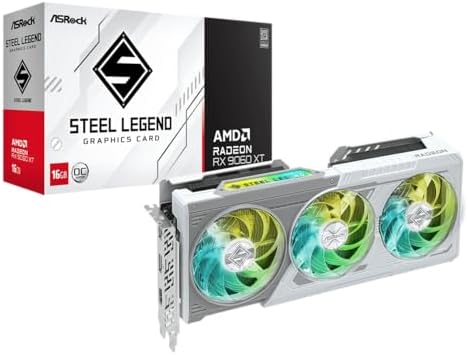
For Qwen 3.6 27B specifically, choose a 5060 Ti: either the ASUS Prime GeForce RTX 5060 Ti 16GB OC Edition, a compact SFF-ready card, or the MSI GeForce RTX 5060 Ti 16G Ventus 2X OC Plus, a two-fan design. The deciding spec is memory bandwidth, 448 versus 320 GB/s. At this model size every token is a full read of 13–14 GB of weights, so bandwidth is the speed limit. If you also do a lot of 7–14B work, or the price gap is wide when you check, the ASUS Dual Radeon RX 9060 XT 16GB is the value pick. The proposal also named the ASRock RX 9060 XT Challenger, which we couldn't match to a catalog listing; the ASRock Radeon RX 9060 XT Steel Legend 16GB is the in-catalog ASRock option with the same 16GB and 320 GB/s memory. All four cards hold the same quants. Only the speed differs.
Bottom line
16GB is the lowest tier where Qwen 3.6 27B runs fully on the GPU at a usable 3-bit quant with real context: Q3_K_M at 8K, or at 32K with q8_0 KV. The RTX 5060 Ti 16GB should generate about 1.4x faster than the RX 9060 XT on this model because of bandwidth. The RX 9060 XT is the better-value card on smaller models. Neither card holds Q4_K_M without offload. If you need 4-bit or better plus long context, plan for 24GB.
This article is an editorial synthesis of the published specifications and third-party benchmarks cited above. SpecPicks did not run these cards. VRAM figures and throughput ceilings are calculated from the cited sources and labeled as such. Where no public run exists, the tables say so rather than estimate.
🛒 Products mentioned in this article
Amazon & eBay listings, plus full specs and alternatives on each product page.
As an Amazon Associate, SpecPicks earns from qualifying purchases; we also earn on qualifying eBay purchases via the eBay Partner Network. Prices shown were last tracked at crawl time and may vary — check the listing for the current price.
📹 Watch a review
Which RX 9060 XT Is Best? Sapphire vs PowerColor vs ASRock Tested — KitGuruTech on YouTube
Frequently asked questions
Can Qwen 3.6 27B run entirely on a 16GB GPU?
Yes, at 2-bit and 3-bit quants. Q3_K_M (13.59 GB) needs about 13.9 GiB with an 8K f16 KV cache, well inside the roughly 15.5 GiB a 16GB card leaves free, and UD-Q3_K_XL still fits at 8K. IQ4_XS is marginal even with a q8_0 KV cache, and Q4_K_M and above have to offload layers to system RAM, which cuts generation speed sharply. The per-quant VRAM table above shows each row's math.
Does ROCm or Vulkan matter for the RX 9060 XT on Qwen 3.6 27B?
It does. In the public parsapp llama.cpp sweep on an RX 9060 XT 16GB, Vulkan and ROCm tied on prompt processing, but Vulkan generated 8.8% faster on a 14B Q4_K_M model (33.5 vs 30.8 tok/s). Start with llama.cpp's Vulkan build, compare runs only when backend and quant match, and confirm your ROCm release officially lists the card before relying on it.
Is 16GB enough for 32K context with Qwen 3.6 27B?
Yes, with the right quant. Only 16 of the model's 64 layers keep a growing KV cache, so 32K costs about 2 GiB in f16 and about 1.06 GiB with a q8_0 cache. Q3_K_S fits at 32K with an f16 cache, and Q3_K_M fits once you switch the KV cache to q8_0. If you need 4-bit weights plus 32K or longer context every day, a 24GB card avoids those compromises.
Should I upgrade from an RTX 3060 12GB to a 16GB card just for Qwen 3.6 27B?
Only if 27B-class models are your main workload. The extra 4GB moves you from a tight Q3_K_S with almost no context to Q3_K_M or UD-Q3_K_XL held fully on the card with room for 8K to 32K tokens, which is the bigger jump in quality. If you mostly run 7-14B models, the 3060 12GB already fits them at Q4-Q6, and a 16GB card adds mostly speed.
What power supply do these 16GB cards need for 24/7 inference?
Both are mid-power cards. NVIDIA rates the RTX 5060 Ti at 180W total graphics power with a 600W system recommendation, and AMD rates the RX 9060 XT 16GB at 160W typical board power with a 450W minimum PSU. Sustained token generation is memory-bandwidth-bound and usually draws less than gaming, but long prompt-processing bursts can reach full board power, so follow the vendor PSU guidance and keep case airflow adequate.