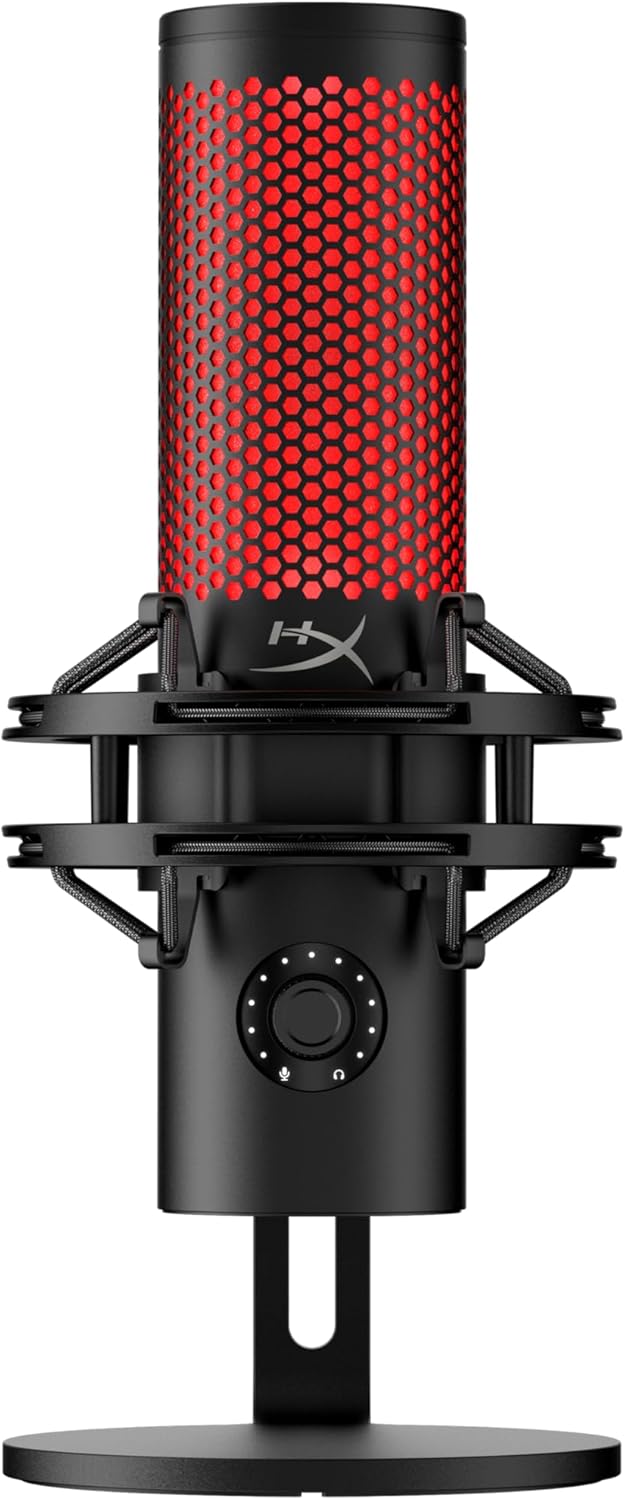
If you are starting a stream in 2026, the difference between a stream people watch and a stream they close within thirty seconds is 80% audio and lighting, 15% personality, and 5% camera. This guide walks through the five pieces of gear that get new creators past their first hundred concurrent viewers on a modest budget, ranked by impact on production quality. We are opinionated: HyperX QuadCast 2 USB mic is the top pick, Blue Yeti is the venerable alternative, and either the Neewer 18-inch ring light or the UBeesize 22-inch ring light with stand covers your lighting for the next couple of years.
Key takeaways
- Prioritize mic over camera by a factor of at least 3x on your first purchase.
- USB condensers in the $100-$150 tier deliver 90% of the audio quality of pro setups.
- Ring lights add production value cheaply and predictably.
- A Turtle Beach Recon 50 headset is a fine transitional starter mic while you commit to streaming.
- Skip capture cards and stream decks until your workflow demands them.
#1: HyperX QuadCast 2 — best streamer mic in 2026
The HyperX QuadCast 2 is our top pick for the 2026 starter streamer setup. It is a USB condenser mic with four polar patterns (cardioid, bidirectional, omnidirectional, stereo), built-in shock mount, tap-to-mute, and a headphone monitoring jack that lets you hear yourself without latency.
Why it's #1:
- Cardioid pattern rejects keyboard clatter and side-of-room noise well.
- Tap-to-mute is a genuinely useful feature during long streams.
- Built-in shock mount means you can place it directly on your desk without extra rigging.
- Onboard headphone jack eliminates DAW-latency headaches for beginners.
- Plug-and-play on Windows and Mac with no drivers.
Trade-offs:
- More expensive than the Blue Yeti.
- The RGB lighting is polarizing (though it turns off).
- Only USB — no XLR upgrade path if you later go pro.
Best paired with: any USB-C or USB-A port on your streaming machine, a phone tripod or ring light stand for placement, and OBS Studio as your streaming software.
Bottom-line pick: yes, if the budget accommodates and you plan to stream more than casually.
#2: Blue Yeti — legacy pick, still excellent
The Blue Yeti has been the reference USB condenser mic since 2010, and while newer mics have caught up, it remains a workhorse. Multi-pattern (cardioid, bidirectional, omnidirectional, stereo), plug-and-play USB, and priced usually lower than the QuadCast 2, it is the value pick.
Why it's still relevant:
- 15-year track record — there is a huge community of reviews, tutorials, and troubleshooting for it.
- Multiple polar patterns work for solo streams, interviews, or room-tone captures.
- Included stand is genuinely usable.
- Available for both PC and Mac with no drivers.
Trade-offs:
- Picks up desk vibrations without a shock mount (buy one separately).
- Larger than the QuadCast 2 — takes more desk space.
- Cardioid pattern is broad; you will hear more room noise than with a tighter-pattern mic.
Best for: buyers who want proven hardware at a modest price and are willing to add a shock mount ($30-$60) to complete the setup.
Bottom-line pick: yes, especially if you already own one or find it well below MSRP.
#3: Neewer 18-inch Ring Light Kit — best budget lighting
The Neewer 18-inch Ring Light Kit is the "just make my face look OK on camera" solution for streamers on a budget. It is 55W of 5600K daylight-balanced LED with a diffuser, phone holder, and light stand. Total setup takes about 10 minutes.
Why it works:
- Transforms any laptop webcam into a serviceable face cam.
- Uniform lighting on your face erases most of the "amateur stream" look.
- Adjustable color temperature (warm to cool) matches your room's ambient.
- Cheap enough that if you later upgrade to a panel light setup, it can move to your secondary space.
Trade-offs:
- The circular "eye ring" reflection is a signature look — some viewers love it, some hate it.
- Not portable (uses AC power).
- Stand quality is basic; the light works but the stand can be tippy on carpet.
Best for: face-cam streams where you want cheap, immediate quality improvement.
Bottom-line pick: yes for anyone who face-cams. Consider a bigger 22-inch version if desk space allows.
#4: UBeesize 22-inch Ring Light with 72-inch Stand — bigger, sturdier
The UBeesize 22-inch Ring Light with 72-inch Stand is the step-up option for creators who want a physically bigger light for better wrap-around illumination and a sturdier stand for a phone or camera. 60W total, three color modes, ten brightness levels.
Why upgrade over the 18-inch:
- Larger light produces softer shadows on your face.
- 72-inch stand extends high enough for standing streams or top-down cooking/craft streams.
- Better build quality on the stand.
- Wider color-temperature range for creative looks.
Trade-offs:
- Physically bigger and less portable.
- The 22-inch ring at close range causes an even more visible eye-ring reflection.
- Needs more desk or floor space.
Best for: streamers with dedicated space and workflows involving standing, moving, or multiple camera angles.
Bottom-line pick: yes if you know you want the bigger setup; otherwise the 18-inch is fine.
#5: Turtle Beach Recon 50 headset — transitional mic + monitoring
The Turtle Beach Recon 50 PlayStation Gaming Headset is not a streaming mic — it is a gaming headset with a passable boom mic. But for streamers who are testing the waters before committing to a $150 condenser, it is a legitimate starter option.
Why it makes the list:
- Very cheap.
- Boom mic quality is acceptable for the first month or two of streaming.
- Serves double duty as your gaming headset.
- Comfortable for multi-hour sessions.
Trade-offs:
- Audio quality is noticeably worse than a USB condenser — viewers can tell.
- Upgrade path is inevitable if you stay with streaming.
- Not a real substitute for a dedicated mic; treat it as training wheels.
Best for: brand-new streamers testing the format before committing.
Bottom-line pick: yes as a starter or backup; no as a long-term solution.
The ranked kit
| Rank | Item | Category | Approx. price 2026 |
|---|---|---|---|
| 1 | HyperX QuadCast 2 | USB condenser mic | $140-$170 |
| 2 | Blue Yeti | USB condenser mic (value) | $100-$130 |
| 3 | Neewer 18-inch Ring Light Kit | Lighting (budget) | $55-$75 |
| 4 | UBeesize 22-inch Ring Light | Lighting (upgrade) | $90-$130 |
| 5 | Turtle Beach Recon 50 | Headset (transitional mic) | $30-$45 |
Total budget picks: buy the QuadCast 2 and the Neewer 18-inch light for about $200 all-in. You are set for at least the first year.
Software layer: keep it simple
For streaming software, OBS Studio is the free, open-source answer that runs on Windows, Mac, and Linux. Streamlabs OBS adds convenience features on top and is fine for beginners. Twitch Studio is Twitch's first-party option if you exclusively stream to Twitch.
None of the paid alternatives are dramatically better than OBS Studio for the first year. Start with OBS, learn its scene and source model, and only upgrade if a specific workflow constraint pushes you.
What NOT to buy on day one
- Dedicated capture card: only needed if you stream from a console. Skip until you know you need it.
- Stream deck: helpful once you have 5+ scenes and multiple sources. Skip on day one.
- DSLR or mirrorless camera for face-cam: your laptop webcam plus a ring light is fine for months.
- Green screen: adds complexity; do without until your background is a real problem.
- XLR mic + audio interface: professional path but expensive and complex. Start USB.
- Multiple monitors: nice to have; not a production-quality lever.
Also see the HyperX gaming site and the Logitech StreamCam line for the current lineup of streaming-first products if you want to explore the market more broadly.
Audio treatment before you upgrade the mic
Before you spend $200 on an upgrade mic, spend $50 on your room. The delta is bigger and cheaper. What matters:
- Soft materials on hard surfaces: rugs, curtains, and a bookshelf full of books absorb the reflections that make voices sound "hollow" on cheap mics.
- Mic distance from the wall: 3+ feet away from the wall behind you eliminates the strongest reflection.
- Mic angle: cardioid mics reject sound from behind. Point the mic away from your loudest room speaker or noise source.
- HVAC and computer fan noise: constant low-frequency noise makes everything sound worse. Move the mic further from your PC, or use a boom arm to lift it above the desk.
- Pop filter: eliminates plosive noise ("puh" sounds hitting the mic). Cheap essential.
A well-placed Blue Yeti in a treated room outperforms a poorly-placed QuadCast 2 in an untreated room. Audio quality is 60% room, 30% mic, 10% signal chain.
Lighting basics: three-point vs single ring
The ring light is popular because it works with one light in one obvious position. Multi-light setups produce better results but require more space and more setup time.
Single ring light (recommended for beginners):
- One light directly in front of your face.
- Placed 18-24 inches away for softer eye-ring reflection.
- Fine for anyone streaming from a desk in a bedroom.
Three-point lighting (recommended once you outgrow the ring):
- Key light: main light on your face at 45 degrees.
- Fill light: softer light on the opposite side to lift shadows.
- Rim light: behind you, edging your outline against the background.
Three-point produces the "polished professional stream" look but costs $250-$400 in lights plus setup time. Do not chase this until you know it matters to your growth.
The camera question, revisited
Every new streamer wants to buy a better camera. Almost none actually need one for the first six months.
Laptop webcam: fine for the first 100-1000 viewers. Lighting matters more.
External USB webcam (Logitech Streamcam, C920, Insta360 Link): meaningful upgrade for around $100. Better low-light performance, wider frame. Consider once your stream has settled into a routine.
Mirrorless camera plus capture card: the "professional streamer" upgrade. $400-$800 total. Compelling only if your stream visually competes with other streams that also use this setup, which typically means partner-tier growth.
Start with what you have. Upgrade audio first. Add lighting second. Camera third, and only after the first two have hit their ceiling.
Common pitfalls
- Blaming audio problems on the mic when it's actually the room: a $500 mic in a hard-walled apartment sounds worse than a $100 mic in a treated bedroom. Add a rug and curtains before you upgrade the mic.
- Skipping the pop filter: a $10 pop filter eliminates plosive noise. Cheap fix, huge quality gain.
- Ring light too close: circular eye-ring reflection is a giveaway. Move the light 18-24 inches away for a subtler look.
- Buying a wireless USB mic: latency and battery hassles for zero streaming benefit. Skip.
- Face-cam without a light: dim, orange, shadow-heavy face cams look amateurish. Fix lighting before upgrading the camera.
- Streaming at 4K on a mid-tier upload: 1080p at 60fps looks better than 4K at 20fps on a limited upload. Match your bitrate to your line.
Bottom line
For a new streamer in 2026, the essential two-piece kit is the HyperX QuadCast 2 for audio and the Neewer 18-inch ring light for face illumination. Add the UBeesize 22-inch if you need a bigger light for a more elaborate setup, keep a Turtle Beach Recon 50 around for backup and for private gaming sessions, and consider the Blue Yeti as a fallback if the QuadCast 2 is out of budget.
Everything else — capture cards, stream decks, DSLRs, XLR chains — waits until your stream has grown enough that the incremental production quality actually matters. Focus the first six months on audio, lighting, and consistency. That is what turns a stream into a channel.
Citations and sources
- HyperX — creator gear product line
- Logitech G — StreamCam product page
- OBS Studio — open-source streaming software
- r/streaming and r/Twitch — community setup discussions
This piece is editorial synthesis based on publicly available information. No independent first-party benchmarking is reported.


