A microphone, a light, and a camera — in that order. Buy the Blue Yeti first at around $104, add a ring light second, and treat the webcam as the third purchase. You already own the rest: OBS is free, your GPU encodes, and your existing headphones handle monitoring. A complete starter kit lands near $300 and none of it is wasted spend.
The order of spend
The single most useful thing anyone can tell a new streamer is which purchase to make first, because the answer is not the one most people reach for. New streamers buy a camera. They should buy a microphone.
The reasoning is about tolerance, not quality. A viewer who lands on your channel will sit through a soft, noisy, badly-framed camera image for a long time if the audio is clear. The same viewer leaves within seconds when the audio is hollow, echoing, or clipping — even if the video is pristine. Audio is the channel your audience processes involuntarily; video is the one they choose to look at. Break the involuntary one and nothing else you bought matters.
Lighting comes second because it is the cheapest large improvement to the video you already have. A budget webcam sensor in a well-lit room outperforms a good sensor in a badly-lit one, every time, and by a margin that surprises people. Small sensors get noisy in low light, and noise is what makes a stream look amateur. Adding light removes noise for free, at the source, before compression ever sees it.
The camera comes third because it is the component with the smallest return per dollar at the entry level and the one most people replace within a year anyway. It is also the only piece on this list where "good enough" genuinely is.
Everything else — capture cards, stream decks, second PCs, acoustic treatment panels, XLR interfaces — is not a starter purchase. It is what you buy when a specific limitation is actually blocking you, and at the start nothing is, because you have not streamed enough to find one.
Our Best Overall pick below is the microphone, for exactly this reason. It is also the piece you will still be using in three years.
Step 0 — diagnose your room before you buy anything
Three problems get mistaken for each other, and only one of them is fixed by the gear on this page.
Is it echo? Clap once in your streaming space. If you hear a ring or a slap-back afterwards, your room is reflective and your problem is acoustic, not electronic. A better microphone in a reflective room picks up the reflections more accurately. The fix is soft mass — a rug, curtains, a bookshelf, a duvet on the wall behind the camera — and it costs nothing if you already own the furniture. Do this before upgrading the microphone, not after.
Is it backlight? Sit where you stream and look at where the light is. A window or a lamp behind you means the camera exposes for the bright background and leaves your face in shadow. No sensor fixes this. Turn around so the light is in front of you, or add a front light. This is the problem a ring light solves.
Is it upload bandwidth? Run a speed test during your actual streaming hours, not at a quiet time. Twitch's broadcasting guidelines put 1080p at 60 frames per second in the 6000 kbps range and 720p60 around 4500 kbps, with a two-second keyframe interval. If your upload cannot hold that with roughly 30% headroom for the rest of the household, no hardware purchase helps — drop the resolution first.
Work out which one you have. Buying a $100 microphone to fix a backlight problem is the most common opening mistake in this hobby.
Top picks
| Pick | Best for | Key spec | Price range | Verdict |
|---|---|---|---|---|
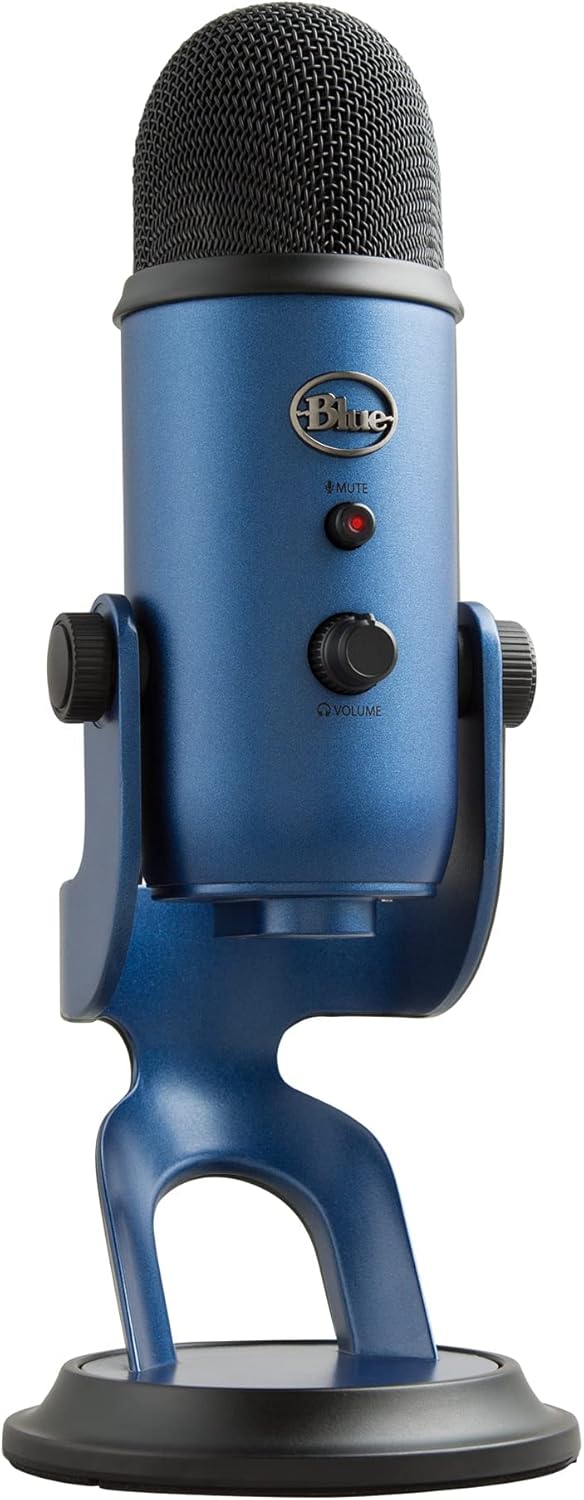
| Blue Yeti USB Microphone | Best overall | 4 pickup patterns, USB, headphone monitoring | ~$100–110 | Buy this first |
| UBeesize 22" Ring Light | Best value | 22-inch ring, 60W, 72-inch stand | ~$100–110 | Biggest light per dollar |
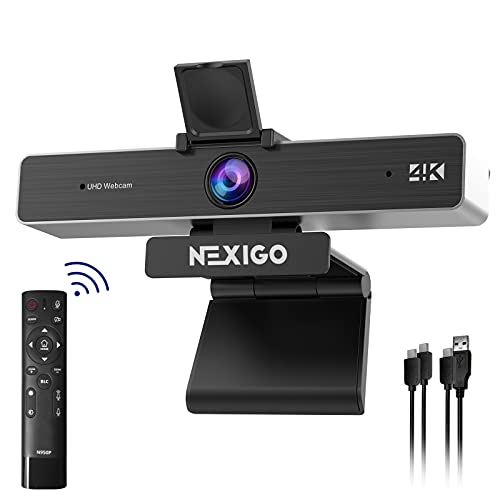
| NexiGo N950P (Gen 2) | Best webcam quality | 4K, Sony STARVIS sensor, dual mics | ~$95–105 | The one you upgrade to |
| NEEWER 18" 55W Ring Light Kit | Best performance lighting | 18-inch, 55W, 5600K, kit with bag | ~$110–120 | Buy for the 5600K spec |
| BENGOO G9000 Headset | Budget pick | Over-ear, boom mic, 3.5mm | ~$30 | Start here, upgrade later |
Prices are our catalog snapshot at the time of writing and move constantly. Check the live listing before acting on any figure on this page.
🏆 Best Overall: Blue Yeti USB Microphone
Specs: USB condenser · tri-capsule array · 4 pickup patterns (cardioid, omnidirectional, bidirectional, stereo) · built-in 3.5mm headphone jack for zero-latency monitoring · Blue VO!CE effects · desk stand included · ~$104.00
Pros
- Four pickup patterns, which means one microphone covers solo streaming, a two-person desk interview, and a room recording without buying anything else.
- Onboard headphone jack gives you zero-latency monitoring — you hear yourself as the stream hears you, which is how you catch clipping before your chat does.
- Physical gain knob and mute button. Both matter more than they sound: a hardware mute you can hit without alt-tabbing is worth having.
- USB, so there is no audio interface, no phantom power, and no XLR cable to buy. It works the moment it is plugged in.
Cons
- It is a condenser on a desk stand, which means it picks up keyboard and desk noise readily. A boom arm and a shock mount are the natural follow-up purchases.
- Large and heavy for the space it occupies on a desk.
The Blue Yeti is the default recommendation in this category for an unglamorous reason: it removes every excuse. There is no interface to configure, no gain-staging chain to learn, no driver to hunt down. You plug it in, set the pattern to cardioid, put it about 15 centimetres from your mouth and slightly off-axis so plosives pass by rather than into the capsule, and you sound dramatically better than any headset microphone.
The four-pattern tri-capsule array is the specification that justifies the price over a single-pattern USB mic. Cardioid rejects everything behind the microphone, which is what you want alone at a desk. Bidirectional picks up front and back for a two-person conversation across a table. Omnidirectional captures the whole room. Stereo gives you a left-right image. Most streamers use cardioid for years — but the day you need one of the others, you already own it, and that flexibility is why the Yeti stays on desks long after the webcam has been replaced twice.
Per Logitech's Yeti product documentation, the onboard headphone output provides direct monitoring with no software round-trip, which is the feature that most distinguishes it from cheaper USB microphones. Monitoring latency through a software mixer is disorienting enough that people stop monitoring altogether — and then they stop catching their own audio problems.
Price disclaimer: catalog price at time of writing; verify on the live listing.
💰 Best Value: UBeesize 22" Ring Light with 72" Stand
Specs: 22-inch ring · 60W · 72-inch adjustable stand · phone holder · dimmable LED · ~$104.99
Pros
- 22 inches is a genuinely large ring. Larger sources produce softer light with gentler shadow edges, which is the difference between "lit" and "well lit."
- The 72-inch stand reaches above seated eye level, which is what you need for the light to sit around or above the camera rather than below it.
- Dimmable, so you can match it to whatever ambient light the room already has instead of blowing out the exposure.
- 60W is more output than the smaller kits, giving you headroom to run it at a lower, softer setting.
Cons
- A 22-inch ring on a full-height stand takes real floor space and is not something you fold away between sessions.
- The phone holder is aimed at phone-based creators and is largely irrelevant if you are streaming from a PC.
The UBeesize 22" ring light is the value pick because ring lights scale almost linearly with diameter for quality of light and nowhere near linearly for price. Going from an 18-inch ring to a 22-inch ring is a meaningful increase in source area — and therefore in shadow softness — for roughly the same money.
The specification that matters here is the stand, not the ring. Ring lights that ship with short desk tripods put the light below your face, which produces the uplit look associated with horror films rather than broadcasts. A 72-inch stand lets you place the ring at or slightly above eye level and angle it down, which is where frontal light is flattering. Any ring light on a desk tripod is a compromise you will end up working around.
Run it dimmed. New streamers reflexively run lights at maximum and end up with a blown-out face and a black background. Set the ring to somewhere in the 40–60% range, let the room's ambient light fill the background, and the image reads as natural rather than interrogated.
Price disclaimer: catalog price at time of writing; verify on the live listing.
🎯 Best for Webcam Quality: NexiGo N950P (Gen 2)
Specs: 4K capture · Sony STARVIS sensor · 5× digital zoom · RF remote · dual stereo microphones · Zoom certified · ~$99.99
Pros
- A Sony STARVIS sensor is a named, back-illuminated part designed for low-light sensitivity — a real specification rather than a generic "HD sensor" claim.
- 4K capture gives you room to crop or digitally zoom without softening the streamed 1080p output.
- The RF remote handles zoom and framing without touching software mid-stream.
- Dual stereo microphones are a usable fallback if your primary microphone fails mid-broadcast.
Cons
- You will stream at 1080p, not 4K, so the 4K sensor buys you crop headroom rather than delivered resolution.
- Digital zoom is a crop, not an optical change. Use it sparingly.
The NexiGo N950P Gen 2 sits at the point in the webcam market where the specification stops being vague. Most sub-$100 webcams describe their sensor as "HD" and nothing else. Naming a Sony STARVIS part is a commitment to a class of sensor built specifically for low-light performance, and low light is what a home streaming desk actually is — which is why this is the webcam pick even though the lighting sections above will do more for your image than the camera does.
The practical way to use a 4K webcam on a 1080p stream is as a framing tool. Capture at 4K, crop to 1080p in OBS, and you can reframe your shot — tighter head-and-shoulders, wider to include a desk — without losing a single delivered pixel, because you are still sending more than 1080p worth of sensor data into a 1080p output. That is a real workflow advantage over a native 1080p camera, where any crop is a quality loss.
Published webcam testing such as the Tom's Hardware webcam round-up consistently finds that lighting conditions dominate sensor differences at this price tier. Which is the honest framing for this pick: buy it third, after the light, and it will look better than it would have if you had bought it first.
Price disclaimer: catalog price at time of writing; verify on the live listing.
⚡ Best Performance Lighting: NEEWER Ring Light 18-inch 55W Kit
Specs: 18-inch ring · 55W · 5600K colour temperature · stand and phone holder · soft tube diffuser · carry bag · ~$112.99
Pros
- 5600K is specified explicitly. That is standard daylight balance, which means your white balance is predictable and your skin tones stay consistent between sessions.
- Ships as a kit with a soft diffuser tube and a carry bag, which makes it the pick if the light needs to be packed away or moved.
- Consistent colour temperature is the thing that separates a light you can colour-grade around from one you cannot.
Cons
- Smaller ring and lower wattage than the UBeesize above, at a higher price. On raw output per dollar it loses.
- 18 inches produces slightly harder shadow edges than a 22-inch source at the same distance.
Be clear about what you are buying here. The NEEWER 18-inch kit is smaller, dimmer and more expensive than the UBeesize — on the two specifications most people compare, it loses. Its case rests on one number the cheaper option does not publish clearly: a stated 5600K.
Why that matters comes down to how cameras handle white balance. A light with a specified, stable colour temperature lets you set a fixed white balance in OBS and leave it there. Your skin tone looks the same on Tuesday as it did on Sunday, and if you ever add a second light you can match it. Lights that do not publish a temperature — or that drift as they dim — force the camera into auto white balance, which visibly hunts when anything in frame changes colour.
So: buy the UBeesize if you want the most light for the money and will run a single source. Buy the NEEWER if colour consistency matters to you, if you expect to add a second matched light later, or if the kit needs to travel. Both are correct answers to different questions.
Price disclaimer: catalog price at time of writing; verify on the live listing.
🧪 Budget Pick: BENGOO G9000 Stereo Gaming Headset
Specs: over-ear · boom microphone · 3.5mm connection · in-line volume control · ~$29.99
Pros
- 3.5mm rather than USB, which means it works on the PC, on a console controller, and on a phone with no adapter or dongle to track.
- Boom microphone gets you on air on day one for $30, before you have decided whether streaming is going to stick.
- Closed over-ear design keeps monitoring audio out of an open microphone.
Cons
- The microphone is thin and compressed compared with any standalone USB condenser. It is a starting point, not a destination.
- Build quality is what $30 buys.
The BENGOO G9000 is on this list as the honest answer to "I want to try streaming this weekend and I have $30." It gets you broadcasting. It will not get you a good-sounding broadcast, and the microphone is the first thing you replace — which is why the Blue Yeti is the Best Overall pick and this is the budget one.
There is a real argument for buying it alongside the Yeti rather than instead of it. A closed-back headset is how you monitor without the microphone re-capturing your own output, and open speakers on a desk with a live condenser produce feedback and echo that your viewers hear even when you do not. If you already own decent closed headphones, plug them into the Yeti's monitoring jack and skip this. If you do not, $30 is a cheap way to close that gap. Better options are in best gaming headsets in 2026.
Price disclaimer: catalog price at time of writing; verify on the live listing.
What to look for in a streaming starter kit
Microphone pickup pattern
Cardioid is the pattern you want alone at a desk: sensitive in front, rejecting behind. Omnidirectional captures the whole room and, on a home desk, that means the whole room's air conditioning and traffic noise. Bidirectional is for two people facing each other. If a microphone offers only one pattern, cardioid is the right one — and if it offers four, you have bought flexibility you will eventually use. Position matters as much as pattern: roughly 15 centimetres away, slightly off-axis so breath passes by the capsule rather than into it.
Colour temperature and consistency
Specified is better than bright. 5600K is daylight-balanced and is the sane default for video. What you are avoiding is a light that shifts temperature as you dim it, because that forces auto white balance and produces a picture that visibly changes colour when anything in frame moves. If you plan to run two lights, matching temperature is not optional — mismatched sources produce a face lit warm on one side and cool on the other, and no amount of grading fixes it cleanly.
Webcam frame rate versus resolution
For streaming, 1080p at 60fps beats 4K at 30fps every time. Motion smoothness reads as production quality; static resolution does not, because your viewers are watching a compressed 1080p stream regardless. Buy 4K for the crop headroom, then configure the camera to deliver 1080p60 into OBS. Check the frame rate the camera actually sustains at your chosen resolution — some cameras advertise 4K but only reach it at 30fps.
Monitoring latency
If you cannot hear yourself as the stream hears you, you will not catch clipping, plosives, or a microphone knocked off-axis. Direct hardware monitoring — a headphone jack on the microphone itself — has no round-trip delay. Software monitoring through OBS or a virtual mixer introduces enough latency to be actively disorienting, and most people respond by turning monitoring off, which defeats the point.
Mounting and desk space
A large condenser on a desk stand transmits every keystroke through the desk into the capsule. A boom arm and shock mount fix that and are the natural second purchase for anyone typing on stream. Ring lights need floor space and a stand tall enough to place the source at or above eye level. Measure before you buy — a 22-inch ring on a 72-inch stand is a piece of furniture.
The most-missed step: treat the room before you upgrade the microphone
The upgrade path almost everyone follows is headset microphone, then $100 USB condenser, then $250 XLR setup with an interface — while streaming from the same untreated room the whole time.
That path plateaus early, because past a certain point you are buying more accurate reproduction of a bad acoustic environment. A better microphone in a room with hard walls, a bare floor and a window does not sound better. It sounds more like the room, and the room is the problem.
The fix is soft mass on the reflective surfaces near you, and it is usually free. A rug on a hard floor kills the strongest reflection. Curtains over a window kill the second. A bookshelf behind the camera scatters what is left. A duvet hung on the wall behind your monitor for the duration of a stream is genuinely effective and costs nothing.
The test is the same clap from Step 0. Clap, listen for the ring, add soft material, clap again. When the ring is gone, your $100 microphone starts performing like one — and the $250 upgrade you were considering stops being necessary.
Do this first. It is the highest-return thirty minutes in this entire hobby.
When a starter kit is not the right buy
You are podcasting, not streaming. Podcasting is recorded rather than live, which changes the calculus entirely. You do not need a webcam, you do not need lighting, and you should put the whole budget into audio — a dynamic microphone and treated space beats a condenser and a camera. Recorded audio can also be edited, which means you can fix in post what a live stream cannot.
You are recording music. A USB condenser optimised for speech is the wrong tool. Instrument and vocal recording wants an audio interface, an XLR microphone chosen for the source, and monitoring you can trust. None of the picks above serve that well.
You are streaming from a console only. A USB microphone connected to a PS5 or Xbox works for party chat but does not route into the broadcast the way it does through OBS on a PC. Check your console's audio routing before buying anything on this page.
You have not streamed yet. Stream three times with whatever you already own. You will learn more about which limitation actually bothers you than any buying guide can tell you — and there is a real chance the answer is "none of them yet."
The complete kit, priced
| Component | Pick | Catalog price |
|---|---|---|
| Microphone | Blue Yeti USB | $104.00 |
| Lighting | UBeesize 22" ring light | $104.99 |
| Webcam | NexiGo N950P Gen 2 | $99.99 |
| Monitoring | BENGOO G9000 headset | $29.99 |
| Desk surface | SteelSeries QcK XXL | $29.99 |
| Total | $368.96 |
Buy it in stages rather than all at once. Microphone in month one, light in month two, camera in month three — by which point you will know whether you are still streaming, and you will have spent $104 rather than $369 finding out. The SteelSeries QcK XXL is the optional line: a full-desk cloth pad gives the microphone stand and camera a non-slip surface and keeps desk noise from transmitting quite as readily, which is a small acoustic win for $30.
Related guides
- HyperX QuadCast 2 vs Blue Yeti: best USB mic for game streaming — the head-to-head behind our Best Overall pick
- Best streaming gear for game streamers in 2026 — the wider gear round-up once you are past the starter tier
- Best budget streaming gear for Twitch in 2026 — if $369 is above your budget
- Best streaming setup for PC gamers in 2026 — encoder settings and the PC side of the chain
- Best budget gaming peripherals under $100 — the desk around the kit
Citations and sources
- Twitch — broadcasting guidelines — official bitrate, resolution and keyframe-interval recommendations.
- Logitech — Yeti USB microphone — pickup patterns, monitoring output and manufacturer specifications.
- Tom's Hardware — best webcams — published comparative webcam testing and low-light findings.
- OBS Project — the free capture and encoding software this guide assumes.
- Colour temperature — reference — why 5600K is the daylight-balanced standard for video lighting.
Prices and availability were accurate to our catalog at the time of writing and change frequently.
— Mike Perry