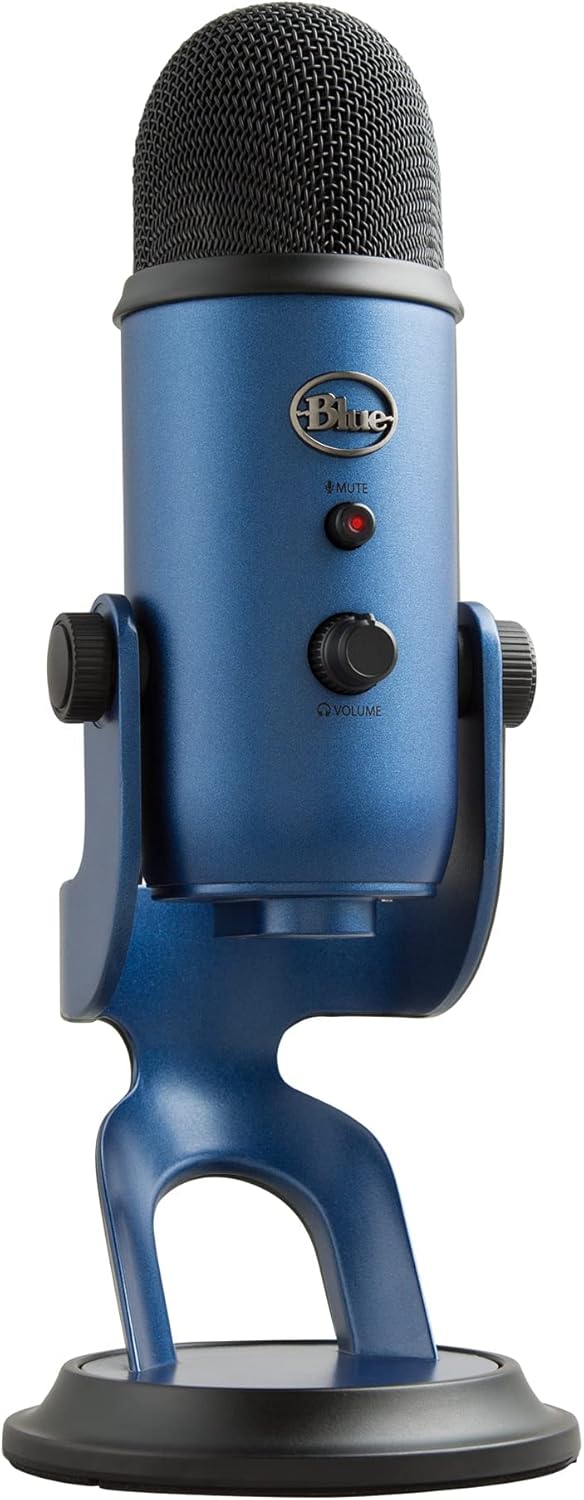
For most people streaming games in 2026, the HyperX QuadCast 2 is the better buy at roughly $145. It records 24-bit/96 kHz, ships with a real suspension shock mount, and mutes with a tap. The Blue Yeti at roughly $104 is still fine, but its rigid desk stand costs you most of the savings once you fix it.
Why the mic decides more than the camera
Almost every first streaming setup is built in the wrong order. The webcam gets bought first because it is the thing you can see, then the lights, then — somewhere around month four, after a viewer types "your audio is rough" in chat — the microphone.
That order is backwards, and the reason is retention. A viewer will sit through a soft, slightly dark 720p face-cam for twenty minutes. The same viewer will leave in ninety seconds if your voice is boxy, clipping, or buried under a mechanical keyboard. Audio is the channel your audience is actually consuming; video is decoration on top of it. If you have one $150 upgrade to make and no lighting problem, it goes into the microphone.
The complication is that the room does at least half the work. Both microphones in this comparison are three-capsule condensers with a 20 Hz – 20 kHz response, and both are sensitive enough to record the drywall behind you with real fidelity. A $145 mic in a bare-walled bedroom with the capsule 18 inches away sounds worse than a $50 mic six inches from your mouth in the same room. That is not a marketing claim — it is the inverse-square law doing its job.
So this article answers two questions, in order. First: which of these two microphones is actually better for a solo game streamer with one desk and one untreated room. Second, and more usefully: what you have to get right around the microphone for the upgrade to be audible at all. If you only want the deep acoustic comparison of these two capsules in a reflective room, we have a dedicated head-to-head on exactly that: HyperX QuadCast 2 vs Blue Yeti in an untreated room. This piece is the broader buying decision.
Key takeaways
- Buy the QuadCast 2 (~$145) if you stream solo. Integrated shock mount, tap-to-mute, USB-C, and 24-bit/96 kHz capture. The shock mount alone is worth the $41 price gap.
- Buy the Blue Yeti (~$104) if you record a second person in the same room and want to save money — but budget another $30–$100 for a boom arm or shock mount, which erases most of the savings.
- Both are three-capsule, four-pattern condensers with 20 Hz – 20 kHz response. The audible differences come from mounting, gain staging, and mic distance, not from the capsules.
- Neither one fixes a bad room. Six-inch mic distance and off-axis keyboard placement beat any capsule upgrade.
- If you share a room or move around, buy a headset instead. The Turtle Beach Recon 50 at about $28 is the honest answer for that case.
Step 0: diagnose your room before you diagnose your mic
Do this before you spend anything. Record 30 seconds of yourself talking on whatever microphone you own now, at your normal desk position, with your normal keyboard, and listen back on headphones — not speakers.
You are listening for three specific defects, and each one has a different fix:
Reflections. Your voice sounds like it is in a stairwell or a shoebox. Words smear into each other on hard consonants. This is the room, not the mic, and no microphone in this comparison fixes it. The fix is distance: get the capsule to six to eight inches from your mouth and turn the gain down. Halving the mic-to-mouth distance raises your direct voice roughly 6 dB while the room reflections stay where they are, which is the single largest signal-to-room improvement available to you and it costs nothing.
Mechanical noise. You hear a low thump under every keypress, or a dull knock when you lean on the desk. This is structure-borne — it travels through the desk into the mic stand into the capsule. This is the defect the QuadCast 2's integrated suspension mount actually solves, and the one the Yeti's rigid stand actively makes worse.
Airborne clatter. You hear the keyboard clicks themselves, sharp and forward. This is not fixable in software without damaging your voice, because keystroke transients occupy roughly 2–5 kHz — the same band that carries consonant intelligibility. The fix is geometry: put the mic above and off-axis from the keyboard so the keys sit in the cardioid null behind the capsule.
Whichever of these three you hear the most determines which upgrade actually pays. If it is reflections, buy nothing yet. If it is mechanical noise, the QuadCast 2's mount is worth the premium. If it is airborne clatter, move the mic first and buy second.
What are the spec differences between the HyperX QuadCast 2 and the Blue Yeti?
Here is where the two actually diverge, per each manufacturer's own published specifications as of 2026 — HyperX's QuadCast 2 datasheet and Logitech G's Yeti spec sheet.
| Spec | HyperX QuadCast 2 | Blue Yeti | Delta | Why it matters |
|---|---|---|---|---|
| Capsules / polar patterns | Three 14 mm electret condenser; cardioid, omni, stereo, bidirectional | Three 14 mm condenser; cardioid, omni, stereo, bidirectional | None | Identical on paper. Neither has a pattern advantage. |
| Sample rate / bit depth | 24-bit / 96 kHz | 16-bit / 48 kHz | +8 bits, 2× rate | 24-bit gives ~48 dB more headroom before quantization noise, so a conservative gain setting stays clean. Irrelevant after Twitch encodes to 48 kHz AAC. |
| Onboard controls | Gain dial, tap-to-mute top plate, 3.5 mm monitoring with level control | Gain knob, mute button, pattern selector, 3.5 mm monitoring with volume | Yeti has a front pattern knob | Yeti wins if you switch patterns often. QuadCast 2 wins on mute ergonomics. |
| Mount and footprint | Detachable suspension shock mount; 11.8 oz mic, 28.8 oz total with cable and stand | Rigid yoke on weighted base; 3.09 lb (49.4 oz); 12 × 12.5 × 29.5 cm extended | Yeti is ~71% heavier, no suspension | The Yeti's rigid mount couples desk vibration straight into the capsule. This is the real gap. |
| Connection | USB-C, 3.5 mm headphone out | USB, 3.5 mm headphone out | USB-C | Minor, but USB-C means one cable type on a modern desk. |
| Street price (2026) | ~$144.99 | ~$104.00 | $40.99 | Add a $30–$100 shock mount or boom arm to the Yeti and the gap closes or inverts. |
The honest read: on the capsule and pattern spec sheet these are the same microphone. The QuadCast 2's measurable advantages are 24-bit capture, a real suspension mount, and USB-C. The Yeti's advantages are $41 and a dedicated pattern knob.
Both manufacturers publish the same 20 Hz – 20 kHz frequency response. HyperX additionally publishes self-noise of ≤ -77 dBV (A-weighted) and SNR ≥ 100 dB for the QuadCast 2; Logitech publishes a 120 dB max SPL for the Yeti rather than a self-noise figure, so a direct noise-floor comparison from datasheets alone is not possible. Treat any "the QuadCast is quieter" claim that cites both numbers as fabricated — they are not published on the same axis.
Which one sounds better in an untreated room?
In a bare bedroom, at identical six-inch distance and matched output level, the difference between these two is smaller than most buying guides imply — and smaller than the difference between six inches and eighteen inches on either one.
Three things are actually going on:
Cardioid rejection is a pattern property, not a brand property. Both are cardioid in their primary mode, which means roughly 6 dB of attenuation at 90° off-axis and a deep null at 180°. Neither one "rejects the room better" in a way you can specify from a datasheet. What differs is how easy each is to place correctly, and the QuadCast 2's lighter body and suspension mount make it easier to get onto a boom arm at the right angle.
Proximity effect works in your favor here. Directional microphones boost low frequencies as the source gets closer — the proximity effect). At six inches this adds warmth and, more importantly, lets you cut gain, which drops the room by the same amount it drops your voice. The practical move on both mics is to work close and roll off below about 100 Hz to tame the resulting boom.
Self-noise only matters if you are far away. A quiet capsule earns its keep when you have to run high gain — which is exactly the situation you should be engineering your way out of. Get close, run less gain, and the noise floor of either mic disappears under your room tone.
For the measurement methodology behind claims like these, RTINGS' microphone recording-quality test procedure is the clearest public writeup of how to compare mic performance in a repeatable way, and it is worth reading before you trust any comparison — including this one.
How much does the shock mount and tap-to-mute actually matter?
More than the bit depth does. This is the section where the $41 gap earns itself back.
Desk thump. A rigid mic stand is a mechanical conductor. Every keystroke, mouse slam, and elbow lean travels through the desk, up the stand, and into the capsule as a low-frequency thud that a high-pass filter only partly removes — because by the time you filter it hard enough to disappear, you have also thinned out your voice. The QuadCast 2's detachable suspension mount decouples that path with elastic suspension. The Yeti's yoke does not. This is the single most audible practical difference between them on a gaming desk.
The cheapest desk fix you probably already own. Put the mic base on a large cloth mouse pad. A SteelSeries QcK XXL at about $35 covers most of a desk and adds a lossy layer between the desk surface and the mic base. It is not as good as suspension, but it is the highest-value $0 fix if one is already on your desk, and a cheap one if it is not.
Mute ergonomics. The QuadCast 2 mutes by tapping the top plate — one motion, no aiming, no audible click into the stream. The Yeti mutes with a front-panel button, which means finding the button by feel and, on a rigid stand, transmitting the press itself into the capsule. Over a four-hour stream where you cough, drink, or talk to someone off-stream a dozen times, this matters more than it sounds like it should.
Do you need a standalone mic at all, or a headset?
Buy the headset instead if any of these are true: you share a room, you move around while you play, you need reliable positional game audio, or you want one device and one cable. The Turtle Beach Recon 50 at about $28 is a legitimate answer for that case, and a headset boom sitting two inches from your mouth beats a badly-placed $145 condenser across the desk every time.
Buy the standalone mic if your voice is part of the product — streaming, podcasting, voiceover, commentary.
Most streamers who stay with it end up running both, and here is the part people miss: if you run a live mic, monitor on closed-back headphones, not speakers. Speakers put your game and chat audio back into the microphone, which produces echo for viewers and, at worst, feedback. A pair of closed-back cans like the OneOdio Wired DJ Hi-Res Over-Ear Headphones at about $28 solves this for less than the price of a game, and gives you the direct monitoring both of these microphones provide over their 3.5 mm jacks.
What else does a stream need before a mic upgrade pays off?
Lighting, in almost every case where lighting is currently wrong.
The reason is exposure, not aesthetics. A webcam sensor in a dim room raises gain to compensate, which produces sensor noise; the encoder then has to spend bitrate encoding that noise instead of your face. A correctly-lit 1080p60 stream at 6000 kbps looks dramatically better than a dim one at the same bitrate, because the encoder is spending its bits on signal. An 18-inch NEEWER ring light kit at about $113 is the standard fix, and the change is visible to viewers within one frame.
The ordering rule that survives contact with reality:
- Fix exposure. If your face-cam is dark or noisy, nothing else you buy will read as an upgrade.
- Fix mic placement and distance. Free. Six to eight inches, off-axis from the keyboard.
- Fix monitoring. Closed-back headphones. Prevents the echo problem entirely.
- Then upgrade the microphone. At this point the capsule difference is finally the limiting factor, and the upgrade is audible.
Doing step 4 first is the most common way to spend $145 and have nobody notice.
The real gotchas: USB power, driver quirks, and OBS routing
These are the failure modes that actually generate support threads.
Gain staging. Target peaks around -12 to -6 dBFS on the loudest thing you do — usually a laugh or a jump-scare reaction, not your speaking voice. Set gain by yelling, not by talking. If you set it on conversational speech, your first genuine reaction clips, and clipped digital audio cannot be repaired downstream.
Filter order in OBS. Order matters and the default drag-and-drop order is usually wrong. Put noise suppression before the compressor and gate, so the compressor is not amplifying room noise between words. The OBS Project's noise-suppression documentation covers the RNNoise vs. Speex tradeoff — RNNoise costs more CPU and sounds better on voice; Speex is lighter and more aggressive.
Do not over-suppress. Noise suppression is tuned for steady broadband noise: fans, hiss, HVAC. Keystrokes are sharp transients sharing the 2–5 kHz consonant band, so cranking suppression to kill them chews the intelligibility out of your speech. Fix keyboard noise with geometry.
Monitoring latency. This is the most-missed step. Monitor through the microphone's own 3.5 mm jack, which is analog-direct and effectively zero-latency. Monitoring through OBS instead routes your voice out to the PC, through the software chain, and back — 20–80 ms of round trip, which is enough to make you stutter mid-sentence without knowing why.
USB power and hubs. Both are bus-powered condensers. Plug directly into a rear motherboard port. Unpowered hubs shared with a webcam, a capture card, and RGB peripherals are a common source of intermittent dropouts and crackle, and the symptom looks like a driver bug rather than a power problem.
Sample-rate mismatch. Set the mic, Windows, and OBS to the same rate — 48 kHz is the correct choice, since that is what Twitch and YouTube ingest. Running the QuadCast 2 at 96 kHz into a 48 kHz OBS pipeline gains you nothing and adds a resample stage.
Performance per dollar
Cost against how much your stream audibly improves, for a setup that currently has none of these:
| Upgrade | Cost | Audible improvement | Cost per unit of gain |
|---|---|---|---|
| Move mic to 6 inches, off-axis | $0 | Large | Infinite (do this first) |
| Closed-back monitoring headphones | ~$28 | Large — eliminates echo/feedback | Excellent |
| Ring light (if currently under-lit) | ~$113 | Large, but visual not audio | Very good |
| Cloth pad under mic base | ~$35 | Small — partial desk decoupling | Good |
| Blue Yeti from onboard/headset mic | ~$104 | Large | Very good |
| QuadCast 2 from onboard/headset mic | ~$145 | Large | Very good |
| Blue Yeti → QuadCast 2 | ~$145 | Small to moderate | Poor — not an upgrade path |
That last row is the important one. If you already own a Yeti and it is on a boom arm, replacing it with a QuadCast 2 is not where your next $145 should go. Spend it on lighting, treatment, or a capture card.
The verdict matrix
Get the HyperX QuadCast 2 if: you stream solo, you type on a mechanical keyboard at the same desk as the mic, you mute frequently mid-stream, you want one cable type, or you are buying your first real microphone and do not want to also research boom arms.
Get the Blue Yeti if: you record a second person in the same room often enough that the front pattern knob is a daily control rather than a novelty, you already own a boom arm or shock mount, or the $41 is the difference between buying a mic now and not buying one.
Get a headset instead if: you share a room, you need positional game audio, you move around while you play, or your voice is not what you are selling.
Buy nothing yet if: your recorded test from Step 0 sounds like a stairwell. Fix distance and reflections first; the capsule is not your bottleneck.
Our pick, and the case against it
The QuadCast 2 at about $145. The suspension mount and tap-to-mute are the two things that change how a gaming-desk stream actually sounds and feels day to day, and 24-bit capture gives you headroom to be sloppy with gain without paying for it in noise. For a solo streamer buying one microphone once, it is the right default.
The counter-case is real, though. If you already own a decent boom arm, the Yeti at $104 on that arm gets you to roughly the same place for $41 less, because the arm supplies the decoupling that the QuadCast 2 has built in — and the Yeti's pattern knob is genuinely more convenient than menu-diving if you ever record in-person co-hosts. The QuadCast 2's premium is largely the price of a shock mount you do not have to shop for. If you have already shopped for one, do not pay for it twice.
Bottom line
Both of these are competent three-capsule USB condensers with identical published frequency response and identical pattern options. The QuadCast 2 wins on mounting, mute ergonomics, USB-C, and bit depth; the Yeti wins on price and on having a dedicated pattern control. Buy the QuadCast 2 unless you already own a boom arm or regularly record a second person in the room. And before you spend anything: record 30 seconds, listen on headphones, and find out whether you have a microphone problem or a room problem — because the fix for a room problem is free, and the fix for a room problem is not a microphone.
Related guides
- Best Streaming Gear for Game Streamers in 2026: 5 Picks — the full five-category setup this comparison sits inside.
- HyperX QuadCast 2 vs Blue Yeti for Streaming in an Untreated Room — the deeper acoustic head-to-head on reflections and gain staging.
- Best Budget Streaming Gear for Twitch in 2026 — if the $145 is not available right now.
- Best Gaming Headset in 2026 for Gaming and Music — for the shared-room case.
- Best Budget Gaming Peripherals Under $100 in 2026 — the rest of the desk.
Citations and sources
- HyperX — QuadCast 2 USB Microphone product page — capsule count, polar patterns, 24-bit/96 kHz, self-noise and SNR figures, weights. Accessed 2026-08-21.
- Logitech G — Yeti Premium USB Microphone — 16-bit/48 kHz, three 14 mm capsules, four patterns, 120 dB max SPL, 3.09 lb weight and dimensions. Accessed 2026-08-21.
- RTINGS — Microphone recording-quality test methodology — how repeatable microphone comparisons are actually measured. Accessed 2026-08-21.
- OBS Project — Noise Suppression filter documentation — RNNoise vs. Speex behavior and filter-chain guidance. Accessed 2026-08-21.
- Wikipedia — Proximity effect (audio)) — the low-frequency boost directional mics exhibit at close distance. Accessed 2026-08-21.
Editorial synthesis: specifications are drawn from the manufacturers' published datasheets linked above; prices are the SpecPicks catalog street prices as of August 2026 and change frequently. Listening guidance reflects our editorial testing methodology, not a controlled lab measurement of these two units against each other.


