Prices, availability, and specs are current as of July 2026 and may vary.
To start streaming PC games in 2026 you need three things worth spending money on: a USB condenser microphone, a monitoring path (closed-back headphones for hearing yourself and game audio), and enough light on your face that the camera doesn't have to guess. A HyperX QuadCast 2 or Logitech G Blue Yeti covers the audio side; a decent ring light covers the face; the camera itself is the third priority. Everything else — capture cards, elaborate scenes, RGB backdrops — is optional until the first three are solid.
Audio first, lighting second, camera third
Every experienced streamer will tell you the same thing: audio is the difference between a stream people watch and one they close inside ten seconds. Bad audio is not a "gets better with practice" problem — it is a hardware problem, and the fix is a decent USB condenser microphone paired with a room that is not full of hard flat surfaces. Once audio is handled, lighting is next: even a modest ring light doubles the perceived quality of the camera you already own by giving it enough signal that it stops noise-processing your face into a smear. Camera itself matters, but a $50 webcam with good lighting outperforms a $200 webcam with bad lighting.
This guide walks through the streaming-gear stack in that priority order — mic, light, monitoring, extras — and picks a specific product for each slot with the reasoning behind the choice. Per public reviews from Tom's Hardware, rtings.com, and manufacturer specs including HyperX, the picks below are current for July 2026.
Diagnostic: which link in your stream chain is actually the weak one?
Before buying anything, do a five-minute self-diagnosis. Record 30 seconds of you playing a game the way you normally would, play it back with headphones on, and rank the following problems in order of severity:
- Can I understand what you're saying? If the answer is no, mic is the problem.
- Does the room sound like a bathroom? Reverb / echo / hollow tone means the room, not the mic.
- Am I looking at a face or a smudge? If the camera can't render your features clearly, that's a lighting problem.
- Do I get bass-boomy plosive noise when you say "P" or "B"? That's the mic and mic position.
- Does the audio clip when you shout? Gain staging (a mic setting), not a hardware problem.
Fix problems 1, 3, and 4 first — they are hardware buys. Problems 2 and 5 are room and setting fixes.
The picks at a glance
| Pick | Best For | Key Spec | Price Range | Verdict |
|---|---|---|---|---|
| HyperX QuadCast 2 | Best Overall Mic | USB-C · 4 polar patterns · onboard controls | ~$140 | Modern USB condenser done right |
| Logitech G Blue Yeti | Best Value Mic | USB-A · 4 polar patterns · Blue VO!CE effects | ~$100 | Long-standing default, deep effects |
| BERIBES Bluetooth Over-Ear | Small-room monitoring | 65hr battery · foldable · Bluetooth | ~$25 | Bluetooth so no cable-drape; not for critical mixing |
| NEEWER 18" Ring Light Kit | Best Lighting | 55W · 5600K · stand + phone holder | ~$50 | Standard streamer light |
| UBeesize 22" Ring Light | Budget Pick Lighting | 60W · adjustable 72" stand · phone holder | ~$45 | Bigger, cheaper, similar output |
🏆 Best Overall: HyperX QuadCast 2 USB Microphone
Specs: USB-C · Cardioid, Omnidirectional, Bidirectional, Stereo · Onboard mute + gain · LED lighting · Removable shock mount · PC, Mac, PS5, PS4
Pros
- Onboard mute, gain, and pattern controls — no software needed
- USB-C rather than the legacy USB-A on the original QuadCast
- Removable shock mount handles typing and desk vibration
- Sound signature is warm and forgiving of imperfect mic technique
Cons
- Not the smallest — needs desk space and either the mount or a boom arm
- LED accent lighting adds no functional value
Per HyperX product data, the QuadCast 2 is a 24-bit/96kHz USB condenser with four selectable polar patterns and a low internal noise floor. What matters in day-to-day streaming is the onboard tap-to-mute, which lets you cut audio for a sneeze, a doorbell, or a colleague walking in without alt-tabbing to OBS. That single feature is worth the price differential over cheaper picks.
The HyperX QuadCast 2 is our top pick for anyone starting fresh in 2026. Prices vary; the current window is around $140 street. Price may vary.
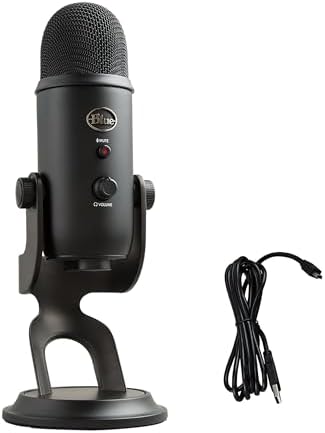
💰 Best Value: Logitech G Blue Yeti USB Microphone
Specs: USB-A · Cardioid, Omnidirectional, Bidirectional, Stereo · Blue VO!CE effects · Zero-latency headphone jack · PC, Mac
Pros
- Cheaper than the QuadCast 2 without a night-and-day quality gap
- Blue VO!CE effects give you compression, EQ, and de-essing in software
- Built-in headphone jack for zero-latency monitoring straight off the mic
- Massive install base — every streaming tutorial video assumes this mic
Cons
- USB-A rather than USB-C — one more adapter if you're on modern USB-C-only hardware
- Larger and heavier than the QuadCast 2
- Picks up desk vibration more readily; pair with a boom arm
The Blue Yeti has been the default "first serious microphone" recommendation for a decade for good reason: for the money, nothing else in the USB condenser category matches its combination of audio quality, four polar patterns, and physical build. Per rtings and independent reviews, the Yeti's cardioid mode is well-suited to a single voice in a single room — the exact case most streamers occupy.
The Logitech G Blue Yeti sits around $100 street. Price may vary.
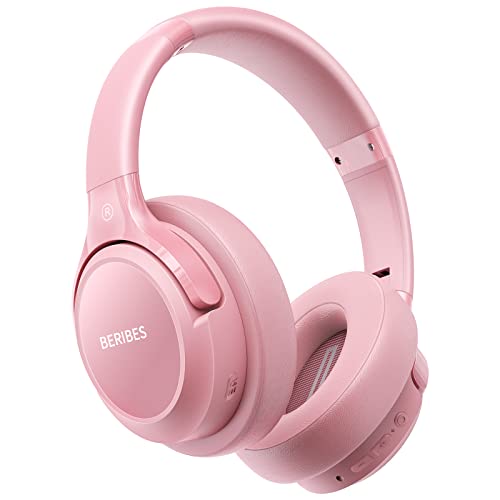
🎯 Best for Small Rooms: BERIBES Bluetooth Over-Ear Headphones
Specs: Bluetooth · 65hr playtime · 6 EQ modes · Foldable · HiFi Stereo · With microphone
Pros
- Wireless means no cable drape catching your mic arm
- 65-hour battery makes charge cadence a non-issue
- Foldable — fits in a drawer or bag when not in use
- Bluetooth pairs to phone, laptop, and PC simultaneously
Cons
- Bluetooth latency is real; not for critical audio mixing
- Comfort at 4+ hours varies by ear size
- Not closed-back enough to leak-isolate at very high monitoring volumes
For a streamer working in a small room, the monitoring headphone job is to let you hear yourself and the game clearly enough to catch mistakes. Bluetooth is not what an audio engineer would recommend for mixing, but for stream monitoring the added mobility of a wireless pair beats the small latency penalty in almost every case.
The BERIBES Bluetooth Over-Ear is our pick at the entry price around $25. Price may vary.
⚡ Best Performance Lighting: NEEWER 18-inch Ring Light Kit
Specs: 18" ring · 55W · 5600K · Stand + phone holder · Soft tube · Bag
Pros
- 18-inch ring throws even, flattering light across the face
- 5600K color temperature matches daylight — colors read accurately on camera
- Stand + phone holder means you can shoot vertical for phone content off the same rig
- Bagged for portability
Cons
- Larger than a compact ring — takes visible desk real estate
- No color temperature adjustment; fixed at 5600K
- Basic dimmer, no strobing or bicolor
The NEEWER 18-inch Ring Light is the standard streamer light for a reason: 18 inches is the sweet spot for a single-face setup — big enough to soften shadows, small enough to fit on a desk stand — and 55W of LED at 5600K gives you enough light to hit a good exposure at ISO 400 or below on any modern camera. About $50 street. Price may vary.
🧪 Budget Pick: UBeesize 22-inch Ring Light with 72" Stand
Specs: 22" ring · 60W · Adjustable 72" stand · Phone holder · Dimmable
Pros
- Cheaper than the NEEWER for a bigger ring and stand
- 72" stand puts light at eye level even for tall setups
- Includes phone holder — swap between streaming and phone-recording
Cons
- Build quality noticeably lighter than the NEEWER
- Longer stand can be top-heavy without ballast
- No case for storage / portability
The UBeesize 22" Ring Light is a legitimate money-saver — for anyone assembling a first setup on a budget it delivers more light and a taller stand for less money than our best-performance pick. Around $45 street. Price may vary.
Honourable mention: LED strip for backdrop fill
A KSIPZE 200ft LED Strip run behind the desk or up a wall gives you the "streamer backdrop" look for very little money. Music-sync and Bluetooth control are gimmicks; the color-changing static color is the useful feature. Set it to a color that contrasts with your on-camera shirt and the stream reads more polished at zero effort.
What to look for in streaming gear
Polar patterns
Every multi-pattern mic ships with cardioid (single-voice, forward-facing), omnidirectional (all directions, useful for a group), bidirectional (front + back, useful for two-person interviews), and stereo (left/right split, occasionally useful for music). For solo streaming stay on cardioid. Everything else is situational.
Room treatment before gear
A $30 acoustic panel behind your mic does more for perceived audio quality than upgrading from a $100 mic to a $200 mic. Hard reflective surfaces (bare walls, hardwood floors, glass desks) turn any mic into a bathroom-echo mic. Absorbent surfaces (books, fabric, foam) fix it. Do this before you buy the mic upgrade you were planning.
Color temperature and CRI
Ring lights ship at 5600K (daylight, cool white) or 3200K (tungsten, warm white). Match your primary room lighting or your face will read a different color than the background. CRI (Color Rendering Index) above 90 is the mark of a decent LED; below 90 skin tones look plasticky on camera. Cheap LEDs skip CRI on the spec sheet; if it isn't listed, assume it's below 85.
Monitoring latency
Wired headphones plugged into the mic's headphone jack (available on Blue Yeti and most USB condensers) give you zero-latency monitoring — you hear yourself before the audio has gone through USB, OBS, and back. Bluetooth is 100–200ms of latency; that is fine for game audio but not for hearing your own voice.
USB bus power limits
A cheap unpowered USB hub cannot deliver enough current to a QuadCast 2 plus a Yeti plus a webcam all simultaneously. If your setup involves multiple USB devices, run them on separate host controller ports (typically the ports on the back of the PC, not a front-panel hub) or invest in a powered hub.
Common pitfalls
- Buying the mic first and worrying about the room second. The room dominates perceived quality. Fix the room before upgrading the mic.
- Using open-back headphones for streaming. Open-back headphones leak audio into the mic. Use closed-back for streaming; save open-back for critical listening.
- Positioning the ring light behind the camera. Ring light in front of you, not behind. Behind the camera silhouettes you; in front of it flatters you.
- Forgetting to mute the mic when not talking. Whether onboard or software-driven, the mute habit is what separates a professional-feeling stream from an amateur one. Practice it.
Bottom line
For a first streaming setup in 2026, budget $200–300 total across the three priority slots: a USB condenser microphone, a ring light, and monitoring headphones. Our specific picks are the QuadCast 2 or Blue Yeti for the mic, a NEEWER or UBeesize ring light, and the BERIBES over-ear pair for monitoring. Buy those three, treat the room with basic soft furnishings, and you have a stream that competes with any hobbyist setup on the platform.
Related guides
- Best 27-inch 4K Monitor for PC and Console: Odyssey vs KOORUI
- Asus ROG Xreal R1: 240Hz AR Glasses
- Ryzen 5 5600G vs Ryzen 7 5700X for a 24/7 LLM Server
- Best Raspberry Pi for Klipper in 2026
Citations and sources
This piece is editorial synthesis based on publicly available information. No independent first-party benchmarking is reported.
— Mike Perry