
YEELIYA
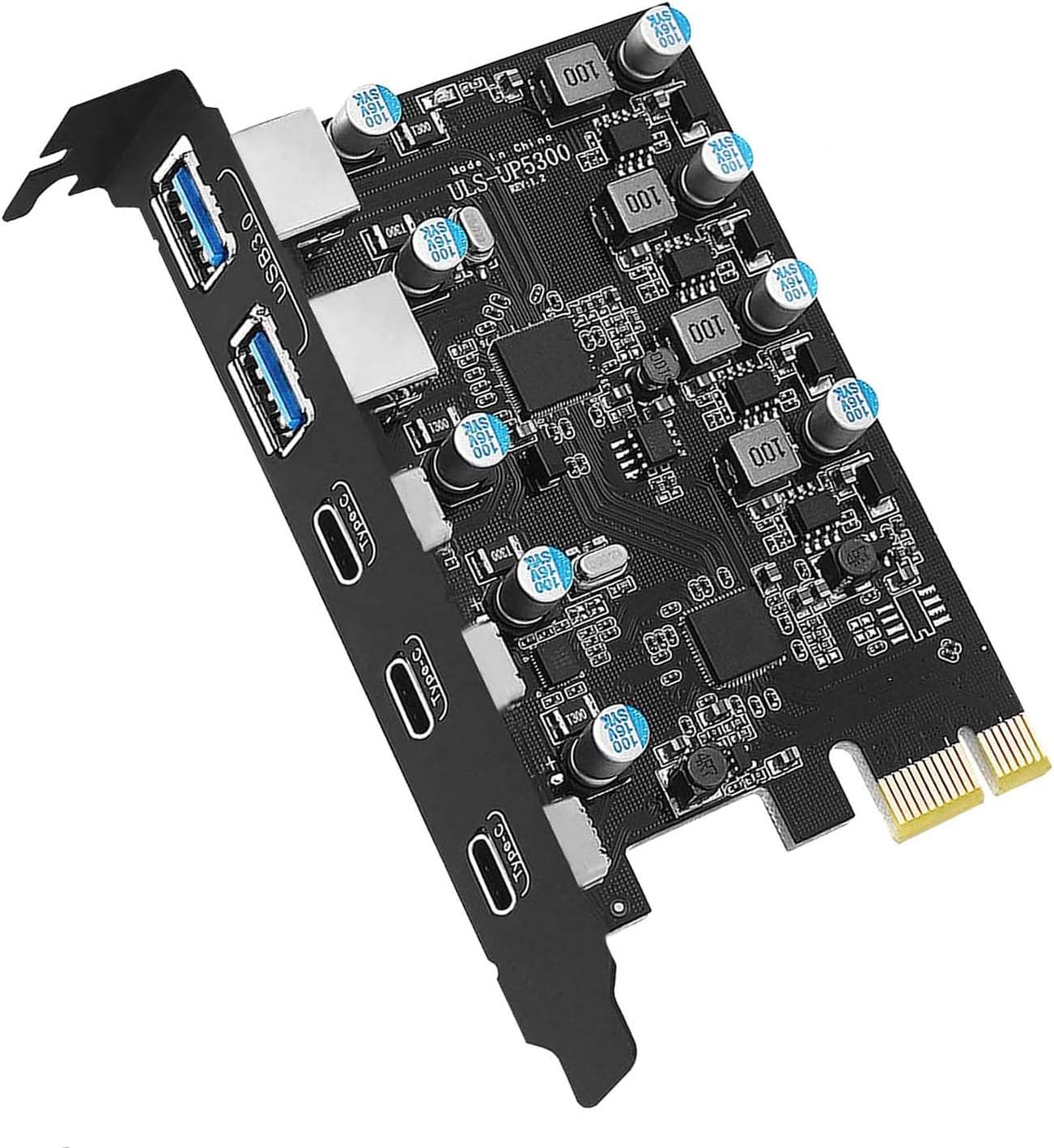
YEELIYA USB PCIE Card 5-Port (3X USB C
Bottom line: The USB PCIE Card 5-Port ($17.27 on Amazon as of 2026-10-06): Adds 5 ports total: 3x USB-C plus 2x Type-A from one PCIe x1 slot; main trade-off: USB-C ports do not support the Thunderbolt protocol.
As an Amazon Associate, SpecPicks earns from qualifying purchases. Full disclosure →
*Price sourced from Amazon.com. Last updated 2026-10-06. Price and availability subject to change.
Pros & Cons
Pros
- ✓ Adds 5 ports total: 3x USB-C plus 2x Type-A from one PCIe x1 slot
- ✓ No external power needed — draws entirely from the PCIe slot
- ✓ USB 3.0 rated up to 5Gbps, 10x the bandwidth of USB 2.0
- ✓ Driver-free install on Windows 10 and macOS 10.8.2 or newer
- ✓ Each port has its own fuse for over-current and short-circuit protection
Cons
- ✗ USB-C ports do not support the Thunderbolt protocol
- ✗ Windows 7 and XP require a manual driver install
- ✗ 5Gbps is theoretical; real speed capped by the attached device
- ✗ Driver ships on a CD, awkward for driverless modern PCs
SpecPicks Verdict
SpecPicks scored USB PCIE Card 5-Port (3X USB C,2X Type A) PCI Express Expansion Card… using a rating × review-volume × price-fit model applied to published specs and reviews across the expansion cards category. YEELIYA's expansion cards lineup sits within the broader category mid-tier; price and specs are the deciding factors over brand loyalty here. Judge it on the specification table and the price rather than on sentiment: check the figures that decide your use case, then put it side-by-side with two or three close alternatives in the Compare tool before clicking through.
Common buyer scenarios for expansion cards of this kind: matching it to an existing build, replacing a failing part, or upgrading from a previous-generation equivalent. Check the spec table below against your current setup — particularly socket / form-factor / power-rating fields — and confirm compatibility on the retailer's listing before purchase. Prices and stock are set by the retailer and may have moved since this page was last updated.
Key Features
- Easy to Expansion: Insert the USB PCIE Card Inside the computer PCIE x1 slot, no additional power supply, it can be easily upgraded to 3x USB C and 2x USB A ports.Solve the problem of fewer USB ports on the host and allow more devices to be connected to the computer system, such as keyboard, mouse, external hard drives, usb printer, scanner, game controller,USB VR, digital camera, etc
- SuperSpeed USB 3.0: Card can theoretically provide data transfer speeds of up to 5Gbps bandwidth,10 times faster than USB 2.0. Transfer files, HD movies, and songs to your USB device in just seconds.Note: The actual transfer speed may be limited by the connected devices-USB-C port isn’t compatible with the Thunderbolt protocol
- Wide Compatibility: Support Windows and Mac OS operating systems, this card is compatible with PCI Express x1 to x16 slots. Compatible with PCI-e 3.0 and 2.0. When installing the PCIE Card, Win 10, Mac OS 10.8.2 above and do not need a driver, and Windows 7/XP systems must install a driver.If there are compatibility issues/not working, let me konw
- Easy to Use: Power can be supplied from the PCI express slot. Installation is very simple, plug and play. Each interface of the USB card has independent insurance, with over-current and short-circuit intelligent protection, which can protect your computer equipment
- Packing List: 1x USB 3.0 PCIE card, 1x CD driver, 1 x installation screws . You get a 1-year-product-Care and friendly customer-service
Full Specifications
| Brand | YEELIYA |
|---|---|
| Style | Classic |
| Style Name | Classic |
| Connectivity | USB-C |
| Model Number | PCI Express 3 |
| Packing List | 1x USB 3.0 PCIE card, 1x CD driver, 1 x installation screws . You get a 1-year-product-Care and friendly customer-service |
| Compatibility | PC, Mac |
| Compatible Devices | Supports Standard Tower Case,for Gigabyte B550/B560M/B650/990FX,for ASUS AM4 / B450M/B550/ TUF Gaming X570,for MSI B450/550/X470,for ASRock B450M Motherboards etc. |
| Hardware Interface | PCIE x 1, PCIE x 16, PCIE x 4, PCIE x 8, USB 3.0 |
| Warranty Description | 360 days warranty |
| Item Dimensions L x W x H | 4.72"L x 3.14"W x 0.72"H |
| Full listing title | USB PCIE Card 5-Port (3X USB C,2X Type A) PCI Express Expansion Card Desktop PC Internal hub for Windows 10/8/7 and MAC OS 10.8.2 Above |
Ready to buy?
USB PCIE Card 5-Port (3X USB C,2X Type A) PCI Express Expansion Card Desktop PC Internal hub for Windows 10/8/7 and MAC OS 10.8.2 Above is listed on Amazon. Price, availability, shipping and returns are set by Amazon and its sellers — check the listing for current terms. SpecPicks earns a small commission on qualifying purchases — thank you for supporting independent review work.
*Price sourced from Amazon.com. Last updated 2026-10-06. Price and availability subject to change.
Related Expansion Cards


![EZDIY-FAB PCIE Gen 4 16x Extreme Flexible, High Speed Riser Cable PCI Express 4.0 Port GPU Extension Card-Right Angle Connector, Supports RTX3090/3090ti/4080/4090 [7.87in/20cm]- White](https://m.media-amazon.com/images/I/71NKOd80sQL._SL1500_.jpg)


More guides & deep dives from the SpecPicks archive
Browse all articles & guides →- Emulation Hardware in 2026: FPGA, Software, and Cart-Reader Ecosystems
- Best Retro Handhelds in 2026 — From $35 to $500
- RTX 4070 Super vs RX 7800 XT — Which to Buy in 2026
- Best Budget Gaming PC Build 2026 — ~$1,000 ($800 on Sale)
- Best 1440p Gaming GPUs in 2026
- How to Build a Windows 98 Retro PC in 2026
- The Complete Voodoo5 5500 AGP Driver Guide (2026 Edition)
More reviews from the SpecPicks archive
Browse all reviews →- Second Streaming PC vs NVENC: What an Old i7-9700K Is Still Good For
- GameSir G7 SE vs 8BitDo Pro 2 vs DualSense for PC
- Intel Arc B50 for Stable Diffusion vs RTX 3060 12GB: Which Wins in 2026
- Best SATA SSDs for Console and Retro PC Upgrades in 2026
- RetroPie on a Raspberry Pi 4 8GB: The Definitive 2026 Emulation Build
- Self-Hosting Jellyfin on a Raspberry Pi 4 8GB: What It Can Really Do
- The $5M Sega Bet That Saved Nvidia — and Still Shapes GPU Launches
- Radxa Rock 5B+ Review (2026): The Enthusiast's RK3588 Board
- Building multi-agent AI orchestrators — LangGraph, DSPy, n8n, and picking the right one
- AMD Ryzen 7 5800X3D Re-Review Shows DDR4 Still Has Gaming Legs in 2026
- OpenAI Codex Now Encrypts Agent-to-Agent Instructions: The Case for Local, Auditable Agents
- Best CPU for Streaming and Gaming on a Single PC in 2026
- Crucial BX500 vs Samsung 870 EVO: Best 2.5" SATA SSD for a Budget Build
- SANSUI 27" 4K vs KOORUI 27" QD-Mini LED: Best Sub-$400 4K Gaming Monitor
- Cerebras Running GPT-5.4 and GPT-5.5 Internally: What the CFO's Slip Tells Us About Wafer-Scale Inference
- Best Storage Kit for Archiving a Physical Game Collection in 2026
- RTX 5090 vs RX 7900 XTX — does AMD still matter?
- MicroPython Now Runs on the Super Nintendo — On Real Hardware
- Best Gaming Mouse for Office Productivity Crossover (2026)
- AMD Ryzen AI Halo: Pre-Orders Open for Linux Developers
- Asus ROG Harpe II Extreme: A 24K-Gold, 65K-Sensor Gaming Mouse
- Best CPU Cooler for Ryzen 7 5800X Heavy Workloads (2026)
- RTX 3060 12GB vs Ryzen 5 5600G iGPU for Entry Local LLM Inference
- Best Internal SSDs Under $100 in 2026
Earliest SpecPicks reviews
Browse full archive →- Best GPU for Llama 3.1 8B (2026)
- Best GPU for Qwen 3 14B (2026)
- Best GPU for Qwen 3 32B (2026)
- Best GPU for Llama 3.1 70B (2026)
- Best GPU for DeepSeek-R1 32B (2026)
- Best GPU for Llama 3.1 405B (2026)
- How to run Llama 3.1 8B on NVIDIA GeForce RTX 5090
- How to run Qwen 3 14B on NVIDIA GeForce RTX 5090
- How to run Qwen 3 32B on NVIDIA GeForce RTX 5090
- How to run Llama 3.1 70B on NVIDIA GeForce RTX 5090
- How to run DeepSeek-R1 32B on NVIDIA GeForce RTX 5090
- How to run Llama 3.1 8B on NVIDIA GeForce RTX 4090