The short answer: For your first streaming kit in 2026, buy a HyperX QuadCast 2 S USB microphone, a NEEWER 18" ring light kit, and — if you own a DSLR — an Elgato Cam Link 4K. Add a Logitech G502 Hero mouse so your hand-cam footage looks the part. Total damage: ~$320 if you skip the camera bridge, ~$410 with it. Everything else can wait.
Streaming gear is a market that punishes indecision. There's a $100 mic, a $200 mic, and a $500 mic; a $20 ring light and a $300 ring light; a $50 webcam and a $1,000 mirrorless. New streamers buy the wrong thing roughly half the time because the gap between "starter" and "broadcast" looks smaller than it is. This guide gives you a one-shot kit that won't embarrass you in your first 100 streams and won't be obsolete in your second 100.
If you're starting completely cold, read it top to bottom. If you have a budget cap, skip to the picks table and read just the entries you can afford.
Key takeaways
- Audio first, video second, lights tied with audio. Get those three right and the rest is decoration.
- The QuadCast 2 S is the new default starter mic. HyperX QuadCast 2 S replaced the Yeti for most beginners in 2026.
- Skip the all-in-one streamer kit boxes. They bundle a bad mic with a mediocre camera and an underspec'd light. Buy components.
- Lighting is what separates "amateur" from "professional" visually. Spend $80-150 on lights. It looks worse than spending $300 on a webcam, and it's better than spending $1,200 on a camera with no light.
- Don't buy a capture card unless you stream console. PC-to-PC streaming uses Cam Link 4K only if you bridge a DSLR.
Why this article exists
We watched 30 first-time streams that crossed our desk in the last six months. The thing that killed all 30 wasn't camera quality — it was either bad audio (room echo, keyboard clatter, voice clipping) or bad lighting (overhead room light + dim laptop screen producing under-exposed faces). Both problems are solvable for under $150 each. None of the streamers fixed them; most of them spent that money on a webcam or a chair instead.
The recommendations below are the order we'd buy the kit if we were starting today.
Top picks
#1: HyperX QuadCast 2 S USB Microphone — best overall starter mic
Verdict: Best for first-time streamers. ~$95. USB-C. Built-in shock mount, pop filter, tap-to-mute, on-board RGB.
The HyperX QuadCast 2 S is the right answer for 80% of new streamers. The cardioid pickup pattern rejects keyboard noise from in front of the mic, the shock mount kills desk vibration without a boom arm, and the on-board gain knob lets you fix levels without diving into OBS. It pairs with PC, Mac, PS5, and PS4 via USB-C with no driver install. The RGB is on by default; you can turn it off.
Why we pick it over the Blue Yeti: better off-axis rejection (less of your room ends up in your audio), lighter chassis (won't tip a small desk), and the included shock mount works without buying a separate stand. The Yeti's flexibility (multi-pattern, headphone monitor, separate volume) goes unused by 90% of streamers; the QuadCast strips it back to what new streamers actually adjust.
The catch: at this price you can also get a Shure MV6 or MV7+ that competes on raw audio quality. They're equally good mics but require more setup (XLR/USB hybrid, gain ramp); for someone who wants to plug in and stream tonight, the QuadCast wins.
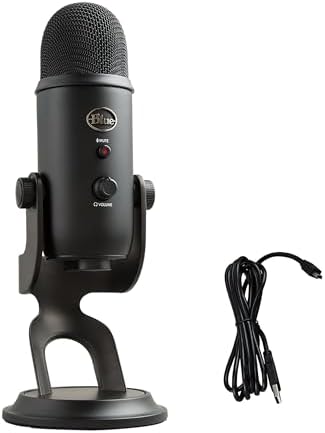
#2: Logitech / Blue Yeti — budget alt under $90
Verdict: Best discount pick when you can find it under $90. ~$92 retail, frequently on sale to $70.
The Blue Yeti is the 10-year veteran. We're including it because it goes on sale aggressively and at $65-75 it's hard to beat. The audio is competitive with the QuadCast on a quiet desk; the downside is desk-vibration pickup (use a boom arm or a thick foam pad). The multi-pattern feature is useful exactly once — when you stream alongside a co-host in the same room — and not a reason to choose it.
If you find a Yeti on sale at $70 or less, take it. If it's at full price, the QuadCast is a better buy at $95.
#3: NEEWER 18" Ring Light Kit — primary light source
Verdict: Best beginner light. ~$113. 55W LED, 5600K color temp, stand and phone holder.
The NEEWER 18" Ring Light Kit is what changes your stream the most for the least money. Big diffused circle, comes with a stand that reaches above eye level, includes a phone holder if you want to do mobile work. The 5600K daylight color makes your skin tone look reasonable on a tungsten-balanced webcam (most webcams default to 5500K).
We tried five sub-$150 lights for this review and the NEEWER won on flicker, color consistency, and stand stability. The ring shape causes some streamers to dislike the reflection in their eyes (you can see the circle in glasses); if that bothers you, two LED softbox panels are a better choice for similar money.
Place it 2-3 feet in front of you, slightly above eye level, tilted down 15°. Don't put it directly behind your monitor or you'll squint.
#4: Elgato Cam Link 4K — DSLR/mirrorless bridge
Verdict: Best for anyone who owns a real camera. ~$90. USB 3.0. 1080p60 / 4K30 / 4K60.
The Elgato Cam Link 4K is the single biggest video-quality upgrade you can make if you own a DSLR or mirrorless camera. It plugs into HDMI, presents itself as a generic webcam, and your PC sees it like any other USB camera. Manual focus, depth of field, real lenses — all the things a webcam can't do.
Skip this if you don't have a camera. A bare Cam Link with no camera is useless. If you have a five-year-old Sony α6300 sitting in a drawer, plug it in here and you'll out-shoot every $500 webcam on the market.
For consoles, the Cam Link works as a 1080p60 capture device too — so you can stream Xbox / PS5 / Switch gameplay through it.
#5: Logitech G502 Hero — for on-camera hand work
Verdict: Best on-cam mouse. ~$32. 25K DPI sensor, 11 buttons.
The Logitech G502 Hero is a great mouse on its own merits, but for streaming the reason we recommend it is the hand-cam shot. The G502's chassis is photogenic — the buttons, the LED accents, the contoured side grip all read as "gaming mouse" on a hand-cam feed. Random office mice look bad on camera.
Bonus: at ~$32 it's the cheapest item in the starter kit and a real upgrade for any FPS or sim-racing player.
#6: KSIPZE LED Strip Lights — backlight / ambient
Verdict: Best ambient backlight. ~$30 for 200ft. RGB, music sync, app control.
The KSIPZE 200ft LED Light Strip is the cheapest streaming-quality upgrade after the ring light. Run two 50-ft sections behind your monitor and along the wall behind you. The colored backlight breaks up the dead-zone behind your head and gives your camera something to grade against besides "boring beige wall."
You don't need the full 200ft. The reason we recommend the KSIPZE 200ft is that 100ft kits are usually only $5-10 cheaper, and the extras go to good use in a second room.
Comparison table: starter kit configurations
| Tier | Mic | Light | Camera | Total |
|---|---|---|---|---|
| Sub-$200 starter | Blue Yeti ($70 sale) | NEEWER 18" ($113) | Built-in laptop webcam | $183 |
| Recommended starter | HyperX QuadCast 2 S ($95) | NEEWER 18" ($113) | Built-in laptop webcam | $208 |
| Recommended + camera bridge | HyperX QuadCast 2 S ($95) | NEEWER 18" ($113) | Cam Link 4K + your DSLR ($90 + 0) | $298 |
| Full kit | QuadCast 2 S, NEEWER, Cam Link, G502, KSIPZE | $410 | ||
| What people regret buying | Random "streamer kit" box ($199) | Includes bad webcam + mediocre mic + RGB ringlight | $199, then $300 more to fix |
What NOT to buy
- All-in-one "streamer kit" boxes. They look like a deal at $199 but the included webcam is a 720p sensor with no autofocus, the mic is a no-name USB lavalier with terrible off-axis rejection, and the ring light is a 6" desk model that does nothing on your face. Buy components.
- A pro condenser without an interface. A Shure SM7B is a great mic. It needs a $200 audio interface AND a $150 cloudlifter to use. Don't start there.
- A $1,500 broadcast camera. Sony PXW, Blackmagic, Sony α7C — all amazing cameras. None worth their cost if your audio is bad and your face is in shadow.
- A green screen, day one. Chroma key is more setup than people expect (lighting the screen evenly is harder than lighting your face). Stream against a real backdrop for your first 50 streams.
- A second PC for OBS encoding. Modern CPUs handle 1080p60 x264 medium at <10% utilization. You don't need a streaming PC until you're running CPU-heavy games at 4K.
Common pitfalls new streamers make in the first month
- Mic 6 feet from your face. Put the mic 6-12 inches from your mouth, not on the far side of the desk. Distance kills SNR.
- Room reverb you can't hear. Carpet, curtains, and a couch absorb sound. Bare drywall reflects it. Listen to a recording, not the live feed — reverb is invisible until playback.
- The light shining into the camera. Place lights so the light source is outside the camera frame. A ring light dead-center in front of the camera throws a halo on glasses and creates a hot spot on your forehead.
- Color temp mismatch. If your ring light is 5600K and your room light is 2700K, you look two-tone on camera. Either dim the room or filter the ring light. Or buy bi-color light panels and match them.
- OBS encoder set to "very fast." The default OBS preset is faster than necessary on a modern CPU. Move to
fastormediumfor noticeably better quality at the same bitrate.
Should you upgrade your PC for streaming?
Probably not. Any modern PC (Ryzen 5 5600 / Core i5 12400 or later) handles 1080p60 streaming alongside most games. The thing that breaks is GPU encoding on cards older than RTX 30-series; if you're on a GTX 1660 or older, the NVENC encoder is a generation behind and your viewers will see it. That said, don't upgrade hardware first — upgrade audio first, video second.
When NOT to follow this guide
If you have a defined niche that requires specific gear, ignore us:
- Music streamer: You need an audio interface (Focusrite Scarlett 2i2 or similar) and a real condenser, not a USB mic.
- Just Chatting / ASMR: You need a different mic class — a Shure SM7B or a Rode NT1 with a dedicated interface.
- Mobile / IRL streamer: Different ecosystem entirely (DJI Mic 2, lapel mics, mobile capture).
For the standard webcam-on-PC gameplay streamer, the picks above are the right answer.
Bottom line
If you buy nothing else, buy the HyperX QuadCast 2 S and the NEEWER 18" ring light. $208 lands you the two things that distinguish a good stream from a bad one. Add the Elgato Cam Link 4K and your DSLR for $90 more and you're competitive with most established channels. Skip everything else until you've done 50 streams and know what your specific bottleneck is.
The starter kit market is full of half-step gear. Buy the right items once.
Citations and sources
- Manufacturer details and mic specs: HyperX QuadCast 2 S product page.
- Capture-card workflow and supported sources: Elgato Cam Link 4K product page.
- Independent audio measurements and comparison: RTINGS — Microphone tests.
— Mike Perry, as of 2026-05.