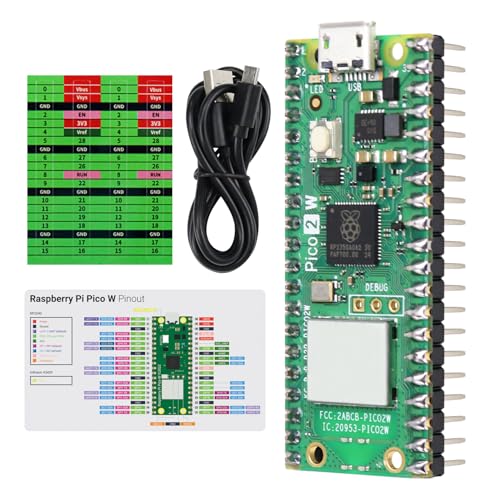
Audio DSP firmware for the Raspberry Pi Pico isn't a single downloadable package — it's a set of building blocks spread across Raspberry Pi's official SDK extras, CircuitPython's synthesis modules, and a scattering of community projects. Anyone searching for a turnkey "fully featured" audio DSP firmware for the Pico will find pieces, not a finished product, and understanding what those pieces actually do is more useful than chasing a single repo.
What "Audio DSP Firmware" Means on the RP2040
The RP2040, the microcontroller at the heart of the original Raspberry Pi Pico, ships with two Cortex-M0+ cores, 264KB of on-chip SRAM, and — notably for DSP work — no hardware floating-point unit, according to Raspberry Pi's official RP2040 datasheet. That last point shapes everything downstream: audio code written for the Pico is almost always fixed-point rather than floating-point, because emulating float math in software on an M0+ core is expensive on a per-sample basis.
What the RP2040 does have going for it is its Programmable I/O (PIO) subsystem — eight small state machines split across two PIO blocks that can generate precisely timed signals like I2S clocks without spending CPU cycles on bit-banging, paired with 12 DMA channels to move sample buffers in and out of memory. Raspberry Pi's official Pico documentation covers this hardware in detail, and it's the reason Pico-based audio projects lean so heavily on PIO+DMA rather than software I2S loops.
On the firmware side, Raspberry Pi's own pico-extras repository on GitHub is the closest thing to an official audio DSP starting point. It includes example audio backends for I2S, PWM-based audio output, and S/PDIF — enough scaffolding to build a real output pipeline, but it's sample code and drivers, not a complete effects-and-mixing firmware.
Setting Up I2S and S/PDIF Audio Output on a Pico
Most real-world Pico audio DSP builds follow the same basic hardware pattern:
- Choose an output path. I2S to an external DAC breakout (common options use chips like the PCM5102) gives clean stereo output and is the path pico-extras'
audio_i2sexample targets. For a digital handoff to an AV receiver or DAC, theaudio_spdifexample in the same repo outputs a raw S/PDIF-compatible signal from a GPIO pin, which can feed a coax input directly or be converted to optical with a Toslink transmitter module — a Toslink optical cable is the simplest way to carry that signal onward to a receiver once it's converted. - Wire the PIO pins. I2S needs three signal lines (bit clock, word select, data), all assignable to GPIO through PIO rather than fixed hardware pins, which is part of why the RP2040 doesn't need a dedicated I2S peripheral.
- Set your sample rate and bit depth in firmware, matched to what your DAC or S/PDIF receiver expects, and confirm DMA buffer sizing is large enough to avoid underruns at your chosen block size.
- Add input if needed. For microphone capture rather than just playback, an I2S MEMS microphone breakout is the standard route — SpecPicks' Adafruit I2S microphone CircuitPython guide walks through wiring and reading samples from exactly that kind of board, and the same I2S wiring principles apply whether the downstream code is CircuitPython or the C SDK.
For builders who'd rather stay in Python, CircuitPython's synthio module adds waveform synthesis, basic envelopes, and simple filtering on RP2040 boards without dropping into C — a reasonable starting point for synths and simple effects, even if it isn't positioned as a full DSP effects chain.
Real-Time Processing: What the RP2040 Can Actually Do
Because the RP2040 lacks a hardware FPU, tight per-sample DSP loops (biquad filters, FFT-based analysis, convolution) are written in fixed-point C to avoid the overhead of software float emulation — and compiled C running on bare metal will always outperform an interpreted MicroPython loop for the same task, though the exact multiple varies by workload and isn't something that can be stated as a fixed number without a specific published benchmark. PIO and DMA are what make continuous, glitch-free I2S output achievable at all on a chip this small, since they keep the timing-critical clock generation off the CPU cores entirely.
Here's how the Pico's raw specs compare to two other boards commonly used for budget and semi-pro audio DSP work:
| Board | Cores / Clock | Hardware FPU | On-chip RAM | Typical use case |
|---|---|---|---|---|
| Raspberry Pi Pico (RP2040) | 2× Cortex-M0+ @ 133MHz | No | 264KB SRAM | Budget synths, I2S/S-PDIF output, simple effects |
| Teensy 4.1 | 1× Cortex-M7 @ 600MHz | Yes | 1MB RAM | Multi-channel mixing, Teensy Audio Library effects chains |
| STM32F4-class boards | Cortex-M4 @ up to ~180MHz | Yes | Varies by part | CMSIS-DSP filter/FFT pipelines, embedded audio products |
Specs per the RP2040 datasheet and PJRC's Teensy Audio Library documentation.
Pico Audio DSP vs Commercial and Semi-Pro Boards
The Teensy 4.1's Cortex-M7 core, hardware FPU, and roughly 4.5× clock speed advantage over the Pico give it meaningfully more DSP headroom, and PJRC's Audio Library ships with a drag-and-drop web design tool that generates working effects-chain code — there's no equivalent visual tool in the Pico ecosystem today. STM32F4-class boards occupy similar territory, backed by ARM's CMSIS-DSP library for optimized filter, FFT, and matrix operations on Cortex-M4/M7 cores.
What the Pico brings instead is price and its PIO/DMA offload model: a board that costs a fraction of a Teensy 4.1 can still produce clean, continuous I2S or S/PDIF output because the timing-critical work never touches the CPU. That makes it a reasonable choice for simple synths, sample players, and single-effect processors, and a weaker one for dense multi-channel mixing or convolution-heavy effects where the lack of an FPU becomes the bottleneck.
For builders assembling large sample libraries to feed a Pico-based sampler or granular synth over USB, storage capacity becomes the practical constraint rather than the microcontroller itself — a portable SSD is a straightforward way to stage and back up sample sets during development before they're trimmed down to fit the Pico's own flash.
Where This Fits Alongside the Rest of the Audio Stack
Pico-based DSP work sits at the opposite end of the spectrum from GPU-driven audio AI — projects like locally hosted Qwen-Audio-3.0-TTS-Plus speech synthesis or Flux 3's native-audio video generation need a discrete GPU, not a $5 microcontroller. The RP2040's niche is small, real-time, always-on signal paths: MIDI-controlled effects, simple synths, or retro-style audio interfaces. That last category has real overlap with hobbyist retro-PC audio work — see SpecPicks' comparisons of a modern Sound BlasterX G6 against a legacy AWE64 and the broader Sound Blaster legacy-to-modern bridge piece for context on why builders still care about dedicated audio hardware in an era of onboard codecs.
For anyone building a Pico project as part of a larger desk or gaming setup, it's also worth checking SpecPicks' best budget gaming audio roundup and best PC gaming peripherals guide for how a DIY audio interface compares to off-the-shelf DACs and headsets on cost and simplicity. And on the open-firmware theme more broadly, AMD's fully open-source Linux stack for Ryzen AI Halo is a useful reminder that "open source firmware" spans everything from full Linux audio stacks down to a few hundred lines of PIO assembly on a $5 board — the Pico sits firmly at the small end of that range, and that's exactly what makes it approachable for a weekend build.
Citations and sources
- Raspberry Pi Pico documentation
- RP2040 datasheet (PDF)
- pico-extras repository, Raspberry Pi (GitHub)
- Teensy Audio Library documentation, PJRC
- CircuitPython synthio module documentation
- ARM CMSIS-DSP library documentation
This piece is editorial synthesis based on publicly available information. No independent first-party benchmarking is reported.