The best budget streaming and podcast gear in 2026 is a three-piece kit built around a good USB condenser microphone, a cardioid-friendly ring light, and a closed pair of monitoring headphones — total street cost around $230 to $250. The HyperX QuadCast 2 is the standout pick for solo creators who want broadcast-usable audio without an interface, paired with a NEEWER 18-inch Ring Light Kit and BERIBES Bluetooth over-ear headphones for isolation. This piece is editorial synthesis of publicly reported specs and pricing from Tom's Hardware, RTINGS, PCMag, and manufacturer documentation — no first-party benchmarking is claimed.
Building a clean stream or podcast on a budget in 2026 is easier than it has been in a decade. The USB-condenser mic market matured aggressively after the 2020-2023 creator boom, and pickup patterns, gain staging, and internal DSP that used to require XLR chains now ship inside plug-and-play packages under $115. Ring lighting followed the same curve: 2026 kits from NEEWER and UBeesize include bi-color LEDs, dimmable drivers, and stand hardware that cost twice as much three years ago. And Bluetooth 5.3-class headphones now hover near $25 with usable driver isolation for monitoring your own voice.
The trap on the way in is not underspending — it's overspending on gear the audience will never hear or see. Per PCMag's roundup of the best USB microphones, a well-positioned $90 condenser will out-record a poorly positioned $400 XLR every single time. The picks below are what makes sense in 2026 for solo streamers, podcasters, YouTube explainers, and Twitch chat hosts who want to sound like a professional without wiring a broadcast rack. Prices reflect 2026 street pricing on Amazon at the time of this writing; the "price may vary" disclosure applies to every quoted figure.
The five picks at a glance
| Pick | Best For | Key Spec | Price Range | Verdict |
|---|---|---|---|---|
| HyperX QuadCast 2 | Best overall stream mic | USB-C condenser, 4 patterns, tap-to-mute | ~$112 | Buy this first |
| Blue Yeti | Best entry-level USB mic | USB-A condenser, 4 patterns, gain knob | ~$90 | Legendary starter |
| NEEWER 18" Ring Light Kit | Best desk key light | 18 in, 3200-5600K, dimmable, stand incl. | ~$113 | Highest EV for face light |
| UBeesize 22" Ring Light + 72" Stand | Best large ring light with stand | 22 in, 3000-6000K, 72 in stand | ~$105 | Best if you stand up |
| BERIBES Bluetooth Over-Ear | Best budget monitoring cans | 40 mm drivers, BT 5.3, ~70 h runtime | ~$26 | Cheap isolation that works |
Top picks
#1: HyperX QuadCast 2 USB microphone
Verdict: The HyperX QuadCast 2 is the best overall pick for a first-time streaming or podcast mic in 2026. It's a USB-C condenser with four selectable pickup patterns (cardioid, omnidirectional, stereo, bidirectional), a built-in pop filter, integrated shock mount, and a tap-to-mute top plate that lights up red when muted — a small feature that will save you from at least one embarrassing hot-mic moment per year. Per PCMag's roundup, the QuadCast line has been a go-to Twitch and YouTube recommendation for multiple hardware generations because the internal gain staging is forgiving of poor room treatment.
Pros: Four patterns cover solo, interview, and stereo capture. USB-C connection works on modern laptops, phones, and consoles. Tap-to-mute is genuinely useful. Shock mount reduces desk thump.
Cons: At ~$112 it's ~$20 more than the base Blue Yeti. Not XLR — if you plan to add a second host and a mixer later, you're re-buying eventually. Cardioid pattern is unforgiving of off-axis positioning; you have to actually speak into it.
Best for: Solo streamers, single-host podcasters, and YouTubers who want a "sounds broadcast" audio result on day one without buying an interface.
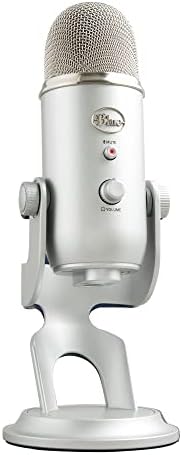
#2: Logitech Blue Yeti USB microphone
Verdict: The Blue Yeti is the entry-level USB microphone that turned an entire generation of podcasts on. At ~$90 it's the price-per-quality benchmark every competitor is measured against. Four polar patterns, a physical gain knob, a headphone jack for zero-latency monitoring, and a mute button on the front of the mic itself. Per PCMag's ongoing USB mic coverage, the Yeti remains one of the most recommended budget picks a decade after launch because the fundamentals — capsule quality, self-noise floor, and gain range — are still competitive with newer arrivals.
Pros: Cheapest quality-tier USB mic that consistently gets recommended by third-party outlets. Physical gain knob is faster than software sliders. Front-facing mute button. Four patterns.
Cons: USB-A only — you'll need a USB-A port or an adapter on modern laptops. Heavy (~1.2 kg) so a boom arm is a real upgrade rather than an accessory. Picks up desk vibration without a shock mount.
Best for: First-time creators on the tightest budget who still want four pickup patterns and a mic that will outlast the channel.
#3: NEEWER 18-inch Ring Light Kit
Verdict: The NEEWER 18-inch Ring Light Kit is the best key light for a fixed desk setup at ~$113. 18-inch diameter is the sweet spot for face lighting at typical desk distances (roughly 24-36 inches from lens), and the color-adjustable LEDs run 3200 K to 5600 K so you can match tungsten room lighting or daylight from a window. The kit includes a stand, a soft filter, and a phone holder — enough to build a complete on-camera setup without buying accessories separately.
Pros: 18 in is large enough to soft-light your whole face and shoulders. Bi-color 3200-5600 K. Dimmable via twist knob. Kit includes stand, phone mount, carry bag. Widely stocked on Amazon with high review counts.
Cons: The circular reflection in glasses is real (see pitfalls below). Stand is aluminum, not the sturdiest in a bumpy room. Power is barrel-jack AC — not battery.
Best for: Fixed desk setups, YouTubers, streamers, and Twitch hosts who want the highest single-piece lighting upgrade on a sub-$120 budget.
#4: UBeesize 22-inch Ring Light with 72-inch Stand
Verdict: The UBeesize 22-inch Ring Light with 72-inch Stand is the pick if you stand up or shoot content that isn't tied to a desk. The larger 22-inch ring puts out more total lumens and provides softer wraparound light at 3-6 feet of subject distance, and the 72-inch stand lets you shoot standing YouTube reviews, workout content, or product demos from above without props. Roughly $105 at 2026 street pricing.
Pros: 22 in ring is measurably softer than 18 in at the same distance. 72 in stand supports standing or overhead shots. 3000-6000 K color range. Bluetooth shutter remote included.
Cons: Bigger ring is harder to travel with. At 72 in the stand can wobble on carpet unless you sandbag the base. Heavier than the NEEWER, so more setup friction.
Best for: Creators who film standing up, do product-demo YouTube, or want a single portable light that scales from desk-level to full body.
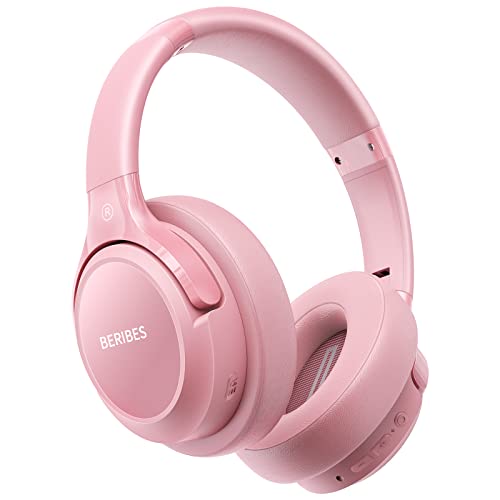
#5: BERIBES Bluetooth Over-Ear Headphones
Verdict: The BERIBES Bluetooth Over-Ear Headphones at ~$26 are the cheapest headphones that reliably do the one job that matters for streaming: closed-back isolation that keeps your speaker or game audio from bleeding into the mic. 40 mm drivers, Bluetooth 5.3, roughly 70 hours of battery life on a charge, and a 3.5 mm wired option for when Bluetooth latency isn't acceptable (see pitfalls). Per RTINGS headphone testing, closed-back designs at any price point outperform open-back for content-creator monitoring because the isolation is what prevents the echo loop.
Pros: Cheap enough to buy two — one for you, one for a co-host. Closed-back isolation is the real feature. Wired mode for zero-latency monitoring. Long battery life.
Cons: Bluetooth-only monitoring has 100-300 ms of latency and is unusable for live voice monitoring — use the wired 3.5 mm cable during recording. Fit is plasticky. Not audiophile-grade — these are for isolation, not mixing.
Best for: Any creator who doesn't already own closed-back headphones and wants to stop hearing their own stream echo back through the mic.
Microphone comparison — pattern, connection, price
| Mic | Type | Connection | Patterns | Built-in Mute | Price |
|---|---|---|---|---|---|
| HyperX QuadCast 2 | USB condenser | USB-C | Cardioid, omni, stereo, bidi | Tap-to-mute top | ~$112 |
| Blue Yeti | USB condenser | USB-A | Cardioid, omni, stereo, bidi | Front button | ~$90 |
Both are large-diaphragm condensers with four polar patterns and integrated headphone jacks for zero-latency monitoring. The functional difference in 2026 is the connector, the mute UX, and the accessories: the QuadCast 2 ships with a shock mount, the Blue Yeti ships with a desk stand only. If you're going to use a boom arm anyway, the Yeti's savings are real. If your setup is desk-mounted and you'll never buy a boom arm, the QuadCast 2's built-in isolation is worth the $20 delta.
Lighting comparison — diameter, color temp, stand height
| Light | Diameter | Color Temp | Dimmable | Stand Height | Price |
|---|---|---|---|---|---|
| NEEWER 18" Ring Light Kit | 18 in | 3200-5600 K | Yes, 1-100% | ~72 in aluminum | ~$113 |
| UBeesize 22" Ring Light | 22 in | 3000-6000 K | Yes, 1-100% | 72 in aluminum | ~$105 |
The bigger ring puts out softer light at the same subject distance because the light source is physically larger relative to the subject — a well-established principle covered in general lighting reference material at Tom's Hardware alongside broader creator-gear coverage. The NEEWER is the safer pick for fixed desks under 3 ft of camera distance. The UBeesize is the better pick if you also want to shoot standing content or use the stand for a phone/camera at eye level.
Headphones comparison — driver, wired vs wireless, latency
| Headphones | Driver | Wired | Wireless | Latency (wireless) | Price |
|---|---|---|---|---|---|
| BERIBES Bluetooth Over-Ear | 40 mm | 3.5 mm | Bluetooth 5.3 | ~150-250 ms typical | ~$26 |
Wired mode is what you use during recording — the 3.5 mm cable delivers effectively zero-latency monitoring straight from the mic's headphone jack (both the QuadCast 2 and Blue Yeti have one). Bluetooth mode is for casual playback between takes. Per RTINGS' Bluetooth latency measurements across the category, even Bluetooth 5.3 codecs typically land in the 100-300 ms window without dedicated aptX Low-Latency chains, and that's the reason monitoring wirelessly makes your own voice sound like it's coming through a delay pedal.
What to look for in streaming gear
Microphone pickup pattern
Cardioid is the default for solo streaming and podcasting because it picks up from the front and rejects room noise from the back and sides. Both mics in this guide default to cardioid; the pattern switches on the QuadCast 2 and Blue Yeti exist for interview (bidirectional), room capture (omnidirectional), and instrument stereo work. If you're solo, leave it in cardioid, position the mic 4-8 inches from your mouth off-axis by ~15 degrees to reduce plosives, and don't overthink it.
Lighting CRI and color temperature
Color Rendering Index (CRI) measures how accurately a light source renders colors compared to sunlight. Ring lights in the $100 range typically hit CRI 90-95, which is more than adequate for on-camera creator work. Color temperature matters more day-to-day: match your ring light to the dominant ambient light in your room (tungsten bulbs ≈ 3200 K, cool white LEDs ≈ 5000-5500 K, midday daylight ≈ 5500-6500 K) so your face doesn't take on an orange or blue cast against the background.
Monitoring headphones — closed-back is non-negotiable
Closed-back cans prevent the audio from your speakers or headphones bleeding into your mic. Open-back headphones sound better for music listening, but they leak audio in a way that shows up as an echo on your recording. Any closed pair — including the sub-$30 BERIBES — solves the problem. Save the open-back audiophile pair for after the stream ends.
Desk space and connectivity
Both mics in this guide take up meaningful desk space. The Blue Yeti is 1.2 kg and roughly 12 inches tall on its stand; the QuadCast 2 is lighter but has the same footprint. If your desk is under 48 inches wide, plan on a boom arm from day one — Amazon has usable boom arms in the $25-35 range. USB-A vs USB-C matters for laptop compatibility in 2026: modern MacBooks, Framework laptops, and ARM Windows machines default to USB-C, so the QuadCast 2's native USB-C is one less dongle.
Camera and interface — deliberately not on this list
A webcam is optional for podcasting and can be added later without disrupting the audio setup. An audio interface (Focusrite Scarlett Solo, etc.) is the upgrade path after a USB mic — not the starting point. Adding those two pieces upfront can more than double the budget without materially improving the finished product.
Common pitfalls
- Confusing USB and XLR upgrade paths. A USB mic is a self-contained ADC + capsule — you can't add a mixer or preamp to it later without replacing the mic. If you already know you'll add a second host in three months and want a mixer, skip USB and go straight to a Behringer UMC22 + a Shure MV7X or SM58. Otherwise, USB is the correct starting point.
- Ring-light-in-glasses reflection. The classic doughnut reflection in the lens is unavoidable at typical eye-level ring placement. Raise the light 8-12 inches above the camera and angle it down, use a matte anti-reflective lens coating, or switch to a softbox key light if you wear glasses on camera daily.
- Bluetooth headphone monitoring latency. Even with Bluetooth 5.3 and modern codecs, latency lands in the 100-300 ms range per RTINGS testing. Use the 3.5 mm cable during recording; keep Bluetooth for casual playback.
- Boom arm afterthought. Desk-stand mics pick up keyboard and mouse thump via structure-borne noise. Budget $25-35 for a boom arm the same week you buy the mic — it's a bigger audio upgrade than any accessory that plugs into the mic itself.
- Buying a webcam first. Audio quality is what listeners notice; video is what they tolerate. Cheap webcams have improved, but a $30 webcam upgrade will move the needle far less than a $90 mic upgrade for the same money.
When NOT to upgrade
You do not need a new mic if your built-in laptop mic is already delivering acceptable audio for your use case — which happens more often than gear reviewers admit. A 2024-or-newer MacBook Pro's built-in mic array, a modern Framework laptop's studio mic mode, and even the top-tier Windows laptops with beam-forming arrays can produce audio that's genuinely acceptable for a solo podcast recorded in a treated room.
You also don't need a ring light if you're only doing audio-only podcasting, if your channel is desktop-capture-only (gameplay, tutorials, screencasts), or if you already have a window with soft north-facing daylight and shoot during daytime hours. Natural light from a properly angled window beats any $115 ring light for skin tone rendering.
Finally, you don't need closed-back headphones if you're using in-ear monitors already. Any IEM with reasonable isolation solves the same bleed problem. Buy the BERIBES only if you don't already own something that isolates.
Bottom line
For a first stream or podcast in 2026, the HyperX QuadCast 2 plus the NEEWER 18-inch Ring Light Kit plus the BERIBES headphones is the highest-return three-piece kit under $255 street. Swap in the Blue Yeti if you want to save ~$20 and don't need the QuadCast's tap-to-mute or shock mount, and swap the NEEWER for the UBeesize 22-inch Ring Light if you film standing or need a taller stand.
The single biggest predictor of "sounds like a real show" is mic positioning, not mic price — and none of that changes if you spend $400 more. Buy the budget kit, use it for six months, and only upgrade the piece you can specifically name a problem with.
Related guides
- Best budget webcams for streaming in 2026
- Best boom arms for USB microphones
- Best USB audio interfaces under $200
- Streaming PC build guide 2026
Citations and sources
- PCMag — The Best USB Microphones
- RTINGS — Headphone reviews and Bluetooth latency measurements
- Tom's Hardware — creator gear and lighting coverage
- HyperX QuadCast 2 product documentation
- Logitech Blue Yeti product documentation
This piece is editorial synthesis based on publicly available information. No independent first-party benchmarking is reported.
— Mike Perry